

 SA
SA
 KW
KW
 IE
IE AU
AU UAE
UAE UK
UK USA
USA
 CA
CA DE
DE
 QA
QA ZA
ZA
 BH
BH NL
NL
 MU
MU FR
FR










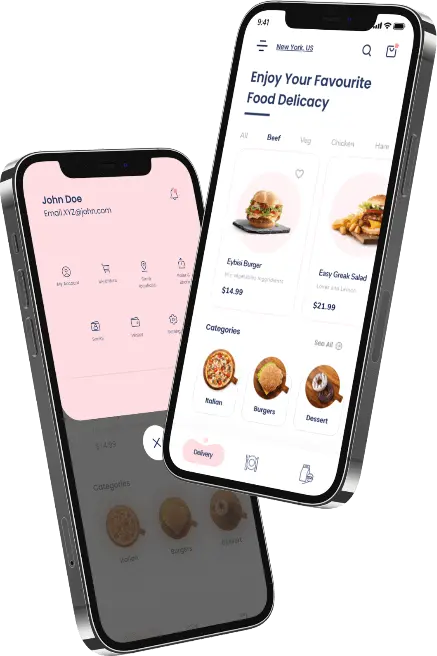





Ever noticed how ordering food has gone from a “maybe tonight” thing to an everyday habit? That shift didn’t just happen; it was built. Apps like EatSure have completely changed how people discover, order, and trust food online. Clean interfaces, multiple brands in one place, reliable delivery, and a smooth experience that just… works.
Now here’s where it gets interesting:
More and more businesses in India are trying to build something similar. Not just another food app, but something that actually competes. And the first question that comes up is always the same:
What is the cost to build an app like EatSure?
The answer is not just a number. The food delivery app development cost depends on what you’re building, how advanced you want it to be, and how well you want it to perform in a competitive market.
Right now, India’s food delivery market is expanding rapidly. It is being driven by rising smartphone usage and growing demand across Tier-2 and Tier-3 cities. With millions of users ordering online every day, the space is becoming more and more competitive.
As per current industry standards, the cost to build an app like EatSure in India in 2026 ranges from ₹3,50,000 to ₹20,00,000+, depending on features and scale.
In this blog, we’re breaking it all down: the features that make apps like EatSure work, the real cost in India, the development process, and the tech stack behind it.
Understanding EatSure-Like Food Delivery Apps
Before you think about cost, understand what you are actually building because everything else depends on it.
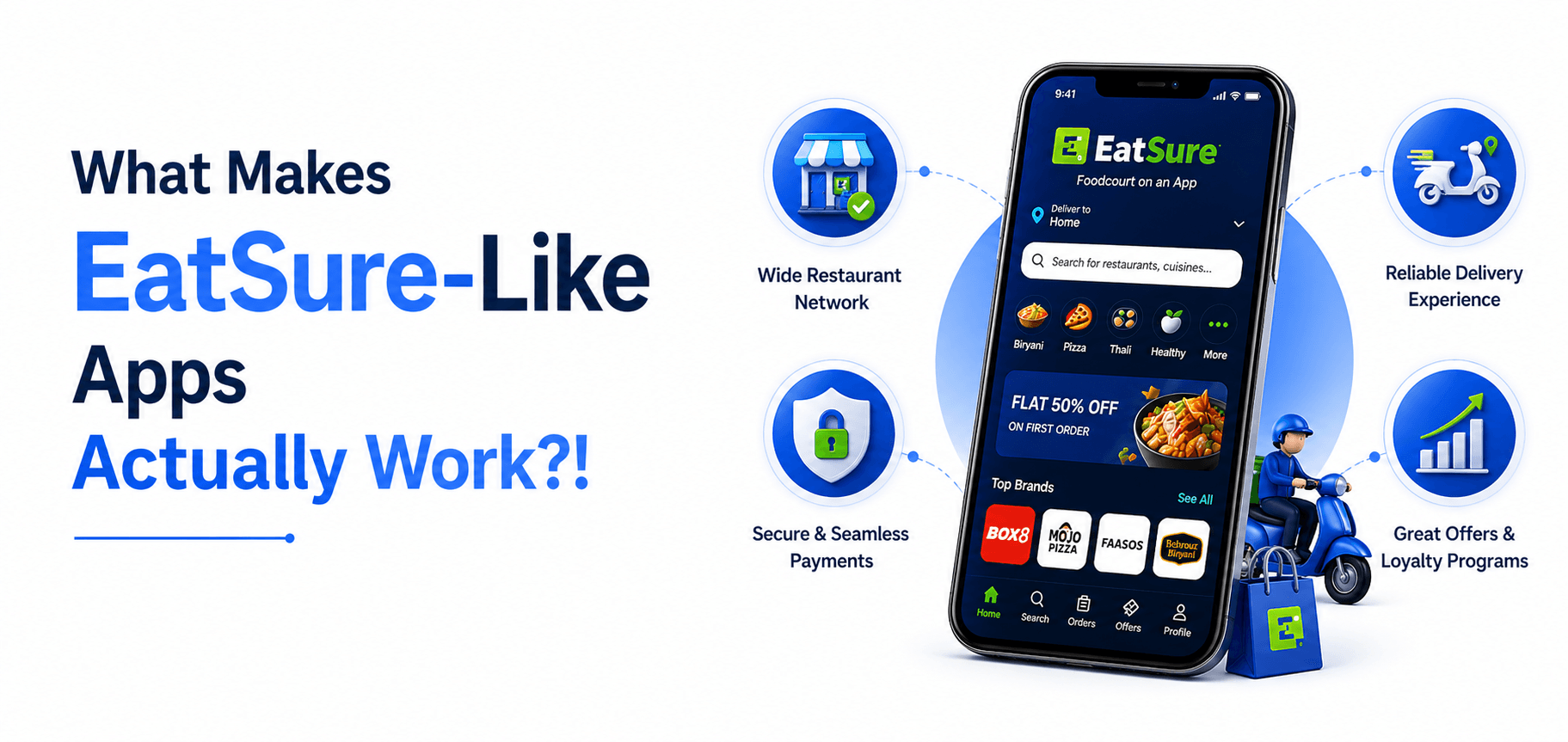
An app like EatSure isn’t just a typical food delivery app where you order from one restaurant and wait for your food to arrive. It is a multi-brand platform that brings together multiple food brands under one roof. It offers a consistent, reliable, and quality-controlled experience to the users.
Instead of hopping between different apps, users get everything in one place: with better trust, better packaging, and a smoother ordering journey.
What really makes apps like this stand out? It’s how effortless everything feels. Users get a clean, reliable experience. Trusted brands. Smooth ordering. No confusion. But behind the scenes, there’s a lot more going on. Businesses can track orders, monitor performance, and manage everything in one place. No chaos. No guesswork. Just control.
So when you plan to build something like this, you’re not just creating a basic food ordering app. You’re building a complete system. One where users, delivery partners, and your business are all connected in real time.
And that’s exactly why the features, development process, and cost are a bit more layered than a basic app.
Find out how in the upcoming sections.
Features of the EatSure App That Redefine Food Delivery
A food delivery app works best when it makes life easier for everyone: users, delivery partners, and businesses alike.
And EatSure is one of such food delivery apps. Customers receive convenience in their orders and instant feedback, delivery services are increasingly quick, and the control of business activity becomes easy.
The following are the main characteristics that enable an app like this to be so effective in terms of food delivery:
1. Seamless User Experience
Think about the user side first. The process of ordering food should be easy. EatSure gives users the ability to shop and browse restaurants, filter by cuisines, and order with the touch of a few taps. Everything flows naturally. Users do not become disoriented in the menus and buttons. The app feels fast and smooth. Users will continue coming back when the use of the app is easy. It is that recurring business that makes a food delivery application successful.
2. Real-Time Order Tracking
Ever been placing an order and felt like asking, “Where is my food? Users would like to know the location of their food. EatSure is the solution to that issue. Applications such as EatSure display all the order steps. Live GPS shows the position of the driver. The application automatically updates its status and predicts the time of delivery. Customers feel empowered, and they have confidence in the service. Companies receive less customer grievances and calls. Real-time order tracking makes the waiting process stress-free and interesting.
3. Smart Delivery Partner Dashboard
It is not only speed that is important in the delivery of food, but also efficiency and clarity. EatSure provides delivery partners with a special dashboard, where they can visualise orders, track optimal routes, and track their status in real-time. They are notified about the last-minute changes, and the interface is easy to use even when on the go. This implies that deliveries are quicker, errors are reduced, and the drivers are confident and not frustrated. Having your delivery team working as an oiled machine makes the entire app experience smooth for all.
4. Comprehensive Admin Panel
Restaurants will be able to handle menus, order tracking, promotions, and performance all in a single place. There is nothing difficult to observe and to control. Admins have the ability to react to trends fast and minimise errors. An effective administrative panel is used to maintain the smooth running of the app. It simplifies the operations of businesses to provide better services. In the case of any application, such as EatSure, the key ingredient is the admin panel, which ensures that the users are satisfied and the operations go smoothly.
5. Multiple Payment Options
You know what else users like? Choices. It is convenient to have options as one checks out an order.
It is all about convenience in terms of paying to be fed, and that is what EatSure is doing right. Customers have the option of paying through credit/debit cards, UPI, digital wallets or even cash-on-delivery depending on their preferences. Friction that leads to cart abandonment is eliminated with secure payment gateways and simple processing, leading to more orders. To achieve success in India, it is not a luxury for an app to provide the customers with several secure payment options, but rather a matter of course. An elastic payment system makes it easy and credible for everyone when it comes to making an order.
6. Personalised Recommendations & Offers
A food delivery application does not simply have a list of restaurants. It anticipates the desires of the users even before. It proposes dishes in accordance to previous orders, popular dishes, and time of the day.
Individual recommendations, edited offers, and personalised offers keep the users active and promote repeat purchases. Based on the past behaviour, preferences and times of order, algorithms present meals liked most by users. It is an application of this nature that renders the app intelligent, sensitive, and human.
Often, users order more when the app feels like it is made for them. When users feel understood, they’re not just ordering food; they’re building a habit around your app, which is exactly the edge a competitive food delivery business needs.
These features make EatSure stand out in India’s crowded food delivery market, and also influence the cost of building an app like this.
Cost to Build an App Like EatSure in India: 2026 Breakdown
Now that you know what goes into the app, let’s talk numbers: the part you have been waiting for.
The cost to build an app like EatSure in India depends heavily on complexity, features, and scalability. There’s no fixed number, but there is a realistic range.
Here’s how it typically breaks down:
| App Type | Features Included | Estimated Cost (INR) |
| Basic App | Login, browsing, ordering, payments | ₹3,50,000 – ₹6,00,000 |
| Mid-Level App | Tracking, notifications, dashboards | ₹6,00,000 – ₹12,00,000 |
| Advanced App | Full-scale platform, analytics, scalability | ₹12,00,000 – ₹20,00,000+ |
The cost does not only entail the construction of the app, but also the performance and competitiveness once it is launched.
To make an entrance into the market, a simple application is sufficient, but it will not be prominent. A mid-level application provides a competitive advantage. However, when you want something such as EatSure: clean, scaled, and self-service, then you are in the upper end.
And here lies the truth to which most people are blind:
A cheaper app might save money today, but it can cost users tomorrow. Because in a market like India, users don’t just compare prices, they compare experiences.
Factors Affecting Food Delivery App Development Cost
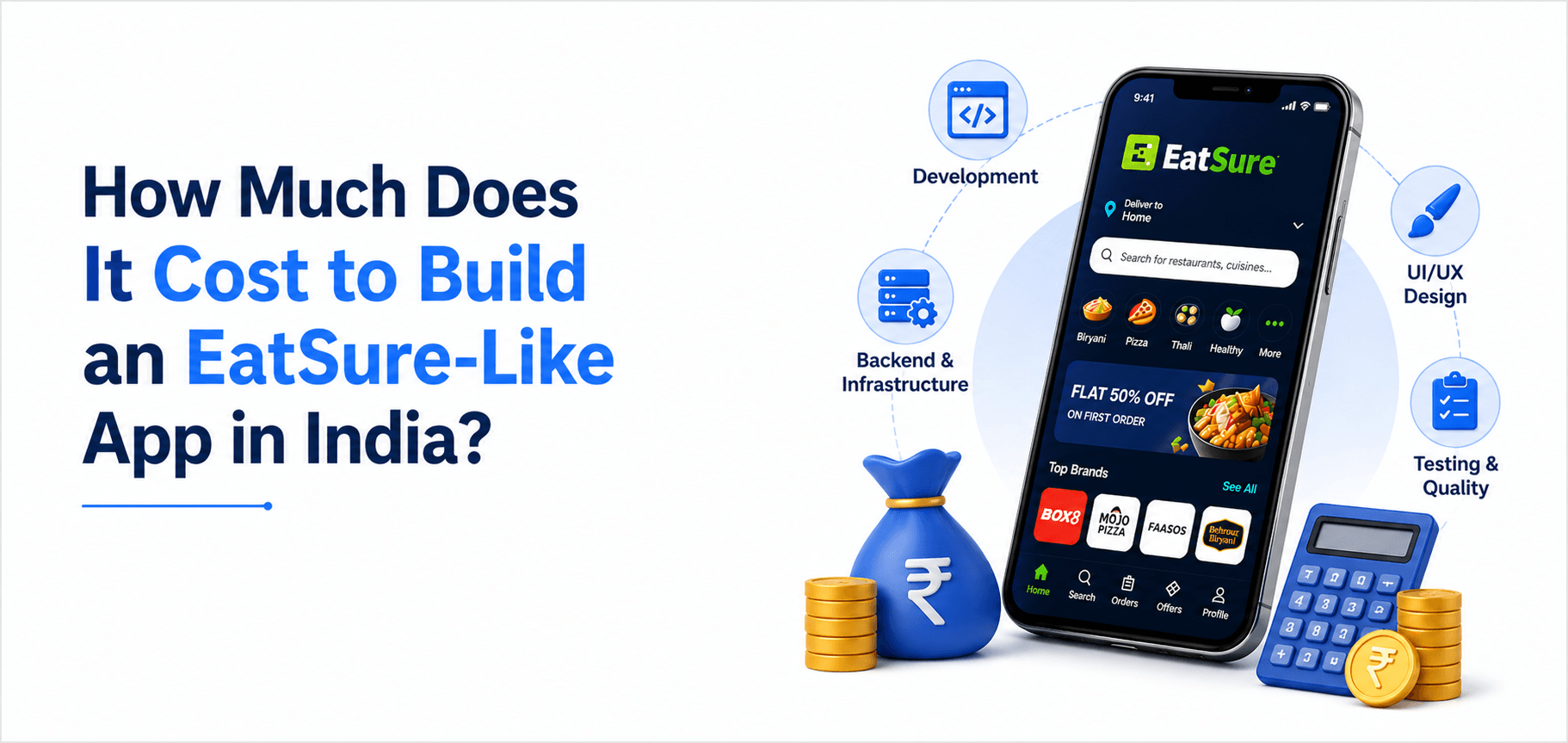
Now you might be wondering: why such a big range? Why not one fixed number? That’s because multiple factors influence the food delivery app development cost, and each one adds its own layer of complexity.
Here are the factors that affect the development cost of apps like EatSure:
Complexity of the App: A basic MVP proves to be faster and cheaper, whereas a scalable app with thousands of users is more expensive.
Features: Live tracking, notifications, analytics, loyalty programs, and personalisation improve the development.
UI/UX Design: Fluid, user-friendly design maintains user engagement, decreases friction and has a direct cost impact.
Tech Stack: There are technologies that are easy to develop and difficult to scale, and those that are difficult to develop but easy to scale.
Maintenance Need: The frequent updates, bug corrections and performance enhancements contribute to the overall cost in the long term.
What you end up paying is your choice at each step, whether for features, team or technology.
Food Delivery App Development Process: Everything From Scratch
Building a food delivery app is a whole journey (especially if you are starting from scratch).
From planning what the app should do, to designing how it looks and feels, to actually building and testing it, every step matters. Skip one, and the experience falls apart.
Here, we’ll walk you through how to create a food delivery app step by step, so your platform works effortlessly from the first tap to the last bite.
1. Planning & Strategy
You must have a good plan before you are able to write a single line of code. Identify your target market, their behaviours, and the issues that your application will address. Determine what features will be necessary during the launch time and what will be required later. Mapping of business model, revenue streams, and growth strategy is also involved in planning. A well-outlined plan will make sure that the app will satisfy actual users and be a well-founded basis to be developed.
2. UI/UX Design for Food Delivery Apps
It is in design that your app gets made. Food delivery apps are designed using UI/UX that aims at making the interface a comfortable, easy-to-use interface. Imagine all the interactions: going through menus, putting items in the cart, taking discounts, and checking out. Every movement must be easy. Good design does not just appear attractive, but it should be in a way that it directs the user in an intuitive manner, minimises mistakes and makes the user want to visit again. The experience can be even more interactive with some personalised touches, such as suggestions of previous orders or favourites.
3. Development
When the design is prepared, development starts. It involves the creation of the front-end (what the users see) and the back-end (servers, databases and APIs). Here, core features such as real-time order tracking, notification, secure payment gateway, and analytics dashboard are integrated. The correct tech stack will have your app in a place to scale to your growth without crashing and enable it to update easily in the future without rewriting it completely.
4. Testing
The test is where the app is made to go through it. Functionality test ensures that all functions are as intended. Performance testing tests to ensure the app remains fast even when it is heavily used. Security testing will make sure that the data of the user is secure, and usability testing will ensure that the app feels like a natural one to the actual users. This step will minimise the problems after launch and enhance the overall satisfaction of the users.
5. Launch & Support
The app is being launched, which is exciting, but it is only the beginning. Post-launch services involve performance monitoring, bug fixing, new features, and optimisation of the user experience as per the feedback. Constantly updating your app will keep it relevant, address the changing user demands, and ensure the app remains engaging over time.
A strong process ensures your app is not just built, but built right.
By following this structured food delivery app development process, you don’t just create an app; you create a complete ecosystem that connects users, delivery partners, and businesses efficiently. Thoughtful planning, smooth UI/UX design for food delivery apps, and careful development ensure your app stands out and scales for long-term success.
Tech Stack for Food Delivery App Development
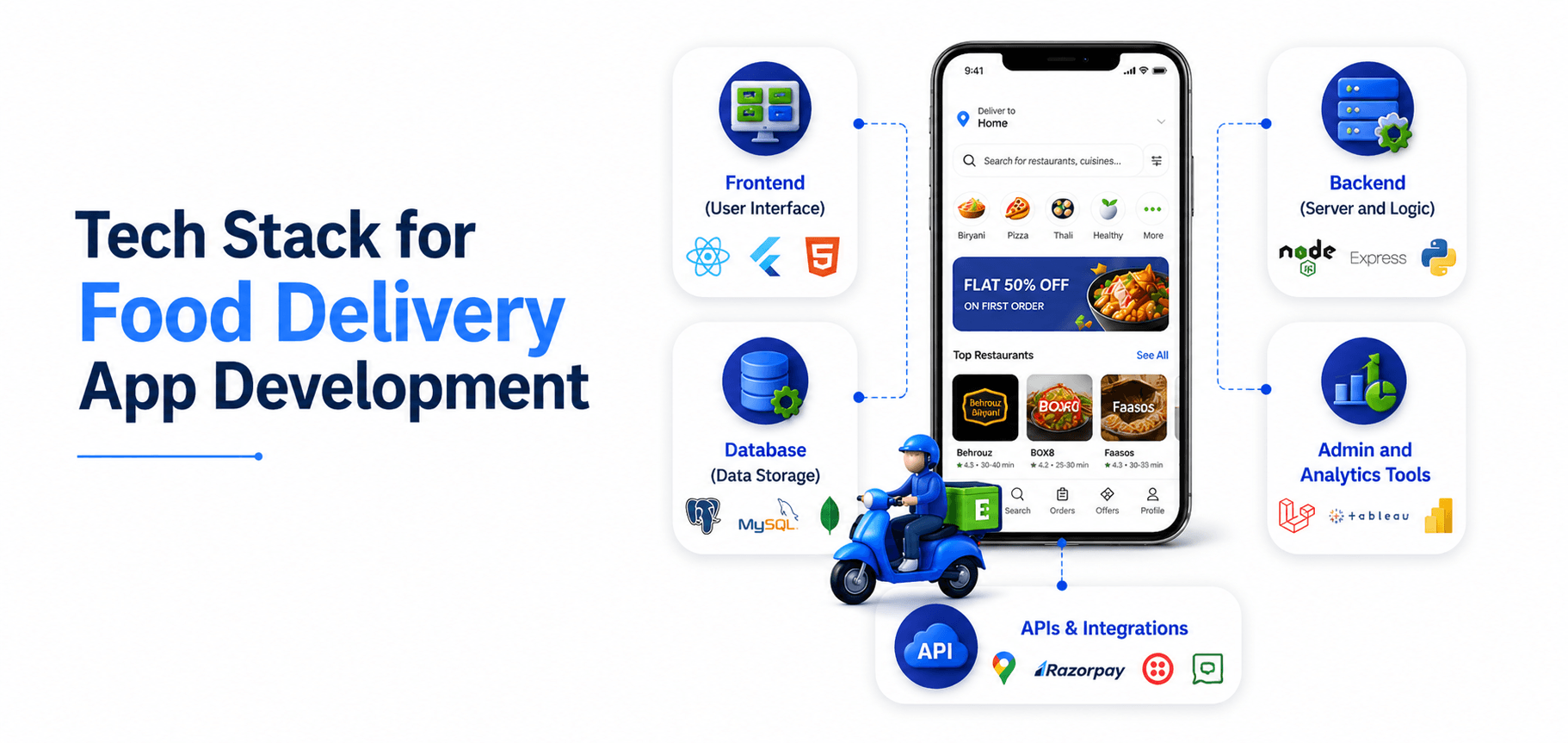
Creating a food delivery app is not only about a sleek interface. It is also about having the right tech powering every click, tap, and swipe. The tech stack determines how fast your app runs, how reliably it handles orders, and how easily it can scale as your user base grows.
Here’s a breakdown:
Frontend (User Interface): Frontend deals with all that the users are viewing on a screen: menus, buttons, scrolling, and checkout. It is developed using React Native, Flutter, Swift, or Kotlin, which makes the app fast, smooth and intuitive.
Backend (Server and Logic): It manages the orders, the user profiles, real-time tracking, and analytics. Such technologies as Node.js, Python/Django, and Java/Spring Boot ensure the stability and scalability of the app.
Database (Data Storage): connects such critical services as Razorpay, Stripe, Google Maps, and push notifications. Payments are made safely, the accounting is done properly, and the report is made immediately.
Admin and Analytics Tools: Assists the companies to manage menus, place orders, performance and know who is using them. Firebase, Mixpanel, and Google Analytics are the platforms that offer growth insights.
APIs & Integrations: APIs integrate your application with other services you need, such as payment gateways, maps, shipping packages, and push notifications. Incidentally, payments are processed via Razorpay or Stripe, live tracking is enacted by Google Maps, and APIs notify users of updates. Integrations facilitate the smoothness of the app, reliability, and completeness of the app.
Choosing the appropriate tech stack to develop a food delivery app is a major challenge. The correct mix means that your app will be quick, dependable, scalable and capable of providing a seamless experience to the users, delivery partners, businesses and so on.
Choosing the Right Development Partner
Building an app like EatSure requires expertise. And that’s where Techugo, a leading mobile app development company in India, comes in.
Why partner with us:
- Expertise in Food Delivery Apps: We’ve helped multiple startups and enterprises build apps that handle thousands of users, deliveries, and transactions smoothly.
- UI/UX That Works: Our designs aren’t just user-friendly; they’re intuitive, fast, and crafted to keep users engaged and coming back.
- Scalable & Secure Tech Stack: We build apps that grow with your business. From real-time tracking to secure payments, everything is built for performance.
- End-to-End Support: From strategy and design to development, testing, and launch, we’re there every step of the way.
- Proven Results: Milkbun, developed by Techugo, crossed 10,000 users in its first month and recorded a 67% increase in customer engagement soon after launch.
Partnering with the right team can make all the difference. Choosing a food delivery app development company like Techugo means you’re not just building an app, you’re creating a platform that’s scalable, secure, and user-friendly from day one
If you’re serious about creating a competitive, scalable, and user-friendly food delivery app that stands out in India’s booming market, partner with Techugo to make it happen.
FAQs
1. How much does it cost to build an app like EatSure in India?
The cost to build an app like EatSure in India usually ranges between ₹3,50,000 and ₹20,00,000 or more. The final cost depends on the features you choose, the complexity of the platform, and how scalable you want the app to be in the long run.
2. How long does it take to develop a food delivery app?
On average, it takes around 3 to 9 months to build a food delivery app. A basic version can be launched faster, while a fully-featured, scalable platform requires more time for development, testing, and optimisation.
3. What features are essential in an app like EatSure?
A food delivery app like EatSure needs a smooth user interface, real-time order tracking, multiple payment options, a delivery partner dashboard, and a strong admin panel. Personalised recommendations and offers also play a key role in improving user engagement.
4. What makes EatSure-like apps different from regular food delivery apps?
Unlike standard food delivery apps, EatSure-like platforms operate as multi-brand ecosystems. They offer consistent quality, better control over operations, and a unified experience where users can order from multiple brands within a single app.
5. Which tech stack is best for food delivery app development?
The ideal tech stack depends on your goals, but commonly used technologies include React Native or Flutter for the frontend, Node.js or Django for the backend, and Firebase or MongoDB for the database. Integrations like payment gateways and maps are also essential for smooth functionality.
6. Can I launch with a basic version first?
Yes, starting with a minimum viable product (MVP) is a practical approach. It allows you to enter the market quickly, test your idea, and gradually add advanced features based on user feedback and business growth.

Get in touch
We'd love to hear from you.