

 SA
SA
 KW
KW
 IE
IE AU
AU UAE
UAE UK
UK USA
USA
 CA
CA DE
DE
 QA
QA ZA
ZA
 BH
BH NL
NL
 MU
MU FR
FR













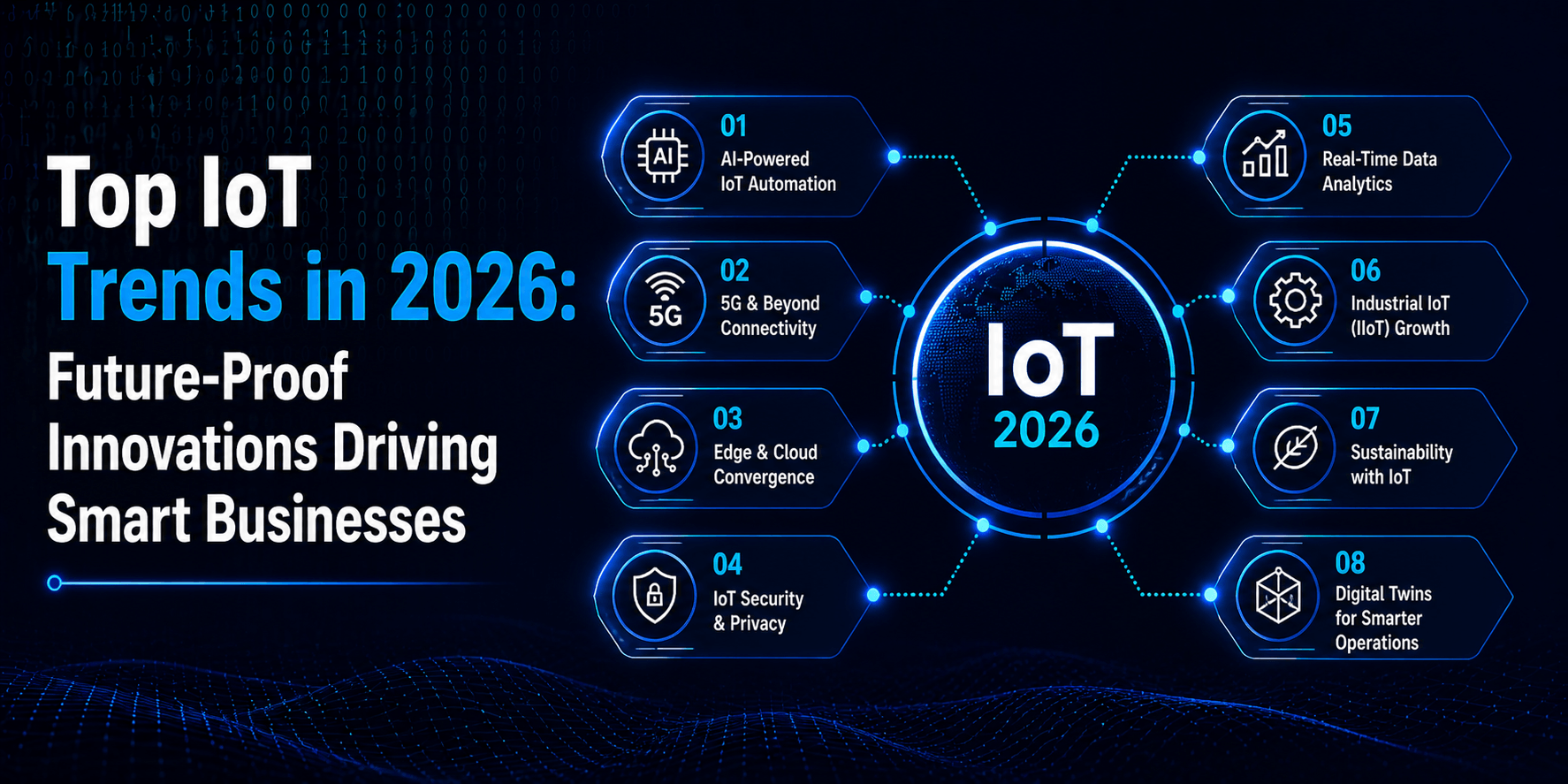


As we move deeper into 2026, businesses are entering a highly competitive, technology-driven landscape where innovation defines survival. The past few years have proven that digital transformation is no longer optional, it is essential. Among the technologies leading this revolution, the Internet of Things (IoT) continues to stand out as a game-changer.
From smart homes to industrial automation, IoT is reshaping how businesses operate, analyze data, and deliver value. Organizations that leverage IoT strategically are gaining a significant competitive advantage by improving efficiency, reducing costs, and unlocking new revenue streams.
In this blog, we explore the most impactful IoT trends in 2026 that businesses must adopt to stay ahead.
A Brief Introduction To IoT
If you want to dig deep into the term ‘Internet of Things’ then you must know the basics. The simplest way to understand is by acknowledging that IoT is all about expanding the capability of the internet beyond smartphones and computers to a completely different range of environments, things, and processes.
Once we connect the devices with the internet we can experience benefits that weren’t possible before. IoT is a dense network of physical things or objects. These objects are embedded with sensors with the main motive of exchanging and connecting data with systems and devices over the Internet.
When a device or a thing is connected to the internet, they can smoothly receive and send data, and the ability to do so makes them smart.
This technology is all about extending the power of the internet beyond smartphones and computers to a completely different range of things/environment. This ability helps businesses to fetch better insights and control over the complete environment that remain beyond the reach of the internet. With so much to offer, this technology is becoming popular in the business world, and to help you reap its maximum advantages, we would be learning more about its upcoming trends.
So shall we begin?
Emerging IoT Trends Everyone Must Know About!
For success in any domain, businesses need to move in the right direction, which can only be achieved when one is fully aware of the upcoming trends. Take a look further to update your knowledge.
Top IoT Trends in 2026 Explained in a Simple Way
Let’s be honest—technology is moving fast, and sometimes it feels hard to keep up. But when it comes to IoT (Internet of Things), things are actually becoming more useful and practical for businesses and everyday life.
So instead of getting too technical, let’s break down the biggest IoT trends of 2026 in a way that actually makes sense.
1. AI-Powered Data Analytics
Think about all the devices around you—smartwatches, sensors, home assistants—they are constantly collecting data. Now imagine handling all that data manually. Not possible, right?
That’s where AI comes in.
In 2026, IoT is no longer just about collecting data—it’s about understanding it. AI helps businesses analyze this data instantly and make smarter decisions. For example, a retail store can predict what customers will buy next, or a factory can detect a machine failure before it actually happens.
In simple terms, AI + IoT = smarter and faster decisions without human guesswork.
2. Edge Computing (Faster Decisions, Less Waiting)
Earlier, IoT devices used to send all data to the cloud for processing. That takes time.
Now with edge computing, data is processed closer to where it is generated—right at the device level.
What does that mean for you?
- Faster response time
- Less delay
- Better performance
For example, in healthcare, a wearable device can instantly alert doctors in case of abnormal health readings—without waiting for cloud processing.
3. 5G Making Everything Super Fast
You’ve probably heard about 5G, but its real power is seen with IoT.
In 2026, 5G is making devices communicate almost instantly. This is a big deal because IoT depends heavily on connectivity.
With 5G:
- Devices connect faster
- Data transfers happen in real-time
- Large networks of devices work smoothly
This is what makes things like smart cities, connected cars, and advanced automation possible.
4. IoT Security Becoming a Priority
More devices connected = more chances of cyberattacks.
And businesses are finally taking this seriously.
In 2026, IoT security is not optional anymore. Companies are investing in:
- Strong encryption
- AI-based threat detection
- Secure device authentication
Because one weak device can compromise the entire system.
So yes, security is now a major part of IoT planning, not an afterthought.
5. Smart Cities Are Becoming Real
Smart cities are no longer just an idea—they’re actually happening.
IoT is helping cities become more efficient and organized. For example:
- Smart traffic lights to reduce congestion
- Waste management systems that track garbage levels
- Smart energy grids that reduce power wastage
All of this improves daily life without people even noticing it.
6. Industrial IoT (IIoT) Changing Manufacturing
Factories are getting smarter.
With IoT, machines can now:
- Monitor their own performance
- Predict when maintenance is needed
- Reduce downtime
This is called Industrial IoT or IIoT.
In simple words, factories are becoming more efficient, saving both time and money.
7. Smart Homes Getting Smarter
Smart homes are no longer a luxury—they’re becoming normal.
In 2026, IoT-powered home devices are:
- More affordable
- More connected
- More intelligent
From controlling lights with your voice to automated security systems, everything is designed to make life easier and safer.
And the best part? All devices now work together more smoothly than before.
8. Sustainable IoT (Tech That Saves the Planet)
Businesses today are focusing a lot on sustainability—and IoT is helping them achieve it.
With IoT, companies can:
- Track energy usage
- Reduce waste
- Optimize resources
For example, smart energy systems can automatically reduce electricity usage when not needed.
So it’s not just about technology anymore—it’s about responsible technology.
9. Digital Twins (Virtual Copy of Real Things)
This might sound futuristic, but it’s already happening.
A digital twin is basically a virtual version of a real object or system.
For example:
A company can create a digital model of a factory and test changes on it before applying them in real life.
This helps in:
- Reducing risks
- Saving costs
- Improving efficiency
It’s like testing things in a simulation before doing them for real.
10. IoT in Healthcare (Better Care, Less Hassle)
Healthcare is one of the biggest winners of IoT.
In 2026, patients don’t always need to visit hospitals for basic monitoring. Devices can:
- Track heart rate
- Monitor blood pressure
- Send real-time updates to doctors
This is especially useful for elderly patients or people with chronic conditions.
It saves time, reduces hospital visits, and improves overall care.
Real-World Use Cases of IoT Across Industries
IoT is already part of everyday life and business. It quietly works in the background to make things faster, smarter, and more efficient. Here are five simple real-life uses:
1. Smart Healthcare
IoT devices like smartwatches and health monitors track things like heart rate, oxygen levels, and sleep. Doctors can even check patient health remotely, which makes treatment faster and easier, especially in emergencies.
2. Smart Homes
From lights to ACs to security cameras, everything can be controlled using a phone or voice assistant. These devices also learn your habits and adjust settings automatically to save energy and improve comfort.
3. Industrial Automation
Factories use IoT to monitor machines in real time. If something is about to break, the system gives an alert in advance. This helps reduce downtime and keeps production running smoothly.
4. Smart Transportation
Delivery trucks and vehicles use IoT for GPS tracking and route updates. This helps companies know exactly where goods are and ensures faster, more efficient deliveries.
5. Smart Retail
Stores use IoT to track inventory and customer behavior. It helps them know what products are running low and also improves the shopping experience with better recommendations.
How Startups Can Leverage IoT for Growth
Startups can use IoT in simple and practical ways to grow faster, reduce costs, and build better products. Here’s how:
- Smart product development
Startups can build connected products that talk to users in real time and offer more value than regular products. - Real-time data insights
IoT helps collect live data from users and devices, which can be used to understand customer behavior and improve services. - Cost efficiency and automation
Many tasks like tracking, monitoring, and reporting can be automated, which saves time and reduces costs. - Subscription-based revenue models
Startups can offer IoT-based services on a monthly or usage basis, creating steady and recurring income. - Better customer experience
IoT allows products to become more personalized and responsive, making the user experience smoother and more useful. - Faster innovation
Startups can quickly test, improve, and launch new ideas using IoT, helping them stay ahead in the market.
Future Scope of IoT Beyond 2026
Beyond 2026, the biggest transformation in IoT will come from the deep integration of Artificial Intelligence. IoT will no longer remain just a network of connected devices collecting and sharing data; instead, it will evolve into an intelligent ecosystem where devices can think, learn, and act on their own. With AI, IoT systems will become far more predictive and autonomous, meaning they will not only identify patterns in real time but also make decisions without human intervention.
For example, smart systems in industries will be able to detect potential failures before they happen and automatically adjust operations to avoid downtime, while smart homes will learn user behavior and manage energy, security, and comfort settings proactively. In healthcare, AI-powered IoT devices will go a step further by analyzing patient data continuously and predicting health risks early, enabling preventive care instead of reactive treatment.
This shift will reduce dependency on manual monitoring and improve efficiency across industries. In simple terms, AI will transform IoT from a data-driven technology into an intelligence-driven system that continuously improves itself, making businesses smarter, faster, and more adaptive than ever before.
In A Nutshell
These are all the popular IoT-based trends that we will observe in 2021. If you want to know more about the integration of IoT with your business, then feel free to reach out to us. We have the right experience that you are looking for.
The power of technology is indeed unmatchable, but when we renovate it with innovation, the result is mesmerizing. It is time that you too witness the power of tech and trigger the revenue funnel. For more information, get in touch right away. But until then, stay tuned for more!
FAQ
1. Is IoT only useful for large enterprises?
No, IoT is increasingly accessible to startups and small businesses. With affordable devices and scalable solutions, even small companies can benefit from automation and data insights.
2. What industries benefit the most from IoT?
Industries like healthcare, manufacturing, retail, logistics, and smart home services benefit greatly from IoT due to real-time monitoring, automation, and improved customer experiences.
3. What are the main challenges of implementing IoT?
Some common challenges include:
Data security risks
Integration with existing systems
High initial setup costs
Managing large volumes of data
4. How secure is IoT in 2026?
IoT security has improved significantly with advanced encryption, AI-based threat detection, and secure authentication. However, businesses must still follow best practices to avoid vulnerabilities.
5. What is the cost of implementing IoT solutions?
The cost varies depending on the scale, devices, and infrastructure. However, cloud-based and modular IoT solutions have made it more affordable than ever, especially for startups.

Get in touch
We'd love to hear from you.