 SA
 KW
 IE
 AU
 UAE
 UK
 USA
 CA
 DE
 QA
 ZA
 BH
 NL
 MU
 FR







 Android
 iOS












📌 Key Takeaways
- Starting niche and then expanding should be the aim.
- Vision 2030 is driving a digital gold rush in the Saudi Arabia marketplace.
- Compliances such as PDPL and ZATCA e-invoicing are essential.
- Marketplace business models include B2C, B2B, C2C, service, and niche.
Saudi Arabia’s growing digital economy is creating new opportunities for businesses to launch online marketplace platforms. Vision 2030 drives the change, shifting the Kingdom toward a tech economy. This opens huge opportunities for investors and entrepreneurs. Consumer behavior is changing quickly. It’s now mobile-first, focused on convenience, and built on trust. Marketplace apps are the new essential for growth. Mobile platforms are rapidly reshaping Saudi’s business world, from fashion and food delivery to logistics and luxury. They connect buyers, sellers, and services instantly.
Today’s Saudi consumers expect:
1. A personalized experience
2. Transparency in transactions
3. Instant service
The real chance is to invest early and lead locally. To do this, it’s important to understand marketplace apps.
What Is A Marketplace Application?
A marketplace app is a digital platform that connects multiple buyers and independent sellers through a single website or mobile app. It allows users to discover products or services, compare prices, place orders, and make payments, while the platform owner earns revenue through commissions, subscriptions, transaction fees, or advertisements.
Unlike traditional ecommerce applications, marketplace apps support multiple independent vendors operating within one platform.
What Are The Different Types of Marketplace Business Models In Saudi Arabia?
Where both the parties (buyers and sellers) can connect, and that too on an online medium, is the key. However, some marketplace business models cover a range of types that are discussed below:
1. Business to Consumer (B2C)
A platform that connects businesses directly to the end user is what you can call a B2C model. Generally, multiple sellers can list their products, which gives users an option to choose. Under this, the platform gets its sales from commissions, subscription fees, or on-site advertising.
2. Business to Business (B2B)
A B2B marketplace connects one business to another. It is as simple as that. But when you go through e-commerce app development, you will need to include manufacturers, wholesalers, and corporate buyers to complete the ecosystem.
Example: Regional and international B2B logistics players like Alibaba.
3. Consumer to Consumer (C2C)
A place where individuals can buy and sell their stuff online is a C2C marketplace. It can be the most basic thing, like furniture, or even a collector’s item.
Example: Haraj is a good example of a consumer-to-consumer marketplace.
4. Service Marketplace
A platform where customers can meet people (often professionals in their field) and get their services for a specific period of time or project is what a service marketplace is all about. So, unlike a traditional platform, customers are not buying anything physical but are searching for services and comparing prices.
Example: A good example would be Khidmah.
5. Vertical & Niche Marketplaces
These are online platforms that connect buyers and sellers within a specific industry, product category, or target segment rather than offering the complete set of inventory.
Example: Ounass.
Not sure which marketplace model fits your idea?
B2B, B2C, C2C, service, or niche: each has different features and costs. Our experts will match the model to your goals.
What Marketplace App Features Should Your Business Have?
If you look at the DNA of a marketplace, it is more than just a digital storefront. It is an ecosystem where customers, sellers, service providers, delivery partners, and various administrators interact.
This means the development team of an app development company in Saudi Arabia needs to consider multiple user journeys while figuring out what the application is. So, let’s divide the essential features, which include:
Customer Side
1. User Authentication & Profiles: Secure login via email, phone number, or social media, alongside saved addresses and preferences.
2. Smart Search & Filters: Advanced search bars with instant category filters, sorting, and tag options to locate items quickly.
3. Multi-Vendor Cart & Checkout: A unified shopping bag that handles items from different sellers simultaneously, paired with encrypted payment gateways (credit cards, digital wallets, and Buy Now Pay Later options)
4. Real-Time Order Tracking: Contains and reflects live status updates from order confirmation to the dispatch process.
5. Ratings & Reviews: Verified feedback systems for products and individual vendor performance.
Seller Side
1. Dedicated Seller Dashboard: A centralized hub to monitor store performance, total revenue, and active listings.
2. Product Catalog & Inventory Tools: Easy tools to upload items, manage stock levels, update pricing, and handle bulk imports.
3. Order Management Systems (OMS): Tools to accept, package, and update the shipping status of incoming customer orders.
4. Payout & Earnings Settings: Configurable banking or wallet details to receive automated or manual sales revenue splits.
5. In-App Messaging: Direct communication channels to answer buyer questions regarding items or shipping.
Admin Side
1. Central Admin Panel: High-level command center to oversee total platform health, gross merchandise value (GMV), and user activity.
2. Vendor Onboarding & KYC: Identity verification workflows, merchant approval gates, and document checks.
3. Commission & Fee Controls: Automated commission calculations, category-based fee rules, and payout automation.
4. Dispute Resolution Hub: Tools to review buyer-seller conflicts, process funds, and manage chargebacks through marketplace app development.
5. Analytics & Reporting: Data tools tracking conversion rates, top-selling categories, and traffic trends.
Other Advanced Features
Beyond the important features, businesses can integrate advanced capabilities to improve customer engagement, automate marketplace operations, and create more personalised shopping experiences.
1. AI-Powered Product Recommendations: Recommending relevant products and improving their discoverability through analyzing browsing and purchasing behavior.
2. Arabic-Language Conversational Search: Through the use of the natural Arabic language of customers, rather than relying entirely on exact product keywords.
3. Personalized Offers: Based on the customer’s purchase history, interests, and engagement, displaying discounts and promotions.
4. Real-Time Delivery Tracking: Providing accurate order updates through delivery partners and location services.
5. Dynamic Pricing: Support flexible pricing based on availability, demand, booking periods, or seller-defined rules.
6. Fraud Detection: Identify suspicious transactions, unusual account activity, and potentially fraudulent seller behavior.
7. Loyalty & Rewards: Encourage repeat purchases through reward points, membership benefits, and customer incentives.
8. Multi-Vendor Payment Reconciliation: Automatically calculate commissions, refunds, seller earnings, and settlement amounts.
What Regulations Must Marketplace Businesses Follow In Saudi Arabia?
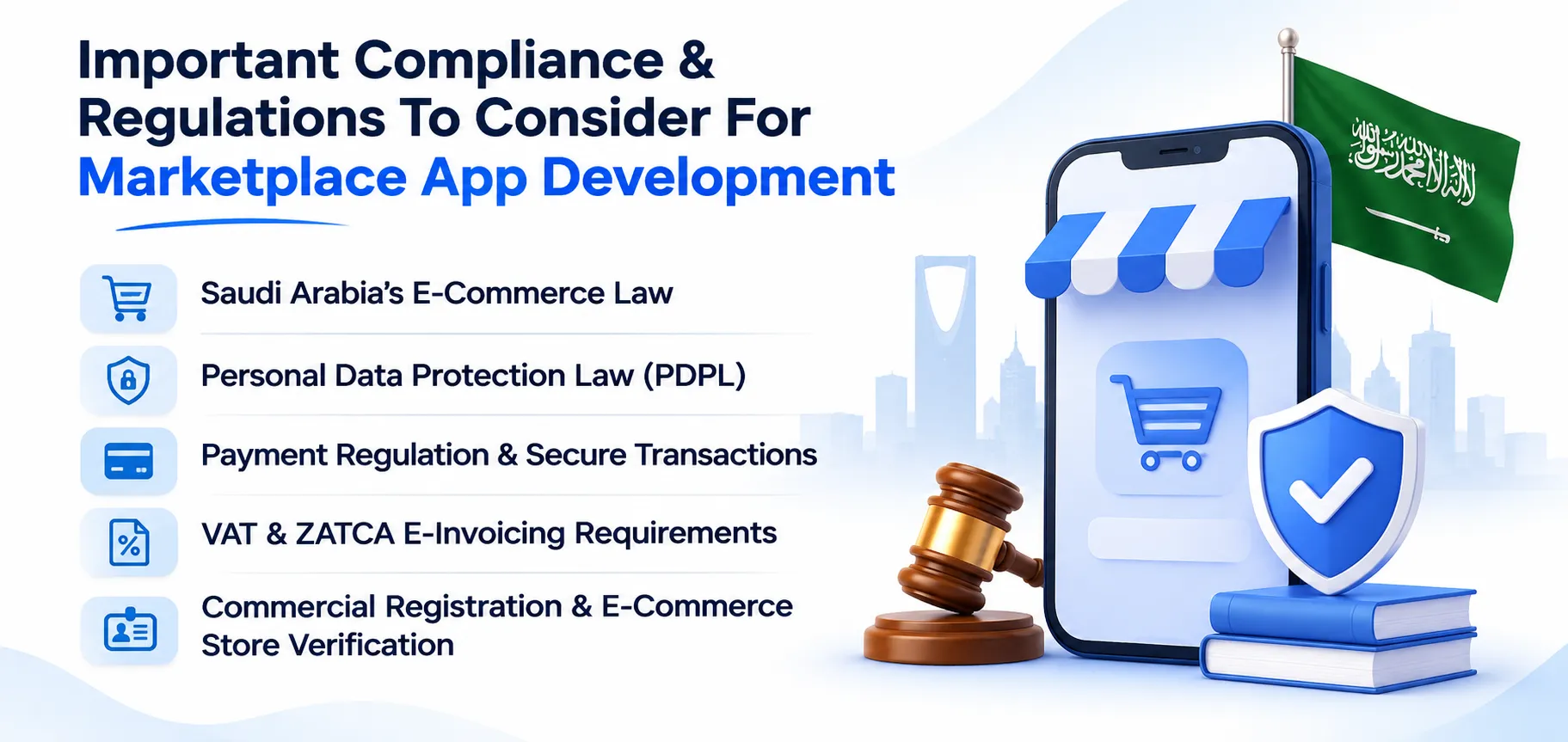
Compliance and marketplace app regulations in Saudi Arabia are what make a whole lot of difference in this space. So, if you are planning to launch, understanding what happens in the Middle Eastern nation on the legal front is important. But the question “why does it matter?” might have crossed your mind.
This is because the marketplace will handle sensitive customer data, seller details, payments, product listings, and whatnot. Therefore, let’s understand each one of them:
Saudi Arabia’s E-Commerce Law
This e-commerce regulation applies to businesses operating within the Kingdom and some that function outside it. But the end consumer is the Saudi audience.
Here, the important requirements include:
1. Displaying contact info and business identification.
2. Providing necessary commercial registration details.
3. Clearly communicating product and service descriptions.
4. Showcasing relevant transaction terms and pricing.
5. Offering transparent terms and conditions.
6. Defining and simplifying delivery, exchange, return, and refund policies.
Personal Data Protection Law (PDPL)
Saudi Arabia’s personal data protection law (PDPL) sets the requirements for processing and safeguarding personal information.
So, as a marketplace owner, it is important to establish:
1. Gathering personal information needed for a specific purpose.
2. Explaining how the information will be used.
3. An appropriate and effective privacy policy.
4. Suitable technical and company-based measures must be implemented.
5. Managing consent and other applicable legal material.
6. Establishing processes for handling data access and other data subject requests.
7. Understanding the requirements of transferring personal data outside the KSA.
Payment Regulations & Secure Transactions
An important aspect of e-commerce app development in Saudi Arabia is payment processing. Customers expect convenient payment options, while sellers expect more accurate transaction records and timely settlements.
Under this, the important things are:
1. PCI DSS Compliance: Payments through debit and credit cards must follow the Payment Card Industry Data Security Standard.
2. If your marketplace handles digital wallets, P2P transactions, or financial services, approvals and open banking/AML/CFT compliance through the Saudi Central Bank (SAMA) are mandatory.
3. Support what Saudis actually use. That means Mada debit cards, Visa, and Mastercard, Apple Pay, STC Pay, and increasingly buy now pay later options like Tabby and Tamara.
VAT & ZATCA E-Invoicing Requirements
Saudi VAT is 15%, administered by the Zakat, Tax and Customs Authority (ZATCA). So, if you have a business or are looking to build one, a marketplace app development company in Saudi Arabia is required to register once the taxable revenue passes SAR 375,000, and this is mandatory. But voluntary registration starts at SAR 187,500.
The bigger operational topic is e-invoicing (Fatoorah), which rolls out in two phases:
Phase 1 (Generation): Invoices or Fatoorahs must be created and stored in an electronic format and also in a structured format, with a QR code on simplified (B2C) invoices.
Phase 2 (Integration): ZATCA’s platform integration into your marketplace business is a must. In Saudi Arabia, B2B invoices are cleared by ZATCA before being issued, and B2C invoices are reported within 24 hours.
Commercial Registration & E-Commerce Store Verification
If you are going for MVP development for your marketplace application, it is better to look at these commercial licenses:
1. Commercial Registration (CR): It is issued by the Ministry of Commerce and the Saudi Business Center. Your CR should list e-commerce among its activities.
2. Seller Verification: As the operator of the marketplace, it is vital that the operator checks if the sellers have valid CRs (or any other valid documents for individual/small sellers) prior to permitting them to put their products on sale on the platform.
3. Foreign-Owned Businesses: Usually, an investment license from MISA will also be required.
4. Trust Signals: The Ministry has created the Maroof system, which provides stores with documentation and ratings that can enhance customers’ trust in you.
Build v/s Buy. Which One Should You Build As A Marketplace App?
Starting a marketplace in Saudi Arabia is a huge opportunity. E-commerce is mainstream in the Middle Eastern nation, and there is a lot of mobile usage, and Vision 2030 is pushing for the digitization of commerce. Before bringing in developers or going for a cloud services company in Saudi Arabia, you need to answer two key questions: how are you going to create the marketplace, and what competition do you have once it is launched?
Thus, understand them in detail.
| Factor | Buy (Ready-Made) | Build (Custom Development) |
| What It Is | Subscribe to or license a platform with core marketplace features already in place: vendor, onboarding, listings, carts, and commissions | Design and develop the platform from scratch, in-house or with a development partner |
| Speed To Launch | Fast, often weeks | Slow, often many months |
| Upfront Cost | Lower. No full engineering team needed before you earn revenue | Higher, with a bigger budget needed |
| Flexibility & Control | Limited. Unusual workflows within the platform’s limits | Strong. Custom code can deliver a unique workflow, pricing model, or buying experience |
| Saudi Compliance & Localisation | Often built in (Arabic/RTL, local payment gateways, shipping integrations, ZATCA e-invoicing) | You own the burden: ZATCA integration, PDPL controls payment, security, and every future update |
| Ongoing Costs | Recurring subscription and per-transaction fees that grow with you | Continuous maintenance: bugs, security patches, new features |
| Main Risks | Vendor lock-in and difficulty moving data and operations later | Budget and timeline overruns, plus the compliance workload |
| Best For | Testing an idea or validating demand; a standard marketplace model | A unique model, solid funding and a strong tech team |
If you look at the factors mentioned above and their respective responses, you will find buy and build have their own advantages and disadvantages.
For example, if you have a limited budget, it is better to go for a buy (ready-made solution). However, if you have an enormous budget, then take the risk of a custom build.
What Challenges Can Businesses Face When Launching A Marketplace App In Saudi Arabia?
When building a business like that of a marketplace or going to the development stage, it is important that you consider what you are about to deal with. It is quite often that business owners in Saudi Arabia don’t know the full scope of things and commit mistakes that then become too costly. So, before you go ahead, consider these marketplace business challenges in Saudi Arabia:
1. The Chicken Egg Problem: Be it B2B, B2C, or any other model, each faces this challenge. Buyers won’t come without sellers, and sellers won’t come without buyers. And in a market where the players are strong, the challenge even becomes enormous. How to overcome this? The best step is to find a niche, test it, and then expand.
2. Competing With Giants: In Saudi Arabia, established players like Amazon and Noon, and some other participants, have set high expectations. This is in terms of pricing, delivery, and other services. So, cracking them is always tough.
3. Logistics & Last Mile Delivery: Saudi Arabia’s size poses challenges in providing reliable delivery services in both major cities as well as smaller towns and remote locations. Customers want quick deliveries for the goods they purchased, and late deliveries can impact the brand name of companies. So, meeting such needs can be a painful task.
4. Cash On Delivery (COD) & Returns: While cashless payments are getting more popular every day, cash on delivery is still a favorite for many clients. Cash on delivery is associated with failed deliveries, returned orders, and complications with managing cash flow.
What Is The Cost of Developing A Marketplace Application In Saudi Arabia?
Building a marketplace app in Saudi Arabia is a strategic investment, and the budget depends on the scope, features, and everything else in between. Knowing what drives marketplace app development cost and how long each stage takes helps you plan realistically and avoid surprises.
| Project Type | Estimated Cost (SAR) | Timeline |
| MVP / Basic App Type | SAR 95,000 – SAR 190,000 | 3 – 4 Months |
| Mid-Level Marketplace | SAR 190,000 – SAR 450,000 | 5 – 8 Months |
| Enterprise Grade Marketplace | SAR 450,000 – SAR 1,100,000+ | 9 – 14+ Months |
Wondering what it will cost to launch your marketplace app in Saudi Arabia?
Get on a call with our expert and get an estimate for your marketplace app.
What Marketplace App Development Trends Are In Saudi Arabia?
If you have ordered groceries on HungerStation, hired home services through an app, or snagged a deal on Noon, you already know the Kingdom has fallen for marketplace apps. With Vision 2030 pushing digital transformation, high performance penetration, and a young, tech-savvy population, Saudi Arabia is one of the most exciting places in the region to launch a marketplace.
So, here are the marketplace app development trends in Saudi Arabia that are shaping the DNA:
Arabic First But Bilingual Experiences
It is no longer sufficient to have a version in Arabic. It is expected that Saudi users will want their applications to be made in a native way: they should have proper right-to-left layouts, properly written Arabic text, and be able to easily switch from English to Arabic. Using local dialects for search and relevant visuals will help customers trust an application much faster.
Local Payments & Buy Now Pay Later (BNPL)
Saudi Arabs want to pay in any way they want. Nowadays, those marketplaces can successfully work which take into account all the payment needs of consumers.
1. Use of Mada cards, Apple Pay, and STC Pay
2. Buy Now, Pay Later option available (for instance, Tabby or Tamara)
3. Cash on delivery, which is still important for many customers
4. Use of digital wallets providing quick and easy repeat purchases
The more convenient checkouts are, the fewer abandoned carts there will be.
AI-Backed Personalisation
From product recommendations to dynamic pricing and smart search, AI is becoming a core aspect of the competitive marketplace, and even driving the marketplace app vs ecommerce debate. So, expect more to go in this direction and follow Arabic-capable chatbots, predictive recommendations based on browsing and buying behavior, and fraud detection to protect buyers and sellers.
Niche & Vertical Marketplaces
General marketplaces have a lot of competition, so there’s a shift to specific platforms such as:
1. Oud, perfume, and luxury gifts
2. Modest fashion and abayas
3. Dates, coffee, and local foods
4. Services around the house, car services, and maintenance
5. Tourism and Umrah
6. B2B marketplaces for building/construction, wholesale, and supplies
Niche platforms are good for building loyal communities quickly, and customers trust experts.
Social & Live Commerce
Saudi Arabia is one of the countries where social media is used the most, thus changing how people buy. Live-stream selling, influencer-led storefronts, shareable product links, and in-app reviews with photos and videos are becoming standard marketplace features rather than add-ons.
How Can Techugo Help You In Your Marketplace App Development Journey?
Saudi Arabia’s marketplace economy is built on innovation, inclusivity, and intelligence. The growth opportunity is huge. It spans from AI-led personalization to cloud-native scalability.
Techugo builds not just apps but powerful digital ecosystems.
Our expertise in building Milkbun has generated outcomes like:
- Surpassing 10k+ users in a month.
- And helped boost customer experience in the second month by 67%
And for BuyEazzy (now Glamzy), our services have been fruitful in delivering:
- Established a digital foundation supporting 2k – 3k daily orders.
- Helped build the platform that onboarded more than 75,000 first-time online shoppers.
We helped Lal10 by:
- Covering 3 countries.
- Empowering 2,290+ MSMEs.
- And customising a website that is accessed by 350 international buyers.
And for Waqti, our help has resulted in:
- Peer-to-peer (P2P) live auctions.
- Developed seamless seller categories (2), individual sellers and professional dealers.
- Crafted an escrow model that leads to secure payments.
We are your mobile app development agency in Saudi Arabia. Whether you’re a startup testing an MVP or an enterprise scaling nationally, we deliver.
The Final Word
Marketplace app development is a strong investment in Saudi Arabia, driven by Vision 2030 and mobile-first consumers who expect personalisation, transparency, and speed. The article covers the main marketplace models, essential features for customers, sellers, and admins, and Saudi compliance rules like PDPL, SAMA payment regulations, and ZATCA e-invoicing. It compares buying a ready-made platform with building custom, warns of challenges such as the chicken-and-egg problem, strong competitors, logistics, and cash on delivery, and highlights trends like Arabic-first design, BNPL, AI personalisation, and niche or social commerce.
FAQs
Q) How long does it take to build one?
Basically, it depends on the scope:
1. MVP / Basic App: 3 – 4 Months
2. Mid-Level Marketplace: 5 – 8 Months
3. Enterprise-Grade Marketplace: 9 – 14+ Months
Q) How do I keep a marketplace secure from fraud and data breaches?
A combination of measures includes fraud detection, seller verification, payment security, data protection (PDPL), disputes, and trust.
Q) What happens after launch, and what does ongoing maintenance involve?
After the launch of marketplace application in Saudi Arabia, the next thing is to do maintenance, compliance upkeep, managing operations (seller verification and commission), looking after growth and performance, and beyond.
Q) How can a marketplace app make money in Saudi Arabia?
Revenue-generating sources include seller commissions, subscription plans, featured product listings, sponsored advertisements, transaction fees, and much more.
Q) What technologies are used to develop a marketplace app?
A marketplace app technology stack basically includes React Native or Flutter for mobile development, Node.js or Java for backend development, PostgreSQL or MongoDB for databases, and AWS or Azure for cloud infrastructure.
Q) How much does marketplace app development cost in Saudi Arabia?
Developing a marketplace app in Saudi Arabia can cost between SAR 95,000 and SAR 1,100,000+, depending on the complexity, features, integrations, and scalability requirements. A basic MVP may cost SAR 95,000 – SAR 190,000, while an enterprise-grade solution can exceed SAR 450,000.