


 SA
SA
 KW
KW
 IE
IE AU
AU UAE
UAE UK
UK USA
USA
 CA
CA DE
DE
 QA
QA ZA
ZA
 BH
BH NL
NL
 MU
MU FR
FR

















📌 Key Takeaways
- AI is reshaping the global education market by enabling personalized, data-driven learning experiences.
- Schools, universities, and EdTech companies are adopting AI-powered tools to improve teaching efficiency and student outcomes.
- Generative AI, virtual tutors, and intelligent analytics are becoming essential components of modern education ecosystems.
- As AI adoption accelerates in 2026, institutions must balance innovation with data privacy, security, and ethical considerations.
How AI in education would help in bridging the gaps between teachers and students in the near future? Well, this is something that many institutions, educators, and students are thinking about right now.
As we all know that today the spectrum of the technology is ever-growing, and there are many expectations from it. One of the great examples is artificial intelligence in education which is growing rapidly. Today, schools, universities, and EdTech platforms are looking for smarter ways to reduce the unnecessary challenges that have been a part of the traditional education system for years.
- Personalized learning
- AI-powered tutoring systems
- Smart classrooms
- Automated assessments and so on…
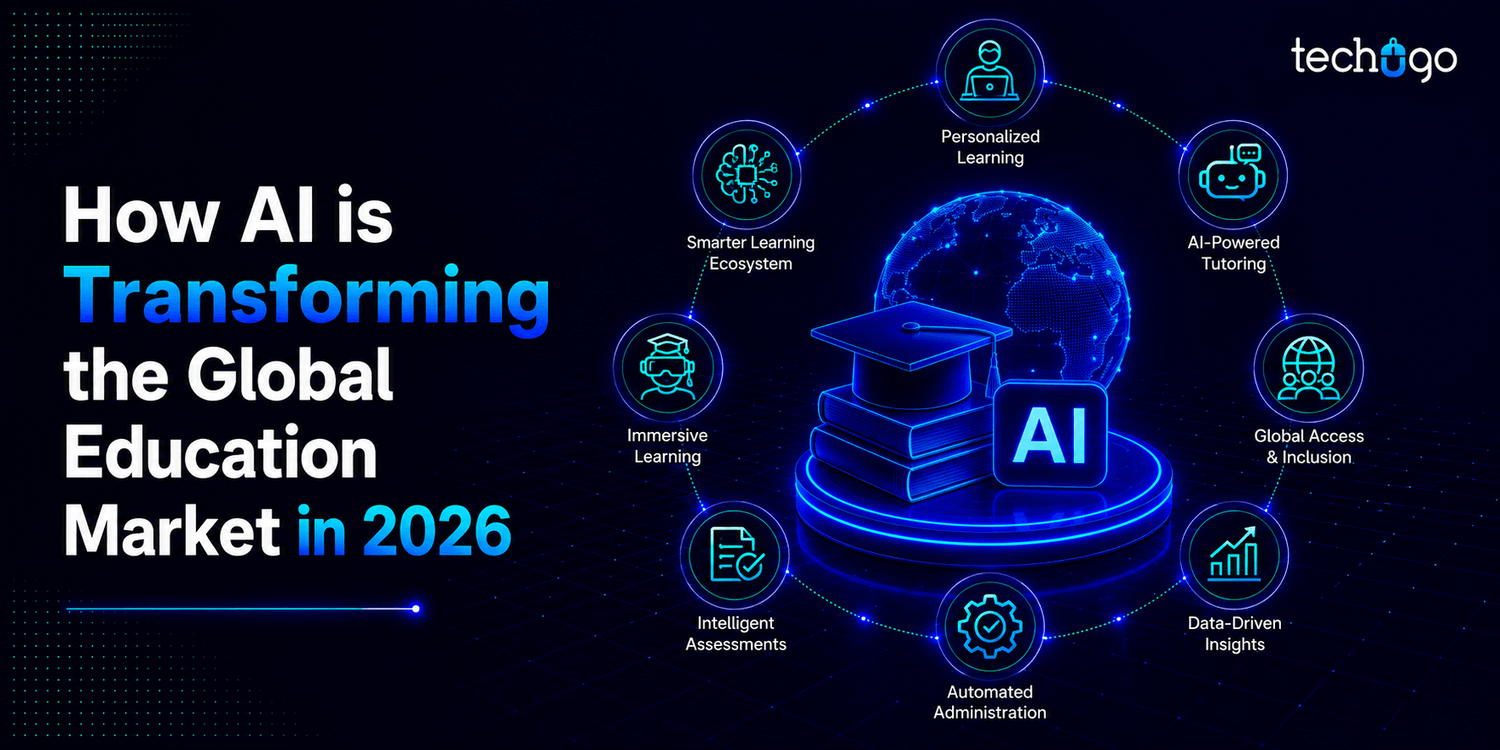
Artificial intelligence is gradually transforming the global education market, and since the demand for digital learning experiences is increasing worldwide, AI-powered education solutions are becoming more important than ever before.
Well, to help you understand this transformation better, we have brought this post for you. Let us explore how AI in education will continue bringing innovation and smarter learning experiences by 2026.
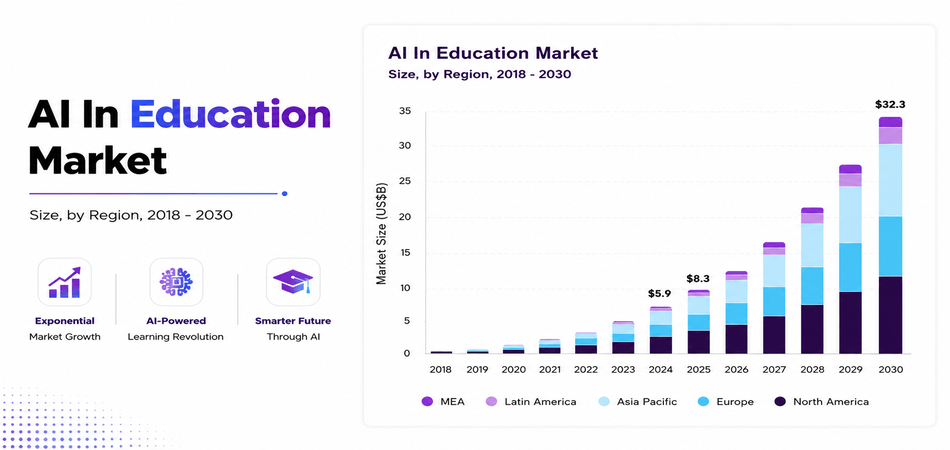
Source: Grand View Research
The global AI in education market has been growing by 31.2% annually from 2025–2030, and it is likely to reach USD 32.27 billion by 2030 (which was USD 5.88 billion in 2024).
The market is growing rapidly, because schools, universities, and online learning platforms are now focusing more on personalized learning experiences and smarter education systems.
Today, educational institutions are using AI tools like Intelligent Tutoring Systems (ITS), chatbots, and learning analytics so that students can learn in a better and more flexible way. And teachers are also getting support in improving their teaching methods.
Since every student learns differently, AI is helping institutions create customized learning experiences, and therefore, the demand for AI in education has been increasing continuously.
Key market trends and insights
There are several trends that are driving the growth of the AI in education market.
North America dominated the market in 2024 and held nearly 38% of the total revenue share. At the same time, the U.S. market is expected to grow at a very fast pace during 2025-2030 because of the increasing adoption of advanced educational technologies.
Based on components, AI education solutions captured around 70.3% of the market share in 2024. And cloud-based deployment also remained dominant with a revenue share of 60.1%, because institutions are now preferring scalable and cost-effective cloud solutions. Machine learning technology was another major contributor, and it accounted for nearly 64.7% of the total market share.
Rise of eLearning and digital classrooms over the years
One of the biggest reasons behind this market growth is the increasing shift toward eLearning and digital classrooms. And after the COVID-19 pandemic, this transformation became even faster because educational institutions were looking for more accessible and technology-driven learning solutions.
At the same time, investments in EdTech startups have been growing continuously, and many companies are introducing AI-driven education platforms so that students can receive better learning support.
Technologies like Natural Language Processing (NLP) and computer vision are also being used for automated grading, adaptive learning, content recommendations, and student assessments. Therefore, institutions are now able to reduce manual workloads and improve the overall learning experience.
Suggested Read: Metaverse in Education: Redefining the Learning Experience!
AI is helping institutions make smarter decisions
Educational institutions are increasingly using AI-based analytics to monitor student performance and identify learning gaps. In many cases, AI systems are even helping institutions predict dropout risks so that they can take early action and support students more effectively.
Another important factor behind the growth of AI in education is skill development and workforce training. Many students and working professionals are using AI-driven online courses and certification platforms because they want to improve their skills and stay competitive in the job market.
Governments across different countries are also supporting the adoption of artificial intelligence in education through funding programs and digital education initiatives. And because of these growing investments and policy support, the global AI in education market is expected to witness massive growth in the coming years.
How AI is improving learning experiences and transforming modern education in 2026
Customized learning experience
The moment we hear the word customization, it instantly grabs our attention. And in the education sector, personalized learning has become more important than ever before because every student learns differently.
For many years, the traditional education system followed the same learning approach for every student. But now, with the growing use of AI in education, this approach is gradually changing. AI-powered learning systems are helping schools and institutions create personalized learning experiences based on a student’s learning speed, interests, behavior, and performance.
Instead of following the same one-size-fits-all model, AI can help students receive customized study materials and learning programs according to their individual needs. Therefore, students are able to focus more on their weak areas and improve their understanding in a much better way.
Accurate career path prediction
One question that almost every student keeps asking is – what will I become in the future? And honestly, many students struggle while choosing the right career path because interests and goals keep changing with time.
Sometimes students choose the wrong career direction, and later realize that it does not match their skills or interests. But AI technology is now helping educational institutions solve this problem as well.
AI systems can analyze student data, learning patterns, academic performance, strengths, and interests so that institutions can provide more accurate career guidance. As a result, students are able to make smarter career decisions and identify opportunities that are more suitable for their future goals.
No grading bias
Bias in grading has always been a major concern for many students and institutions. And in traditional systems, manual checking often consumes a lot of time and effort for both teachers and students.
To reduce these challenges, AI-powered assessment systems are now being introduced in the education industry. These systems can evaluate answer sheets, recognize handwriting, and even analyze exams using technologies like computer vision.
Computer vision helps machines understand and process visual information such as handwritten text and images. Therefore, institutions can reduce grading errors, improve accuracy, and save valuable time. In many cases, AI-based systems are also helping institutions detect plagiarism and reduce cheating during examinations.
Welcome smart schools
For years, smart schools and smart classrooms were only considered futuristic concepts. But today, the combination of AI and IoT is turning these ideas into reality.
IoT-enabled devices can connect classrooms, attendance systems, cameras, and other educational tools through the internet so that institutions can manage operations more efficiently. Within smart classrooms, AI systems can help monitor student attendance, improve classroom management, track learning behavior, and even support online exam invigilation.
And because educational institutions are rapidly adopting digital infrastructure, smart schools are becoming an important part of the future education ecosystem.
Smooth learning
One of the biggest challenges faced by institutions is helping students collaborate with the right peers. Because when students work with people who match their skills and learning abilities, the learning experience becomes much more effective.
AI systems can analyze personality traits, interests, strengths, and learning behavior to pair students more efficiently. Therefore, students can collaborate better, improve communication, and learn from each other in a smoother and more productive environment.
Tutoring via Artificial Intelligence
The demand for online tutoring app and online learning platforms has increased significantly in recent years. But in many situations, tutors find it difficult to manage a large number of students at the same time.
This is where AI tutors and virtual learning assistants are becoming highly valuable. AI-powered tutoring systems can provide instant support, personalized feedback, and on-demand learning assistance to students whenever they need help.
The demand for AI tutoring became even stronger after the pandemic, because remote learning and digital education platforms experienced rapid growth worldwide.
Generative AI in education
Students can access learning materials at any time with just a few prompts, and teachers can also improve their teaching models using generative AI tools like ChatGPT, that generate key insights and offer feedback.
Learning Gaps
There is often a difference between what is written in books and what students actually understand. And these learning gaps can affect a student’s overall academic performance.
Natural Language Processing (NLP), which is a major branch of artificial intelligence, is helping institutions bridge these gaps more effectively. NLP allows AI systems to understand human language and analyze educational content in a smarter way.
With the help of AI and NLP, institutions can identify the weak and strong areas of students and make improvements accordingly. Therefore, teachers can provide better learning support, and students can receive a more personalized and effective education experience.
Well, well, well, there is indeed much to be explored further with AI, and this is just a glance, as this very technology is still in the nascent stage.
Sooner there will be improved advancements to be experienced at the end of artificial Intelligence.
However, if you are looking forward to giving a shot of AI-powered education apps then you must reach out to the Techugo team.
Real-world examples of AI in education
Today, many global EdTech platforms and educational companies are actively using AI in education to improve learning experiences and make digital education more personalized and interactive.
- For example, Duolingo uses artificial intelligence and machine learning to provide personalized language lessons based on a learner’s progress, performance, and learning behavior.
- Similarly, BYJU’S has integrated AI-powered learning models to deliver customized educational content and improve student engagement through adaptive learning techniques.
- At the same time, WhiteHat Jr uses AI-enabled technologies and interactive learning approaches to support coding and online learning experiences for students.
Apart from these platforms, many leading educational companies in the USA and other countries are investing heavily in AI virtual classrooms, automated assessments, and AI chatbots, so that students can receive smarter and more flexible learning support.
But… just like everything has its advantages and disadvantages, so does AI.
AI in education has some challenges and ethical concerns as well, and everyone must be aware of them.
Challenges and ethical concerns of AI in education
Although AI in education is transforming learning experiences and improving accessibility, there are still several challenges and ethical concerns associated with it. And because educational institutions are increasingly depending on AI-powered systems, maintaining a balance between technology and human involvement has become extremely important.
Some major challenges of AI in education include:
- Data privacy and security concerns, because AI systems collect and process large amounts of student information and learning data.
- Overdependence on AI tools, which may reduce direct interaction between teachers and students over time.
- AI bias and inaccurate recommendations, especially when the training data is incomplete or improperly managed.
- Lack of emotional understanding, as AI systems still cannot completely replace human guidance and mentorship.
- Risk of misinformation and plagiarism through AI-generated educational content and assignments.
Therefore schools, universities, and EdTech companies must focus on the ethical and responsible use of artificial intelligence so that technology can improve education without affecting transparency, fairness, and student trust.
Future trends of AI in education beyond 2026
Below are some trends around AI in education that are and will be leading the market beyond 2026, let’s have a look at each of them…
- AI virtual classrooms will make remote learning more immersive and interactive for students worldwide.
- Generative AI tools will help students create notes, summaries, presentations, and assignments more efficiently.
- AI avatars and virtual tutors will provide 24/7 personalized learning support and instant query resolution.
- AR and VR technologies integrated with AI will create more engaging and practical classroom experiences.
- Predictive analytics will help institutions identify learning gaps and student performance issues much earlier.
- Emotion-aware AI systems will analyze student behavior and engagement levels to improve learning experiences.
- Multilingual AI learning platforms will make education more accessible for students across different regions and languages.
- AI automation will reduce administrative workload for teachers and educational institutions.
How Techugo can assist you with adopting AI in education?
Techugo is an experienced education app development company. It has been working since 2015 and now it has more than 10 years of proven experience in web and mobile app development for e-learning sector.
Over the years, Techugo has worked with several leading educational platforms and EdTech businesses to build scalable and engaging digital learning solutions.
Techugo’s experience in eLearning app development can be seen in its portfolio. It has developed different kinds of eLearning apps that are now leading the industry.
One of those achievements are like Lifology, it’s a Guinness World Record Holder app. Take a quick view of Lifology’s Case Study.
The other one is Byju’s, an e-learning app that has 150 Million+ registered students and has raised $5.6B. Take a quick view of Byju’s Case Study. Techugo has also developed WhiteHat Jr. , another leading education platform.
Our all apps are already leading the education market and if you want yours to be the next with AI integrated in it, then don’t hesitate to reach out to our eLearning app experts. Their hands are itching to develop something extraordinary in the world of AI-powered education apps. Get in touch

Get in touch
We'd love to hear from you.