

 SA
SA
 KW
KW
 IE
IE AU
AU UAE
UAE UK
UK USA
USA
 CA
CA DE
DE
 QA
QA ZA
ZA
 BH
BH NL
NL
 MU
MU FR
FR
















📌 Key Takeaways
- AI voice ordering systems use speech recognition, NLP, and machine learning to understand customer requests and automate restaurant order management.
- Voice AI helps restaurants reduce order errors, improve service speed, and deliver a more seamless customer ordering experience.
- Restaurants can implement AI voice ordering across drive-thrus, mobile apps, phone calls, kiosks, and smart assistant platforms.
- Integration with POS systems enables real-time menu syncing, automated order processing, inventory updates, and smoother kitchen operations.
- AI-powered voice ordering supports personalized recommendations, upselling opportunities, and smarter customer engagement strategies.
- Voice AI technology allows restaurants to handle high order volumes efficiently while reducing dependency on manual order-taking staff.
- Advanced AI ordering systems can understand multiple accents, natural conversations, and complex menu customizations with improved accuracy.
- Real-time analytics and customer data insights help restaurants optimize operations, improve menu performance, and enhance customer satisfaction.
- AI voice ordering is becoming a key innovation in the food delivery and restaurant industry as businesses move toward automation and digital transformation.
- Partnering with an experienced AI app development company helps restaurants build scalable, secure, and future-ready voice ordering solutions.
What if your restaurant could take orders without anyone on the other end?
Online ordering is getting a major upgrade. This is what AI voice ordering systems for restaurants are doing. You only have to speak, and it’s done. They make ordering quicker, reduce mistakes, and make life easier for both staff and customers.
You can place an order just by speaking, and the system handles the rest.
Restaurants, from busy fast-food chains to small cafés, are using this technology to cut mistakes and serve customers better. In this blog, we will explain what an AI voice ordering system for restaurants is, how it works, provide real examples, and discuss the benefits for both restaurants and customers.
Also Read – Automate Your Reservations! How AI Agents Are Filling Restaurants, Hotels Cafes
What Is an AI Voice Ordering System for Restaurants?
Let’s start with the basics: what is this technology, really?
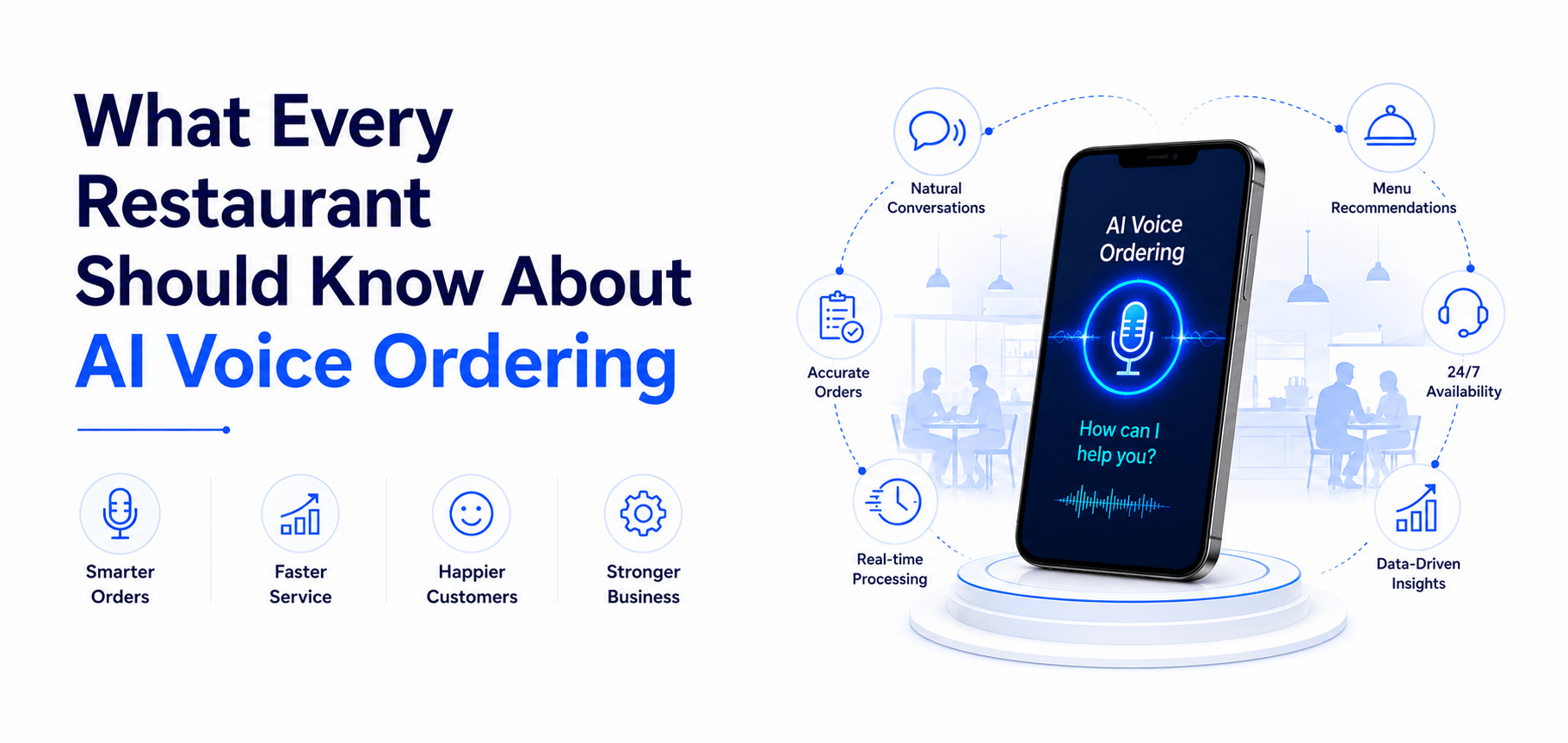
An AI voice ordering system for restaurants allows customers to order food by talking, using AI. No tapping menus. No typing. For example, a customer could say, I would like a large pepperoni pizza with additional cheese and the system listens to it and interprets it, and then enters it into the POS (point of sale) system of the restaurant. All these occur without a human being touching anything.
Also Read – Pharmacy Point of Sale Software Development
But how does it work?
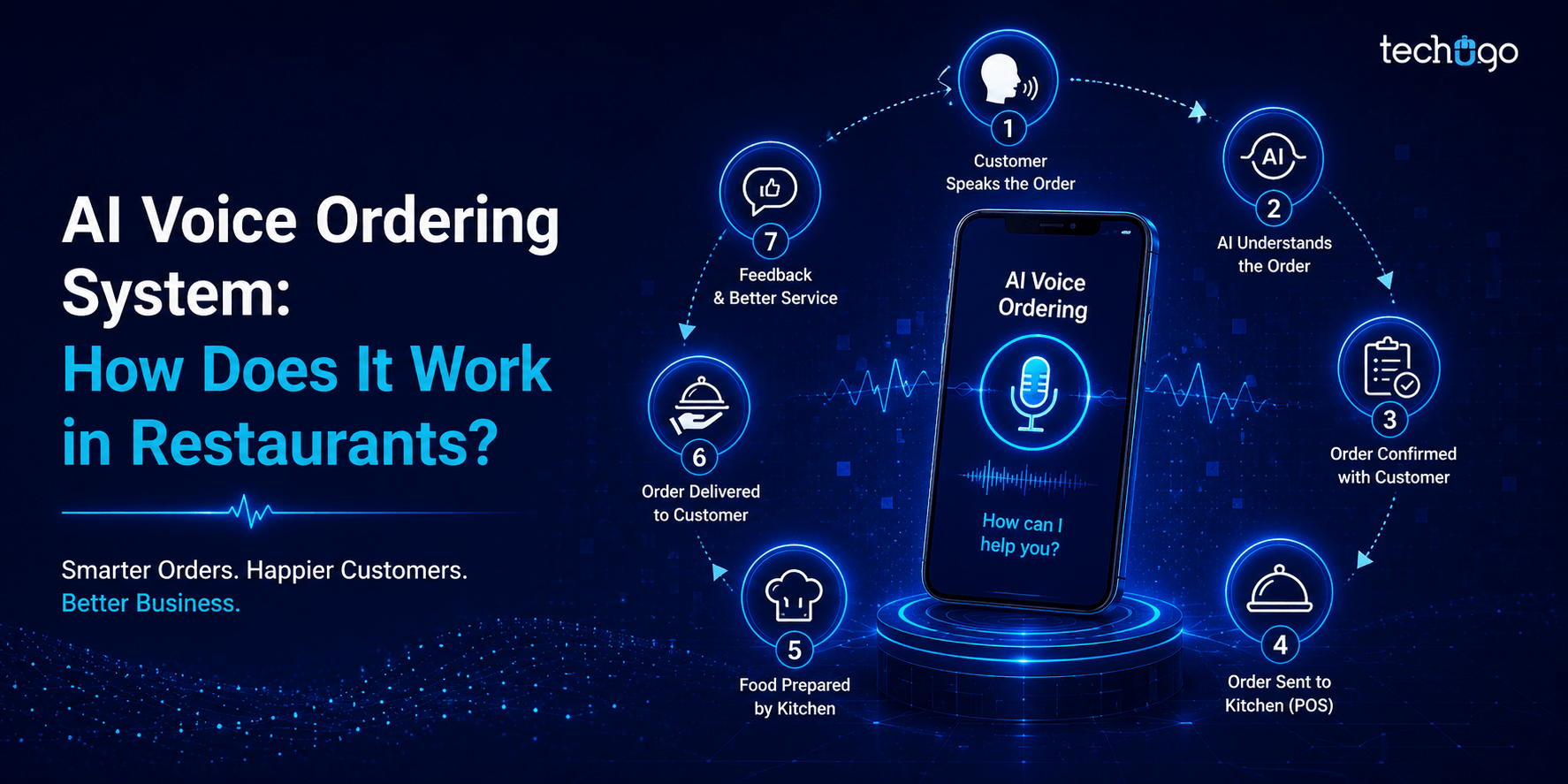
- Voice Capture: The system basically hears what you say, via phone application, smart speaker, kiosk, or drive-thru microphone.
- Speech Recognition: It converts your words into text with the help of AI.
- Command Understanding: The AI determines precisely what you desire.
- Action & Feedback: The order is placed, the system accepts your decisions, and it is added to the workflow of the restaurant.
When individuals refer to a restaurant voice assistant, they are referring to such a smart solution, which is directly linked to the ordering backend. You do not have to press buttons; you simply talk.
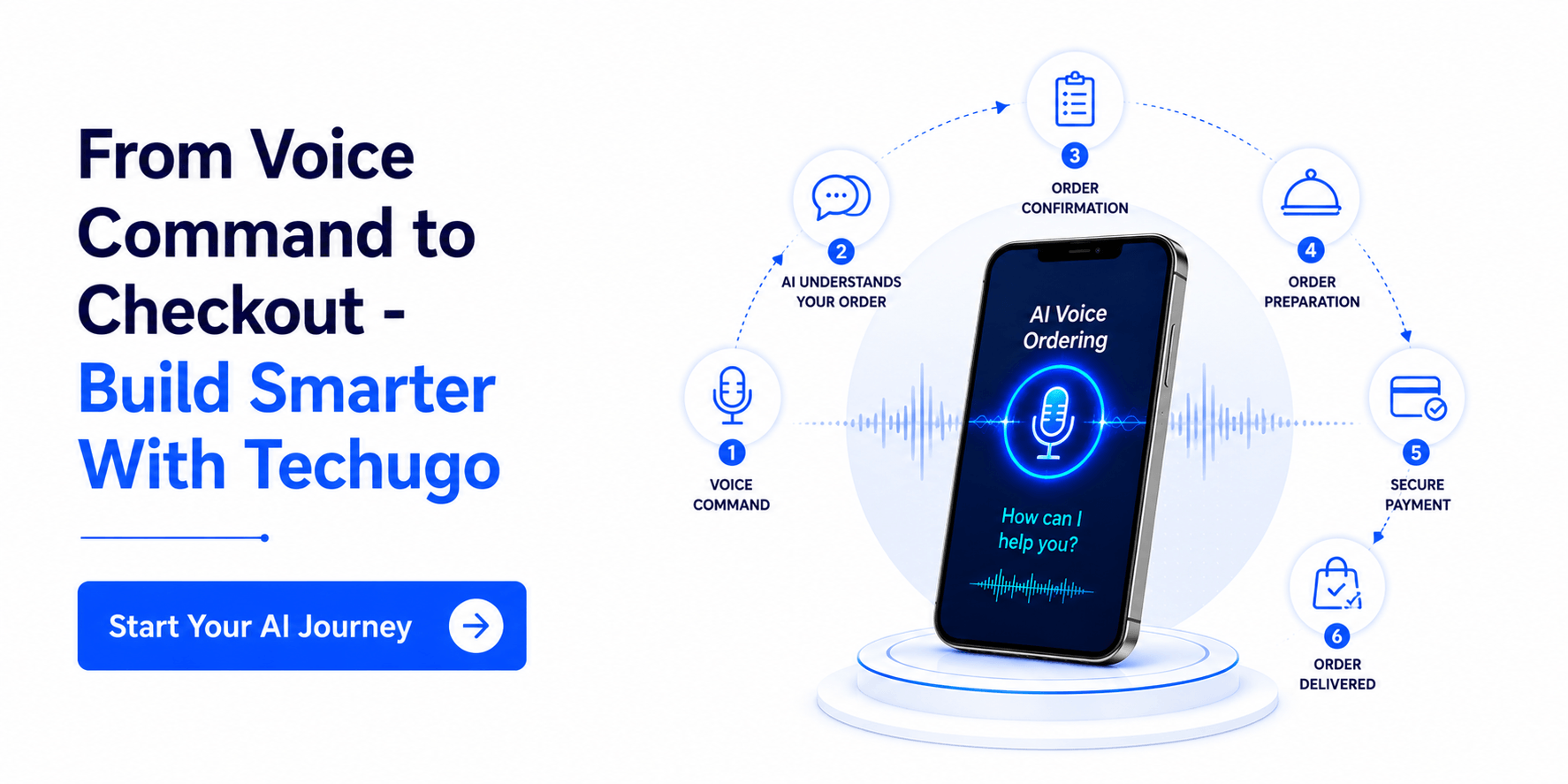
A lot of the current systems are also linked to payment gateways. It means that you are able to place, customize, confirm, and even pay for your order (all through talking).
Key Use Cases of AI Voice Ordering in Restaurants
Now let’s move from “what it is” to “where it is actually used.”
Voice AI isn’t just a gimmick. It is already being applied in actual restaurant situations to minimize friction and accelerate service, and enhance customer experience. The following are a few good voice AI examples in food delivery and the restaurant business:
1. Drive‑Thru Ordering
Tired of long waits? Well, Drive‑thru lines have traditionally been controlled by human attendants who manually input orders. By the use of AI voice ordering, customers just need to speak their order, and the system automatically understands it. This is capable of decreasing wait times, minimizing human error, and releasing staff to concentrate on fulfillment.
Example: A customer says, “Two burgers, fries, and a Coke,” and the AI quickly parses the items and sends the order directly into the kitchen.
2. In‑App Voice Ordering
No more menu hunting. Voice commands can be used by customers when making their orders within restaurant mobile applications instead of scrolling through menus on tiny screens. This will facilitate easier and quicker ordering, particularly among the visually impaired or the aged.
Example: “Reorder my usual from Joe’s Pizza”, and the app will know what you are talking about.
3. Smart Speaker Integration
Think of placing an order for dinner at your kitchen counter without the need to operate your phone: “Order a chicken wrap and salad at Main Street Café. That is voice AI combined with intelligent speakers, which is on the rise in urban markets.
Example: Restaurants such as Domino’s allow customers to place an order for pizza using smart speakers without using a screen.
4. Customization and Upselling
Voice AI is not only taking orders, but it can also suggest upgrades. When a customer orders a burger, the system may suggest such things as, Would you like fries or a drink with that? It is at that point when an AI voice system begins to behave more like a human assistant.
Example: McDonalds is applying AI to suggest combos or upgrades, which makes the experience seem more like communicating with a human helper.
5. Multilingual Ordering
Language may be a hindrance in different cities. AI voice systems are capable of supporting more than one language, thus customers can place their order in a language that they feel comfortable with.
Example: Restaurants in New York have systems that are aware of English, Spanish, Mandarin, and others, so that everyone can easily order.
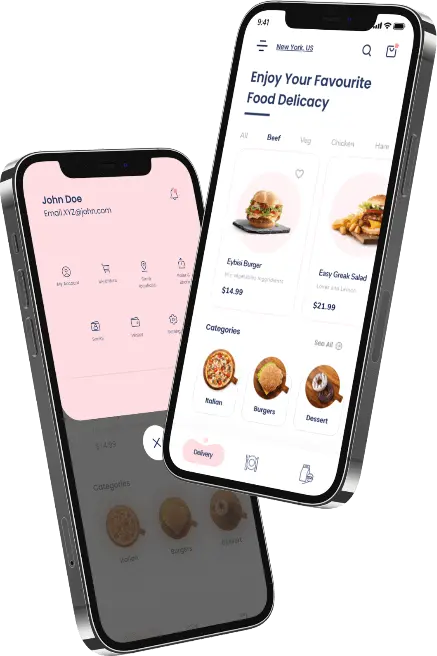
To bring these use cases to life, restaurants often partner with a food delivery app development company. Such companies can create custom apps tailored to your menu, ordering workflows, and customer preferences, integrating AI voice features, real-time tracking, and seamless payment options.
The Big Benefits of AI Voice Ordering in Restaurants You Can’t Miss
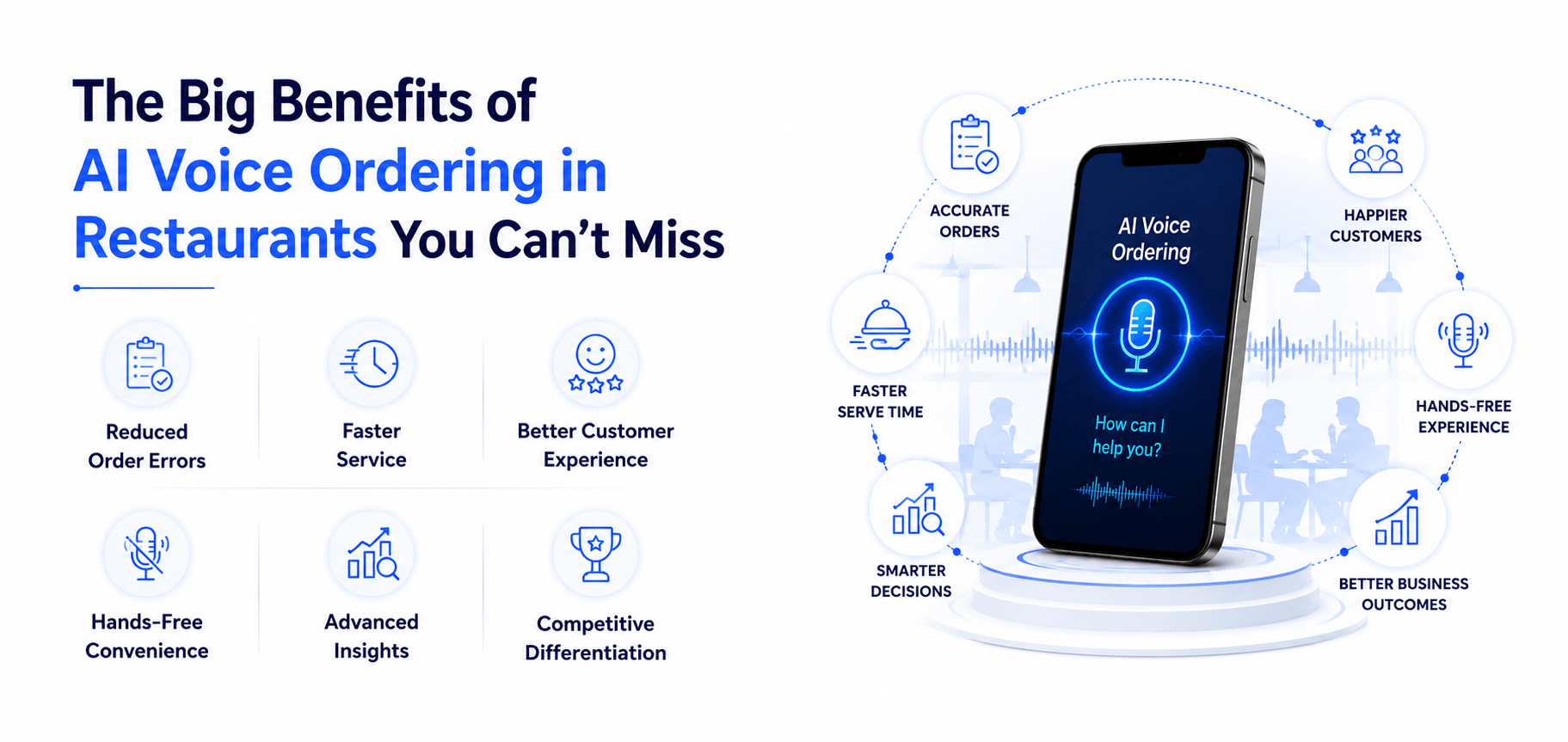
To be frank, innovation in itself is not helpful. The question is: What does it mean to your business?
The voice ordering of AI has some obvious, practical advantages to restaurants and delivery systems:
Reduced Order Errors
The conventional ordering with the drive-through or over-the-phone order is likely to be inaccurate. Missquoted, wrong modifiers, and customizations all result in dissatisfied customers.
In the case of AI voice systems, verbal instructions are recorded directly, eliminating translation errors that occur between the customer and the employee.
Faster Service
The AI system does not get tired, does not require explanation, and can hear several customers in a short time. This translates to reduced waiting time and throughput, whether in a drive-thru or in-app voice order.
Better Customer Experience
Customers love convenience. It is quicker and easier to say Order my lunch as opposed to tapping through menus when one is on the go. This ease of access (along with personalization) creates loyalty.
Hands‑Free Convenience
Voice ordering is hands-free in nature. An enormous advantage in the case of customers who are able to multitask or move about. It modernizes and makes your ordering experience available.
Advanced Insights
AI is not only assisting in taking orders but also gathering information. Restaurants are able to study patterns of voice commands to identify which items are frequently ordered in combination, what people request most frequently, and how ordering trends evolve.
Competitive Differentiation
Voice AI, however, is not a universal use in all restaurants. This will make you stand out among other companies, particularly in markets where consumers are tech-savvy and seek new experiences.
Stack these benefits together, and voice AI helps restaurants run more smoothly, make customers happy, and grow revenue.
Step-by-Step: How Restaurants Can Implement AI Voice Ordering
If you are convinced this technology has value (and by now you should be), the next step is practical: how do you implement it?
Here’s a simple, clear breakdown of the implementation process:
Step 1: Introduce Your Platform
The initial consideration is the location of your AI voice ordering system for restaurants. Will it be used by your mobile application or smart speakers such as Alexa or Google Home, in-store kiosks, or drive-throughs? It is based on the point of contact of your customers with your brand.
A cafe may open up to integrating apps for regulars, and a fast-food chain may consider more drive-thru or kiosks to increase the busy time. It becomes easier to pick the appropriate platform and then go through the rest of the process.
Step 2: Select the Appropriate Partner
The second step is to locate a trustworthy mobile app development firm familiar with restaurants and AI voice technology.
The right partner will assist in the integration of the AI voice system into your POS, link it safely to payment systems, and make the orders flow smoothly. Having seasoned developers not only hastens the implementation but also avoids typical errors, which saves time and money. Technology partners, who are familiar with restaurant app development and voice systems, will be able to help you in every step, and the process will become much less intimidating compared to working alone.
Step 3: Build and Integrate
Now you need to put your plan into operation. This is where your vision becomes something of a working system. The developers install voice recognition, train AI to comprehend natural language, and create the order-processing logic.
Feedback loops are added to allow the AI to verify orders, pose clarifying questions where necessary, and fit into the workflow of your restaurant. The idea is to have a system that is easy to use among customers and staff members, and thus, voice order is smooth, natural, and time and again
Step 4: Test With Real Users
Do not go live without testing the system using real users. Begin with your employees and a few customers. Look for misinterpreted orders, unclear responses, or slow confirmations.
This phase is concerned with perfecting the experience, ensuring that it is comfortable and smooth. The response you will get here will assist you in making adjustments to the system so that when it goes live, customers will be able to go through the ordering process hassle-free.
Step 5: Train Staff and Promote
Last but not least, prepare your team and inform your customers about the new system. The personnel should know where the orders arrive, how to deal with mistakes, and how the AI will assist them in their daily tasks. Once the team is confident, it’s time to promote the feature to your customers.
Emphasize the ease, speed, and precision with which one can order. When done right, this step ensures your AI voice ordering for restaurants not only works well but also gets used and loved.
What the Future Holds for Voice AI in Food Delivery
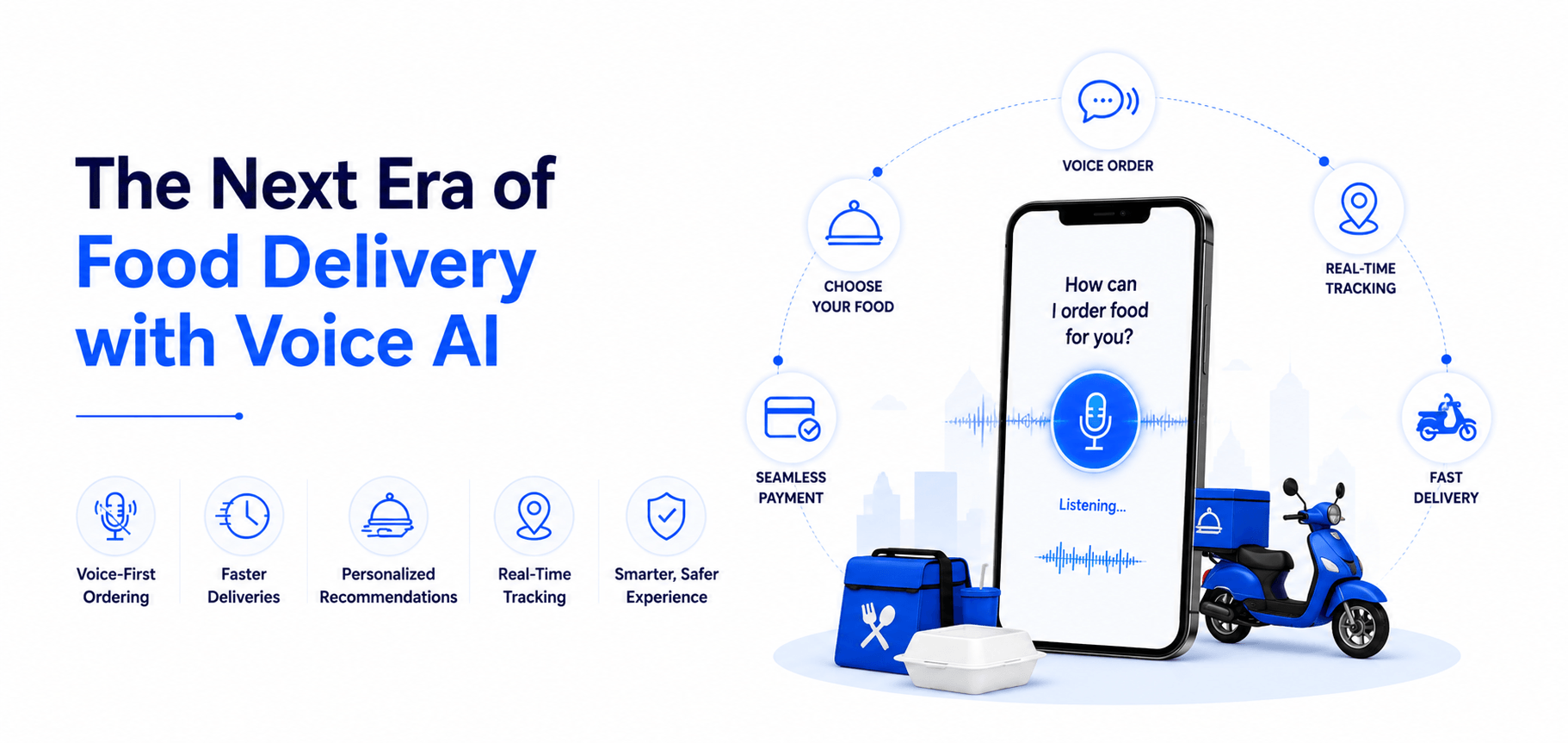
Voice AI is not just halting with basic ordering. This is where we are going:
Predictive voice ordering: Future systems could automatically recommend choices, depending on customer habits. “Hey, would you like your usual combo again?” That kind of thing.
Authentic multichannel ordering: Your restaurant application, website, kiosks, drive-thru, and smart speaker applications will feel connected. When a customer orders dinner, whether it is via his phone or by his smart speaker at home, he receives the same easy experience.
IoT and Wearables: Voice ordering on smart watches, fridges, connected cars, and others will introduce voice AI to a more normal context.
Combined voice and visual hybrids: Voice AI will not be used by all, but the interactive and entertaining process of placing an order may be offered by voice AI integration with AR, or even visual interfaces.
Such innovations transform voice AI examples in food delivery to real conveniences that the customers like.
Techugo’s Approach to Smarter, Faster Food Delivery Solutions
Have a food business idea in mind, but don’t know where to start? Techugo can help.
Techugo is a leading mobile app development company with extensive expertise in creating food delivery and restaurant apps. We build solutions that simplify ordering, improve operational efficiency, and deliver a seamless experience across mobile, web, and smart devices.
We offer easy-to-use user interfaces, live order tracking, secure payment integrations, loyalty programs, and administration dashboards that enable restaurants to efficiently administer their orders, menus, and delivery partners. With such features mixed with AI-inspired recommendations and multichannel integration, we ensure that both customers and businesses benefit.
A prime example of our work is the Milkbun app. Techugo developed this platform to support both delivery and dine-in experiences. The project included planning, UX/UI design, development, and deployment. After launch, the app gained over 10,000 users and contributed to a 67% improvement in customer experience, supporting smoother operations and stronger engagement.
So, if you want ordering to feel effortless for your customers, we’ll create the app that does it. Partner with Techugo and make it happen.
FAQs
Q1: What is AI-based voice ordering in food delivery?
A: Voice ordering AIs enable customers to order products with voice commands via applications, smart speakers, etc. The AI understands the verbal commands, recommends menu options according to taste, and automatically finishes the transaction, enabling a hands-free, smooth ordering process.
Q2: How does AI voice ordering benefit restaurants?
A: Voice AI helps to minimize errors in orders, accelerate processing, and enhance efficiency. It is able to process multiple orders at once, offer customized suggestions, and allow employees to concentrate on the physical service. This results in increased customer satisfaction and repeat business.
Q3: Is it possible to combine AI voice systems with current restaurant work?
A: Yes. The voice AI of the present is able to interoperate with POS systems, kitchen displays, loyalty programs, and delivery systems. This makes the orders run easily between customer input, preparation, and delivery without errors and enhances the workflow.
Q4: Does AI voice ordering work for all types of restaurants?
A: Absolutely. Voice AI has the potential to fit all types of menus and ordering systems, whether it is a quick-service restaurant or a fine dining establishment. It can be especially helpful in busy restaurants, high-volume delivery, and chains that are interested in providing a consistent, tech-driven customer experience.
Q5: What is the future of voice AI in food delivery?
A: Future consists of predictive ordering, wearables, and IoT device integration, multichannel experiences, and hybrid voice-visual interfaces. Voice AI will be a daily convenience, which will help restaurants remain competitive and adjust to the changing customer demands.

Get in touch
We'd love to hear from you.