


 SA
SA
 KW
KW
 IE
IE AU
AU UAE
UAE UK
UK USA
USA
 CA
CA DE
DE
 QA
QA ZA
ZA
 BH
BH NL
NL
 MU
MU FR
FR




















📌 Key Takeaways
- Cloud data warehouse consulting costs for enterprise-level projects range from $40,000 to $100,000+.
- A well-designed cloud warehouse provides better scalability, security, governance, and long-term cost control.
- Consultants align the data warehouse strategy with business goals, analytics needs, security, and scalability.
- A structured consulting approach can enable faster implementation and better technology decisions.
- Data migration, transformation, validation, security, testing, and deployment are critical implementation stages.
Connected to the digital world, this has generated a lot of data from the user’s end. But having access to a lot of data is not the same as being able to use it effectively.
This is where a cloud data warehouse comes in.
Cloud data warehouses give businesses a centralised environment to store, process, analyse, and manage large volumes of data without maintaining expensive on-premises infrastructure. However, moving to a cloud data warehouse involves more than simply choosing a platform and migrating data. Therefore, to fit this into an architecture, your business needs cloud data warehouse consulting.
So, in this guide, we will explain what cloud data warehouse consulting involves, what service consultants typically provide, the benefits you can expect, how implementation works, how much it can cost, and much more. But first, let’s understand cloud data warehouse consulting.
What Is Cloud Data Warehouse Consulting?
A professional service that helps businesses design, plan, implement, migrate, optimise, and manage cloud-based data warehouse environments is what cloud data warehouse consulting is all about.
Instead of taking cloud migration as a technology upgrade, consultants look at the bigger picture: your business goals, existing data infrastructure workloads, security needs, analytics requirements, and future scalability.
Cloud data warehouse consulting firms can help you answer questions such as:
- Which cloud data warehouse platform fits the requirements?
- Should hybrid cloud migration be done at once or over time?
- How should data warehouse architecture be designed?
- What security and compliance controls do we need?
- How can we reduce cloud infrastructure costs?
- How can we improve query performance?
Need A Scalable Cloud Data Warehouse Strategy?
Get expert guidance to design a secure, scalable, and business-focused data warehouse aligned with your long-term goals.
What Does Cloud Data Warehouse Consulting Services Cover?
From creating the initial plan to continuous improvement, cloud data warehouse consulting services can cover all aspects. A list of them includes:
1. Cloud Data Warehouse Strategy
To begin with, it is important to know what is to be accomplished.
The consultants analyze the existing architecture, the data sources, the analytical needs and the number of users, their workload, legal compliance issues, and future development plans. The plan can cover the following aspects:
- Data architecture
- Platform to choose
- Migration method
- Integration of data
- Concept of data security
- System of governance
2. Cloud Data Warehouse Architecture
The architecture of the system has a say in the way that data will move, be stored, processed, secured, and accessed. When preparing for architecture, consultants will take into account the following considerations:
- Structured and unstructured
- Batch and real-time processing
- Data lakes and data warehouses
- ETL and ELT pipelines
- Business intelligence
3. Data Warehouse Migration
If your company is already utilizing an existing database or local warehouse, then migration needs to be given serious thought. A team of experts can assist you with:
- Infrastructure assessment
- Inventorying the data
- Making dependency analysis
- Designing the next-gen architecture
- Giving suggestions on the next steps of migration
- Transforming the data
4. Data Integration
Certainly, most companies have their data not located under one roof. You might have the data available in multiple places such as:
- CRM applications
- ERP systems
- Apps available for mobile devices
- Websites
- Payment processing systems
5. ETL & ELT Development
Generally, data extraction, transformation, and loading are essential steps before conducting successful analyses. Consultants can assist in determining whether your processes are better suited to traditional ETL or modern AI development services.
The implementation may also involve:
- Data extraction
- Transformation
- Data cleansing
- Data validation
- Data loading
- Big data analytics
6. Data Warehouse Optimisation
Owning a cloud warehouse does not imply successful performance. As the amount of data and queries grows, a business may face the following issues:
- Slow queries
- Spending more on cloud services
- Poor dashboards
- Unnecessary duplication of data
- Ineffective processes
What Are The Key Benefits of Cloud Data Warehouse Consulting?
When the focus is on a cloud data warehouse, you can expect significant value. But it is dependent on how it is designed and implemented in the first place. Thus, working alongside a cloud data warehouse consultant can get you access to several advantages, which include:
1. Quicker Implementation: Developing from scratch requires architecture planning, migration experience, platform expertise, testing, and effective optimisation. However, the expert consulting team has processes and technical knowledge of these.
2. Better Technology Decisions: You can create problems for yourself and the business when choosing one based on popularity only. Cloud data warehouse consultants will first evaluate your specific requirements before suggesting any architecture.
3. Reduced Migration Risks: There are multiple risks attached when it comes to data migration. This includes incomplete data, incompatible schemas, broken integrations, and more. Hence, a structured methodology is what helps identify these risks through cloud migration services.
4. Improved Data Quality: Processes for data validation, cleansing, transformation, and monitoring can be introduced by the consultants. So, the team will have more confidence in the reports and its generated analytics.
5. Better Scalability: Cloud data warehouses are designed to support changing workloads, but the architecture still needs to be designed properly. So, allowing your business to increase data volumes, user queries, and analytical workloads without the need to redesign the environment. Well, if you are also looking to transform your digital presence, then our digital transformation services can be helpful.
6. Strong Security & Governance: Cloud data warehouse consultants help in forming governance and security systems initially so they do not have to fix them after they are established. This is advantageous for companies managing sensitive and regulated information.
7. Lower Long-Term Costs: A well-designed cloud data warehouse does reduce unnecessary infrastructure usage, inefficient queries, duplicated systems, and expensive rework. So, it is better to use cloud consulting services to control costs.
What Are The Common Challenges In Cloud Data Warehouse Implementation?
Businesses often face challenges related to data migration, integration, security, performance, and financial management. Awareness of these difficulties from the start will start a business to have a successful implementation and stay away from such problems.
1. Complex Data Migration
Migrating information from legacy database systems, local storage locations, or a range of cloud platforms may be one of the most challenging tasks. Variations in schemas, formats, structures, and quality of data make the transfer difficult.
2. Integrating Multiple Data Sources
Various platforms may provide customer, financial, operational, marketing, and application data. So, it is important to plan the connections and create trustworthy ETL or ELT pipelines. Bad integrations can result in having data that is incomplete, duplicated, or inconsistent.
3. Data Quality Issues
Duplicate entries, lack of data, outdated details of some records, and mismatched formats can affect analytics and reporting. So, the process of data cleansing, validating, converting, and maintaining quality should be considered while implementing the solution.
4. Security & Data Governance
Businesses need to manage user access, encryption, authentication, monitoring, and data governance effectively and ideally. If done incorrectly, businesses may struggle with data ownership, compliance, and maintaining consistent data policies.
5. Choosing The Right Technology Stack
When having too many options like Snowflake, Amazon REDSHIFT, Google BigQuery, Microsoft Fabric, Azure Synapse, and beyond, making the right choice feels like a challenge.
6. Performance Optimisation
With an increase in data size and user query volume comes the issue of performance. Poor data modeling, ineffective queries, and incorrect compute settings can lead to slowed analytics and excessive usage of infrastructure.
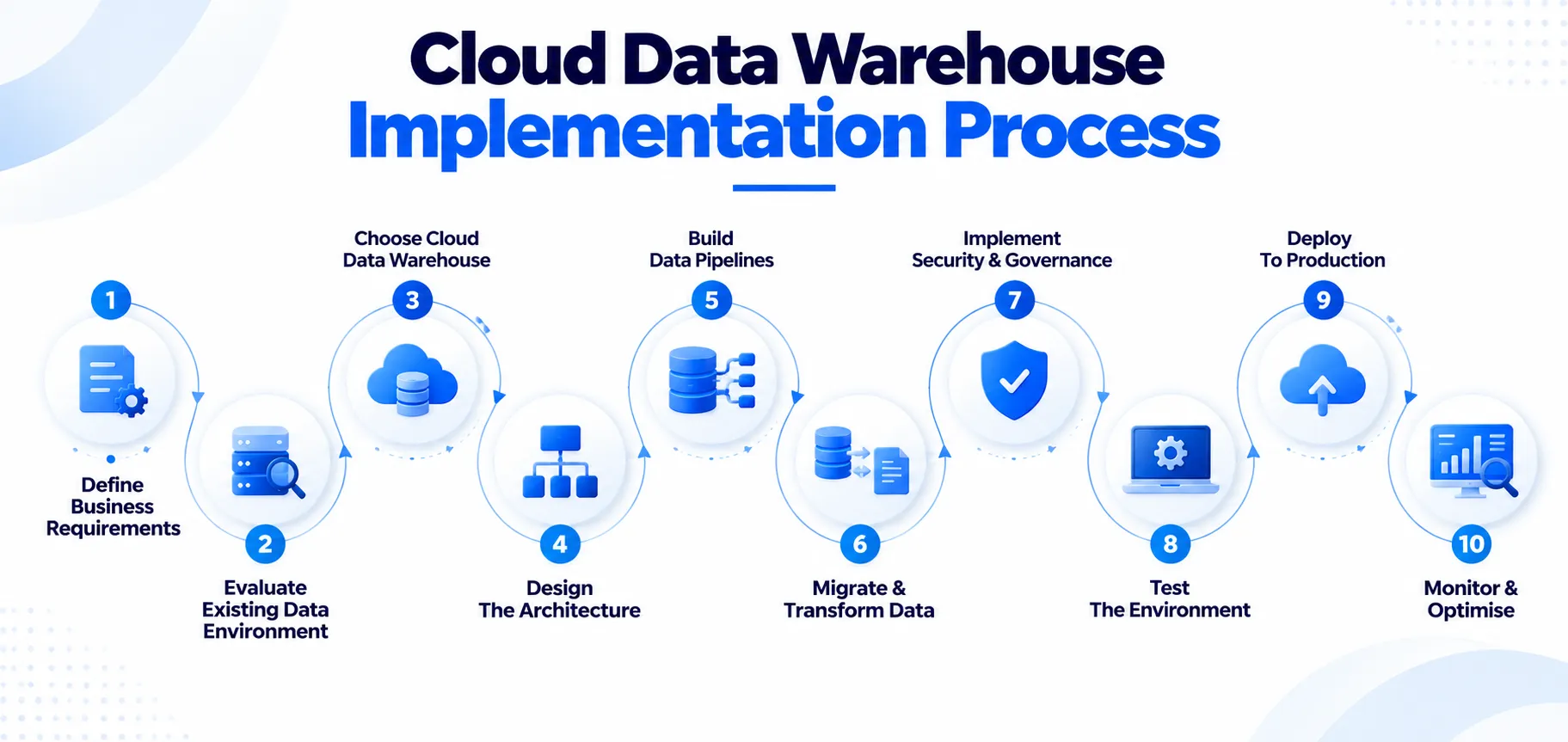
Cloud Data Warehouse Implementation Process (Detailed Breakdown)
For a successful implementation, cloud data experts follow a structured and detailed process. But the methodology depends on the project, following stages with a practical framework. Therefore, the stages look like this:
1. Define Business Requirements
Before you go into the depths of choosing technologies, identify what the business needs to achieve. For example:
- Quicker reporting
- Centralised customer report
- Real-time analytics
- Better business intelligence
- Reduced infrastructure maintenance
2. Evaluate Existing Data Environment
Next, the data warehouse consulting firms evaluate your current cloud foundation. Under this, the possible aspects are:
- Databases
- Data sources
- Existing data warehouses
- ETL pipeline
- BI tools
- Data formats
3. Choose Cloud Data Warehouse
Appropriate & reliable platforms and supporting technologies are the next step. When going with the best cloud data warehouse consulting services, the decision should consider:
- Workload requirements
- Data volume
- Query patterns
- Performance expectations
- Security Requirements
- Integration needs
4. Design The Architecture
After establishing the technology stack, the architecture is to be designed. This determines how data will be:
- Consumed
- Stored
- Transformed
- Modeled
- Secured
- Monitored
- Accessed
5. Build Data Pipelines
After all of this is done, the next stage is to link data sources to the warehouse. Batch or real-time pipelines can be chosen, depending on the use case. Data is extracted from source systems, transformed where it is required, and loaded into the environment with cloud transformation consulting.
6. Migrate & Transform Data
Now, the new environment is being introduced to the existing data through cloud transformation services. To give an idea of it, the migration process may involve:
- Schema conversion
- Data extraction
- Data transformation
- Data loading
- Data validation
- Reconciliation
- Performance testing
7. Implement Security & Governance
Before the deployment of products takes place, security must be implemented at all costs. This involves introducing regulations on access, encryption, authentication, permissions, monitoring, and the use of information management policy.
8. Test The Environment
When testing, it shouldn’t be limited to whether data appears in the warehouse. A cloud data warehousing consulting firm should test for:
- Data accuracy
- Data completeness
- Pipeline reliability
- Query performance
- Security
- Failure recovery
9. Deploy To Production
The cloud warehouse can be situated to production after successful testing is done. Deployment may involve a carefully planned transition to control disruption when it comes to migration projects.
10. Monitor & Optimise
Implementation is not the final process of the project. Once the warehouse is live, teams should continuously monitor:
- Query performance
- Data pipeline health
- Storage growth
- Computer usage
- Data quality
- Cloud spending
How Much Does Cloud Data Warehouse Consulting Cost?
Depending on business size, data volume, cloud platform, integration requirements, and the level of expertise, the cloud data warehouse consulting cost may differ. So, for your information, here is a quick breakdown:
| Consulting Scope | Estimated Cost | Typical Timeline |
| Initial Assessment & Strategy | $2,000 – $8,000 | 1 – 3 Weeks |
| Data Warehouse Architecture & Planning | $10,000 – $20,000 | 2 – 5 Weeks |
| Cloud-Based Warehouse Migration | $15,000 – $40,000+ | 4 – 12 Weeks |
| End-To-End Implementation Consulting | $30,000 – $60,000+ | 8 – 20+ Weeks |
| Enterprise-Level Consulting & Optimisation | $40,000 – $100,000+ | 2 – 4 Months |
| Ongoing Consulting & Support | $3,000 – $10,000+/month | Ongoing |
If you’re planning to modernize your data infrastructure or migrate to a cloud data warehouse, working with an experienced consulting partner, like Techugo can help you select the right architecture, minimize migration risks, and optimize long-term costs.
Want To Know About Cloud Data Warehouse Consulting?
Talk to Techugo’s cloud data experts to get a tailored approach and cost estimate for your project.
What Factors Affect Cloud Data Warehouse Consulting Costs?
Due to the fact that each company has its own data volume, infrastructure, integration needs, security preferences, and project objectives, consulting costs differ widely between projects. So, being able to identify the factors that contribute to cost can help you prepare your budget accurately and avoid any unexpected costs from appearing.
1. Project Scope & Complexity: The implementation of a simple cloud data warehouse with a limited number of data sources will require less consulting effort than the large-scale enterprise implementation that features numerous systems, complicated workflows, acronyms, and extensive governance needs.
2. Data Volume: A business working within a few terabytes of data may have relatively straightforward migration requirements, while organisations handling hundreds of terabytes or petabytes may need more extensive planning, migration tooling, testing, and optimisation.
3. Number of Data Sources: CRMs, ERPs, databases, SaaS platforms, APIs, mobile applications, and beyond are all systems from which businesses collect data. The more sources, the more work required for data integration, schema mapping, pipeline development, data transformation, validation, and ongoing synchronisation.
4. Cloud Data Warehouse Platform: The required qualifications and technologies depend on the platform being used, be it Snowflake, Amazon Redshift, Google BigQuery, Microsoft Fabric, Azure Synapse, or Databricks, etc. The experience, architecture, integration, and transfer techniques differ based on the platform, which ultimately impacts the cost.
5. Data Migration Requirements: Working on data extraction, schema conversion, transformation, cleansing, validation, testing, and production cutover are all things consultants need to handle. But if the existing environment has inconsistent or outdated data, additional effort may be required.
How Do You Choose The Right Cloud Data Warehouse Consulting Firm?
When you have the best partner, you can choose the best technologies, build a scalable architecture, migrate to the cloud, control cloud expenses, and improve data quality.
Yet, there is no shortage of consulting companies. So how can you choose the right one?
Here are some important points to consider.
1. Look For Relevant Cloud Data Warehouse Experience
Start by assessing the prior experience that the consultant has in cloud data warehousing. Look for their expertise in technologies such as Snowflake, Amazon Redshift, Google BigQuery, Microsoft Fabric, Azure Synapse, or Databricks, depending on your needs.
2. Evaluate Their Technical Expertise
Cloud data warehousing involves more than data storage. Your consulting partner should understand:
- Cloud Architecture
- Data Engineering
- ETL/ELT Pipelines
- Data Modeling
- Data Migration
- API & System Integration
- Data Security
- Data Governance
3. Check Their Approach To Data Migration
Ask the consultants how they handle data recovery, schema mapping, transformation, validation, testing, and production cutover. A structured migration approach can help reduce downtime and minimise data integrity issues.
4. Assess Their Security & Governance Capabilities
Your data warehouse may contain sensitive customer, financial, operational, or business information. Make sure the consulting firm understands your security and governance requirements. Ask about their approach to:
- Access Management
- Encryption
- Data Governance
- Audit Logging
- Data Privacy
- Compliance Requirements
5. Consider Looking At Scalability & Performance
Designing an architecture that accommodates rising data volumes, users, workload, and integrations is the job of a reliable consulting partner. They should also have a clear approach to query optimisation, resource management, workload monitoring, and performance tuning.
Cloud Data Warehouse Consulting vs In-House Implementation: Which One Is Best?
When you look at it, there isn’t a universal answer. Hence, the right approach depends on your organisation’s technical expertise, project complexity, budget, timeline, and long-term data strategy.
| Factor | Cloud-Based Warehouse Consulting | In-House Implementation |
| Initial Expertise | Access to specialised consultants | Requires existing internal expertise |
| Implementation Speed | Can accelerate complex projects | Depends on team availability |
| Internal Control | Shared or outsourced depending on engagement | High internal control |
| Hiring Requirements | Lower need for immediate specialist hiring | May require hiring or training |
| Knowledge Retention | Requires documentation and knowledge transfer | Knowledge stays within the company |
| Flexibility | Can scale specialist sources as needed | Limited by internal capacity |
| Long-Term Ownership | Can transition to internal teams | Fully owned internally |
| Complex Migrations | Access to specialised migration experience | Depends on internal capabilities |
| Ongoing Support | Can be included in engagement | Requires internal operational resources |
When cloud warehouse consulting can make sense:
- You don’t have specialised cloud engineering expertise
- You are migrating from a legacy warehouse
- You need to implement quickly
- You have a complex multi-source data environment
- Your internal team is already overloaded
- You need help selecting the right tech stack
When in-house implementation may make sense:
- You already have experienced data engineers and cloud architects
- Your architecture is relatively straightforward
- Your team has enough capacity for the project
- You want maximum control over implementation
- You plan to maintain and expand the platform internally
How Can Techugo Help As A Cloud Data Warehouse Consultant?
Techugo helps businesses build secure, scalable, and high-performing cloud data warehouses with end-to-end consulting covering strategy, architecture, migration, integration, optimisation, and support.
Ready to convert your data into a business advantage?
The Final Thought
The concept of cloud data warehouse consulting is far more complex than just choosing a cloud computing platform. The successful implementation of a project consists of various aspects such as strategy, architecture, data engineering, migration, security, governance, optimization, and management.
The right consulting method can allow companies to prevent the typical mistakes in implementation, speed up migration, improve the quality of data, and create an adaptable environment that will grow in line with changing business needs. The most important consideration is not simply where your data is stored. It’s whether your data warehouse gives your teams reliable, accessible, secure, and scalable data for better analytics and business operations.
FAQs
Q) Is cloud warehouse consulting suitable for business?
Yes, cloud data warehouses can be suitable for small businesses. This is because they let you start with the resources you need and scale as data volumes and analytics requirements grow.
Q) Can a cloud data warehouse handle real-time data?
Yes, cloud data warehouses do support real-time or near real-time analytics when they are designed with appropriate data ingestion and processing pipelines. The right approach depends on the business use case and data freshness requirements.
Q) Can a cloud data warehouse work with existing business systems?
Of course! Cloud data warehouses integrate with existing systems such as CRM platforms, ERP software, applications, websites, databases, and payment systems.
Q) How often should a cloud data warehouse be optimised?
A cloud data warehouse should be monitored continuously and optimized whenever performance, data volume, query patterns, workloads, or cloud spending changes.
Q) Can a cloud data warehouse be scaled as data grows?
Yes, a cloud data warehouse is designed to accommodate growing data volumes and workloads. However, scalability still depends on having an architecture that is properly designed to enhance users’ queries, integrations, and analytical requirements.

Get in touch
We'd love to hear from you.