

 SA
SA  KW
KW  IE
IE AU
AU UAE
UAE UK
UK USA
USA  CA
CA DE
DE  QA
QA ZA
ZA  BH
BH NL
NL  MU
MU FR
FR 














📌 Key Takeaways
- Custom CRM development costs range from $20,000 to $220,000.
- A good CRM boosts segmentation, retention, ROI, and reduces churn.
- Development follows 9 stages, from discovery to post-launch support.
- Skipping discovery or data planning often causes budget overruns.
- The best CRM depends on your size, stage, and budget
Running an ecommerce business today means managing customer data that lives everywhere at once. Your storefront, email platform, support desk, and ad accounts all pull in different directions. A generic CRM built for long B2B sales cycles rarely keeps up with the speed and volume of online retail. That’s where custom ecommerce CRM development comes in: a platform built specifically around unified customer profiles, automated marketing, and integrations tailored to your exact tech stack. In this guide, we will walk through why businesses need to invest in custom CRMs for ecommerce.
What Is Ecommerce CRM?
Ecommerce CRM brings the best of marketing, sales, and customer data into a single, aligned platform built to support digital retail. Unlike the generic CRMs that focus on a host of activities leading to a long B2B cycle, ecommerce CRMs are tailored for intense volumes and quick-turn customer journeys.
Some of its common aspects include:
- Unified Profiles
- Tailored Integrations
- Automated Marketing
Why Is CRM Important For Ecommerce Businesses?
Rather than being a “nice-to-have,” CRM has become one of the essential tools for ecommerce companies looking to grow in a sustainable manner, keep customers, and compete with the giants of the industry.
1. It Turns Scattered Customer Data Into One Clear Picture
Ecommerce companies obtain data from a variety of places: your store, email marketing platforms, payment processing systems, chat systems, and social media campaigns. If you don’t have a CRM, that information exists in separate systems, making it difficult to determine who your best customers are or what their needs actually are.
2. Improves Customer Retention
Generally speaking, acquiring new customers is much more expensive than retaining existing customers, but many e-commerce companies spend most of their resources on acquisition activities. So, it is better to identify at-risk customers before they churn and send timely win-back campaigns.
3. It Enables Personalization At Scale
The expectations of modern consumers revolve around personalized suggestions, corresponding offers, and personalized messaging, which takes into account consumers’ actual interests. A customer relationship management system enables this by dividing consumers into various groups on the basis of their behaviors, buying behavior, and demography.
Major Benefits of CRM For Ecommerce
When implementing customer relationship management in ecommerce, you will come across the reasons why you and your business need it. Therefore, some of the many major benefits include:
1. Better Customer Segmentation
Collecting and analyzing real-time consumer data like browsing behavior, purchase habits, and demographics is the perfect base for customer segmentation. Thus, the resultant engagement rates and conversion potential will be high, and your marketing campaign will be a success.
2. Improved Retention Rates
Thanks to the marketing campaign, your retention rates will significantly improve. This comes from sources like automated loyalty programs, purchase reminders, and personalized follow-ups. Just think: when you are sending messages and campaigns about products that the user actually wants, then the numbers will definitely go up, which raises retention. Retention can also be improved when consumers are conversing, which you can connect with AI chatbot development.
3. Higher ROI From Marketing
Rather than generalized messages, specific and targeted ones perform better and create accurate data. Therefore, the ad spend you do will be less, controlled, and aimed. On top of this, your ROI from marketing will improve. To further improve your ROI, generative AI integration services can be of real value.
4. Reduction In Churn
Churn rate is the single most effective factor that can make or break a business. So, tracking consumer behavior and understanding why they don’t want to continue to transact with your business gives you time to solve it proactively. Thus, businesses that don’t have ecommerce CRM platforms will perform poorly.
5. Seamless Upselling & Cross-Selling
Purchase history is a great indicator of what the consumer is actually into. Using this leads to intelligent product recommendations that the customer might be interested in buying. Hence, optimal upselling and cross-selling opportunities are present that have minimal acquisition cost.
Ecommerce CRM Software Development Cost Breakdown
When talking about ecommerce CRM software development costs, you know the conversation will go in depth. The cost is divided into tiers that are classified based on their complexity to develop. Thus, the list includes:
| Platform Complexity | Estimated Cost (USD) |
| Basic or MVP | $20,000 – $50,000 |
| Mid Tier Platform | $50,000 – $120,000 |
| Enterprise Level Platform | $120,000 – $220,000+ |
Important Features For Ecommerce CRM Solutions
Features are what can make or break your ecommerce CRM strategy. Adding them ensures that the user will find the application useful and may come back to your platform. So, the core features look like this:
1. Customer Profiles: Every consumer has a single source of truth thanks to a centralized database that records contact details, preferences, interaction history, and behavioral patterns across websites, apps, and marketing channels.
2. Purchase History Tracker: Complete order histories facilitate the identification of purchasing patterns, allowing for customized product suggestions, focused loyalty programs, and data-driven upselling tactics.
3. SMS & Email Automation: By scheduling welcome emails, transactional updates, and promotional campaigns, integrated automation. These include email and SMS integration tools that allow businesses to increase engagement while lowering manual labor. To ease your work in writing SMS and drafting emails, you can always ask for generative AI development.
4. Order Tracking: Post-purchase communication is improved with real-time order status updates, which also decrease support inquiries and improve customer satisfaction.
5. Segment-Based Marketing: Precision targeting and increased marketing ROI are guaranteed by customer segmentation based on demographics, frequency of purchases, or browsing habits.
6. Abandoned Cart Recovery: A CRM workflow’s automated reminders and incentive-based notifications help in the recovery of unfinished transactions and reduce revenue leakage.
Advanced Features of Ecommerce CRM Software
1. Unified Customer Profiles: Sophisticated customer relationship management systems aggregate information from a number of points, including website participation, purchase records, email and SMS communication, customer complaints, social engagement, and even in-store purchases for businesses operating through various media in order to get a cohesive real-time profile of a consumer.
2. AI-Powered Predictive Analytics: Today, methods employed in contemporary ecommerce CRMs rely more on machine learning in determining customer behavior rather than on simply reporting what happened before.
3. Advanced Segmentation & Dynamic Audiences: Basic CRMs have features by which you can sort customers using certain simple criteria such as location or number of orders made. An advanced version of CRM has the ability to create sophisticated and behavior-based segmentation and hence allows you to segment customers automatically.
4. Omnichannel Marketing Automation: Modern ecommerce CRMs are capable of going beyond just emails to create automation for everything from email, SMS, push notifications, WhatsApp, retargeting advertisements, and any other channel, relative to the behavior of consumers.
Ecommerce CRM Development Process (A Detailed Breakdown)
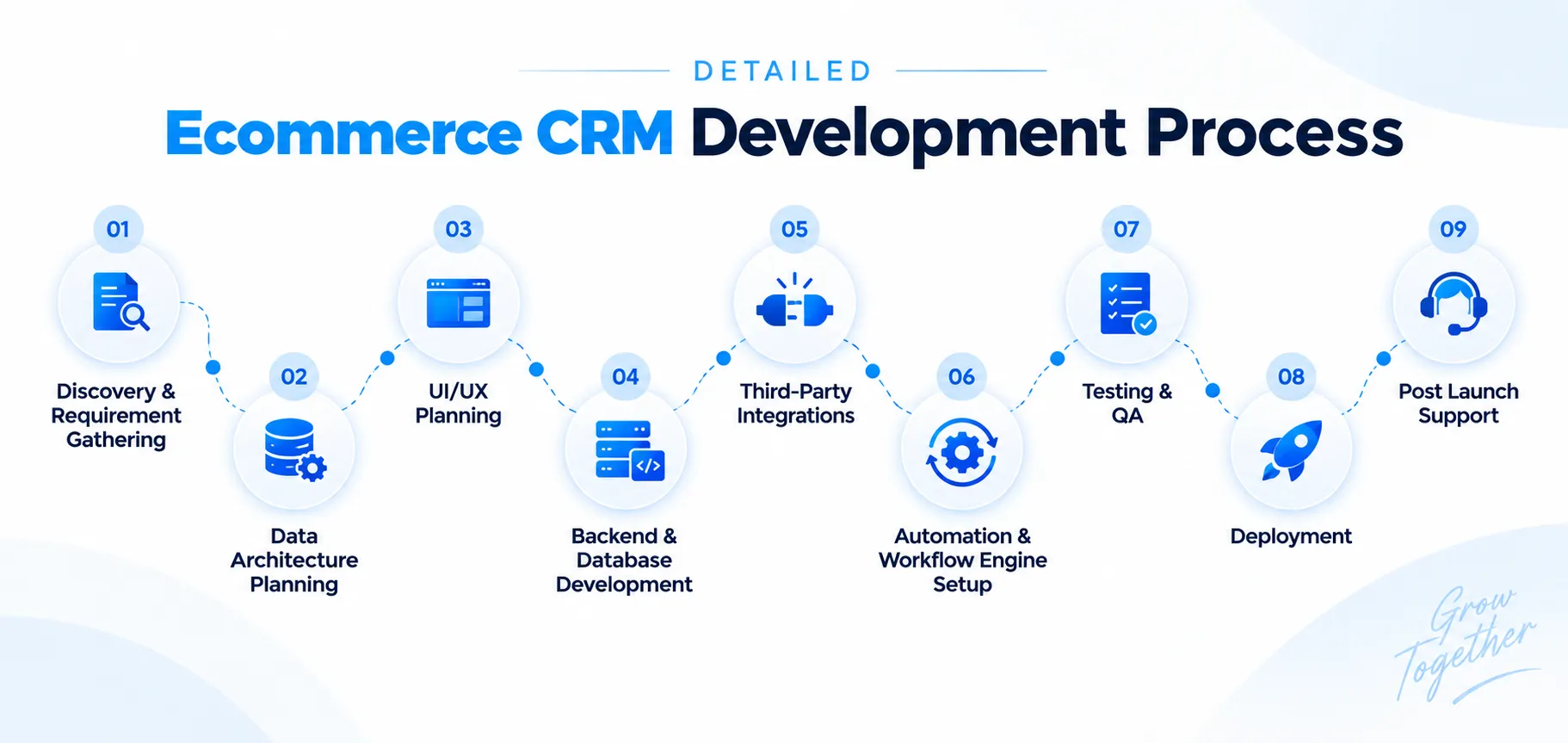
Building a custom ecommerce CRM isn’t a single project with one finish line; it’s a structured process that moves from understanding the business to shipping a system your team actually uses. So, take a look at what the development process typically looks like:
1. Discovery & Requirement Gathering
Before any code is written, the aim is to understand exactly how the business operates and where the gaps are.
1. Map existing workflows across marketing, sales, and customer support.
2. Identify every system that holds customer data today, like storefront, help desk, or email tool.
3. Document pain points with the current setup – manual data entry, disconnected profiles, missing automation.
2. Data Architecture Planning
With requirements in hand, the next step is designing how customer data will actually be structured and stored.
1. Define the core data model: what makes up a “customer” record, and what related entries connect to it.
2. Decide how data will be unified across sources.
3. Map out the integration points that will feed data into the CRM in real time.
3. UI/UX Planning
A CRM is only useful as it is usable by the people running it every day.
1. Prioritize speed and clarity over feature density; CRMs that try to show everything at once tend to go unused.
2. Plan for role-based views so each team only sees what’s relevant to them, which can further be enhanced via digital transformation services.
4. Backend & Database Development
Thanks to the ecommerce app development company, this is where the core system gets built. The logic that stores, processes, and serves customer data.
1. Build the API layer that will expose CRM data to the frontend and to other systems.
2. Implement the customer data model designed in the earlier planning stage.
3. Build in the audit trails and data validation needed to keep customer records accurate over time.
5. Third Party Integrations
An ecommerce CRM lives and dies by how well it connects to the rest of the stack.
1. Integrate payment gateways for transaction data.
2. Connect email/SMS providers to enable CRM-triggered messaging.
3. Integrate support tools so customer service history feeds into the same profile.
6. Automation & Workflow Engine Setup
This is where the CRM starts actively working on the business’s behalf rather than just storing data.
1. Build or configure a rules engine to define trigger-based actions.
2. Set up multi-step workflows for post-purchase sequences, win-back campaigns, and loyalty milestones.
3. Layer in predictive features if needed, such as churn scoring or product recommendations.
7. Testing & QA
Before the launch, the system needs to be stress-tested against real-world conditions, not just the happy path.
1. Validate data accuracy across every integration point via the software development company.
2. Load test the system against expected peak traffic (holiday sales, flash promotions)
3. Run user acceptance testing with the actual teams who will use the CRM day to day.
8. Deployment
A technically successful launch can still fail if the team isn’t ready to use the new system.
1. Roll out in stages where possible.
2. Migrate historical data carefully with validation checks to catch mapping errors.
3. Train marketing, sales, and support teams on the new workflows and dashboards.
9. Post-Launch Support
Development doesn’t stop at launch. A CRM should evolve alongside the business.
1. Monitor usage patterns to see which features are actually being adopted.
2. Collect feedback from the teams using it daily.
3. Refine automation rules based on real performance data.
Difference Between Custom v/s Off-The-Shelf CRM
The dilemma of choosing between a custom built v/s off-the-shelf ecommerce CRM is always a challenge for entrepreneurs. But when you look at each approach, they have distinct advantages depending on company size, industry complexity, budget, and long-term goals.
| Factor | Custom CRM | Off-The-Shelf CRM |
| Initial Cost | High upfront investment | Low upfront cost (typically subscription-based) |
| Time To Deploy | Longer – weeks to months of development | Fast – can be up within days |
| Customization | Fully tailored to specific business processes and workflows | Limited to built-in configuration options and available integrations |
| Scalability | Scales exactly as needed but each change requires development | Scales easily but within the vendor’s feature and pricing tiers |
| Ongoing Maintenance | Requires an in-house team or dedicated vendor for updates and fixes | Maintenance handled by the vendor; automatic updates |
| Integration w/ Existing Systems | Can be built to integrate deeply with any legacy or niche system | Depends on pre-built connectors/APIs; may not support niche tools |
| Ownership of Data & Code | Full ownership of source code and data architecture | Data stored on vendor’s platform; code is not owned by the business |
| Feature Set | Only includes what’s built and no unnecessary bloat | Comes with broad generalized features, some of which may go unused |
| User Interface | Designed around actual user workflows | Standardized UI, sometimes requiring workflow automation |
| Support | Dependent on internal team or contracted developers | Vendor-provided support, often with SLAs |
Best CRM Tools For Ecommerce
In today’s market, there are multiple applications of CRM in the B2C and B2B space that are certainly going to grow your business. When you look at it, the choice depends on your size, growth stage, and budget. Therefore, so you don’t make mistakes by choosing the wrong one, the list looks somewhat like this:
| CRM | Best For |
| Microsoft Dynamics 365 Sales | Mid-market to enterprise retailers using Microsoft tools |
| Odoo | ERP and CRM are required by medium-sized to large omnichannel retailers |
| SAP Sales Cloud | International businesses with intricate B2B/B2C operations |
| Salesforce Commerce Cloud | Enterprises with complex customer journeys and also need cloud transformation |
| Zoho CRM | Good for small and midsize businesses that are budget-conscious |
| HubSpot CRM | Expanding B2B and B2C ecommerce companies looking to scale |
| Klaviyo | D2C & B2C ecommerce brands looking to do marketing automation |
| Omnisend | Great for mid-sized ecommerce brands, focusing on fast-to-launch automated campaigns |
How To Choose The Right Ecommerce CRM?
There are several CRM platforms available in the market for ecommerce brands, which can confuse you when choosing the right fit. If you happen to choose wrong, you will surely end up spending money on unnecessary features and, moreover, miss out on some important functionalities which you really need. Choose the right one, and it will become your go-to for managing customer relationships. So, here are some of the pointers you can look at before choosing one:
1. Start With Your Business Model & Scale
Not every customer relationship management system is suited for each kind of ecommerce store. Before comparing different platforms, assess the following factors:
1. Order Volume: A system designed for a store processing 500 orders monthly might struggle to support a store with 50,000 orders monthly.
2. Business Model: Customer relationship management is essential in every business model; thus, the respective needs vary across DTC, subscription, marketplace, and B2B.
3. Team Size: Solo founders, for example, prefer straightforward alternatives as opposed to larger teams, which require collaboration tools and access management.
4. Growth Trajectory: Select a solution that can accommodate the company in the future and not only at the moment of selection.
2. Prioritize Native Ecommerce Platform Integration
It’s important for the CRM to make a profound connection with your ecommerce platform (Shopify, WooCommerce, BigCommerce, Magento, etc.), not merely replicate some data. Keep an eye out for the following features:
1. Real-time synchronization of orders and inventory
2. The level of support for your pricing scheme (subscriptions and bundles, or wholesale pricing)
3. Two-way synchronization of actions taken in the CRM to the store
4. Integration with the current technology stack (email platform, support service, loyalty program)
3. Assess Segmentation & Personalization Capabilities
Since personalization is one of the primary advantages of ecommerce CRM, investigate whether the segmentation features really work well. For that purpose, ask the following questions:
1. Is it possible to create segments based on the customers’ behavior and not only on static characteristics?
2. Do segments change automatically in real time?
3. Is it easy for a marketer who does not have technical skills to create a new segment on his/her own?
4. Is it possible to use segments to start personalized marketing campaigns?
4. Evaluate Automation & Workflow Flexibility
Look past the ready-made templates and consider the actual extent of the automation engine’s customization options.
1. Is it possible to create multi-step and multi-channel journeys (meaning a combination of email, SMS, and push notifications)?
2. Does it have the ability to implement conditional logic (using if/then statements based on how the customer behaves)?
3. Is it possible to build workflows for internal processes, such as marking orders that might be too risky or letting sales representatives know when the VIPs are acting?
4. Just how easy is it to test and create new versions of automated processes?
Challenges In Adopting Customer Relationship Management In Ecommerce
Doing CRM ecommerce integration might not be as simple as it seems. Similar to other aspects of business operations, there are some challenges that can make life a bit difficult. But knowing them before you commit is a major advantage. So, take a look at some of them:
1. Lack of A Single Customer View
Collecting data from various silos is the job of an ecommerce CRM. As the data is located separately, it becomes a nightmare for businesses to unify and work upon them. Your platform will not reap the fruits of customer behavior or even halt unnecessary marketing emails.
2. Maintaining Quality Data
Major work on CRMs is done through data and data alone. But if the data turns out to be outdated, inaccurate, or duplicate, then it could ruin personalization and automated campaigns. Working on them only leads to faulty analytics and a severe waste in ad spend, which negatively affects ecommerce CRM consulting.
3. Balancing Automation & Personalization
Do you know when your business can reap the benefits of CRM for ecommerce? When the user gets personalized emails and notifications, they can engage more. But when you scale using automation and AI, you lose the human touch, making interactions more robotic. To know more about this, you can always go for software development consulting.
4. Expectations From Multi-Channel Support
Customers are quickly switching between social media, live chat, email, and phone calls. Therefore, integrating all of these elements in your CRM and allowing room for historical texts can open the room for repeat customers. But this is a technical burden for which you can always rely on SaaS development services.
5. User Resistance & Training
Employees are not comfortable, especially if it has to do with a lot of data entry or lacks any clear design. Therefore, without any ongoing training, staff will find ways to bypass the CRM, and hence your business will have fewer and less accurate records.
Ecommerce CRM Data Security And Compliance
In contrast to some B2B systems, unlike many B2B tools, CRMs for online transactions have the capability of collecting huge amounts of personal details about consumers, as well as data on payments made by clients and how often purchases have been made by them.
1. Encryption In Transit & At Rest
When it comes to customer data security, encryption should apply both during transmission, e.g., between the shop and the CRM, and at the storage level, i.e., the store database. Make sure your CRM solution utilizes adequate encryption protocols and does not keep sensitive information such as payment data in readable form.
2. Role-Based Access Control (RBAC)
It’s not necessary that every member of the organization should have access to all customer details. With the new user-friendly versions of CRM, permission management has become easier. For instance, the marketing staff can access engagement information while not having access to financial information.
3. Two-Factor Authentication & SSO
Account-level security is equally vital as data-level security. Opt for CRM systems that provide two-factor authentication and single sign-on features to minimize the risk of unauthorized access to customer information.
4. Regulatory Security Certifications
Search for CRMs that uphold recognized certifications and requirements, such as:
1. SOC 2 Type II – Confirms security, availability, and confidentiality measures.
2. ISO 27001 – Global benchmark for information security management.
3. PCI DSS Compliance – Obligation if the CRM deals with any payment card information.
Future Trends In Ecommerce CRM Development
With an increase in customer expectations and the evolution of technology, the next generation of ecommerce CRMs is going to vary significantly from what companies are using today. The factors shaping the course of ecommerce CRMs are given below:
1. AI-Driven Hyperpersonalization
While personalization has been around in CRM for quite some time, an entirely new level of personalization has emerged due to the use of AI in businesses. Here is a preview of what is possible in the very near future:
1. Dynamic product recommendations that change depending on the customers’ current browsing behavior.
2. AI-created personalized email and SMS messages tailored to the needs of customers based on their purchasing patterns and tone of voice.
3. Next-best-action recommendations for marketing and sales teams based on the predictive analysis of future behavior.
4. Personalization of offers and prices according to individual sensitivity of customers and their tendencies toward buying
2. Conversational & Generative AI Integration
Generative AI is steadily advancing into the core processes of CRM. Future ecommerce CRMs are expected to aim, for example:
1. AI assistants that respond to team inquiries such as “which customers might stop doing business this month?” using plain language.
2. Campaign copy, customer answers, and reports automatically generated using information from a CRM.
3. Conversational interfaces that allow customers to make changes to preferences, orders, or requests.
4. AI-assisted summaries of customer history for support agents.
3. Predictive & Prescriptive Analytics Becoming Standard
Advanced CRM solutions currently offer predictive analytics such as churn scores, but prescriptive analytics, or the capability to predict outcomes and suggest precise actions to take, is the next trend in CRMs. Expect CRMs to incorporate:
1. Automatically recommending the right channel, message, and time of contact for every customer.
2. Alerts for necessary inventory and price changes based on predicted demand variations.
3. Identifying the customer segments that will respond positively to the future campaign.
4. Deeper Omnichannel & Unified Commerce Support
As the distinction between online shopping and offline shopping gets hazy, CRMs are becoming better and better at providing real unified commerce — where all channels become part of the same relationship with the customers. Future developments are likely to be oriented towards:
1. Real-time synchronization between e-commerce, marketplaces, social commerce, and traditional retail.
2. Unified loyalty programs, so customers will receive the same experience whether they are shopping online or at the store.
3. Consistent approach to personalization across all the channels to make sure that customers feel that their experience with the brand has continuity no matter where they interact with the brand.
Tech Stack Used For Ecommerce CRM Development
Running an online store means juggling customer data scattered across your storefront, email platform, support desk, and ad accounts. A good CRM tool pulls all of that into one place, so you can see a customer’s full purchase history, send the right message at the right time, and turn one-time buyers into repeat customers. So, here’s a breakdown of the best of the tech stack used:
| Layer | Technologies Used |
| Frontend | React, Next.js, Vue.js |
| Backend & API | Node.js, Java Spring Boot, Python |
| Database | PostgreSQL, MySQL, MongoDB |
| Customer Data & Identity | Segment, Apache Kafka, AWS Kinesis |
| Integrations | Shopify, Magento, BigCommerce, WooCommerce |
| Automation & Workflow | Temporal, Apache Airflow |
| Analytics & Reporting | Snowflake, BigQuery, Redshift |
| Infrastructure & DevOps | AWS, Docker, Kubernetes |
Why Choose Techugo?
Upgrading your custom ecommerce CRM solutions or getting your first requires the help of experts. And there is no one better than us, Techugo, who have been providing such solutions for 10+ years.
The Final Word
Custom ecommerce CRM development isn’t a one-size-fits-all decision; it’s a trade-off between control and speed, weighed against your budget, growth stage, and how deeply your business needs to integrate with its existing systems. For some, an off-the-shelf tool like Klaviyo or HubSpot will cover everything needed to unify customer data and automate marketing. So, whichever path you choose, the goal stays the same: a single, accurate view of your customer that turns one-time buyers into repeat ones.
FAQs
1. Which features should I expect in a custom ecommerce CRM solution?
Ans) Some of the core features include unified customer profiles, a purchase history tracker, SMS and email automation, real-time order tracking, segment-based marketing, and abandoned cart recovery.
2. Can I integrate a custom ecommerce CRM with existing online store platforms?
Ans) Yes, integration is one of the core reasons businesses choose to build a custom CRM in the first place.
3. How much does ecommerce CRM development cost?
Ans) The cost ranges from $20,000 to $220,000. It depends on the complexity of the platform. A basic or MVP build typically runs $20,000 – $50,000, a mid-tier platform costs $50,000 – $120,000, and an enterprise-level platform can run from $120,000 – $220,000 or more.
4. How does the process of developing a custom ecommerce CRM actually work?
Ans) The process typically moves through 9 structured stages, which include:
- Discovery & Requirement Gathering
- Data Architecture Planning
- UI/UX Planning
- Backend & Database Development
- Third-Party Integrations
- Automation & Workflow Engine Setup
- Testing & QA
- Deployment
- Post-Launch Support
5. Should my business choose a custom CRM or an off-the-shelf one?
Ans) It depends on your size, budget, and complexity of operations. Off-the-shelf CRMs work well for businesses that need to move fast and don’t require deep customization. Custom CRMs make more sense when you need full control over your data architecture.

Get in touch
We'd love to hear from you.