

 SA
SA
 KW
KW
 IE
IE AU
AU UAE
UAE UK
UK USA
USA
 CA
CA DE
DE
 QA
QA ZA
ZA
 BH
BH NL
NL
 MU
MU FR
FR







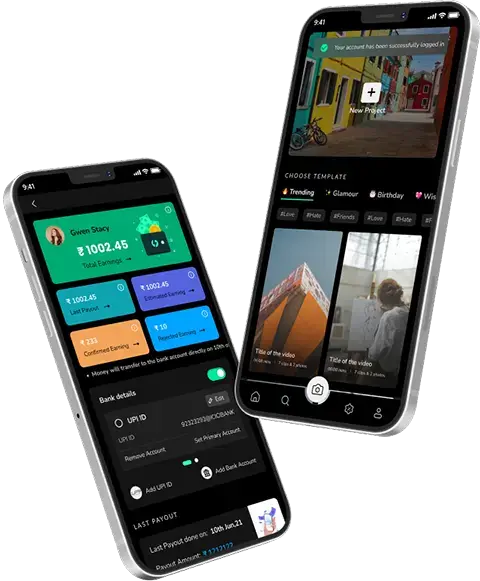






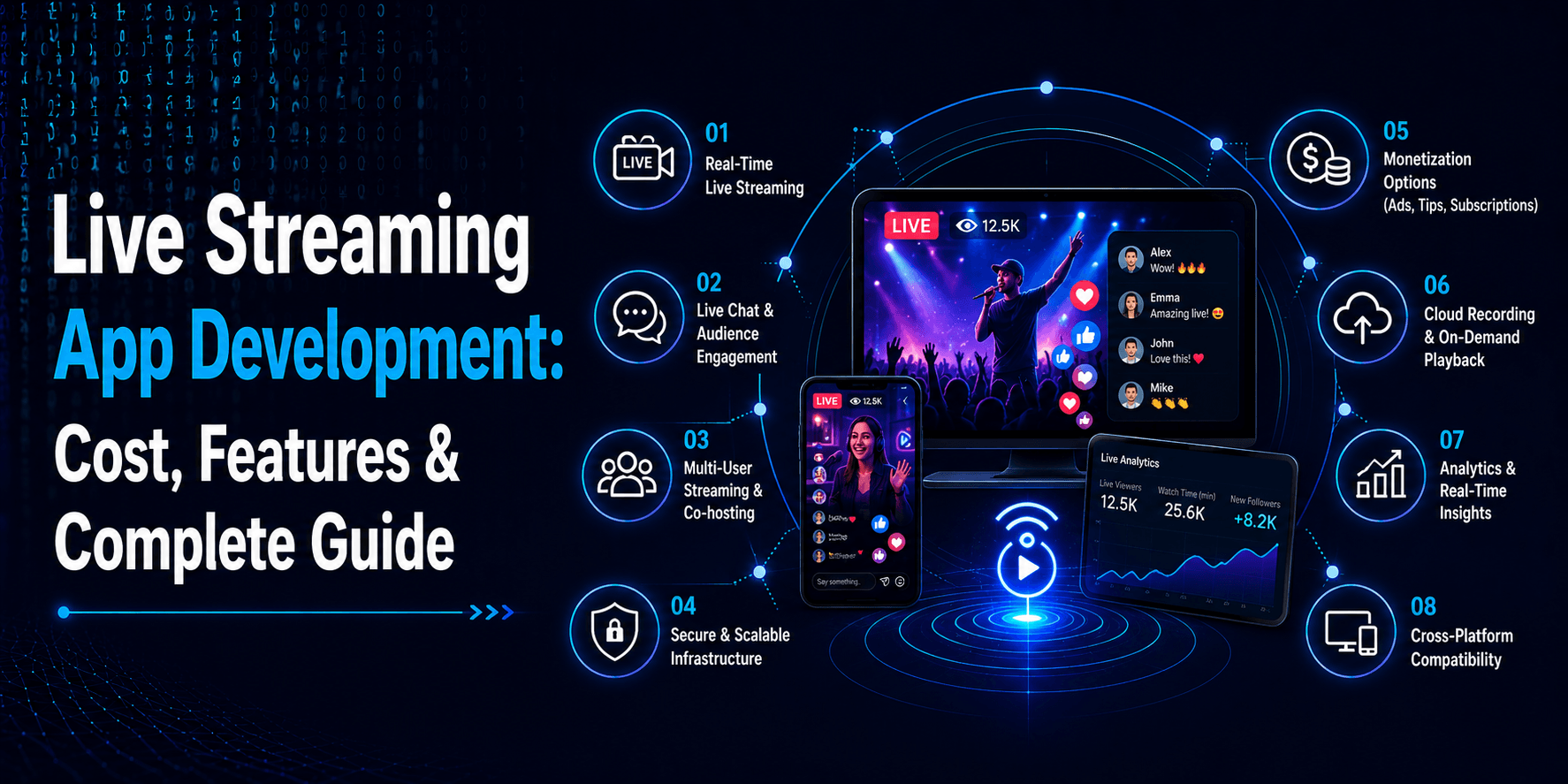


The live streaming app development market is growing rapidly and was worth a staggering US $ 70 billion market by the year 2021. Today, the industry has expanded significantly and is expected to surpass $247 billion by 2027 (Statista). This growth clearly indicates how fast the video streaming app development space is evolving, helping businesses increase their reach, build a strong brand image, and gain more attention in a highly competitive market.
Surprisingly, users’ expectations are evolving, and now 82% of users enjoy live videos over social media posts (Livestream). Altogether, 80% also like to read blogs. In this space, there is no dearth of established players, and they are dominating the market with more innovative and intuitive real-time streaming apps. Facebook Live, Twitch, YouTube Live, Instagram Live are the top live streaming applications in the world.
Though, you probably have heard about video streaming apps. But! The fact is that the market is full of various other types of streaming apps that are gaining huge traction and doing well. From OTT platforms to audio-based platforms, streaming application development is expanding across multiple formats. If you have an idea to bring something new to the market, then you must try live streaming app development.
However, before that, you need to decide what kind of streaming app you want to develop. Here learn about the aspects that you need to know.
Types of streaming applications
Below are the three most popular types of streaming applications, let’s look at them:
-
Live broadcasting app
This types of live streaming media applications are very popular in the market and offering users the opportunity to go live and interact with people. The applications are very entertaining and about watching video in real-time mode. These application records and broadcast the video simultaneously.
This types of applications are everyone’s favorite and professional streamers broadcast their day to day things live such as how to play games, dress well and more. Some people even answer questions online. The most popular applications in this niche are YouTube Live, Facebook Live, Livestream and more.
-
Video on demand streaming
Don’t you want to watch all your favorite movies and TV shows? These VOD app development platforms are quenching this desire of users by providing the streaming of TV series and movies. And! the best is that you don’t need to download the movie of TV show. The screen touch is like a magic wand, you can pause it, resume it, rewind it while streaming. Altogether, you don’t need to stick with your TV system. You can watch them anytime and anywhere.
This is the most profitable streaming app monetization model. As users have to pay a price in exchange of streaming subjects. The leaders in this niche are Netflix, Vevo, Hulu, Amazon Prime.
-
Audio-only streaming
These applications are also very profitable business today, the example is audio streaming app development. The principle that users can listen to the audio whether it is song, poetry or books. Everything is simple and exciting. Spotify, Pandora are the most popular music streaming applications.
Benefits of creating live streaming application
The fact is live streaming app development can be very profitable for your business and can make your business able to make a difference in the market. Probably, you might be facing various challenges in the market. All of those challenges can be overcome by a streaming mobile app.
Gain more attention of customers
A live streaming can help you gain more attention of customers since live broadcasts are always recognized by users. People today are more interested in real-time streaming apps than any other type of content. So, creating such an app can be helpful in keeping your customer engaged and capture their more attention.
Increase brand loyalty
Live streaming app enables you to gather a huge user base on your app easily, and this helps in gaining brand recognition. The fact is that live streaming offers you the opportunity to increase customer loyalty for your brand by streaming contents they are looking for. By providing them desired content, you can create loyalty in their heads and it invites them to your app recursively.
Huge return on investment
Money is what every business seeks, and live streaming app enables you to earn a lot by just rendering video contents. You can earn a lot by streaming high quality and engaging content. Incidentally, streaming apps enable you to gain a huge return on investment.
Latest trends in live streaming
Live streaming is no longer just about “going live.” That phase is long gone. What we’re seeing now is a shift toward experience where content, interaction, and monetization all blend into one continuous loop. And honestly, the platforms that understand this shift are the ones growing fast.
Here are the trends that are actually shaping live streaming app development right now.
Interactive & real-time engagement
Streaming has become less passive and more participative. Viewers don’t just watch anymore. They comment, react, vote, and even influence what happens next. Features like live chat, polls, Q&A sessions, and instant reactions are now expected, not optional. Platforms are actively building around this behavior because real-time interaction increases engagement and retention significantly.
Live commerce (streaming + shopping)
This one is growing quietly… but very fast. Brands are now using live streaming to sell products in real time. A creator goes live, demonstrates a product, and viewers can buy it instantly without leaving the stream. It blends entertainment with commerce in a way that feels natural. This model is already huge in some markets and is steadily expanding globally as businesses look for more direct conversion channels.
AI-powered personalization
Content discovery is getting smarter. Streaming platforms are now using AI to recommend content based on behavior, preferences, and even real-time interactions. Some platforms are experimenting with conversational discovery, where users can literally “ask” what to watch. The goal is simple: reduce decision fatigue and keep users engaged longer.
Short-form + live content blend
Traditional streaming apps are now borrowing from social media. Short-form videos, vertical content, and quick previews are becoming part of the streaming experience to improve discovery and engagement. Even major platforms are redesigning their apps to include vertical video feeds and snackable content formats.
Hybrid monetization models
The “only subscription” model is fading. Streaming platforms are now combining ads, subscriptions, and pay-per-view into hybrid models. This allows them to monetize both free users and premium audiences without limiting growth. In fact, ad-supported streaming is becoming a major revenue driver across the industry.
Multi-platform & device experience
Users switch between mobile, TV, tablet, and even web, sometimes within the same session. So streaming apps are now designed to deliver a seamless experience across devices. This is why modern video streaming app development focuses heavily on cross-platform compatibility and synchronized playback.
Low latency & high-quality streaming
Whether it’s gaming, auctions, or live events, users expect near-instant streaming with minimal delay. At the same time, demand for HD, 4K, and even immersive formats is increasing. Low latency and high performance are now considered baseline expectations, not premium features.
Creator-led content & community building
Streaming is no longer dominated only by big studios. Individual creators, influencers, and niche communities are driving massive engagement. Users are drawn to authenticity, not just production quality. And platforms are adapting by building tools that support creators, not just broadcasters.
If you look closely, all these trends point in one direction. Streaming is becoming less about content delivery and more about experience, interaction, and personalization. And that’s exactly where the next generation of live streaming apps will compete, not on who has more content, but on who keeps users engaged longer.
How streaming apps can make money
Building a live streaming app is only half the journey. The bigger question is how it turns into a consistent revenue-generating platform. And in most cases, the answer isn’t a single model, but a combination of strategies working together over time.
The way users consume content has changed. They don’t always want to commit immediately, and they don’t always want to pay upfront. So the monetization approach needs to feel natural, almost invisible, while still driving revenue in the background.
1) Subscription model (SVOD)
This is one of the most widely used approaches in streaming. Users pay a monthly or yearly fee to access content, and in return, they expect consistency, exclusivity, and quality. The model works best when your platform offers something users cannot easily find elsewhere. Over time, subscriptions create a predictable and stable revenue stream, which is why many businesses prefer starting here.
2) Advertising model (AVOD)
For platforms targeting a larger audience, advertising becomes a practical option. Instead of charging users, the app generates revenue by displaying ads during the streaming experience. These could appear before, during, or alongside the content. While users get free access, the platform earns through impressions and engagement. This model scales well, especially when user traffic increases.
3) Pay-per-view (TVOD)
Some content doesn’t need a subscription. It just needs demand. In the pay-per-view model, users are charged only for specific content they choose to watch. This is commonly used for live events, exclusive shows, or special broadcasts. It gives users flexibility while allowing the platform to generate revenue from high-value content without long-term commitment.
4) In-app purchases
This model focuses more on engagement-driven monetization. Instead of charging for access, the platform allows users to spend within the app experience. This could include virtual gifting, premium interactions, or unlocking certain features. It works particularly well in platforms where creators and audiences interact frequently, turning engagement into micro-transactions that add up over time.
5) Sponsorships and brand collaborations
As the platform grows, it naturally attracts brands looking for visibility. This opens up opportunities for sponsored content, branded live sessions, or collaborations with creators. Unlike traditional ads, these integrations feel more organic and often deliver better results for both the brand and the platform.
6) Hybrid monetization
In reality, most successful streaming platforms don’t rely on just one of these methods. They combine multiple models to balance user experience and revenue generation. For example, offering free content supported by ads, while also providing a premium subscription for an ad-free experience, and pay-per-view options for exclusive events.
There is no fixed formula when it comes to monetizing a streaming app. What works for one platform may not work for another. The key lies in understanding user behavior and gradually introducing monetization in a way that doesn’t disrupt the experience because in the end, users don’t mind paying. They just need a reason that feels worth it.
Key features of a live streaming app
If you are planning to enter the space of live streaming app development, then features are not just “add-ons”, they define whether your app survives or disappears because users today don’t just watch. They interact. They react. They expect control.
And honestly, if one feature is missing, they switch apps in seconds. So here are the features that actually matter, not just technically, but from a user and business point of view.
-
User registration & profiles
Every app begins here. A smooth onboarding experience makes a big difference. Users should be able to sign up using email, phone number, or social platforms. Once inside, personalized profiles help them manage preferences, history, and subscriptions.
-
Live video streaming (low latency)
A delay of even 5–10 seconds can ruin the experience, especially for gaming, auctions, or live events. That’s why modern real-time video streaming apps focus heavily on low-latency streaming using protocols like WebRTC.
-
Real-time chat & reactions
Streaming without interaction feels incomplete. Users want to comment, react, send emojis, or even ask questions during a live session. This feature keeps engagement high and increases the time users spend on your platform.
-
Video recording & playback
Not everyone joins live. This is why recording live sessions and allowing users to watch them later is essential. It also helps creators reuse content and build a content library, something critical for video streaming app development.
-
Push notifications
You can’t expect users to remember your app. Notifications remind them when a live session starts, when their favorite creator goes live, or when new content is available. Done right, this feature boosts retention without feeling intrusive.
-
Multi-device compatibility
Users switch devices all the time. They may start watching on mobile and continue on a laptop or smart TV. A seamless experience across platforms is now expected, not optional.
-
Advanced search & content discovery
Content is everywhere. Discovery is the real challenge. Smart search, filters, and AI-based recommendations help users find what they actually want to watch. This is where modern OTT app development is heading – personalized feeds over generic listings.
-
Payment integration
If your goal is monetization, this feature is non-negotiable. From subscriptions to pay-per-view, secure payment gateways allow users to pay easily within the app. It directly impacts your streaming app monetization strategy.
-
Admin panel & analytics
This is your control room. Track user behavior, monitor engagement, manage content, and analyze performance. Without analytics, scaling a live streaming app development solution becomes guesswork.
-
Content moderation & security
Streaming comes with risks. You need proper moderation tools to filter harmful content, manage user reports, and ensure platform safety. Along with that, secure streaming (DRM, encryption) protects your content from piracy.
It’s tempting to add everything at once. But that usually backfires. The smarter approach?
Start with core features. Launch fast. Then evolve based on user behavior. Because in live streaming app development, the best apps are not the most complex ones. They’re the ones that feel effortless to use.
How to build a live streaming app: Step-by-step guide
Building a live streaming app might sound complex at first—and honestly, it is if you try to do everything at once. But when you break it down into clear steps, the process becomes much more manageable.
The idea is simple: don’t aim for perfection in the first version. Focus on building something that works, then improve it based on real user behavior.
Step 1: Define your app type and niche
Before you get into development, you need clarity on what exactly you’re building. Not all streaming apps are the same. Some focus on live broadcasting, others on video-on-demand, and some are built around audio or niche communities.
Your niche will decide everything that follows such as features, tech stack, monetization, and even your target audience. A gaming stream app will look very different from an e-learning or fitness streaming platform.
Step 2: Choose the right monetization model
This step often gets ignored early on, but it shouldn’t. Decide how your app will make money, whether through subscriptions, ads, pay-per-view, or a hybrid model. When you define this early, it becomes easier to design features and user flows that support revenue generation naturally.
Step 3: Finalize the feature set (start with mvp)
At this stage, it’s tempting to include everything. But that usually slows you down. Start with a basic version of your app that includes only core features like live streaming, user profiles, and minimal interaction. This is your MVP. Once it’s live, you can gradually introduce advanced features like chat, recommendations, or multi-host streaming.
Step 4: Select the tech stack
The performance of your app depends heavily on the technology you choose. For live streaming app development, this typically includes frontend frameworks like React Native or Flutter, backend technologies like Node.js, and streaming protocols such as WebRTC, RTMP, or HLS. Cloud platforms and CDNs also play a critical role in ensuring smooth streaming and scalability.
Step 5: Design the user experience
A streaming app should feel effortless. Users should be able to join, watch, interact, and explore content without confusion. Focus on clean navigation, fast loading, and minimal friction. Even a powerful app can fail if the experience feels complicated.
Step 6: Develop the app
The development phase includes building the frontend interface, setting up the backend infrastructure, integrating streaming capabilities, and ensuring that all features work together seamlessly. Regular testing during this phase helps avoid major issues later.
Step 7: Test for performance and scalability
Streaming apps are sensitive to performance issues. You need to test for video quality, latency, buffering, and user load. Even a small lag can impact user experience. This step ensures your app can handle real-time usage without breaking under pressure.
Step 8: Launch and monitor
Once everything is ready, launch your app but treat it as the beginning, not the end. Track how users interact with your app, which features they use the most, and where they drop off. This data helps you make smarter decisions for future updates.
Step 9: Improve and scale
The best streaming apps evolve continuously. Based on user feedback and analytics, keep refining your app. Add advanced features, improve performance, and scale your infrastructure as your user base grows.
Building a live streaming app is not about getting everything right in the first attempt. It’s about building something functional, learning from users, and improving consistently because in this space, the apps that grow the fastest are not the ones that start big. They’re the ones that adapt quickly. Contact Techugo to hire highly skilled mobile app developers and schedule a consultation call with them.
How much does it cost to build a live streaming app in 2026
When businesses start exploring live streaming app development, the first question that comes up is almost always about cost. And while it sounds like something that should have a clear answer, the reality is a bit layered.
Because building a live streaming app is not just about designing screens or writing code. It involves real-time data processing, video infrastructure, cloud integration, and scalability. All working together in the background. That’s why the cost can vary significantly depending on what exactly you’re trying to build.
The live streaming app development cost overview (2026)
| App Type | Features Included | Estimated Cost | Timeline |
| Basic MVP | Login, basic live streaming, simple UI | $10,000 – $40,000 | 2–3 months |
| Mid-Level App | HD streaming, chat, notifications, payments | $40,000 – $120,000 | 3–6 months |
| Advanced Platform | AI recommendations, multi-stream, OTT features, analytics | $120,000 – $300,000+ | 6–12 months |
In 2026, the cost of developing a live streaming app can typically fall into three broad categories, depending on complexity and business goals.
A basic version of the app, often referred to as an MVP (Minimum Viable Product), can cost anywhere between $10,000 to $40,000. This type of app usually includes only the essential features required to launch and test the idea in the market.
A mid-level streaming app, which offers a more refined user experience along with features like real-time chat, better video quality, and user engagement tools, can cost between $40,000 to $120,000. This is where most growing businesses tend to invest.
For companies aiming to build a large-scale platform similar to OTT apps or advanced streaming solutions, the cost can go beyond $120,000 and reach up to $300,000 or more. These apps are designed for high performance, large audiences, and long-term scalability.
What influences the cost the most
The cost of video streaming app development is not fixed because multiple factors shape the final estimate. And interestingly, even small changes in features or technology can create a noticeable difference in budget.
-
Type of streaming experience you want to offer
One of the biggest factors is the type of streaming experience you want to offer. Real-time streaming with low latency requires more advanced technology and infrastructure, which naturally increases the cost. On the other hand, a simple streaming setup with standard delay is comparatively more affordable.
-
Feature set
Another important aspect is the feature set. Adding functionalities like live chat, user reactions, multi-host streaming, or AI-based recommendations can significantly increase development time and cost. While these features improve user engagement, they also require more backend support and testing.
-
Choice of platform
The choice of platform also plays a role. Building for a single platform, such as Android, is more cost-effective. However, if you plan to launch on iOS, web, or smart TVs as well, the development effort increases, and so does the overall cost.
Infrastructure and ongoing costs
One thing many businesses overlook is that live streaming apps are not a one-time investment. Unlike static applications, streaming platforms rely heavily on cloud infrastructure, storage, and bandwidth.
This means you will need to account for ongoing expenses such as server costs, content delivery networks (CDNs), and data storage. As your user base grows, these costs increase as well, sometimes quite rapidly.
In addition to that, regular maintenance is required to keep the app running smoothly. Updates, bug fixes, and performance improvements usually cost around 15–20% of the initial development cost annually.
A practical way to approach the budget
Instead of trying to build a fully-featured platform from day one, most successful businesses take a phased approach. They start with a basic version of the app, launch it quickly, and then gradually add features based on user behavior and feedback.
This not only helps in managing the initial investment but also reduces the risk of building features that users may not actually need.
So, when it comes to the cost of live streaming app development, there isn’t a single number that fits all scenarios. It depends on your vision, your audience, and the level of experience you want to deliver.
What matters more is how strategically you plan the development. Because in most cases, it’s not about spending more – it’s about spending in the right direction.
Now tell, don’t you want to invest in live streaming app development?
If you’re planning to move forward, the next decision matters just as much as the idea itself. For this, you need to hire a reliable and innovative streaming app development company that understands not just the technology, but also the market you’re entering.
Developers at live streaming mobile app development companies can bring imaginations into reality by integrating technologies like AR/VR. As per Techugo developers, these technologies can make streaming more innovative. So, get an incredible streaming app by mixing progressive and magical technologies.
As seen with teams like Techugo, the focus today is not only on functionality but on creating streaming platforms that feel dynamic, intuitive, and future-ready. And that’s where the real difference lies, combining solid development with forward-thinking innovation.
So, if you’re aiming to build something that stands out, it’s not just about launching a streaming app. It’s about building one that users actually want to come back to. Get in touch.

Get in touch
We'd love to hear from you.