

 SA
SA
 KW
KW
 IE
IE AU
AU UAE
UAE UK
UK USA
USA
 CA
CA DE
DE
 QA
QA ZA
ZA
 BH
BH NL
NL
 MU
MU FR
FR







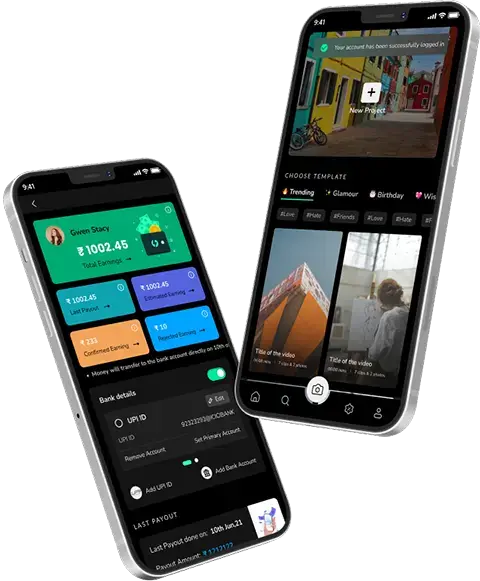






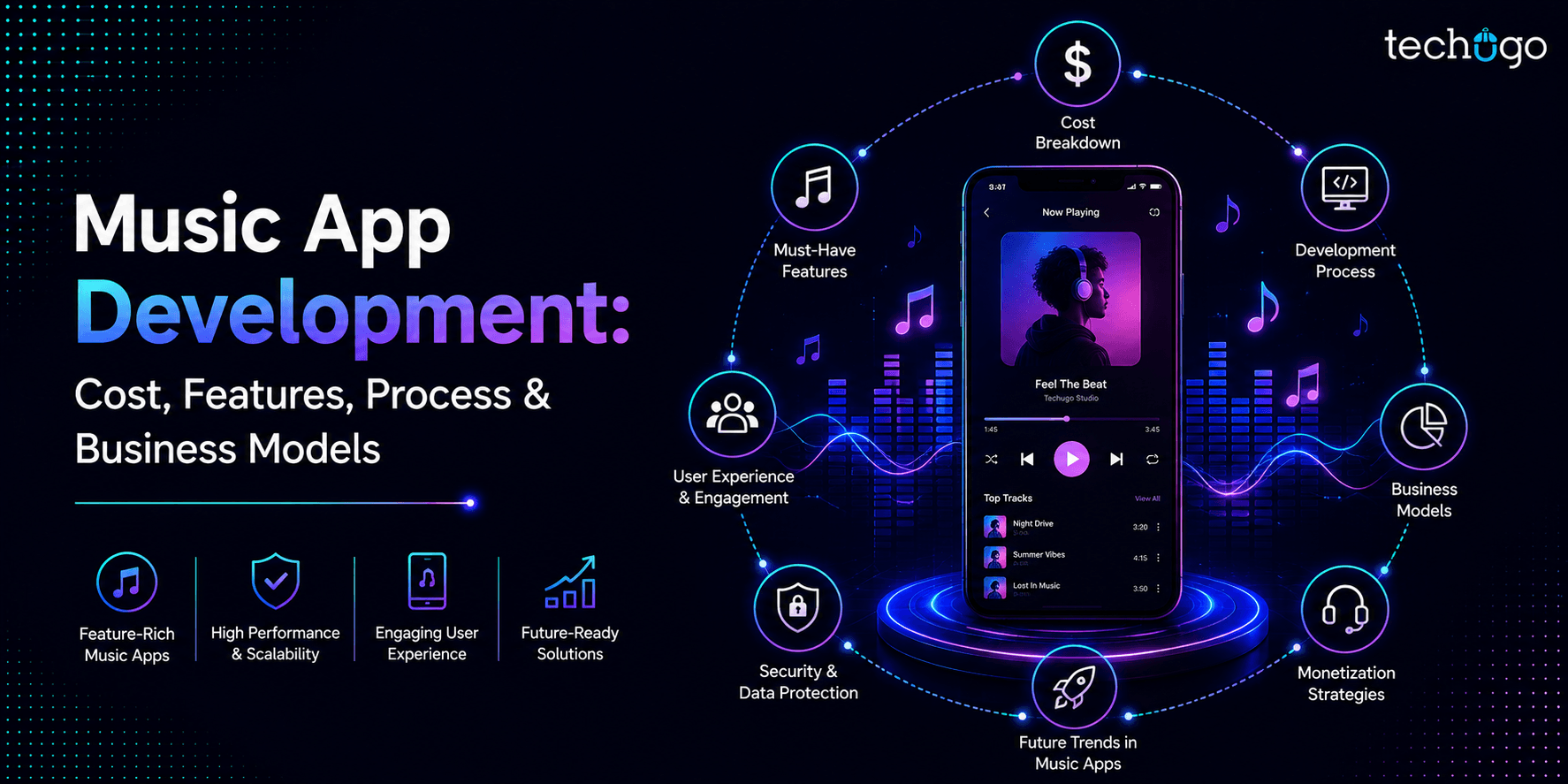


📌 Key Takeaways
- Core features like high-quality audio, offline listening, AI recommendations, and social sharing are essential for user engagement.
- AI enhances music apps with personalised recommendations, mood-based playlists, voice search, and smarter music discovery.
- Music streaming app development costs typically range from $20,000 to $180,000+, depending on complexity and features.
- A diversified monetisation strategy, including subscriptions, ads, licensing, sponsorships, and creator commerce, drives long-term profitability.
- Emerging trends such as blockchain royalties, immersive audio, voice recognition, and cross-device streaming are shaping the future of music apps.
Music streaming apps have revolutionized the way people discover, access, and enjoy their favorite songs, allowing them to do so anytime and anywhere. With rising user demand for personalised experiences and high-quality audio, businesses are increasingly investing in music app development. Building a successful music streaming platform requires the right combination of features, technology, licensing, and a sustainable business model. From estimating development costs to selecting an ideal tech stack, every stage plays a crucial role in the app’s success. This guide explores the essential aspects of music app development companies, including core features, development processes, monetisation strategies, and future industry trends.
What Is A Music Streaming App?
A music streaming app is a digital platform that provides a large library of data, allowing users to access it on demand. These apps take the help of the internet to deliver music directly to the user’s device, which is somewhat different from a traditional media system. If you look at the apps currently available, some of the examples include Spotify, Apple Music, and YouTube Music.
Build Your Music App Idea
Turn your idea into a scalable, feature-rich music streaming app.
Types of Music Apps You Can Develop
Several music streaming apps are designed to meet user requirements. So, if you are planning to go for custom music streaming app development, it is important to understand the various types, which include:
1. On-Demand Streaming Apps
Letting users play songs, albums, artists, or even playlists with personalised recommendations, offline listening, and advanced search. To get this, it is best to opt for music app developers who are well-experienced in building on-demand streaming apps and help you create seamless and user-friendly experiences, leading to a growing user demand.
2. Internet Radio Streaming Apps
Unlike on-demand apps, internet radio apps stream continuous, curated audio content similar to traditional radio, but delivered online. Users tune into a channel or station rather than picking individual tracks.
3. Cloud-Based Music Apps
Cloud-based music apps allow users to upload, store, and stream their personal music libraries from the cloud, accessible across any device without relying on local storage.
4. Live Music Streaming Platforms
Live music streaming apps enable real-time broadcasting of concerts, performances, or DJ sets, connecting artists directly with audiences regardless of location. So, if you are looking to explore multiple live music events on the go, then music discovery app development is your thing.
Core Music App Features To Know About
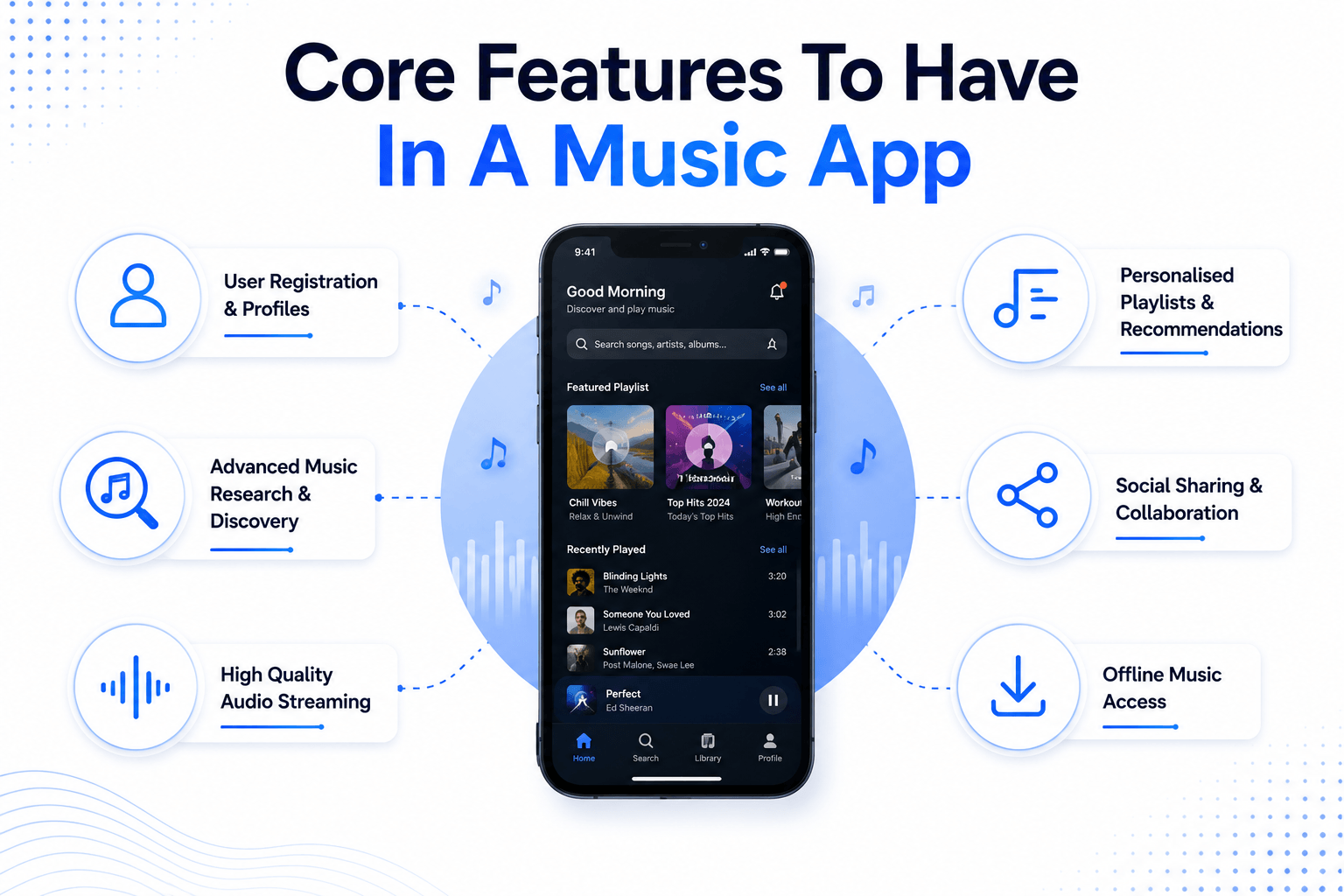
Users create a distinction in their minds and prefer an app that is built with multiple features that have real utility. So, to keep them engaged, you must focus on core features such as:
1. User Registration & Profiles
Allowing users to stream the app and enabling them to create personal accounts are two of the key features to have. This is where personalisation becomes effective, and users help them track their preferences. Even the algorithm creates playlists on its own, which the users will definitely enjoy.
2. Advanced Music Research & Discovery
Being able to find music on the go makes it effective for users to quickly search. This is also true for discovering albums, songs, and artists, which makes the search capabilities even stronger.
3. High Quality Audio Streaming
When a person comes to a music streaming app, they expect the quality of songs to be top-notch. This goes for the amount of bass, treble, and other musical aspects to come out alive. Therefore, uninterrupted music with greater sound quality is a must-have element.
4. Personalised Playlists & Recommendations
As the age of AI and data analytics is growing by the dozens, so is personalisation. Thus, based on mood, activity, user behavior, and AI-led suggestions, recommendations, and personalized playlists must be added to your app.
5. Social Sharing & Collaboration
Connecting people through music is the best collaborative approach to have. Social integration even allows social engagement, which in turn increases the popularity of the app. With this, social media platforms such as Instagram, Snapchat, X, or WhatsApp can be easily linked and shared songs on.
6. Offline Music Access
Offline music allows users to continue listening to songs even in the absence of the internet. This is a differentiating factor and makes the applications more valuable when compared to only internet-dependent platforms, making music app development services a success.
Must-Have Advanced Features For Modern Music Streaming Apps
Today’s users expect more than just play and pause buttons. To stand out in a crowded market dominated by giants like Spotify and Apple Music, your app needs advanced, user-centric features that enhance discovery, personalization, and engagement.
1. AI-Powered Personalisation Recommendations: Generic playlists no longer cut it. A music streaming app development company makes use of machine learning algorithms to analyze listening history, skip patterns, time of day, and mood to serve hyper-personalized recommendations.
2. Offline Listening Mode: Not everyone has reliable internet access at all times. Allow premium users to download songs, albums, or playlists for offline playback, with smart caching that manages storage efficiently on the device.
3. Cross-Platform Synchronization: Users switch between phones, tablets, desktops, and smart speakers throughout the day. Real-time sync of playlists, queue, playback position, and preferences across all devices ensures a seamless experience no matter where they pick up listening. This is a vital aspect of the music player app development.
4. Lyrics Integration & Karaoke Mode: Real-time synced lyrics displayed as songs play add an interactive layer to the listening experience. Some apps take this further with a karaoke mode, letting users sing along or even record their own records.
5. Social Sharing & Collaborative Playlists: Let users share tracks/playlists directly to social media, collaborate on shared playlists with friends in real time, and see what their friends are currently listening to – building community and virality into the app.
Decoding Music Streaming App Development Cost
When your goal is to develop a music app, you must also consider the development cost as well. Therefore, the cost to develop a music streaming app includes:
| Type of App | Estimated Cost (USD) |
| Basic MVP App | $20,000 – $50,000 |
| Mid-Level Complexity App | $50,000 – $120,000 |
| High End App | $120,000 – $180,000+ |
How To Develop A Music Streaming App?
If you think creating an app is easy, then you are in the wrong. You just might need help from music streaming app developers. It is a complicated one and is divided into various stages, which include:
1. Research Your Audience: What does the audience like? What is the demographic that likes techno or R&B music? These are all the questions that must be answered. And once you answer them, you have completed the first step of building a music app. If you do not conduct this primary research, then chances are your applications won’t be a success.
2. Define Key Features: During app development, there are all sorts of features that complete it. And once you are close to launching the software, then it is best to go for a Minimum Viable Product (MVP). This process quickly launches it, tests the idea, and the feedback loop is much smaller to work on it.
3. Get Official Streaming Rights: Before you go on adding songs into your streaming app, it is first important to buy rights for the intellectual property. In this manner, you can successfully supply users with legal content. And if you need help with this, then it is better to opt for a mobile app development company.
4. Focus On UI/UX Design: Stunning app design really attracts normal, even the non repetitive users. Making every segment intuitive and user-friendly makes the app navigational and clutter-free, leading to a better user experience.
5. Choose Technology Stack: Selecting which technology stack fits the app and enhances its features, you can choose among them. Among the best and widely used include React Native, Flutter, Swift, Kotlin, Vue.js, Django, and many more.
6. Develop The App: Development of a music streaming application generally happens in 2 fronts: backend and frontend. Writing the code and making it function effectively on one hand, and storing data and connecting platforms like iOS and Android on the other, is what creates the difference.
7. Testing The App: Once the audio/music app development is complete, the next stage is to test the platform in various environments and how it performs. During the development phase and just before the release, it is considered a good practice to check for bugs and resolve them.
8. Launch The App & Maintain It: After the successful completion and development, it is now time to launch the app. After the release is complete, in the early stages, it is vital to collect feedback and make as many changes as possible.
How AI Is Transforming Music App Development?
Artificial Intelligence has moved from a nice-to-have to a core differentiator in music streaming apps. From how users discover new songs to how platforms detect fraud, AI is reshaping nearly every layer of the music app experience. Here’s how:
1. Smarter, More Accurate Music Recommendations
Traditional recommendation engines relied on basic collaborative filtering (users who liked X also liked Y). AI now analyzes deeper signals – tempo, mood, genre blending, listening context, and even skip behavior to recommendations that feel genuinely personal.
2. AI-Generated Playlists Based On Mood & Activity
AI can analyze real-time context, time of day, weather location, or even a user’s typing/scrolling behavior to auto-generate playlists suited to the moment, whether that’s a workout, a study session, or winding down at night.
3. Voice Recognition & Natural Language Search
AI-powered voice assistants now allow users to search using natural, conversational language – “play something upbeat for a road trip” instead of exact song titles. Natural Language Processing (NLP) interprets intent and mood from casual speech, making music discovery more intuitive and hands-free.
Ways To Monetise Your Music Streaming App
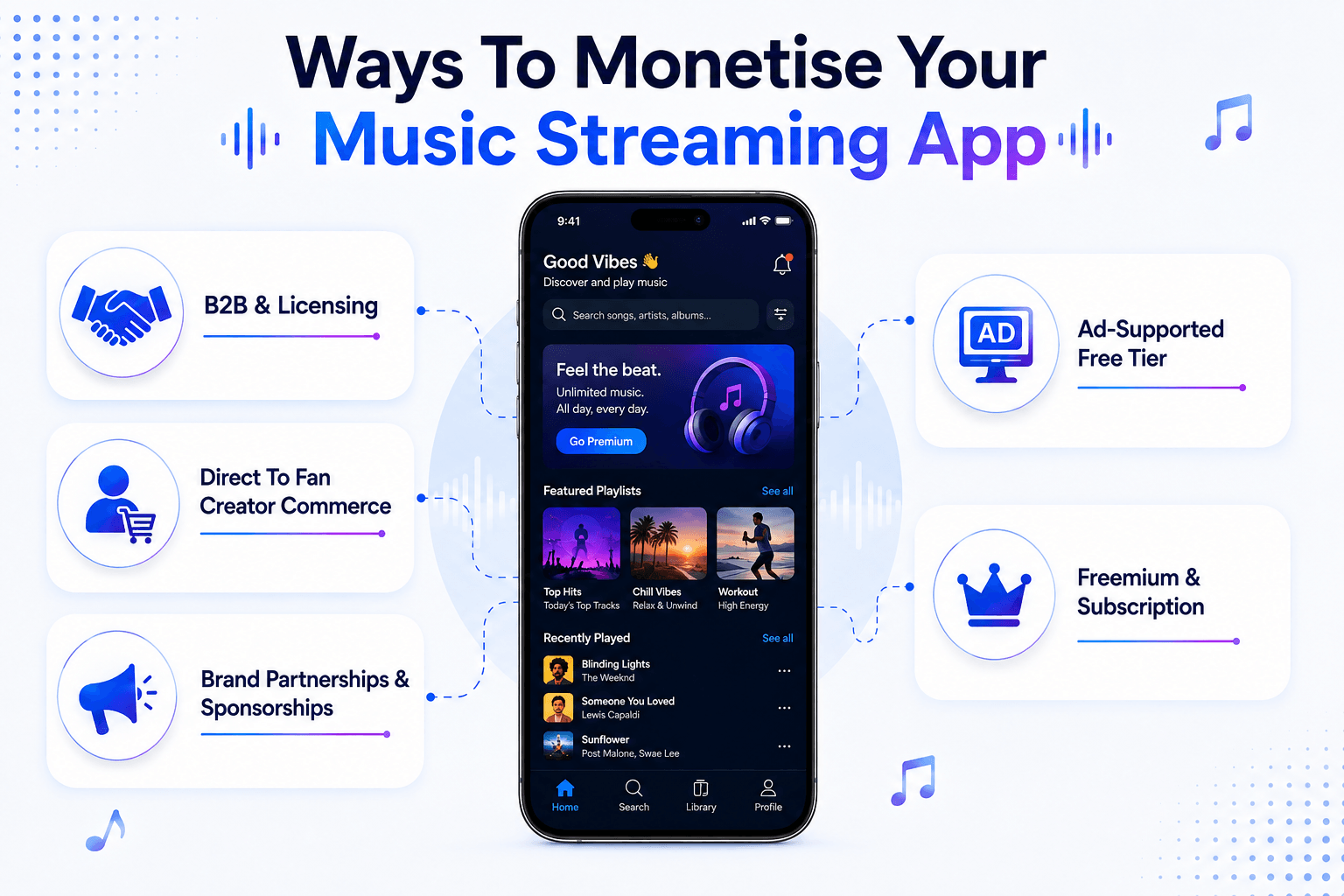
A well-planned monetisation strategy is something necessary to have. Relying on a single stream of revenue can be harmful, which is why you can opt for sources such as:
1. B2B & Licensing
Securing legal rights and distributing songs among users to play or for commercial purposes (business use, public events, or others) involves the use of B2B licensing. B2B frameworks grant the right to go for commercial use only and are a great way to earn huge sums of money from business houses. Under this model, you can look for music apps like Anghami.
2. Direct To Fan Creator Commerce
Bypassing conventional intermediaries, the selling of merchandise, subscriptions, and radio playing rights is what the Direct To Fan and Creator Commerce model is all about. Under this method, creators retain the majority of the ownership and give them invaluable audience data.
3. Brand Partnerships & Sponsorships
Brand partnerships and sponsorships are a great way to contain commercial collaborations where the consumer brands fund or integrate into the platform. One of the examples can be a fitness playlist brought to you by Nike.
4. Ad-Supported Free Tier
Playing audio or visual apps in between songs is what the ad-supported free tier is. Under this, users listen to songs at zero cost, and it is considered the core of music apps’ revenue model. Popular platforms that use this include YouTube Music, Spotify, and music apps like Pandora.
5. Freemium & Subscription
Allowing for free, ad-supported music with limits on restricted track skips or shuffled playback is what the freemium model is. And the subscription model charges recurring fees monthly, quarterly, or on an annual basis.
Music Streaming App Development Challenges & Solutions
Building a music streaming app isn’t just about writing code. It involves navigating licensing complexities, technical stability, and user experience demands unique to audio-heavy platforms. Here are the key challenges music mobile app development services face and how to solve them.
1. Music Listening & Copyright Compliance
Securing rights to stream music legally is one of the biggest hurdles. Licensing varies by region, content type, and usage, and non-compliance can lead to costly legal issues or content breakdowns.
Solution: Partner with licensing aggregators or rights management services early in development. Consider integrating it with established music APIs rather than negotiating with individual labels, especially for MVPs.
2. High Server Load & Streaming Latency
Music apps demand constant, low-latency data delivery to millions of concurrent users. Poor infrastructure leads to buffering, playback delays, and app abandonment – especially damaging during peak usage or live streaming events.
Solution: Use a robust Content Delivery Network (CDN) to cache and serve audio files closer to users geographically. Implement adaptive bitrate streaming so audio quality adjusts automatically based on network conditions, and leverage cloud infrastructure that scales elastically with demand.
3. Data Storage & Bandwidth Costs
Storing and streaming large audio libraries at scale gets expensive fast, particularly as your user base and catalogue grow.
Solution: Use audio compression techniques that balance quality and file size. Implement smart caching strategies and tiered storage to optimise costs – frequently accessed tracks on faster, pricier storage: rarely played tracks on cheaper archival storage.
Future Trends In Music Streaming App Development
Keeping up with emerging technologies is the reality of today that helps your application to stand out from the crowd. These advancements are the truth of tomorrow that are happening today, which include:
1. Voice Recognition Integration: Making it easy for the user to search for songs, artists, and albums is a great discovery that music applications have started leveraging. This is an effective trend where the user wants to go for a hands-free approach.
2. Blockchain Royalty Systems: A trend of tomorrow, blockchain royalty systems leverage smart contracts and decentralised ledgers for automating payments and retaining song ownership. Blockchain in the music industry ensures transparency in terms of payments to the artists, which encourages them to upload more music.
3. Immersive Audio Experiences: Offering quality-rich songs, which lead to more engaging experiences are possible with the help of spatial technologies. This can be done by integrating Sony 360 Reality Audio or Dolby Atmos.
4. Cross-Device Streaming: Connecting devices such as earphones, headphones, smart speakers, and wearables is a trend that is keenly followed by big firms. This trend of back-and-forth functioning, where one device is playing songs and it can be heard on the other, offers immense development opportunities.
Vital Tech Stacks For Music Streaming Apps
A music app development company leverages different kinds of technologies to make it function on a holistic level. Therefore, vital tech stacks that make a music app a success include:
| Technology Layer | Recommended Tech Stack |
| Frontend | Flutter, React Native, Swift, Kotlin, React.js |
| Backend | Python, Java, .Net, Node.js |
| Database | PostgreSQL, MySQL, MongoDB |
| Cloud Infrastructure | Google Cloud Platform, Microsoft Azure, AWS |
| Content Delivery Network (CDN) | Cloudflare, Akamai, CloudFront |
| AI & Recommendation Engine | TensorFlow, Apache, PyTorch |
Why Choose Techugo As A Music App Developer?
If you are reading this, then it means you have a genuine passion to work around music. But if you don’t have the necessary understanding of building an app around it, then don’t be discouraged. You have the option to leverage the expertise of a music app development company in the USA, like Techugo.
Ready to Launch Your Music App?
Partner with experts to build and scale your music streaming platform.
The Final Word
Developing a music streaming app involves careful planning, audience research, feature selection, legal licensing, and continuous maintenance. As a part of entertainment app development, success depends on delivering seamless user experiences with personalised recommendations, offline access, and high-quality streaming. Choosing the right monetization model and modern technology stack helps maximise growth and profitability while ensuring scalability.
Partnering with an experienced developer like Techugo certainly makes a world of difference and helps simplify the process and turn your music idea into a digital platform.
FAQs
Q) How do music streaming apps make money?
Ans) Music streaming apps make money from a combination of methods, which include B2B licensing, direct-to-fan creator commerce, brand partnerships & sponsorships, ad-supported free tier, and freemium subscription.
Q) What is the typical cost for building a custom music player application?
Ans) The typical cost for developing a custom music player application revolves around $20,000 – $180,000+.
Q) What are the essential features of a music streaming app?
Ans) Important features include user registration & profiles, advanced music research & discovery, high quality audio streaming, personalised playlists & recommendations, and beyond.
Q) What factors determine the success of a music streaming app?
Ans) A rich music library, trustworthy cloud infrastructure, smart AI-driven recommendations, an easy user interface, flexible monetisation, and strong legal licensing are the factors that determine music streaming app success.
Q) What is the difference between a music streaming app and a music player app?
Ans) A music streaming app delivers songs from an online music catalog, while a music player app primarily plays audio files already stored on a device or supplied through a connected source. A streaming platform usually requires content delivery infrastructure, user accounts, catalog management, and rights management, whereas a basic music player can operate largely with locally stored audio.
Q) Can a music app work without an internet connection?
Ans) Yes, a music app can support limited functionality without an internet connection by storing authorized content locally on the user’s device. Offline functionality can also allow users to access previously saved playlists, downloaded tracks, or cached content, depending on the app’s licensing and access rules.
Q) How do music apps handle different audio formats?
Ans) Music apps can support multiple audio formats by using compatible audio codecs and server-side transcoding. The platform can convert source files into playback formats suited to different devices, operating systems, and network conditions while maintaining an appropriate balance between audio quality and file size.
Q) What payment gateways can be integrated into a music streaming app?
Ans) Music streaming apps can integrate payment services that support recurring subscriptions, one-time purchases, and other applicable transactions. The choice depends on the target countries, supported currencies, payment methods, platform requirements, and business model. Common integrations can include Stripe, PayPal, Apple in-app purchases, and Google Play Billing where applicable.
Q) How do music apps track user listening behavior?
Ans) Music apps can record events such as songs played, skips, likes, searches, playlist activity, listening duration, and session patterns. This behavioral data can be used for analytics, personalization, recommendation systems, product optimization, and audience segmentation, subject to applicable privacy requirements.
Q) How can a music app improve user retention?
Ans) A music app can improve retention by providing relevant content discovery, personalized experiences, reliable playback, regularly updated catalogs, useful notifications, social interactions, and meaningful premium benefits. Retention strategies should be based on actual user behavior and continuously tested through product analytics.
Q) What analytics should be included in a music streaming app?
Ans) Useful analytics can include daily and monthly active users, listening time, plays per user, skip rates, search activity, playlist engagement, retention, subscription conversions, churn, and content performance. An admin analytics system can help identify user behavior patterns and measure the performance of different content and business initiatives.
Q) How can artists upload music to a streaming app?
Ans) An artist-facing system can allow creators to create profiles, upload audio and artwork, enter metadata such as artist name and genre, and submit tracks for review before publication. The platform can also include content moderation, metadata validation, rights verification, and royalty-related workflows depending on its business model.
Q) Can a music streaming app support multiple languages?
Ans) Yes. A music streaming app can be designed with multilingual support so its interface, navigation, notifications, metadata, and selected content can be presented in different languages. Localization should account for translated UI text, date and number formats, regional content, and right-to-left languages where required.
Q) How can a music streaming app be personalized for different user segments?
Ans) Personalization can be tailored to factors such as listening preferences, age-appropriate content, location, language, musical interests, subscription status, and engagement behavior. Segment-based personalization can help present more relevant catalogs, recommendations, promotions, and app experiences to different groups of users.

Get in touch
We'd love to hear from you.