

 SA
SA
 KW
KW
 IE
IE AU
AU UAE
UAE UK
UK USA
USA
 CA
CA DE
DE
 QA
QA ZA
ZA
 BH
BH NL
NL
 MU
MU FR
FR















📌 Key Takeaways
- Building an NFT marketplace can cost between $20,000 and $150,000, depending on the project’s scope and complexity.
- White-label and ready-made solutions are ideal for businesses that prioritize faster development and lower costs.
- Custom development is the best option for companies that require unique features and specific business functionalities.
- Your choice of blockchain directly impacts development costs, transaction speed, network fees, and the overall user experience.
- AI-powered features can enhance an NFT marketplace, but they don’t necessarily need to be a core component of the platform.
NFT activity remains significant, although the market can be unpredictable. In Q3 2025, NFT trading volume reached $1.58 billion, with 18.1 million NFTs sold, almost twice the trading volume recorded in the previous quarter. (Source – DappRadar)
When developing an NFT marketplace, one of the initial choices you’ll need to make is how you intend to develop it. Are you looking for a turnkey solution or a white-label solution or are you willing to build your own? Of course there are no right answers for everyone.
What you choose will depend on what you want the marketplace to do, how much you’re willing to spend, and how much freedom you want to have as it grows. Let’s break down the options and see which NFT marketplace development solution is right for you, along with the development costs, key factors to consider and how to choose the right NFT marketplace development company.
Are NFT marketplace development services worth investing in 2026?
If your first instinct is “let’s build everything from scratch,” pause for a second.
NFTs went through a lot of ups and downs over the past few years – hype, crashes, “NFTs are dead” headlines and whatnot.
Despite everything, investing in NFT marketplace development services can still be worth it.
But why is that? Let’s look at it.
NFT use cases are expanding
NFTs have moved past just being digital artwork. Businesses now use marketplaces for gaming items, event tickets, memberships, creator content, collectibles – and tokenised real-world assets.
Buyers want utility now
Buyers care less about how something looks and more about what it gives them – access, rewards, community perks, actual ownership. If you’re looking into NFT marketplace development solutions, this is the part to get right first.
Businesses have more ways to make money
There’s money in it if you pick the right model. Marketplaces make money through –
- transaction fees
- listing fees
- premium features
- subscriptions
The right model depends on what you’re selling and who you are selling it to.
The market is still unpredictable
This is worth keeping in mind before you invest heavily. NFT activity can move up and down pretty quickly, so building a marketplace simply because NFTs are trending isn’t a great strategy. You need an audience and a reason for people to use your platform.
So, is it worth it?
If you have a genuine use case, a defined audience and the right blockchain app development team behind it, then yes. It can be worth considering in 2026.
Types of NFT marketplaces you can build
NFT marketplaces can be built around different types of assets. The right type for you depends on what you want users to buy, sell or trade.
Here’s a quick look at the main types you can consider:
| Marketplace type | What it’s used for |
| Art marketplace | Digital artwork, photography, illustrations, and other creative work |
| Gaming marketplace | In-game items, characters, skins, weapons and virtual land |
| Collectibles marketplace | Trading cards, sports moments, limited-edition items and digital collections |
| Music marketplace | Songs, albums, exclusive content and fan experiences |
| Real-world asset marketplace | NFTs linked to property, luxury goods and other physical assets |
| Multi-asset marketplace | A variety of different NFT categories on one platform |
What are the different NFT marketplace development solutions?
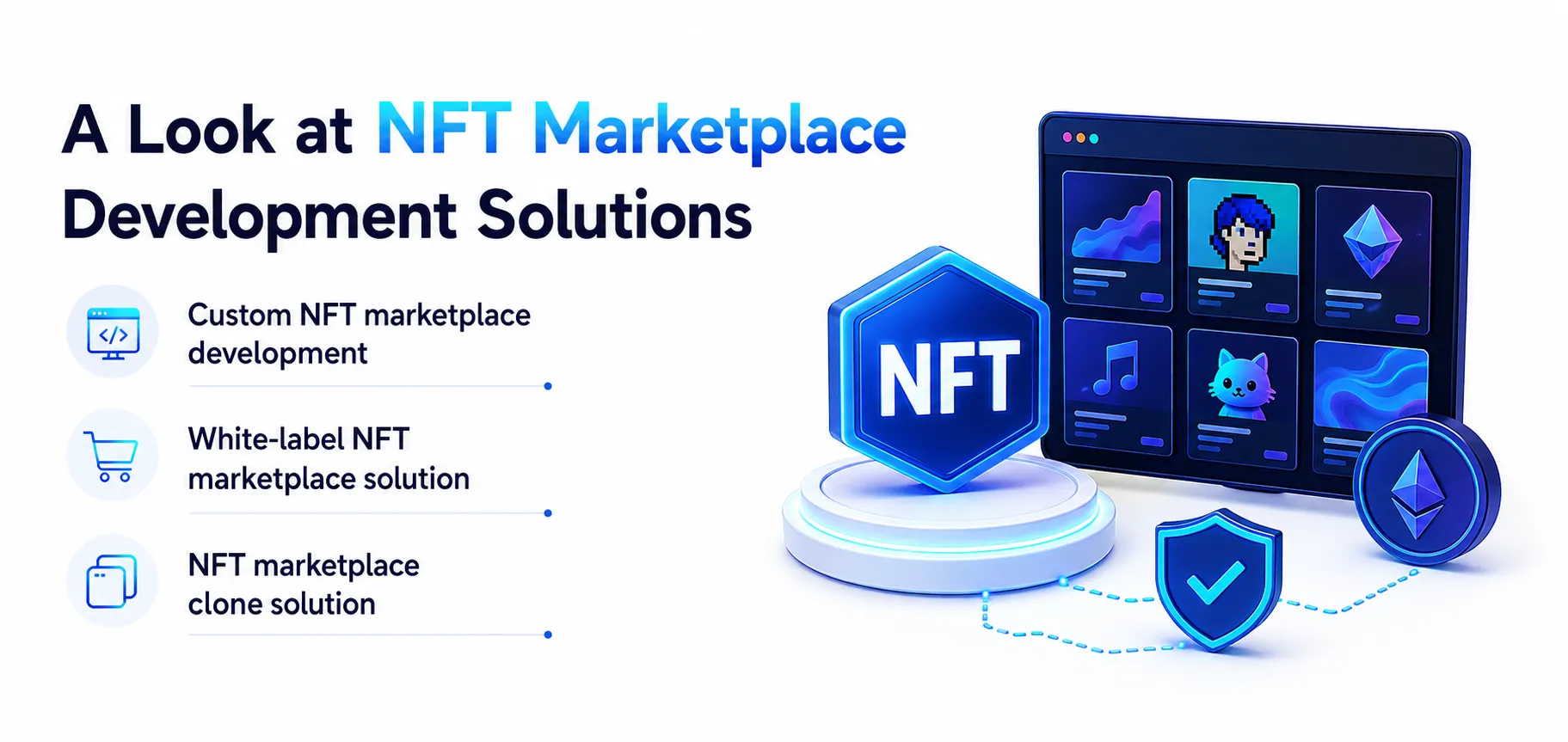
Starting from scratch is one option, but it’s far from the only one. Let’s walk through the different NFT marketplace development solutions out there.
1. Custom NFT marketplace development
If you have a very specific idea in mind, custom development gives you the freedom to build around it. You get to decide how it looks, how it works, what features go in and which blockchains it connects to. Yes, it takes more time and more money – but you end up with way more control over the final product.
2. White-label NFT marketplace solution
Not really keen on building everything from scratch? A white-label NFT marketplace development approach gives you a ready-made base you can brand for your own business. It gets you to launch a lot quicker and cuts down the early development work, though you might hit some limits if you want to make bigger changes down the line.
3. NFT marketplace clone solution
A clone solution basically takes an existing marketplace as a starting point and reshapes its core functions around your business. It saves time. And with NFT and blockchain development… you can still add your own branding, features and integrations.
Your development approach can also depend on what you want the marketplace to do beyond buying and selling NFTs. If you’re planning features such as staking, lending or token-based rewards, you may also need experience in DeFi development.
Custom vs white-label vs clone: which NFT marketplace solution is right for you?
You can have an excellent NFT marketplace idea, but the wrong development approach can make things unnecessarily complicated. That’s where experienced NFT marketplace developers can help. With the right NFT marketplace platform development approach, you can build what you need without spending time and money on things you don’t.
Let’s put the three approaches side by side and see how they compare.
| Factor | Custom Development | White-Label Solution | Clone Solution |
| Development time | Longer | Shorter | Shorter |
| Customization | Extensive | Moderate | Limited to moderate |
| Initial investment | Higher | Lower | Moderate |
| Control | Full | Partial | Partial |
| Features | Built to your requirements | Pre-built and configurable | Based on an existing marketplace |
| Best suited for | Unique marketplace concepts | Businesses looking for a faster launch | Businesses following a proven marketplace model |
| Scalability | Highly scalable | Depends on the solution | Depends on the architecture |
Which one should you choose?
Whichever one actually fits what your business needs.
If you need full control, custom development may be the way to go – but if you want to get started sooner, a white-label solution could be the better pick.
And if you have a proven marketplace model in mind, a clone solution can give you a useful starting point. Your NFT marketplace app development approach should ultimately match your business needs, not the other way around.
Factors to consider when choosing an NFT marketplace development company
1. Relevant experience
First thing, examine what they have built. Have they done NFT marketplaces before or is this their first rodeo? Do they know smart contract development inside out, and have they worked on other blockchain projects too?
If you are going for something specific, say a ticketing platform, you’ll want an NFT ticketing marketplace development company that understands ticket verification, secure transactions, and how to stop people duplicating tickets.
2. Technical expertise
Your team needs to actually know the tech – blockchain, wallets, smart contracts, APIs, the whole stack. You don’t have to be a tech person yourself, but if they can’t explain why they’re doing something a certain way, that’s a red flag.
3. Portfolio and case studies
Go through their past work properly, don’t just look over it. A decent NFT marketplace development agency will show you real projects they’ve actually shipped, not just tack “NFT development” onto a long list of services. See what they built, what features they handled, who they’ve worked with.
4. Security practices
NFT marketplaces deal with transactions, wallets, and digital assets. This is why security needs to be taken seriously from the beginning.
You should ask how the company handles smart contract testing, wallet security, data protection, and vulnerability checks.
5. Customisation
Be sure they’re really working on what you need, not just developing something that they have used for all their clients.
6. Development timeline
Ask how long the project is expected to take and what the development process looks like. A clear timeline makes it easier to plan your launch, budget and other business activities around the project.
7. Post-launch support
Determine whether they will be around to support you after the launch, fix bugs, and update the software, or whether they’ll drop out the moment it’s released.
8. Cost and transparency
Avoid relying only on the lowest-priced option. Identify exactly what they include, what it might cost you more down the line, and how they deal with changes as they go.
How much does an NFT marketplace development cost?
In 2026, NFT marketplace development will cost you around $20,000 to $150,000, depending on the type of marketplace you are building.
A standard marketplace with the essentials is not going to cost anywhere near what a platform with multiple blockchains, advanced smart contracts or metaverse functionality would.
Here’s a rough idea of where the numbers tend to land:
| What you’re building | Estimated cost | What you’re likely getting |
| Basic NFT marketplace | $20,000–$40,000 | NFT listing, buying and selling, wallet integration, basic admin features |
| Mid-level marketplace | $40,000–$80,000 | More customisation, advanced search, payment options, security features |
| Advanced marketplace | $80,000–$150,000+ | Custom features, multiple blockchain support, advanced smart contracts, analytics and integrations |
| Metaverse NFT marketplace | $100,000–$150,000+ | Virtual assets, 3D elements, AR/VR features and metaverse integrations |
Price shouldn’t be the only thing you’re looking at when picking the best NFT marketplace development company. Check what’s actually included in that estimate, what might end up costing extra later, and whether ongoing support is even part of the deal.
One thing to keep in mind is that metaverse projects usually come with a bigger bill. Metaverse NFT marketplace development services can involve 3D spaces, virtual assets, AR/VR – and other features that take more time to build.
Technologies used to build an NFT marketplace
The exact tech stack depends on your marketplace. But these are some of the main technologies you will need:
Blockchain
- Ethereum for NFT ownership and transactions
- Polygon for lower-cost NFT transactions
- Solana
- Other blockchain networks based on your requirements
Smart Contracts
- Solidity for Ethereum-compatible smart contracts
- Rust for Solana-based smart contract development
- Tools for testing and deploying smart contracts securely
Frontend
- React
- Angular
- Next.js
Backend
- Node.js
- Python
- PHP for building backend marketplace functionality
Wallet Integration
- MetaMask
- WalletConnect
- Other crypto wallets based on your target users
Database
- PostgreSQL
- MongoDB
- Other databases depending on your platform
Cloud & Storage
- AWS
- Google Cloud
- Azure
- IPFS
NFT marketplace legal and compliance requirements
The legal side matters just as much as the technical side. Before launching your NFT marketplace, make sure you understand the requirements that apply to it:
1. KYC and AML – depending on your business model and where you’re located, you may need ways to verify users so that you can prevent financial crime.
2. Data protection – you have to make sure that user info is collected and stored properly, and it needs to be handled the way privacy laws say it should be, because if it’s not, you’re in trouble.
3. Intellectual property – there have to be clear rules around who owns the content that’s being minted or sold, and how copyright issues are handled.
4. Consumer protection – your terms should explain fees, refunds, transactions and ownership clearly, so people actually know what they’re getting, and what it is they’re paying for.
5. Smart contract compliance – smart contracts should be properly tested and reviewed before handling real transactions.
Tax requirements: NFT transactions can have tax implications, so requirements may vary depending on where your business and users are located.
Common mistakes to avoid when choosing an NFT marketplace development solution
1. Choosing based only on price
The lowest price isn’t necessarily the most cost-effective. There is a cost to a lower upfront option, whether it is because it lacks features, doesn’t scale well, or is costly to modify later. Check out the solution you’re getting before you commit to it.
2. Ignoring wallet integration
Wallets are a fundamental component of most NFT marketplaces, so don’t put it off. Check whether the solution supports the wallets your users will most likely use and if the team has any experience in cryptocurrency wallet development.
3. Not thinking about future features
Your marketplace may just have a few features to begin with, but what about when you want to grow? When you think about future ideas such as fractional NFT marketplace development, ensure that the platform is capable of doing so without having to start over again.
4. Focusing only on the launch
Getting the marketplace up and running is important, but it isn’t the end. Think about maintenance, upgrades, security, and scalability before choosing a solution. Your NFT marketplace project development approach should also account for what happens after launch.
5. Overlooking the development team
Last but not least, don’t only consider the solution itself. Notice the people involved with it. Before you give them your marketplace, ask them what experience they’ve had, what work they have done for others, the technical skills they possess, and if they provide post-launch support.
Questions to ask before hiring NFT marketplace developers
There are numerous NFT marketplace development companies available; do not simply stick with the initial one you come across. When you are considering hiring someone, here are a few questions that you should ask to help you understand their experience, technical abilities, pricing and how they would work on the project.
1. Have you built NFT marketplaces before?
2. Which blockchains do you support?
3. Can I customize the smart contracts?
4. Who owns the source code?
5. Do you provide security audits?
6. What integrations can you support?
7. How do you handle scalability?
8. What post-launch support do you provide?
9. Are there recurring platforms or licensing fees?
The responses will help you better understand if the team is an appropriate match for your project.
And once you find a team that has an understanding of your objectives, you can proceed further with more clarity.
Does your NFT marketplace solution need AI capabilities?
AI doesn’t have to be the main attraction of your NFT marketplace.
In some cases, a few thoughtful AI capabilities can be enough to make the platform easier and more useful to those using it.
There are countless possibilities for AI to be utilized within the NFT space, from personalized NFT recommendations to smarter search functionality, automated categorisation of NFTs, fraud detection, and even customer service to reply to frequent queries. The features you’ll need depend on the specific project you’re creating and the purpose of that project.
If you’re considering going more decentralized with the platform, then you can also consider dApp development as part of the platform. A dApp may enable users to interface with blockchain-based features by connecting their wallets to the platform, whereas AI can manage recommendations or intelligent discovery.
How to make the final decision?
It’s easy. At this point, you are likely to have a very clear picture of what each option entails. Now all you have to do is figure out what makes the most sense for your marketplace, your timeline and of course your budget.
Here’s a quick way to narrow it down:
Need to launch quickly + limited budget → White-label
Want to test an idea → Ready-made/clone or white-label
Need unique business logic → Custom
Planning a large, long-term marketplace → Custom
Need moderate customization + faster launch → White-label
If it’s a ready-made or white-label solution that can do the job, use it. However, if you are looking for a solution that will not be offered by any other marketplace… then custom development might be a better option.
It’s a good thing if your needs change afterwards as well. You can grow your marketplace with your business.
How Techugo can help you build an NFT marketplace
There’s a lot more to an NFT marketplace than what you see on the surface.
As an industry-leading mobile app development company, Techugo understands that. Our team can help you get your idea from that initial “planning” conversation to the design, development, testing and launch. Whether you have an MVP or desire something with a lot of features from the get-go, we design around your business needs.
Still reading? You probably have a rough idea of what you want to build by now. Why not take the next step and talk it through with our team? Get in touch now!
FAQs
1. How much does it cost to build an NFT marketplace?
An NFT marketplace can cost anywhere from $20,000 to $150,000+. However, the final cost depends on what you want your marketplace to do, which blockchain you choose and how much customisation you need.
2. Can AI be added to an NFT marketplace?
Yes, but you don’t have to add it everywhere. AI can be useful for NFT recommendations, search, categorisation, and spotting suspicious activity.
3. How do I choose an NFT marketplace development company?
Start with their past blockchain projects, development experience, pricing & how well they understand your requirements.
4. Can I build an NFT marketplace without starting from scratch?
Yes. A ready-made, clone or white-label solution can help you get started faster without building every feature from zero.

Get in touch
We'd love to hear from you.