

 SA
SA
 KW
KW
 IE
IE AU
AU UAE
UAE UK
UK USA
USA
 CA
CA DE
DE
 QA
QA ZA
ZA
 BH
BH NL
NL
 MU
MU FR
FR















📌 Key Takeaways
- OTT platform development needs the right tech, UX and infrastructure for it to work.
- Adaptive streaming, DRM, AI recommendations & cross-platform support keep users engaged.
- Picking the right way to monetize, whether it’s SVOD, AVOD, TVOD or a hybrid setup, makes a big difference in how profitable you are.
- The development costs of OTT platforms tend to range from $60,000 to $600,000.
- Keeping up with OTT development trends such as Generative AI, cloud-native architecture & edge computing helps your platform age well.
When was the last time you picked up a remote to switch on your TV?
It has probably been so long that you don’t even remember.
Those memories of switching channels have faded into switching OTT platforms now.
But let’s be real, everything’s just on apps now.
It is not a change in the habit. Even the global OTT video market is projected to hit around $352.96 billion by 2026 (Source – Statista).
That’s not a niche anymore, that’s mainstream.
Which is why OTT platform development has become such a major business. Companies aren’t just throwing together a video app and calling it a day. They are building full streaming ecosystems (ones that need to handle millions of concurrent users and play without buffers on every single device out there). That’s business.
So, in this blog we’re getting into all of it. Features, tech stack, costs, monetisation and the very latest OTT app development trends to watch in 2026.
Why investing in OTT platform development is a smart decision in 2026?
Well, there’s more than one reason why investing in OTT platform development is a smart move in 2026.
Take a look –
1. Streaming has officially overtaken traditional TV (the audience is already there, you’re just meeting them where they are)
2. The $352.96 billion market projection isn’t slowing down anytime soon
3. Ad-based and subscription models can run together
4. You own the data – user behaviour, watch patterns, drop-off points. All of it. And this is something which off-the-shelf solutions don’t give you
5. AI-driven personalisation is now an expectation (custom builds let you actually do this properly)
6. Mobile-first audiences are only growing. A well-built OTT platform works seamlessly across almost every screen
7. Content is becoming cheaper to produce
8. For a change, even Niche OTT platforms are doing really well in 2026
9. You can stream fitness, education, religion & even regional content. You do NOT need to compete with Netflix to make this work.
Custom OTT platform development vs off-the-shelf solutions
| Feature | Custom OTT Platform Development | Off-the-Shelf Solutions |
| Control | Full control over features, UX, and monetization | Limited control, fixed features |
| Flexibility | Highly flexible, can be built around business needs | Limited customization options |
| Scalability | Built to scale with your user base and content | May face limitations at scale |
| Branding | Fully customizable branding and UI | Generic or semi-custom branding |
| Development Time | Takes longer to build initially | Faster to launch |
| Cost | Higher upfront investment | Lower initial cost |
| Monetization | Multiple models (SVOD, AVOD, hybrid, etc.) can be tailored | Restricted monetization options |
| Ownership | You own the platform and data fully | Platform and system controlled by provider |
| Long-term Value | High long-term ROI and flexibility | Limited long-term differentiation |
When you look at it as a business, it starts to make a lot of sense.
Look, when you go custom, you’re not just building an app – you are in control. How the platform works, how users experience it, how you monetise it – all of that is yours to decide.
Off-the-shelf solutions sound convenient until you realise you’re basically renting someone else’s vision. A custom OTT platform development build gives you the flexibility to actually build around your business and not around someone else’s feature list.
Different types of OTT platforms you should know
1. Content-based OTT platforms
Some platforms just build everything around a type of content – movies and shows for the mainstream ones, but plenty go niche too, like anime or documentaries. Whatever the focus is, the entire library gets curated around that one preference.
2. Live streaming OTT platforms
You can stream anything from sports to shows in real time (like the name suggests). You’re in it as it’s happening which is why these work so well for anything time-sensitive.
3. Video-on-demand (VOD) platforms
Probably the format most people already know. Everything’s pre-recorded and sitting there waiting, so you decide what to watch and when. Literally nothing beats it for flexibility.
4. Hybrid OTT platforms
Some platforms don’t want to pick a lane, so they do both – live sports one minute, a full movie library the next. It’s a smart way to keep different types of viewers around instead of losing them to another app.
5. Niche OTT platforms
And then there are the ones that go narrow on purpose. These are built for fitness junkies, kids, students & audience who want content in their own language.
OTT platform features you need to build a successful streaming app
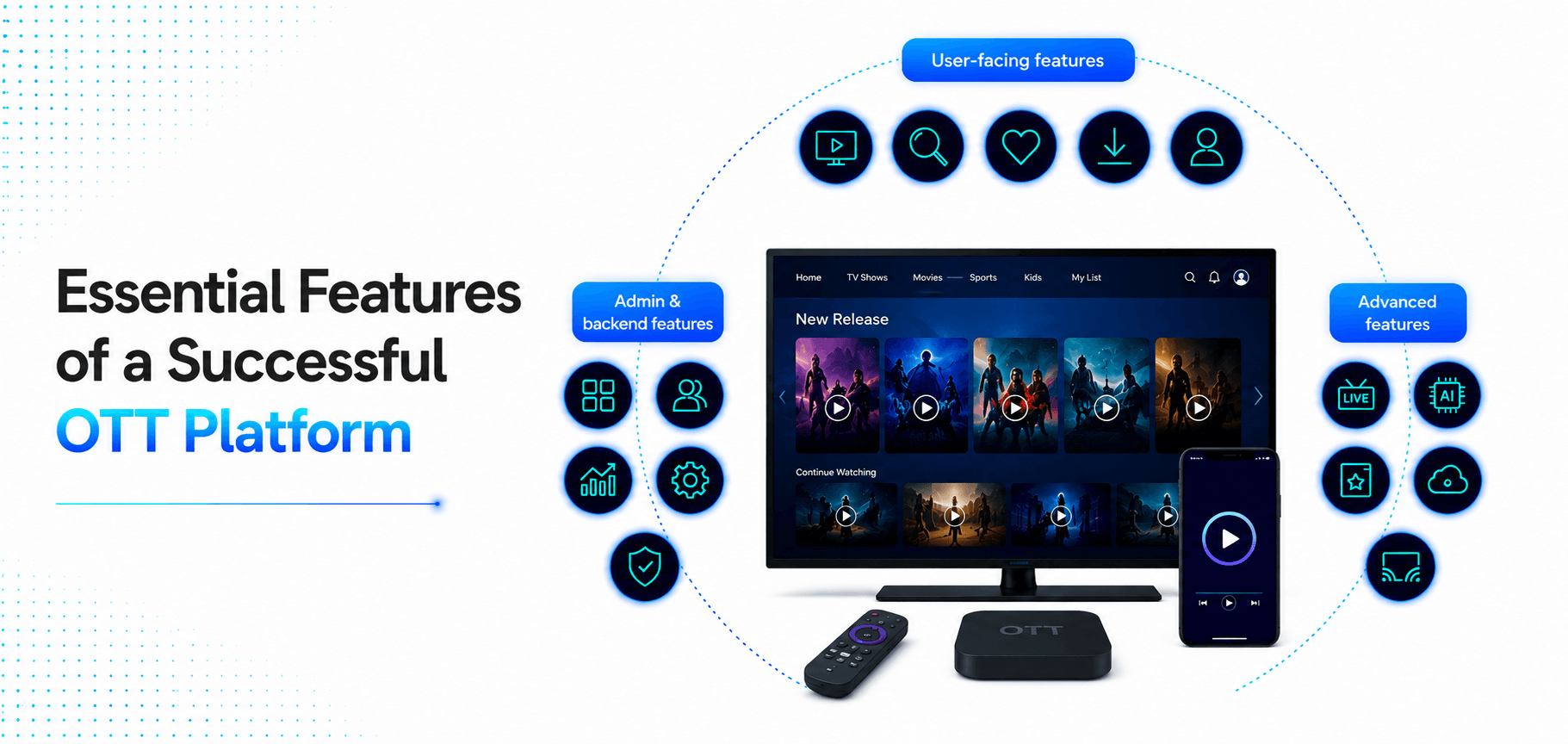
If you ask any OTT platform development company what actually goes into building one of these platforms, they’ll tell you the same thing – it all comes down to these three layers:
1. User-facing features
These are what your viewers interact with every single time they open the app.
- User registration & profiles – lets people set up accounts, manage profiles and make the platform feel like theirs
- Advanced search & filters – nobody wants to scroll forever, genre, language, mood – make it findable
- Personalized recommendations (AI-based) – suggests content based on what you’ve watched, not just what’s popular
- Watchlist & continue watching – sounds basic but users love it, and it keeps them coming back
- Multi-device support – phone, web, Smart TV, it all has to feel the same
2. Admin & backend features
This is the engine room of any OTT platform development solution.
- CMS – upload, organise, manage, done
- User management dashboard – subscriptions, accounts, activity, all in one place
- Analytics & reporting – you need to know what’s working and what isn’t
- Subscription & billing management – handles plans, payments and renewals
- DRM – protects your content
3. Advanced features
This is where entertainment app development gets more advanced.
- Live streaming – real-time events, sports, shows
- Offline downloads – watch with your mobile data & wifi off
- Multi-language & subtitles – opens you up to global audiences
- AI-powered content suggestions – Intelligence that knows what you want to watch before you do
- Push notifications – bring users back without being spammy
Ott platform development tech stack overview
1. Frontend
- React.js / Next.js for web – fast, scalable – and great for content-heavy interfaces
- React Native / Flutter for mobile – one codebase, both platforms
2. Backend
- Node.js / Python / Java – depending on what your team is most comfortable with
- Microservices architecture – so different parts of the platform can scale independently (without breaking everything else)
3. Video & streaming
- HLS / MPEG-DASH protocols – the industry standard for adaptive streaming
- FFmpeg for encoding – converts and compresses video without killing quality
- WebRTC for live streaming – ultra low latency and real time viewer interactions
4. Cloud & storage
- AWS / Google Cloud / Azure – pick your fighter
- Cloud storage (S3-like systems) – reliable, scalable & also handles large media files
- CDN (Cloudflare / Akamai) – makes sure content loads fast no matter where your user is sitting
5. Database & security
- MongoDB / PostgreSQL – depending on whether your data is structured or not
- Redis for caching – keeps things snappy under heavy load
- DRM systems (Widevine, FairPlay) – because your content needs to be protected
Monetization models used by OTT platforms
Picking the right monetization strategy is one of the biggest calls you’ll make with OTT platform development services. It basically decides how you make money in long term.
So let’s see how each model works –
1. Subscription video on demand (SVOD)
People pay monthly or yearly for full access. Works great if you’ve got regularly updated content people actually want to come back for.
2. Transactional video on demand (TVOD)
Free content, ads pay the bills. Great for pulling in bigger audiences who don’t want to commit to a subscription.
3. Transactional video on demand (TVOD)
Pay-per-watch – like renting a movie (perfect for big releases or live events).
4. Hybrid monetization model
This is actually what most of the best OTT apps development platforms go with now. It is a combination of all three so everyone has the flexibility to choose what works best for them.
OTT platform development cost breakdown
OTT platform development costs really come down to how many platforms you’re supporting, how complex the features are, and of course your tech stack choices.
Here is roughly what to expect depending on the stage you’re at.
| Development Stage | Estimated Timeline | Estimated Cost (USD) |
| Basic OTT Platform (MVP) | 3 to 5 months | $60,000 – $100,000 |
| Mid-Level OTT Platform | 5 to 8 months | $100,000 – $250,000 |
| Enterprise OTT Platform | 8 to 12+ months | $250,000 – $600,000+ |
Now this is what you have to keep in mind:
If you’re targeting both Android and iOS… Flutter app development and React Native app development are smart picks since they let you build once and deploy everywhere (saves you time and money).
Just know that extras like AI recommendations, live streaming, DRM & offline access will push the budget up. Going with mobile app development services helps make sure you’re building something that scales and not something you’ll have to redo in a year.
How to develop an OTT platform from scratch
Step 1: Define your OTT business model
The first thing you have to do is figure out who you’re building for, what content you’re offering – and how you’ll make money.
This decision pretty much influences the entire OTT platform development process.
Step 2: Design the user experience
Now create a simple, intuitive UI for mobile, web and smart TV users (people should be able to find and watch content).
Step 3: Build core features
Develop essentials like user login, video streaming, subscriptions, payments, search & content management.
Step 4: Test Across Devices
Now that you have built your core features, your app is “almost” ready. To make it fully ready… check performance on Android, iOS, web browsers and smart TVs.
Step 5: Launch and Maintain
After launch, continue monitoring performance and fixing bugs. Also, you have to keep adding new features through ongoing OTT platforms development support – because the market won’t stay the same forever.
Must-have integrations for OTT platform development
1. Payment gateway integration
Number one recommendation is “payment gateway integration”. Because obviously everyone needs a secure way to handle subscriptions and payments. It should support multiple payment methods like cards, UPI, and digital wallets in order to make onboarding and renewals easy for users.
2. Content Delivery Network (CDN)
CDNs spread your content across multiple servers, so streaming stays fast no matter where your users are. A big pro of CDN is that it reduces buffering.
3. Analytics and tracking tools
You’ll want to know what people are actually watching, how long they stick around, and what’s working. So “analytics integrations” is basically what drives smarter recommendations and better platform decisions.
4. DRM (Digital Rights Management)
DRM protects digital content from piracy and unauthorized access. And not only that but it also ensures secure streaming and safeguards copyrighted media across the platform.
5. Push notifications
Push notifications are a good way to keep people coming back & letting them know about new releases, recommendations, or updates so they don’t just forget your app exists.
6. Social login integrations
Letting people sign up with Google or Apple instead of filling out a whole form makes onboarding way easier (which usually means more people actually stick around to sign up)
OTT platform development challenges you should know
1. Buffering & streaming quality issues
For obvious reasons, buffering is a dealbreaker. And especially with sports OTT platforms development – where even a few seconds of delay or bad video quality can ruin the whole live experience.
Solution: You just need CDNs and low-latency protocols if you want playback to actually feel real-time.
2. High infrastructure costs
Okay, streaming isn’t cheap to run. We have servers, CDNs, storage and all of it adds up fast. A lot of platforms underestimate this until the bills start rolling in.
Solution: Going with cloud-based, pay-as-you-go infrastructure helps a ton here. You’re only paying for what you actually use so costs scale with your growth instead of hitting you all at once.
3. Cross-platform compatibility
People hop from phone to PC all the time so it has to feel the same everywhere. But pulling that off is way trickier than it looks.
Solution: Invest in cross-platform OTT app development services (they’ll help you deliver a consistent experience across Android, iOS, smart TVs and web).
4. Scalability & security
Growth is good. But at what cost? If your platform crashes under traffic or some sketchy site’s ripping off your premium content and reselling it on the low. That growth would mean nothing because privacy is also important.
Solution: This is where teaming up with a good OTT platform application development company will save you.
Latest OTT development trends in 2026
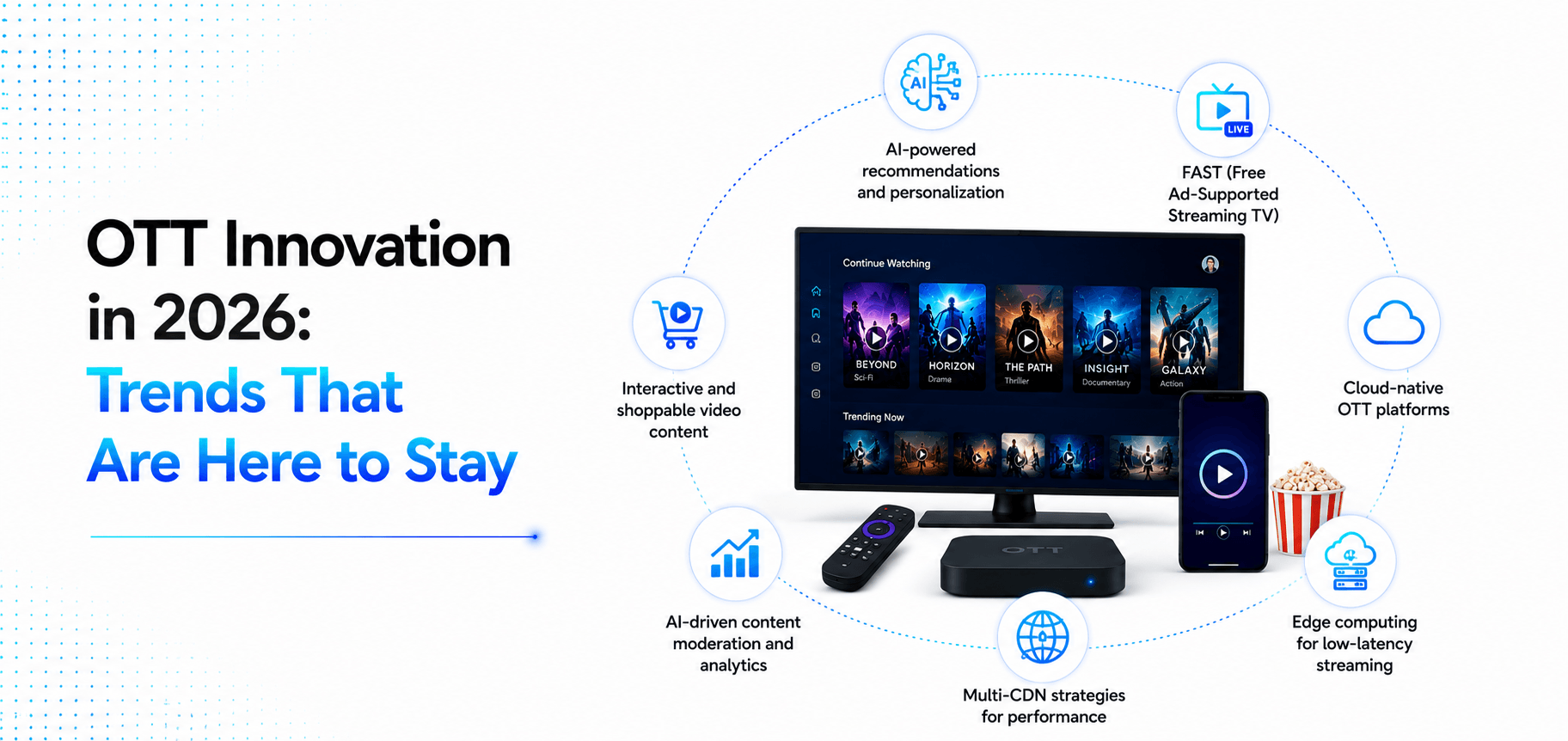
1. AI-powered recommendations and personalization
A lot of platforms are leaning on AI development services now to figure out what people actually watch and suggest stuff that fits – and it works, engagement and watch time both go up when recommendations actually feel relevant.
2. FAST (Free Ad-Supported Streaming TV)
FAST’s been picking up steam lately. Free content backed by ads gives businesses another way to make money besides just relying on subscriptions.
3. Cloud-native OTT platforms
Cloud-native architecture makes OTT platform development –
- more scalable
- more reliable
- and more cost-effective.
All while handling growing user traffic with ease.
4. Edge computing for low-latency streaming
Basically… the closer the data processing happens to the viewer, the less lag you get. So live streams feel quicker and way less choppy.
5. Multi-CDN strategies for performance
Running a few CDNs instead of just one keeps streaming quality steady, cuts down on outages, and viewers everywhere get a more consistent experience – no matter where they’re watching from.
6. AI-driven content moderation and analytics
This one’s underrated – generative AI development services are handling content moderation automatically now, plus pulling insights that actually help platforms make better calls based on real data.
7. Interactive and shoppable video content
- Live polls
- watch parties
- shoppable videos
To people engaged and opening up fresh ways to make money off content.
How to choose the right OTT platform development company
1. Experience in OTT development
You want a company that has built OTT or streaming platforms before, not just talks about it. If they’ve done it, they already know how to deal with stuff like buffering issues, content delivery and scaling for more users.
2. Technical expertise
Make sure they actually know their tech. A professional OTT development partner should be skilled in streaming technologies like HLS and MPEG-DASH, along with cloud platforms and backend architectures that support high traffic and uninterrupted playback.
3. Portfolio and past projects
Definitely check their past work. A good portfolio or a few case studies will tell you a lot, like how their platforms look, how well they’re built, and whether they can actually deliver something that works in the real world.
4. Scalability and customization
Don’t just think about what you need right now. The company you pick should be able to build scalable solutions with features like multi-device support, advanced analytics and of course future upgrades.
5. Post-launch support
Even after the launch, there’s a lot that needs to be done. You’ll need ongoing monitoring, updates, and fixes, so it’s worth picking a partner who sticks around after launch instead of disappearing once it’s live.
Why businesses worldwide choose Techugo for OTT platform development
Businesses pick Techugo because we actually build OTT platforms meant to scale, perform, and keep people coming back.
We handle the whole thing under one roof – strategy, UI/UX, development, testing, post-launch support. All of this is handled by our team of experts.
As a globally trusted mobile app development company, we build secure, feature-packed streaming apps that work with smooth playback, clean interfaces. Moreover, they run well across every platform (be it Android, iOS or web browsers). So whether you are starting small with a niche streaming app or going big with a full-scale OTT service, we make sure what we build works well for your business goals.
Thinking about building your own OTT platform? We’re just a message away. Let’s chat!
FAQs
1. How much does OTT platform development cost?
Usually anywhere from $60,000 to $600,000+ – depending on how complex it is, how many devices you’re supporting, and what features and integrations you need.
2. How long does it take to develop an OTT platform?
Somewhere between 3 to 12+ months. A basic MVP can be done in 3 – 5 months, but an enterprise-grade platform with all the bells and whistles can take 8 to 12 months or more.
3. Which features are essential for an OTT platform?
Some must to have features are – user authentication, video streaming, content management, subscriptions, payment gateways, search, personalized recommendations, analytics, DRM protection & cross-platform compatibility.
4. How do I monetize my OTT platform?
There are a few ways like – subscriptions (SVOD), ads (AVOD), pay-per-view or rentals (TVOD) or a hybrid mix of all three depending on what works best for you.

Get in touch
We'd love to hear from you.