

 SA
SA  KW
KW  IE
IE AU
AU UAE
UAE UK
UK USA
USA  CA
CA DE
DE  QA
QA ZA
ZA  BH
BH NL
NL  MU
MU FR
FR 


















📌 Key Takeaways
- Real estate CRM software assists companies in keeping track of their leads, customers, real estate, and revenue with ease.
- The cost of fintech app development depends on features, integrations, scalability, and AI-powered functionalities.
- Artificial Intelligence can make it easier to evaluate leads, identify properties, conduct forecasting and automate certain tasks.
- Integration of the app with the MLS, maps, email, calendar, and payment instruments adds more value to the CRM.
- Custom CRM applications give companies the ability to create features based on their business processes.
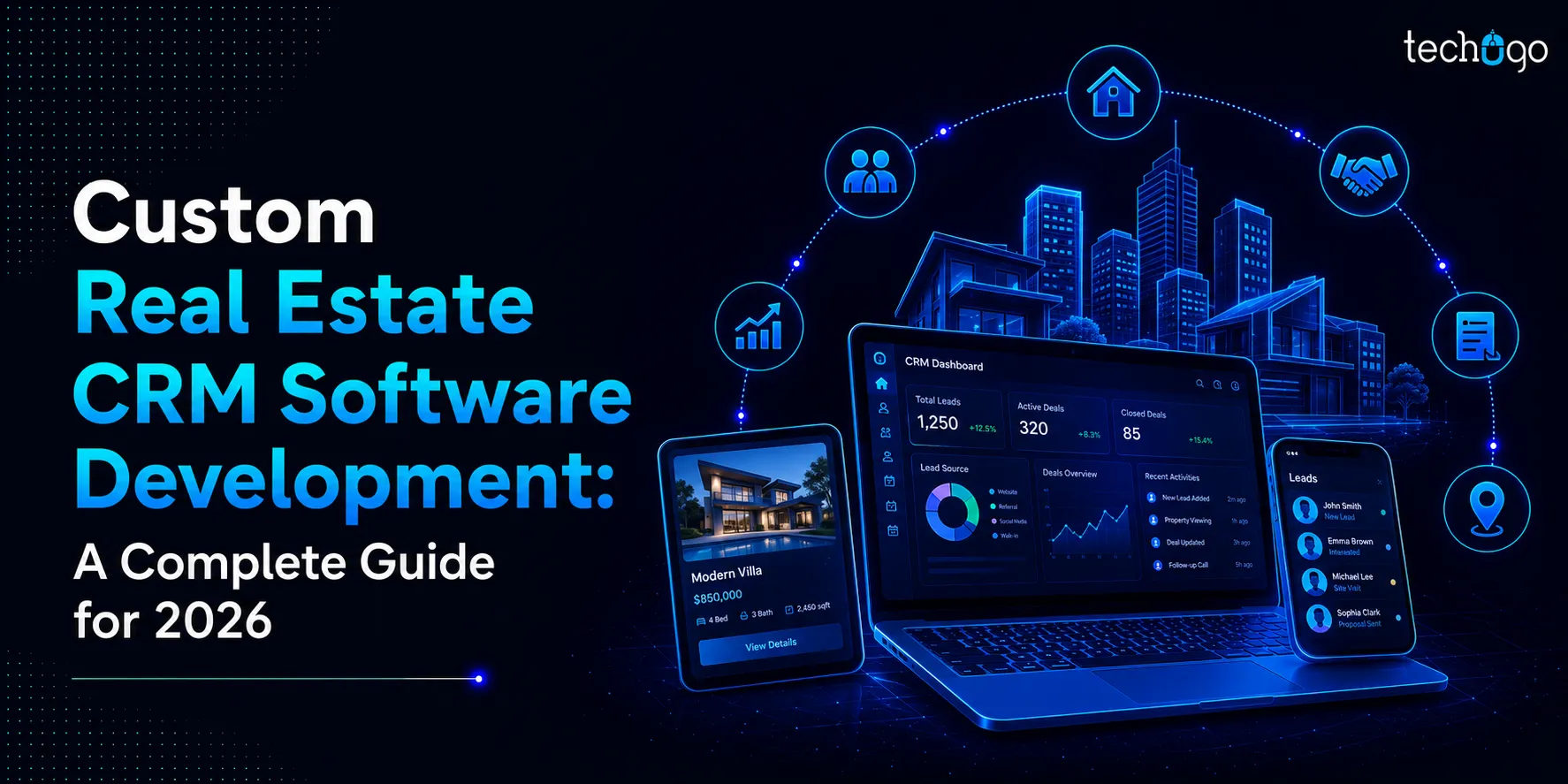
One message can evolve into dozens of calls, emails, follow-ups and spreadsheets to make a property deal happen. It can become a bit of a mess to keep track of all of this. Real estate CRM software development gives businesses a simpler way to manage it all. A real estate CRM system provides real estate companies with a single hub to handle leads, client data, real estate listings, follow-ups and sales actions. Teams can have their work neatly arranged and have the time to focus more on building relationships and closing deals without jumping from tool to tool. Before you begin, we will discuss what features you should look for, how it is developed, how much it will cost, the technology used and more.
What Is a CRM System in Real Estate?
A real estate CRM is basically software that helps businesses manage leads, clients, property listings, communications, follow-ups and sales activities. It gives agents a centralised view of their deals so tracking interactions and staying on top of opportunities becomes a lot easier. Moreover, it can automate repetitive tasks, send reminders – and generate reports. This helps teams manage their sales process more efficiently.
Types of Real Estate CRM Software
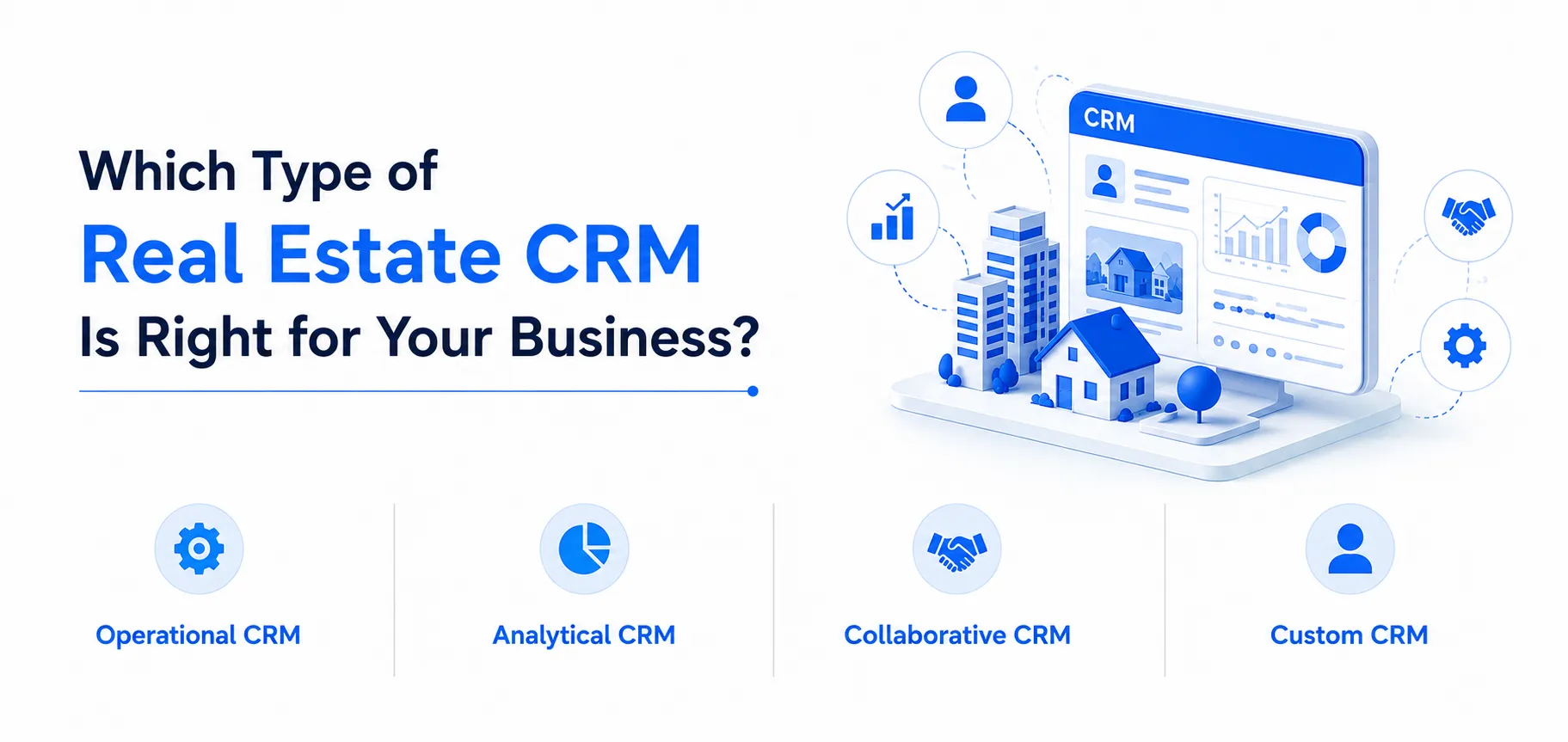
Real estate CRMs usually fall into a few categories depending on what you need it for:
1. Operational CRM – the workhorse. Handles your leads, follow-ups, listings and day-to-day sales tasks.
2. Analytical CRM – helps you understand customer and sales data, spot trends and make better decisions.
3. Collaborative CRM – it ensures that everyone who is involved (agents, brokers, teams) is well informed about client information and communication.
4. Custom CRM – it is made from scratch to fit your company’s operations and consists of the required features.
Why Do Real Estate Businesses Need CRM Software?
Those involved in real estate deal with a lot of leads, conversations with clients, property information and follow-up activities every single day. With no system in place, it can become challenging to keep track of all this. Real estate CRM solutions are designed to combine these activities to make the daily activities easier and more organized.
Some of the ways CRM software can help real estate businesses are:
1. Manage Leads More Effectively
A CRM can help agents collect, structure and monitor leads throughout their sales process, minimizing the chances of losing out on leads.
2. Keep Client Information in One Place
Agents can find contact information, communication history, property preferences and other details about the client without using various tools.
3. Automate Repetitive Work
Routine tasks such as follow-up reminders, notifications, lead assignments and more can be automated to save teams time.
4. Track Deals and Sales
A CRM gives teams a more precise outlook on their sales funnel. This allows them to see how things are going and identify where leads might be falling and where they are succeeding.
5. Build Around Your Business
With custom real estate CRM software development, businesses can design workflows and features to their teams’ actual working styles. A software development company can assist in the planning, development, and integration of these solutions according to the unique needs of a business.
Key Features to Include in a Real Estate CRM Software
To stay on top of every lead and deal, a real estate CRM needs to bring the right features together in one place. A real estate CRM software development service can help businesses build features around how their teams actually work. Some useful features include:
1. Lead Management
- Bring leads from websites, ads and social media into one place
- Assign leads to agents and keep track of their progress
- Record interactions and follow-ups
2. Property Management
- Keep listings, prices, availability, images and property details organised
- Match properties with what clients are looking for
- Update listing information without jumping between tools
3. Client Management
- Store contact details, preferences, enquiries and past conversations
- Keep notes about clients for more personalised interactions
4. Communication & Follow-Ups
- Set reminders for calls, meetings and follow-ups
- Send messages and notifications
- Keep previous conversations easy to find
5. Sales & Analytics
A real estate CRM solution can also help teams follow deals through the sales pipeline, track conversions and see how agents and leads are performing.
Benefits of Custom Real Estate CRM Software Development
If a typical CRM system doesn’t quite meet the needs of a real estate business, a customized solution can be helpful. Real estate CRM tools give teams the tools they need, without having to work around unnecessary features. They offer a number of advantages such as:
1. Better Fit for Your Workflow
You can integrate your current sales process, lead management techniques and team organization into custom software.
2. Easier Integration
It can integrate with property portals, payment systems, communication systems, accounting software and other platforms that your team uses.
3. More Room to Scale
Additional users, features, properties, and workflows can be added to the system without replacing the entire system when the business expands.
4. Improved Data Control
Customers and property data are more secure and can be stored, accessed and controlled by businesses.
5. Support for Mobile Access
Real estate app development can enable your team to access important data in real estate, even if they work remotely.
A real estate CRM software development company can assist in designing and creating a customised system, as well as plan and build the system based on the specific needs of the business.
Steps to Develop Real Estate CRM Software Successfully
Creating a real estate CRM is not a task that can be accomplished in a few steps. It’s important to know how your team operates, what your clients expect and what tools your CRM should link to.
In the early stages of software development, software development consulting can assist you in outlining these requirements and determining the best development approach to take.
Here’s how the process looks:
1. Define Your Requirements
First, make sure to define your business objectives, your users, your workflows and what features you really need.
2. Plan the CRM
Then design the system architecture, select a technology stack and sketch out the functionalities.
3. Design the Interface
Create an intuitive and user-friendly interface to ensure that agents can easily navigate and locate leads, properties, client details and more (without any unnecessary steps).
4. Develop the Software
Build the foundational CRM capabilities, connect third-party tools and create the backend infrastructure to support your workflow.
5. Test and Launch
Prior to releasing the system to your team, test your system to ensure it works, is secure, performs well and is easy to use.
6. Improve Over Time
After the completion of your real estate CRM software development, keep enhancing the system according to the feedback and evolving requirements of the business. This will enable the real estate CRM solutions to remain useful as the company expands.
Custom Real Estate CRM Costs: What to Expect
Now let’s talk about the budget. The cost to develop a real estate app can range from $40,000 to $200,000+.
Here’s how it breaks down:
| CRM Type | Estimated Cost |
| Basic CRM | $40,000 – $70,000 |
| Mid-level CRM | $70,000 – $120,000 |
| Advanced CRM | $120,000 – $200,000+ |
In case you are considering real estate CRM software development services, the final cost will depend on the factors below:
1. Features: All features influence costs in different ways, for instance, lead management, analytical and smart features, etc.
2. Design: A custom user interface is costly, while a basic one will be quite cheap.
3. Integrations: Maps, MLS, payment options, email and other third-party features considerably increase the price of the solution.
4. Platforms: Websites and mobile apps for different operating systems appear in the market and can similarly impact costs.
5. Security: High-security protection will help in keeping your business and clients’ information confidential and will thus require you to spend money on it.
6. Maintenance: The process of maintenance and support of your app will also cost you some money in addition to the initial development costs.
How Long Does It Take to Develop Real Estate CRM Software?
The timeline of development is mainly determined by the complexity of the CRM, the specification of the features, the integrations involved and the level of customisation required.
Generally, the timeline looks something like this –
1. Basic CRM: Takes around 2-4 months to develop basic features such as lead management, customer management, task management and follow-up features.
2. Mid-level CRM: Mid-level CRM takes 4-7 months to develop after adding features like property management and effective reporting.
3. Advanced CRM: It takes about 7-12+ months to develop a complex CRM with customised features.
Technologies Used to Build Real Estate CRM Software
What goes into the tech stack depends largely on the features, users and platforms your CRM needs to support.
Here’s a quick look at the technologies commonly used to build one:
| Technology Area | Common Choices | Used For |
| Frontend | React, Angular, Flutter | CRM interface and dashboards |
| Backend | Node.js, Python, .NET | Business logic and APIs |
| Database | PostgreSQL, MySQL, MongoDB | Storing leads, listings, and customer data |
| Cloud | AWS, Microsoft Azure, Google Cloud | Hosting, storage and scaling |
| APIs & Integrations | REST APIs, GraphQL | Connecting maps, MLS, payments, email and other tools |
| AI & Analytics | Python, TensorFlow, Power BI | Predictions, automation, reports and insights |
| Security | OAuth, SSL/TLS, encryption | Protecting user and business data |
AI & Automation Features to Add to Real Estate CRM Software
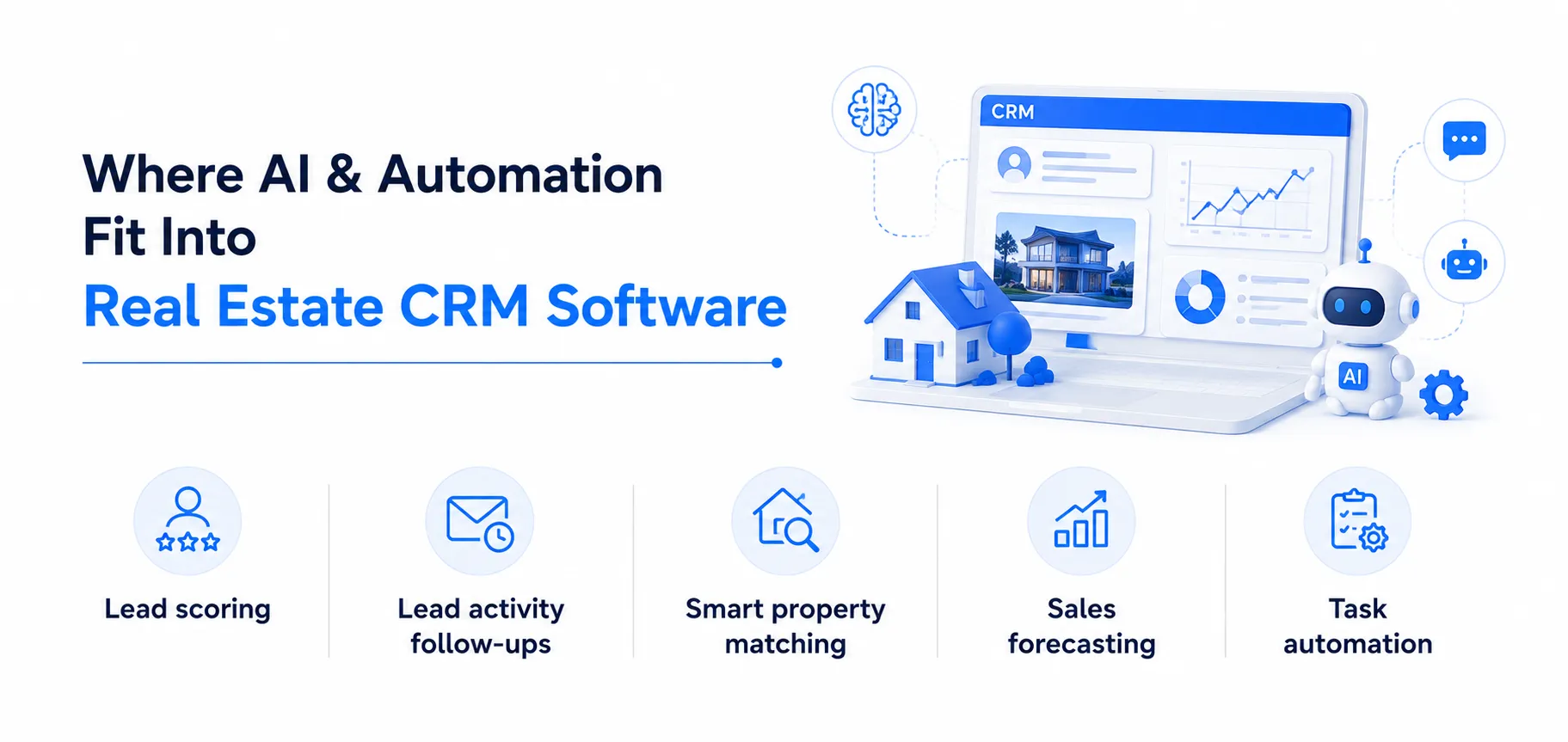
There’s a lot of manual work involved in managing a real estate CRM. AI can take some of it off your team’s hands, from sorting leads to analysing data.
Some useful AI and automation features include –
1. Lead scoring: AI can prioritize leads according to their activity and conversion potential.
2. Lead activity follow-ups: Emails, messages and reminders can be sent based on lead activity.
3. Smart property matching: AI can match buyers with properties based on their preferences & search history.
4. Sales forecasting: Companies can analyze historical data to identify patterns and forecast future sales.
5. Task automation: Many repetitive tasks, like reminders, appointment scheduling, data entry, etc., are done automatically.
Real estate transaction management software can also support teams to monitor deals and important updates with these features. They can be created to work as part of the workflows of the business during real estate CRM software development. This is what makes leading CRM solutions for real estate more useful in day-to-day operations.
Third-Party Integrations for Real Estate CRM
A CRM has to work well with the other tools your team uses every day. Otherwise, you’re back to switching between platforms and entering the same details in multiple places. Here are some integrations worth considering:
1. MLS: Pull property listings and related details directly into the CRM.
2. Maps: Help agents find properties, plan routes and view locations.
3. Email & SMS: Send follow-ups, updates and reminders from the CRM.
4. Payment Gateways: Handle payments or transaction-related fees securely.
5. Calendar: Keep property viewings, meetings and appointments in one place.
6. Accounting Software: Sync invoices, payments and other financial information.
Challenges You May Face When Developing a Real Estate CRM
There are a few challenges in real estate CRM software development, particularly if you are developing a system based on complex business processes. These are some of the more typical ones you might want to take into account:
1. Managing Complex Data
A real estate CRM software should manage property information, leads, customer data, paperwork and connections. So, keeping all this data organised and easy to access can be challenging.
2. Integrating Third-Party Tools
Your CRM may need to connect with property portals, email platforms, payment systems, and other tools. Therefore making sure these integrations work smoothly can add to the development time.
3. Ensuring Data Security
Because the CRM stores customer and business information, security needs to be a priority. Strong access controls, encryption and secure data handling should be considered during development.
4. Building a Scalable System
Your CRM should be able to support more users, properties, and data as your business grows. If scalability isn’t considered early – you may face performance issues later.
5. Making the CRM Easy to Use
While you can have everything you want in a CRM, you will not have anything if your team does not find it easy to use. Designing the interface around your agents’ working processes is therefore important, as it should be simple and intuitive.
Security and Compliance in Real Estate CRM Software
The CRM specialized in real estate contains a plethora of sensitive information. Hence, attention should be paid to security from day one while developing such software.
Here are a few key areas to focus on:
1. Data encryption : it is critical to encrypt sensitive information while being stored and transferred in order to avoid unauthorized entry.
2. Access controls : it is vital to provide users with access according to their roles (so that managers and agents can only see the necessary information).
3. Constant security testing : make sure to conduct testing of the CRM on a regular basis in order to detect and repair vulnerabilities.
4. Secure integrations: Third-party tools and APIs should also be properly secured because they can create additional entry points for security risks.
How to Choose a Real Estate CRM Software Development Company
A low CRM software development cost may sound good, but it doesn’t mean much if the team doesn’t understand real estate or your requirements.
Here are a few things to check:
1. Real estate experience: Check whether they’ve worked on CRMs or other real estate products before.
2. Portfolio: Look at their previous projects and see if their work matches what you have in mind.
3. Technical skills: Make sure they can handle the integrations, automation, AI, security and platforms your CRM needs.
4. Cost: Get a clear estimate and find out what’s included in the CRM software development cost.
5. Scalability: The CRM should be able to handle more users, listings and features as your business grows.
6. Support: Development shouldn’t end the day your CRM goes live. Ask what support and maintenance they provide.
Before you begin, it may help to check out the top CRM systems for real estate. They can give you a better idea of the features already available and what you might want to build differently.
Future Trends in Real Estate CRM Software
The real estate CRM of the future won’t just store information. There’s a lot more a CRM can do than store contacts and property details. The potential future changes in real estate CRMs have been highlighted below:
1. AI-Powered Lead Management
AI can be used to sort leads, pinpointing areas of potential success and recommending suitable timing for follow-ups.
2. Smarter Property Recommendations
CRMs will analyze the buyers’ interests and likes, their search history, and other purchases to recommend properties that the buyers might be interested in.
3. More Everyday Automation
Routine jobs like reminders, follow-ups, appointment scheduling and data entry are likely to become more automated.
4. Predictive Analytics
Old sales data can be used in the future to identify trends, forecast demand and assist teams in making informed decisions.
5. Voice-Based CRM Features
Agents may update client records, search for information or add tasks to a client record using their voice.
6. More Powerful Mobile CRMs
Agents spend a lot of time away from their desks and that’s likely to continue. A good real estate CRM solution ought to provide easy access to leads, listings, appointments and client data at any moment and place.
Why Techugo Is a Smart Choice for Real Estate CRM Development
Your real estate business isn’t exactly like everyone else’s. This implies that your CRM should be able to match your business as well.
Techugo can help you build exactly that. We develop custom real estate CRM solutions based on your workflows, goals and the way your team works. Whether you need lead management, property tracking, automation, or third-party integrations, we can help bring the right features together. And if you want to bring AI into it, we can also build features that help your team score leads, match properties and automate follow-ups.
As a globally trusted mobile app development company, we can build you a mobile CRM that keeps your team connected while they’re on the move. So, let’s connect without any delay and get started.
FAQs
1. What is real estate CRM software?
Real estate CRM software collaborates with businesses to keep their leads, clients, real estate information, follow-ups, appointments and selling activities in one place.
2. How much does it cost to develop real estate CRM software?
Depending on the features, platforms, integrations, design and AI – the cost can range from $40,000 to $200,000+.
3. What features should a real estate CRM have?
The basic features that a real estate CRM should include are – lead management, property listings, client management, automated follow-ups, appointment scheduling, analytics, reporting, notifications and third-party integrations.
4. Can AI be added to real estate CRM software?
Yes. AI can be leveraged to score leads, suggest properties, predict customer behavior, automate follow-up communications, smart search and more.

Get in touch
We'd love to hear from you.