

 SA
SA
 KW
KW
 IE
IE AU
AU UAE
UAE UK
UK USA
USA
 CA
CA DE
DE
 QA
QA ZA
ZA
 BH
BH NL
NL
 MU
MU FR
FR















📌 Key Takeaways
- Running a restaurant gets a lot easier when all your operations are managed from one system instead of multiple tools.
- Features like AI, automation, cloud technology and POS integrations are important for restaurant management software development.
- Custom restaurant management software offers greater flexibility and scalability than off-the-shelf solutions.
- A good development partner won’t just build your software, they will help you improve it over time.
Anyone who’s actually run a restaurant knows the ordering system is the easiest part.
Because running a restaurant means keeping track of a lot more than just orders. You’ve got inventory, staff schedules, reservations, payments, customer feedback… and somehow, all of it has to work together. Trying to manage everything manually? That rarely works for long.
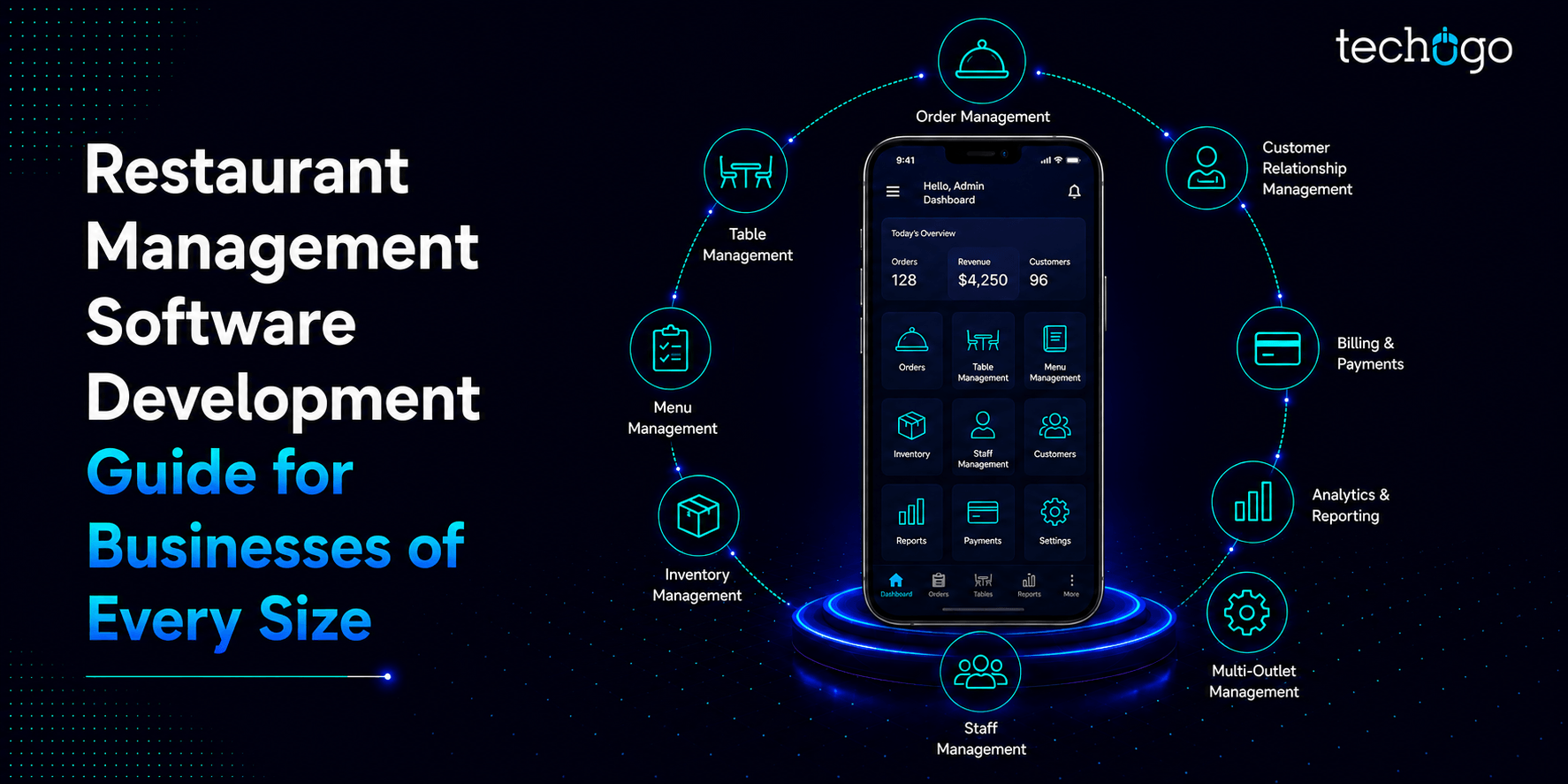
This is why businesses are investing in restaurant management software development. It brings all your day-to-day operations into one place and makes it easier for you to manage your restaurant.
If you’re thinking about building your own platform, this is a good place to start.
We will guide you through everything you need to know about it – including its benefits, types, features, use cases, development process, costs, AI trends and the challenges you should be prepared for.
Why the demand for restaurant management software development is high right now
Well, running a restaurant today is harder than it used to be at a time.
And you’re wrong if you think that the demand is anecdotal.
The global market for restaurant management software is expected to jump from around $7.6 billion in 2026 to $24.1 billion by 2033 (that’s an 18% CAGR) which is a big jump for any industry. (Source: Grand View Research)
The stats themselves are not the only reason behind the growing demand for restaurant management software development. There’s a lot more out there fueling this demand.
Want to know?
Take a look –
1. Operational efficiency – A restaurant management system automates everyday tasks and hence reduces all the manual work
2. Changing customer expectations – Online ordering, digital payments and restaurant reservation software have become the standard. And this standard makes it easier for customers to book tables and place orders.
3. Centralized management – It’s a struggle to manage 5 different apps just to run one restaurant. Most owners would rather have inventory, reservations, staff schedules, payments, and reporting all living on one platform instead of switching back and forth all day.
4. Data-driven decision making – Real-time insights help restaurant owners track sales, monitor inventory, identify trends and improve profitability.
5. Business scalability – Scaling is the whole point of running any business in general. And restaurant management software development makes it possible to build such a system that helps you scale faster than anything.
Now that we know the reason behind the hype of building a restaurant management software, let’s explore its types.
Different types of restaurant management software
1. Point of sale (POS) software
POS is a type of software that handles order processing, billing and payments. And when you have proper restaurant POS integration, it connects to your inventory, accounting, customer data too, so things aren’t separated.
2. Inventory management software
Tracks your stock in real time. Therefore, you’re not overordering, and you’re also not running out mid-service which happens more than you’d think.
3. Reservation & table management software
Its job is to make the entire process of table bookings, waitlists and seating arrangements easy while improving the overall dining experience for customers as a side quest.
4. Staff & payroll management software
Schedules, payroll and labor costs are A LOT to manage. This type of restaurant management software puts it all in one place so you’re not stuck with ten different spreadsheets open at once.
5. All-in-one restaurant management software
Combines – POS, inventory, reservations, staff management, reporting and customer management into one centralized solution. In order to build such a custom platform… businesses choose to work with a restaurant management software development company that can fit their workflow
Look, neither are all businesses the same, nor is the software they need. It’s for you to figure out what works for your setup.
You can go with just one tool, or combine a few, but the goal is usually one restaurant management system that works, for you especially.
Custom software development for restaurants vs ready-made software
Not sure whether to build a custom platform or use an off-the-shelf solution?
The table below compares both options to help you decide which approach best fits your restaurant’s needs.
| Factor | Custom Restaurant Software | Ready-Made Software |
| Customization | Built around your restaurant’s workflows and business needs. | Limited customization with predefined features. |
| Scalability | Easily scales as you add locations, users and new features. | Scaling can be limited by the platform’s capabilities. |
| Integrations | Supports custom POS, payment, CRM and third-party integrations. | Integrations are limited to what the vendor provides. |
| Upfront Cost | Higher initial investment but greater long-term value. | Lower upfront cost with recurring subscription fees. |
| Ownership | You own the software and have full control over updates and data. | The vendor owns the platform and controls updates. |
| Best For | Growing restaurants, chains and businesses with unique requirements. | Small restaurants with standard operational needs and limited budgets. |
Business benefits of restaurant management software development
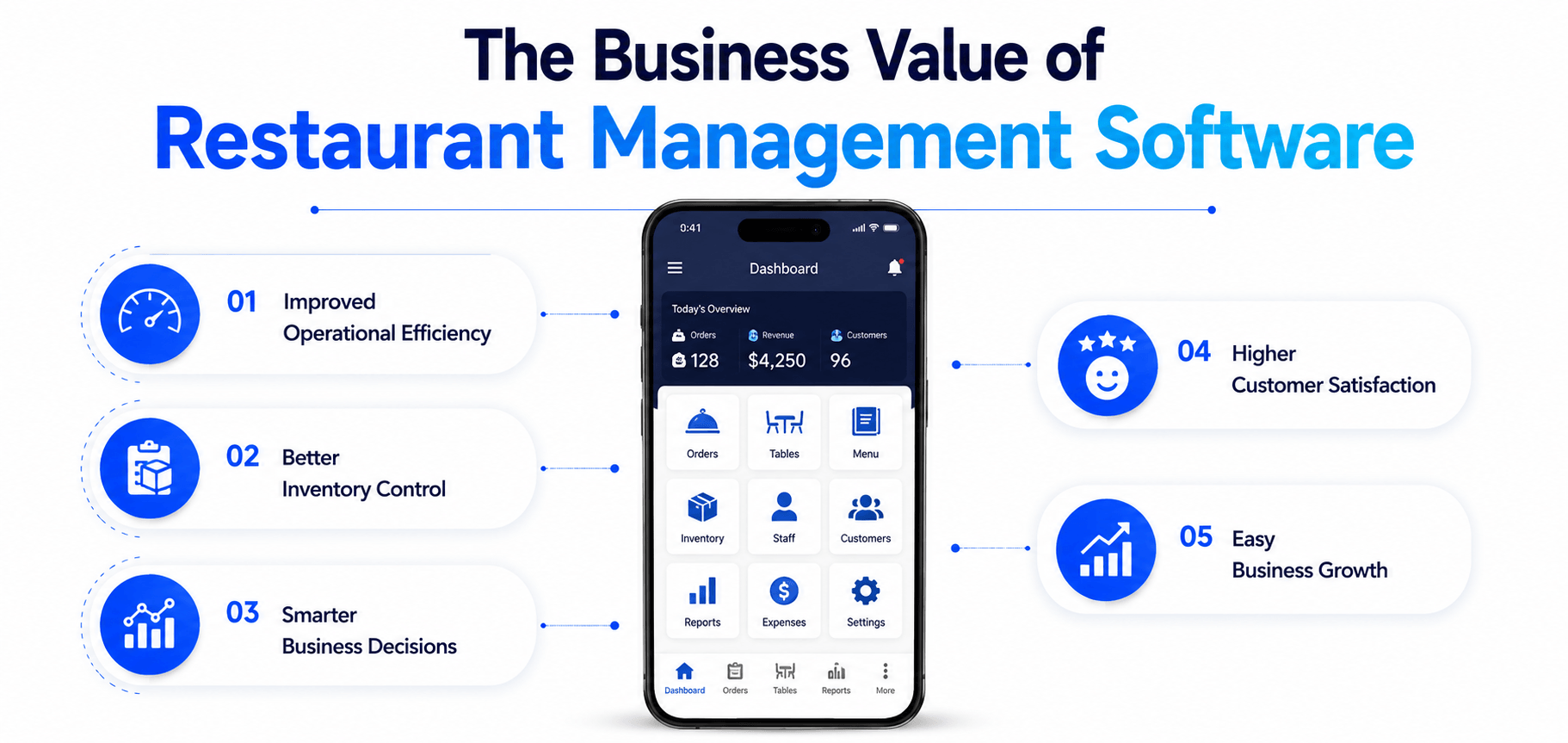
If you are investing in restaurant management software, you are not only replacing manual work, but also making your everyday operations easier.
Here are some of the business benefits of building a restaurant management software:
1. Improved operational efficiency
When your orders, reservations, payments, staff schedules and reports aren’t scattered across five different tools (we’ve all been there), everything works better… and it’s because of the restaurant inventory management system.
2. Better inventory control
Another benefit it serves is – better control over the inventory. A good restaurant inventory management system shows you what you’ve actually got, so you’re not overordering stuff or running out of chicken out of nowhere. It saves money, and it saves your sanity too.
3. Smarter business decisions
You also get to actually see what’s working because of the real time dashboards. And it makes it easier to identify opportunities for improvement.
4. Higher customer satisfaction
This is one of the biggest benefits of getting out of software development.
Because – happy customer, happy business.
You know when a customer is able to order online & pay without fumbling for cash, earn a little something through loyalty perks or book a table without picking up the phone, they notice. And they come back. It’s the little things… and that’s the whole point.
5. Easy business growth
When it’s finally time for your restaurant to grow, custom software development makes it simple to add –
- new locations
- new users
- and new features
You scale, but nothing falls apart along the way.
Restaurant software solutions for different business sizes
1. Quick-service restaurants (QSRs)
QSRs lean on it to push through high order volumes fast, take payments quickly and keep wait times down during rush hour.
2. Full-service restaurants
For dine-in spots, it’s more about managing reservations, staff schedules, billing and just keeping the floor running.
3. Cloud kitchens
Cloud kitchens? They basically live on tech, which is why a lot of them pair restaurant management software development with delivery tools to keep orders and inventory in sync.
4. Cafés & bakeries
Cafés and bakeries use it too, mostly for tracking stock, running loyalty programs and making billing less of a hassle.
5. Restaurants with online delivery
If you’re doing online delivery, chances are you’re working with a food delivery app development company to build ordering platforms that work alongside your restaurant system properly.
6. Multi-location restaurant chains
Well, for chains with multiple locations, centralized dashboards make life easier. Though a lot of them bring in software development consulting to build something that can scale as they grow in the market.
Essential features every restaurant management software should include
-
Order and POS management
Orders come from everywhere – dine-in, takeaway, delivery apps and what not. And it’s all online. Restaurant software solutions bring it all onto one screen, so you can manage every order without switching between systems..
-
Inventory and stock control
Real-time inventory tracking shows you exactly what stock you have left. You catch shortages early, reduce food waste & order supplies before you run out.
-
Reporting and analytics
Clear reports on sales, staff, and what’s actually selling mean you stop making assumptions. The numbers will show you what’s working.
-
CRM
CRM (which stands for “customer relationship management”) tools give you customer profiles and order history, so you understand your regulars what they order, what they like, how often they visit. This makes it easier to keep them coming back.
-
Staff management
Of course, it’s also about your team. Scheduling, attendance and payroll is a big chunk of what modern restaurant software development handles these days.
-
AI chatbots
You would not need your staff answering every late-night question. AI chatbots in restaurants will handle reservations, basic questions (and even orders) any time of day, just so that your team can focus on the customers right in front of them.
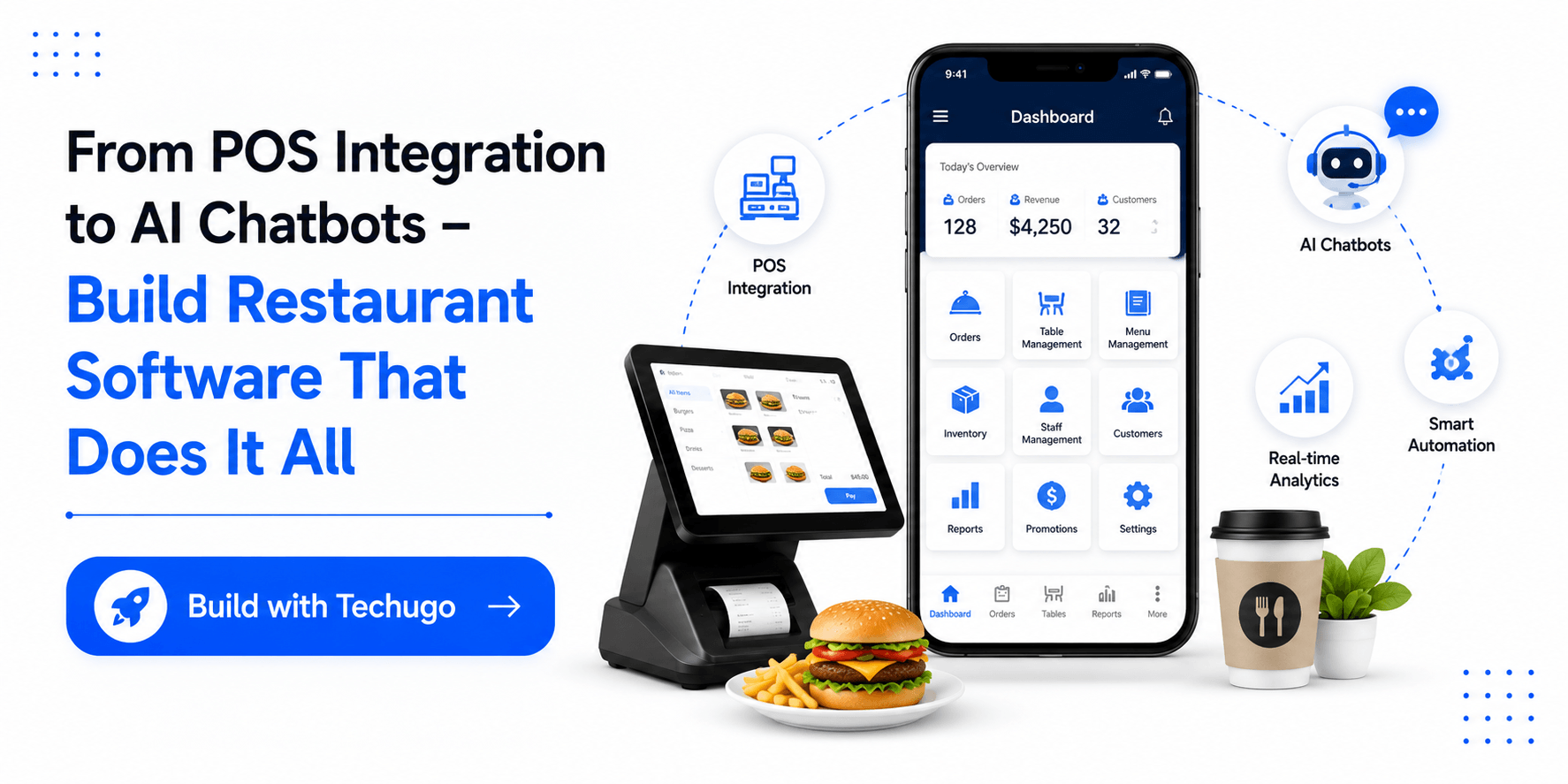
AI features in restaurant management software
1. Hyper-personalized guest experiences
It adjusts the menu placement & highlights the high performing dishes. This is based on customer preferences but also sales data so that restaurants are able to sell more of what actually works.
2. AI-powered staff scheduling
This creates optimized employee schedules and it is based on predicted demand, availability and labor costs because you don’t want to overstaff or understaff (which has been a huge problem for restaurants for years).
3. Computer vision for kitchen monitoring
Cameras and AI – they are used to monitor food preparation, and therefore it reduces errors so that quality standards are maintained (something that was hard to do manually before).
4. Voice AI ordering
It enables customers to place orders through AI-powered voice assistants. This improves speed but also accuracy so you get fewer mistakes & faster service.
Also Read – How Does an AI Voice Ordering System Work
Fraud detection
It identifies – suspicious transactions, refund abuse and unusual ordering patterns. That’s how it reduces revenue losses.
What does it cost to build a restaurant management software?
If you’re hoping for a fixed number, there isn’t really one.
Some restaurants just want a system to handle orders, billing & inventory. Others need –
- online ordering
- loyalty programs
- kitchen display systems
- multiple branches
- delivery integrations
- and custom reporting
All of this in a single platform. But those two projects won’t cost the same.
In most cases, businesses can expect to invest anywhere between $25,000 and $150,000+.
Here’s the breakdown you’re looking for –
| Project complexity | Estimated cost | Best for |
| Basic | $25,000–$50,000 | Single-location restaurants looking for essential features like POS, inventory management & order tracking. |
| Mid-Level | $50,000–$90,000 | Restaurants that need reservations, loyalty programs, online ordering, CRM and support for multiple locations. |
| Advanced | $90,000–$150,000+ | Large restaurant businesses requiring AI features, custom integrations, analytics, mobile apps and enterprise-level automation. |
So the cost to build a restaurant management software depends on the size of your project. If it’s a basic (MVP level) software it would cost comparatively less than an advanced one, for obvious reasons.
And it’s reasonable as well.
Because a few standard modules are relatively quick to build. Custom features, third-party integrations and a fully customized restaurant management platform take more time. And it can increase the overall budget.
This is exactly why many businesses start by identifying their must-have features first and then work with restaurant software development services to build the rest in phases.
Step-by-step restaurant management software development process
Well, now that you are thinking about the development… your entire restaurant management software development process will go through these five crucial phases –
Phase 1 – Discovery and requirement planning
First step in any restaurant management software development project is just talking it through. Talk about what the business needs, what’s broken right now, what features actually matter. Sounds obvious but skip it and you end up rebuilding half the platform later. Costs way more than getting it right at the start.
Phase 2 – UI/UX design
Now comes the design work. Wireframes, screens, all of it built for the people who’ll actually use it daily – owners, staff, managers and customers. Taking an order or pulling a report shouldn’t take five clicks.
Phase 3 – Development and integrations
Then the actual building starts. POS, payment gateways, inventory, delivery platforms, CRM – all of it has to connect and work simultaneously. And if restaurant mobile app development is part of the plan, the customer and staff apps get built right alongside the main platform, so nothing feels disconnected later.
Phase 4 – Testing and deployment
Nothing goes live untested. Bugs get found, performance gets checked, features get double checked to make sure they actually do what they’re supposed to. Once that’s done, it goes live, and someone’s watching closely to catch anything that slips through.
Phase 5 – Maintenance and updates
Your app is now built, tested and deployed. It might work fine as well… but for how long? In order to make sure it works fine in a long term, constant maintenance is necessary. User demands changes along with your time, that’s why constant updates are also necessary. Updates, security patches, small fixes here and there – that’s what keeps things running as the restaurant grows.
Common challenges in restaurant management software development (& how to solve them)
Worrying about the challenges? Don’t worry.
Below, we have listed all the challenges that you might have to face along with their solutions.
1. Integrating multiple systems
Challenge: Restaurants often use separate tools for POS, payments, inventory & online ordering – and because these systems weren’t built for each other, staff end up doing the same work twice.
Solution: To deal with this, you build APIs and integrations that let all systems share data in real time, this creates a connected workflow, and that’s what reliable restaurant software development is really about.
2. Handling peak-time traffic
Challenge: Performance can slow down during peak hours because orders increase rapidly, and when that happens the whole system feels it.
Solution: You use scalable cloud infrastructure, but it has to be optimized too. Therefore the platform can handle traffic without speed or reliability taking a hit.
3. Keeping customer data consistent
Challenge: Information can become fragmented across websites, delivery platforms and a restaurant reservation app. So a customer’s details are never quite the same in two places.
Solution: Centralize customer data so that reservations, orders, and loyalty information stay synchronized across every channel. This way nothing gets lost, and everything you need is in one place.
4. Scaling as the business grows
Challenge: New locations and services often require additional functionality, but most systems weren’t designed for that kind of growth.
Solution: You build a flexible architecture. One that makes future updates and feature additions easier. And because of that, you’re not rebuilding the entire platform every time something new gets added.
Restaurant management software development trends to watch in 2026
Restaurant Management Software Development: What’s New in 2026??
-
AI-powered automation
AI is automating things like inventory, staff scheduling, order processing and demand forecasting, so that restaurants don’t have to do it all by hand. Because of this they run more efficiently.
-
Contactless dining
Contactless dining is still a big priority. You see it everywhere, QR menus, kiosks, digital ordering and cashless payments – these were once extra, but now they are standard, so restaurants deliver faster service.
-
Generative AI
Generative AI, meanwhile, is changing how restaurants converse with the customers, it powers chatbots and recommendations and content, so businesses respond quicker and the engagement goes up.
-
IoT-enabled kitchens
Smart devices track temperature and equipment, and when linked with a management system, downtime drops and food safety improves.
-
Cloud-native restaurant platforms
Cloud platforms let you access data anywhere, and they’ve been making updates easier too.
-
Business intelligence & predictive analytics
Analytics basically tools help you forecast demand, therefore decisions are faster.
This is why restaurant management software development has been shifting more and more toward real time insights (because owners want information they can act on right away).
Why hire a restaurant management software development company?
The reasons why you should hire a professional restaurant management software development company for your project are as follows –
-
Industry expertise
An experienced team gets it. They’d understand your workflows, your customer’s expectations, the day-to-day operational struggles and basically everything.
-
Custom development & integrations
A dev partner can build custom features and tie your POS, payment gateways, CRM, inventory management and delivery platforms into one system that works as a whole.
-
Scalable & secure solutions
Your software needs to keep up with the pace of growth. Custom restaurant management software development means your platform can handle new locations, new users, new features.
-
Ongoing support & maintenance
For post-launch maintenance, you will need a partner who will help you with all the updates, bug fixes, security patches and performance improvements. This way, your software will work just fine long after go-live.
How Techugo helps build high-performance restaurant management software
Restaurant tech is crowded right now. Everyone is claiming to build the same “seamless, scalable” platform. And half the time it just means an app that looks nice in the demo but has bugs hidden behind that demo.
We’re Techugo, a mobile app development company that builds restaurant management software the right way – by talking to you about how your restaurant work before we start the project.
Some of what that looks like in practice – a well-working cloud architecture, automation that removes bottlenecks (not automation for its own sake), AI chatbots/intelligent features that improve customer service and integrations with the POS, delivery apps and inventory tools you’re already using.
We build in short cycles, so you are seeing working versions early instead of waiting months for a big reveal. And once it’s live, we don’t vanish. We stay on to fix what breaks and adjust as your restaurant changes.
So with us, you get more than a “seamless and scalable” software. You get a software that’s –
-
- seamless
- scalable
- secure
- stable
- smart
Whether you are starting from scratch or upgrading an existing system, Techugo is here to help you build it right. Get in touch with our team and let’s get started!
FAQs
1. How much does restaurant management software development cost?
Though the range is – $25,000 and $150,000+… but the answer still depends on the features, integrations, and overall complexity of the project. The best way to get an accurate estimate is through a consultation.
2. How long does it take to build restaurant management software?
Most projects take a few months but the exact timeline depends on the scope and the features you need.
3. What features should restaurant management software include?
Core features usually include – POS integration, online ordering, inventory management, reservations, staff scheduling, payments & reporting (AI-powered features are becoming increasingly popular too).
4. Why choose custom restaurant management software?
Simple. Because it’s built around your restaurant’s needs. You get the features you actually need, better flexibility, and software that can grow with your business.

Get in touch
We'd love to hear from you.