 SA
 KW
 IE
 AU
 UAE
 UK
 USA
 CA
 DE
 QA
 ZA
 BH
 NL
 MU
 FR















📌 Key Takeaways
- The cost for a basic or MVP is around OMR 3,500 – OMR 5,000.
- For basic apps, the timeline is around 1 – 2 months, but for complex/high-end applications, it is 6 – 14+ months.
- Features that affect the overall development cost include payment integration, GPS, and chat.
- Fintech apps are the costliest to develop, but Education & E-Commerce applications cost the least.
- To choose between ready-made vs custom, compare total costs over a 2-3 year period or even more.
Have you ever considered turning your business concept into a mobile app but are unsure about the costs? Whether you want to launch an e-commerce platform, a food delivery app, or a digital solution for your company, understanding the budget is one of the first steps toward making your idea a reality.
So, let’s break down mobile app development costs in Oman in a practical, easy-to-understand way.
What Will Be The Mobile App Development Cost In Oman In 2027?
Wanting to know about the mobile app development cost in Oman is always a good idea. It gives you a rough understanding of what your budget should be for custom mobile app development or even a specific one.
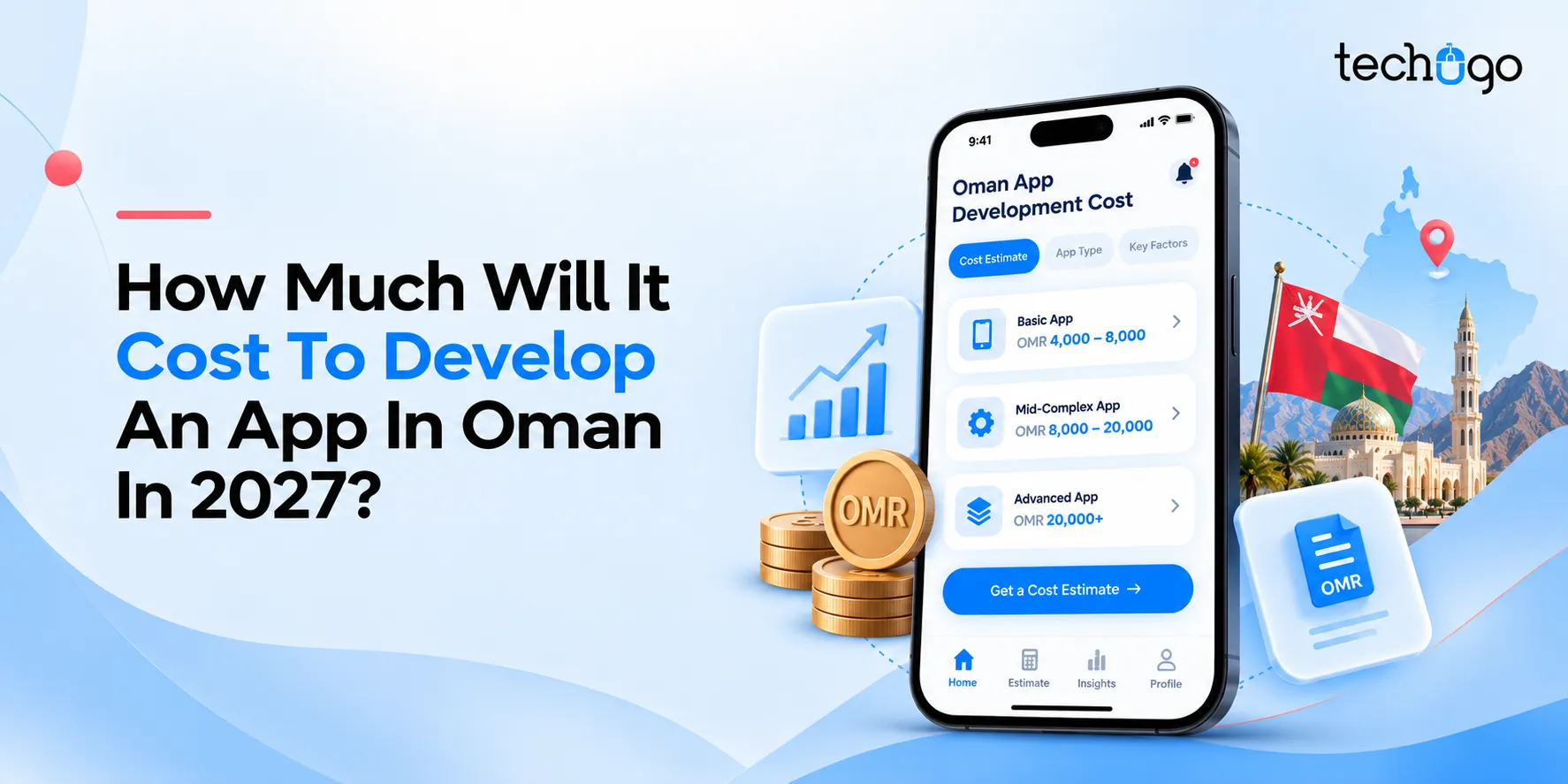
So, for planning purposes, the following figures offer illustrative estimates for 2027 that make sense for the Omani market:
| App Type | Estimated Cost (OMR) | Typical Development Timeline |
| Basic / MVP App | OMR 3,500 – OMR 5,000 | 1 – 2 Months |
| Medium Complexity App | OMR 5,000 – OMR 12,000 | 5 – 8 Months |
| High-Level Complexity App | OMR 12,000 – OMR 25,000 | 6 – 12+ Months |
| Enterprise-Level App | OMR 25,000 – OMR 50,000+ | 6 – 14+ Months |
Want To Know The Cost of Your Mobile App In Oman?
Contact Techugo to discuss everything you need to know about the app.
What Will Be The Hourly Rates For Mobile App Developers In Oman?
If your plan is to develop a mobile application, one of the initial questions you will probably ask is, “How much do app developers in Oman charge on a per-hour basis?” The answer depends on several factors, including the developer’s experience, technical skills, and project complexity. Therefore, the cost includes:
| Developer Type | Estimated Hourly Rates (OMR) | Best Suited For |
| Junior Developer | OMR 6 – OMR 12 | Basic features, bug fixes, and routine coding |
| Mid-Level Developer | OMR 12 – OMR 20 | Standard mobile apps, API integrations, and backend features |
| Senior Developer | OMR 20 – OMR 35+ | Complex applications, architecture, and performance optimisation |
| Specialised AI Developer | Depends on expertise and project scope | AI integrations, machine learning, and intelligent automation |
What Factors Affect Mobile App Development Cost In Oman?
Why can two mobile apps with seemingly similar purposes have very different development costs? This must be one of the questions that might be popping into your mind when you are looking for mobile app development in Oman.
So, to understand this better, here are some of the main factors affecting the cost:
1. The App Complexity
The number of functionalities plays an important role in determining the costs of development. An application that only has static content and a couple of forms requires less effort compared to one that is designed to interact with users, process payments, and send out real-time notifications.
Before you start developing an application or ask the mobile app development company in Oman, make sure you know exactly what functionalities your users may require.
2. Choice of Platform: Android, iOS, or Both?
The platform (Android, iOS, or both) you choose to launch your app on directly affects the overall development cost. This is generally person to person. Some entrepreneurs might want to make the app iOS-specific, or some want it to be Android-specific.
Or do you want to take a broader approach by launching on both platforms? But keep this in mind: the broader approach is expensive. Moreover, Flutter app development is a viable option here.
3. Features & Functionality
Login systems, payment mechanisms, chat, GPS tracking, push notifications, and beyond are all what require development effort. These features and functionality eat up the major chunk of the development cost.
So, testing the market and how your application performs in Oman is going to be crucial. Thus, for this, you can ask for MVP development.
4. Backend Development & Third-Party Integrations
Many apps rely on a backend to store data, process transactions, manage user accounts, handle notifications, and run business processes. Payment processors, geo-location services, customer relationship management systems, inventory applications, and delivery systems are only a few examples of integrations that can make the process more complex. To get the best of everything, you can ask for React Native app development also.
5. Security, Testing & Compliance
Mobile app development services must be driven by development teams that may need to implement secure authentication, encryption, access control, data protection measures, and beyond. Mobile applications being in regulated industries may just require additional compliance work.
Security is particularly important when your application handles personal information, financial transactions, or sensitive business data, which is vital for enterprise mobile app development. Moreover, testing should not be treated as an optional expense. Functional testing, performance testing, device compatibility checks, and security assessments help identify issues before they affect real users.
How Can You Reduce Mobile App Development Costs Without Compromising Quality?
Sometimes, developing a quality mobile app doesn’t necessarily mean that you have to pay a huge amount. Unnecessary costs can be controlled with smart decisions and proper planning, which outlines when and how you can save Omani Riyals.
So, the following are some of the tested methods to control and even reduce costs without compromising quality:
1. Begin With An MVP (Minimum Viable Product): MVP is a smart method to reduce development costs and even test your target market. This is truly 2 birds 1 stone approach. Under this, all the important features will be integrated, and it is helpful in collecting important user feedback on the go.
2. Prioritise Features Before Development Begins: You can also create lists and divide them into three sections: must have, should have, and nice to have. With this simple exercise, you can easily prioritise elements that will make your application perform in the best manner possible.
3. Choose The Right Technology: To cut expenses, you can choose cross-platform app development if you need software for both Android & iOS. But remember, this involves managing only a single shared codebase. But if your app is platform-specific, then native app development is the way for you.
4. Take Help From Pre-Built Models & APIs: Instead of doing everything by yourself, take help from reliable third-party APIs for payments, maps, authentication, and beyond. By doing this, there is less stress on your pocket as well as time.
5. Structure Clear Requirements: When working with mobile app development services, you need to clearly say what you are looking for. There should be no room for confusion or misinterpretations.
How App Type Influences The Cost?
Industry requirements can significantly affect the cost of developing an app. While some businesses need only basic customer-facing functionality, others require advanced integrations, strong security, or specialised operational workflows. So, let’s explore how this works:
| App Type | Key Features Affecting Cost | Estimated Cost (OMR) |
| E-Commerce App | Product catalogues, shopping carts, payment gateways, inventory management | OMR 3,000 – OMR 12,000+ |
| Food Delivery App | Restaurant listings, real-time order tracking, GPS, delivery management | OMR 4,000 – OMR 15,000+ |
| Healthcare App | Appointment booking, teleconsultations, patient records, data security | OMR 5,000 – OMR 20,000+ |
| Education App | Online courses, video lessons, quizzes, progress tracking, student dashboards | OMR 3,000 – OMR 12,000+ |
| Fintech App | Secure transactions, identity verification, payment integrations, fraud monitoring | OMR 8,000 – OMR 25,000+ |
| Travel & Tourism App | Hotel & Tour bookings, multilingual support, maps, itineraries, booking integrations | OMR 4,000 – OMR 15,000+ |
Cost To Build An AI-Powered Mobile App In Oman
The introduction of AI is opening new possibilities in the world of mobile software development in the Middle East and especially in Oman. From virtual assistants to personalised shopping recommendations, there is a lot more to grow into. So, if you are willing, the cost to build an AI-powered application looks like this:
| AI App Type | Estimated Development Cost (OMR) |
| Basic AI-Enabled App | OMR 4,000 – OMR 8,000 |
| Mid-Level AI App | OMR 8,000 – OMR 14,000 |
| Advanced AI App | OMR 14,000 – OMR 30,000+ |
| Enterprise AI App | OMR 30,000 – OMR 50,000+ |
Custom Mobile App Development vs Ready-Made Solutions? Which One To Choose Based on Cost?
Should you build an app specifically for your business, or choose an existing custom mobile app development solution that can be configured to meet your needs? There is no single answer. The right option depends on your budget, business model, required features, and long-term plans.
1. What is Custom Mobile App Development?
Custom mobile app development means creating an application around your specific business requirements. The design, functionality, workflows, and integrations are selected to suit your objectives.
2. What are Ready-Made App Solutions?
Ready-made solutions are existing platforms or software products that can be configured for your business. This is great for solutions that closely match the features you are looking for.
| Factor | Custom App | Ready-Made Solution |
| Initial Investment | Usually higher | Often lower |
| Time To Launch | Depends on complexity | Often faster |
| Customization | High | Limited to platform capabilities |
| Ongoing Expenses | Maintenance and hosting, as applicable | Subscriptions, add-ons, usage fees |
| Scalability | Can be designed around business needs | Depends on platform limitations |
| Ownership & Control | Depends on contract and licensing | Usually governed by the provider’s terms |
3. Which One Should You Choose?
A ready-made solution may be the better choice if you need to validate a business idea quickly, have a limited budget, or require standard features such as booking, product listings, or appointment scheduling.
Custom development may be more appropriate when your business depends on unique workflows, specialised integrations, differentiated user experiences, or functionality that existing platforms cannot provide.
So, before deciding, compare the total cost over two or three years rather than looking only at the initial investment. You can include subscriptions, maintenance, integrations, transaction fees, and future upgrades.
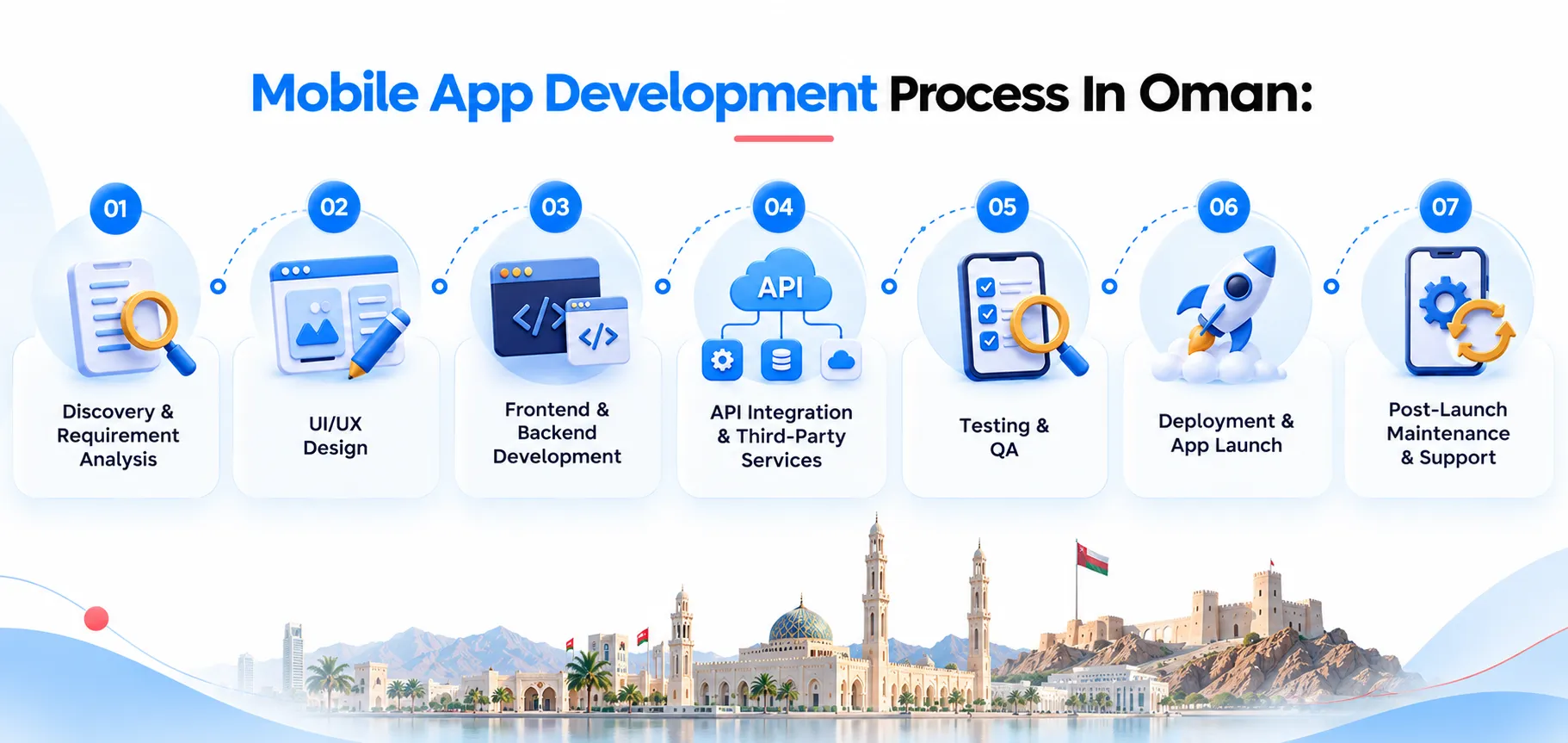
Mobile App Development Process In Oman (With Cost Estimation For Each)
It doesn’t matter if it is your first mobile app development project or you have done a few projects already in the past. The business processes remain the same every time you create an application.
Let’s analyse how to build a mobile app with estimated prices for its implementation.
1. Discovery & Requirement Analysis
A successful application needs to start with a solid plan before going into the development process. This is important because developers need to know exactly what your business goals are, who your target audience is, and what the main functions or specifications of the technology used are.
At this stage, the programmers and project manager define the project scope, conduct an analysis of users’ expectations, foresee possible problems, and create a development strategy.
Estimated budget allocation: 5 – 10%
2. UI/UX Design
After figuring out the requirements, the next step is to plan the look and feel of your application. The next step in the UI/UX design process consists of building wireframes and screen layouts, making interactive prototypes, creating visual designs, and establishing user journey maps.
Estimated budget allocation: 10 – 15%
3. Frontend & Backend Development
Development usually represents the highest proportion of a mobile app development budget, as this is the stage of constructing functionality itself.
Frontend development refers to all the things that users interact with — the screens, buttons, forms, navigation, and dashboards. Backend development is concerned with databases, authentication, business logic, data processing, and communication between different systems.
Estimated budget allocation: 40 – 50%
4. API Integration & Third Party Services
Multiple mobile applications depend on mobile app development companies to work properly. This is typically achieved through APIs, which serve as links between different systems.
Depending on the business needs, you can apply integrations like payment gateways, location services, SMS confirmation, email alerts, customer relationship management apps, and systems for stock management.
Estimated budget allocation: 5 – 10%
5. Testing & QA
Thorough testing is essential before an app reaches any users. An app, no matter how well built, will often run into bugs, performance, and compatibility problems if the testing is not conducted properly.
Quality assurance consists of different forms of testing: functional, device compatibility, usability, performance, and security.
Estimated budget allocation: 10 – 15%
6. Deployment & App Launch
When application development and testing have finished, preparation for app launch should begin. This stage encompasses production setup, server preparation, preparing app store listings, creating release versions, configuring analytics, and uploading the app to the app store.
Both operating systems have specific rules regarding submission and review of applications when releasing to Android (Android app development) and iOS (iOS app development).
Estimated budget allocation: 2 – 5%
7. Post-Launch Maintenance & Support
The start of your application’s journey comes after it has already been released. Once your application is launched, it should be monitored for performance, bugs should be fixed, security updates applied, and compatibility ensured with the ever-changing systems and platforms.
Moreover, you could consider adding new functions as your company grows or your users share their opinions about your application. Here, AI app development is a major factor.
Most often, it makes more sense to regard maintenance as an ongoing cost rather than part of the initial development stage.
Estimated budget allocation: 10 – 20% of the development cost per year.
Ready To Build Your First Mobile App In Oman?
Get a step-by-step description of your mobile app.
How Much Will It Cost To Maintain A Mobile App In Oman?
The development of your app is an important achievement, but what follows after users start downloading it? A mobile app, just like any other digital product, needs to be updated regularly in order to remain functional, secure and compatible with evolving devices.
So, take a look at the maintenance costs of a mobile application in Oman:
| Maintenance Type | Estimated Monthly Cost (OMR) |
| Basic Maintenance | OMR 100 – OMR 200 |
| Standard Maintenance | OMR 200 – OMR 500 |
| Advanced Maintenance | OMR 500 – OMR 800+ |
What Is The Expected Return On Investment (ROI) of A Mobile App?
Developing a mobile application is an investment, so it’s natural to ask how much value it can generate for your business. The ROI helps in understanding the financial gain or loss related to the investment made.
But for a mobile app, that value may come from additional sales, lower operational expenses, enhanced customer retention, or improved employee productivity. However, there’s no guaranteed ROI for mobile software development in Oman. The outcome depends on your business model, target audience, app quality, marketing strategy, and the ability to encourage users to choose it.
How Can Techugo Help You Succeed In The Omani Market?
Choosing a mobile app development company in Oman is an important decision because the team you work with can influence your app’s quality, usability, launch timeline, and long-term maintenance costs.
If you are exploring legacy app modernization or even a new application in Oman, Techugo is something you can always connect with.
The Final Word
So, what is the cost to build a mobile app in Oman in 2027? The answer depends on the type of application being developed; it depends on features and services that should be part of your app, the platforms that will run the app, and technology requirements for app development. After all is said and done, the only thing that needs doing is to set up business objectives and priorities for app development, and prepare for costs and maintenance of the app.
FAQs
Q) What hidden costs should businesses consider when developing a mobile app in Oman?
In addition to the initial costs of development, businesses must account for expenses such as hosting, domains, cloud services, subscriptions from third parties, fees associated with app stores, transaction processing fees, and continuous technical assistance services.
Q) Is it better to hire a freelance app developer or a mobile app development company?
Freelance developers might be a viable option for projects that are simple in terms of requirements and budget. Mobile app development companies offer the services of a larger team that consists of designers, developers, QA specialists, and project managers.
Q) How much does it cost to add Arabic and English language support to a mobile application?
Factors responsible for the cost are how many screens are used, the total amount of information contained, and how difficult the interface is. In terms of Arabic support, the right-to-left layout is required along with translated material, proper fonts, and extra testing procedures.
Q) Can I develop a mobile app in Oman with a limited startup budget?
Yes. A startup can have a limited first launch targeting a significant issue that the customer has. The company should concentrate on the most basic steps in user progression, holding back on unnecessary features.
Q) How long does it take to develop a mobile app in Oman?
However, the time span needed to develop a mobile app in Oman will depend on its feature set, complexity level, and technical requirements. A basic mobile app could take anywhere from 1 to 2 months, a medium-complexity app from 5 to 8 months, while a complex enterprise app may take longer than 6 to 14 months, determined primarily by the scope of the project.

Get in touch
We'd love to hear from you.