

 SA
SA
 KW
KW
 IE
IE AU
AU UAE
UAE UK
UK USA
USA
 CA
CA DE
DE
 QA
QA ZA
ZA
 BH
BH NL
NL
 MU
MU FR
FR

















📌 Key Takeaways
- A multi-vendor marketplace brings customers, vendors, and admins together on one platform.
- The technology stack that you choose will depend on the volume of sellers, items, clients, orders, and integrations that you plan to have.
- The cost of developing a multi-vendor marketplace ranges from $40,000 to over $200,000.
- Managing vendors, payments, orders, product quality, trust and future growth are some of the main challenges to plan for.
There’s a lot more to running an online marketplace than simply listing products and taking orders. This is why multi-vendor marketplace development needs careful planning. When done right, marketplace app development brings different marketplace operations together instead of making vendors and customers deal with separate systems.
But what does it take to build one? From essential features and the development process to technology choices and overall cost, there’s quite a bit to consider before getting started. This guide breaks it all down so you know what goes into building a multi-vendor marketplace.
What is a multi-vendor marketplace & how does it work?
A multi-vendor marketplace is an online storefront that is operated by several merchants – where they can sell their goods or services via a single website or mobile application. It’s not like any ordinary online store. It enables various vendors to utilize the same platform and enables the marketplace owner to take care of the system as a whole.
There are typically three types of users in a multi-vendor marketplace development –
Customers: They can browse products from various vendors, compare products, place orders, make payments and track product deliveries.
Vendors: Profiles can be created, products can be added, inventory can be updated and orders/sales can be managed from one place.
Admin: The marketplace owner controls the activities of the marketplace, including the management of vendors, products, orders, commissions, payments, etc., from the back end.
Different user journeys are developed by a multi-vendor marketplace developer and then linked via a single platform. For this, businesses can turn to eCommerce app development, particularly if they aim to offer their marketplace through a mobile application.
The basic working process is relatively simple –
Vendor registration → Product listing → Customer browsing → Order placement → Payment → Order fulfillment → Vendor payout
It enables several sellers to connect customers to the platform without having to create and operate their own web stores.
Types of multi-vendor marketplaces
Multi-vendor marketplaces can be designed in various ways, depending on the product offered, the types of vendors involved and how customers order. Some common types are:
1. Product marketplaces – Several different sellers offer physical products, like clothes, electronics, or groceries.
2. Service marketplaces – Users are able to find and hire professionals to provide services, like cleaning and repairs, or consulting.
3. Rental marketplaces – Vendors post products or properties that customers can rent for a short duration.
4. B2B marketplaces – Companies can interact with suppliers, manufacturers, or other companies to buy products or services in bulk.
5. Hybrid marketplaces – These marketplaces are a mix of various marketplace types, such as products and services, and provide them on one platform.
Multi-vendor eCommerce website features to consider
A marketplace can get complicated pretty quickly when customers, vendors, and admins all have different things to manage. That’s why choosing the right multi-vendor eCommerce website features is so important. During multi-vendor marketplace development, each side needs specific tools to handle their activities
So, what features should you actually include? Let’s take a look.
Customer-side features
- User profiles: Manage details and addresses.
- Search and filters: Find products faster.
- Product listings: View product information.
- Shopping cart: Review selected products.
- Payment options: Choose preferred payment methods.
- Order tracking: Follow delivery updates.
- Reviews and ratings: Share product feedback.
- Wishlist: Save products for later.
Vendor-side features
- Vendor registration: Sign up and get verified.
- Vendor dashboard: Manage store activities.
- Product management: Add and update products.
- Stock management: Keep stock updated.
- Order management: Track and manage orders.
- Sales tracking: Monitor sales performance.
- Promotions: Create deals and discounts.
- Payout management: Track payments and commissions.
Admin-side features
- Vendor management: Manage seller accounts.
- Product management: Review marketplace listings.
- Commission management: Set vendor commission rates.
- Order management: Monitor marketplace orders.
- Payment gateway integration: Handle payments and refunds.
- Analytics and reports: Track marketplace performance.
- Content management: Update website content.
Though these are features you would want in your multi-vendor eCommerce platform, you may not need all of them. In multi-vendor eCommerce development, the right features depend on how you plan for your marketplace to operate, who the vendors you want to have on your platform and what your customers want.
Wondering Which Features Your Marketplace Needs?
Build the right mix of customer, vendor, and admin features based on your marketplace model.
How to create a multi-vendor marketplace?
There’s quite a bit to figure out before you create a multi-vendor marketplace.
From deciding how sellers will manage their stores to making sure customers can actually find and buy what they need, every part of the platform has a role to play. These are the details worth sorting out before multi-vendor marketplace development gets underway.
So, where do you start? Here are the key steps.
1. Define your marketplace model
Firstly, determine the type of product or service you wish to offer and the customers you wish to cater.
Will vendors supply both physical products and digital goods, services, or a combination of all three? You will also have to choose the ways by which vendors will be involved and how your marketplace will be monetized.
2. Decide on the essential features
Next, determine the needs of each user. Product search, filters, reviews, secure payments, and order tracking are features that customers might want. Vendors must have tools to manage products, inventory, orders and sales. Admins should have control over listings, payments, vendors and other marketplace activities.
These features will be the backbone of your multi-vendor marketplace platform – from inventory management to order processing. There’s always more to add as your business expands.
3. Plan the user experience
Having plenty of features doesn’t mean much if the platform is difficult to use.
During multi-vendor eCommerce marketplace development, prioritize the ease of purchase. Vendors should also be able to run their stores without having to navigate through a labyrinth of screens!
4. Choose the right technology
Select technologies appropriate to your marketplace and its needs.
Consider the number of vendors, products, customers and transactions you will be dealing with. You’ll also have to consider payment gateways, shipping services, notifications, analytics – and other integrations.
5. Develop and integrate the platform
Once the requirements are established, development can be started. Typically, this involves the customer website, vendor dashboard and admin panel.
The development team will then be able to integrate the required services for running the marketplace, such as payments, shipping, inventory, notifications and vendor payouts.
6. Test before launching
Before launching the marketplace, test every aspect of the marketplace correctly. Review product listings, checkout, payments, refunds, order tracking and vendor payments. Test it on various devices and browsers as well. Addressing problems prior to launch is much better than having to deal with customer/vendor problems after the launch.
7. Launch and keep improving
Launching your multi-vendor marketplace platform is just the beginning.
Monitor customer reviews, vendor concerns, sales and utilization of the platform. This will enable you to identify the issues that need to be resolved and determine which features to add in the future.
Technology stack for multi-vendor marketplace development
Your choice of technology greatly influences the performance of your marketplace in the future. During multi-vendor ecommerce website development, it is important to select technologies that can process the orders and payments of your vendors, customers and products (along with the required integrations).
| Part of the platform | Technologies | Purpose |
| Frontend | React.js, Next.js, Vue.js | This is what customers and vendors see |
| Backend | Node.js, Python, Java, .NET | Runs orders, products, payments and accounts |
| Mobile app | Flutter, React Native, Swift, Kotlin | Lets users access the marketplace on mobile |
| Database | PostgreSQL, MySQL, MongoDB | Stores products, users, orders and vendor data |
| Cloud | AWS, Azure, Google Cloud | Hosts your marketplace and handles growing traffic |
| Payments | Stripe, PayPal, Razorpay | Handles customer payments and vendor payouts |
| Search | Elasticsearch, Algolia | Helps customers find products faster |
| Caching | Redis | Makes frequently used data load faster |
| Notifications | Firebase, Twilio, SendGrid | Sends order and payment updates |
| Analytics | Google Analytics, Mixpanel | Shows what customers do on your platform |
How much does it cost to build a multi-vendor e-commerce marketplace?
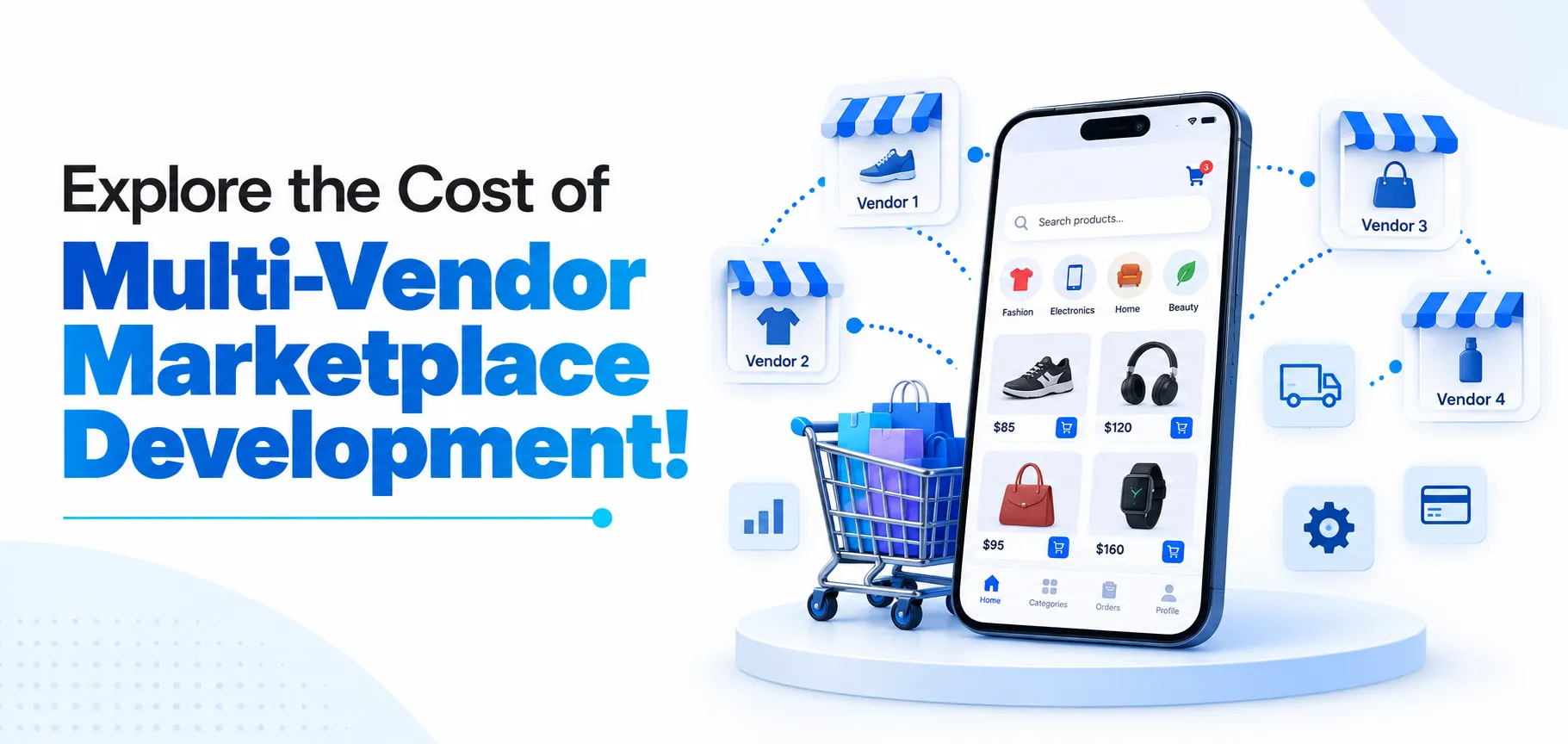
Marketplace app development cost is never constant. A basic platform might cost around $40,000 to $70,000… while more advanced marketplace platforms can cost over $200,000 if you include custom features, mobile applications, integrations, and so on.
| Marketplace type | Estimated cost | Development time |
| Basic | $40,000–$70,000 | 3–5 months |
| Mid-level | $70,000–$120,000 | 5–8 months |
| Advanced | $120,000–$200,000+ | 8–12+ months |
The total price of your multi-vendor eCommerce solution will be determined by your requirements. Features like dashboards, payment gateways, shipping integration, advanced search and custom features will increase the cost.
In case a customer or vendor app is planned as well, the marketplace app development cost will be calculated separately.
Multi-vendor marketplace business models
There are a few ways a multi-vendor marketplace can make money. The model you choose will depend on how your platform works and what you plan to charge vendors or customers for.
Here are some of the most common models –
| Business model | How it works |
| Commission-based | You earn a percentage from every sale or booking made through the platform |
| Subscription-based | Vendors pay a monthly or yearly fee to use the platform and its features |
| Listing fee | Vendors pay a fee to list their products or services |
| Freemium | Vendors can use basic features for free and pay for additional features |
| Advertising | Vendors pay to promote their products or services and reach more customers |
Challenges you may face when building a multi-vendor marketplace
1. Managing multiple vendors
There are hundreds of businesses in a marketplace that sell different products, at different prices, and have varying amounts of stock and policies. As the marketplace expands, it can be hard to keep everything in order and make sure vendors abide by marketplace policies. This needs to be considered from the very start of multi-vendor marketplace development.
2. Keeping product quality consistent
You cannot control every product listed by every vendor. Low-quality products, misleading product descriptions, or incorrect product images can impact customer trust. Quality can be maintained throughout your multi-vendor marketplace solution with the help of vendor approval, product guidelines, reviews and regular monitoring.
3. Handling payments and payouts
It is easy to get into a situation where you collect customer payments and pay various vendors and suppliers. You should have a platform that handles the processing fees, taxes, vendor payouts, commissions and maintains transaction records.
4. Managing orders and shipping
Customers can place orders for multiple vendors simultaneously, leading to more complicated order processing and shipping. You should be able to record each order, vendor, shipment, delivery change, and return without causing confusion for the customer.
5. Maintaining trust
When customers have a problem, they need prompt assistance, and vendors want fair policies and timely payments. Implementing clear refund and return policies, as well as dispute and review procedures, can help eCommerce solutions maintain trust between customers & vendors.
6. Scaling the marketplace
You can have just a few vendors and customers in your marketplace, but the workload can increase rapidly. The more products and orders are added, the more users and transactions the platform will have to handle, and the more resilient the platform needs to be to meet increasing demand. Your multi-vendor eCommerce website developers, who have experience working with multiple vendors, can help you create an architecture that’s ready to support this growth.
How to choose a multi-vendor marketplace development company
A capable development team is important, but choosing the right company involves looking at much more. You must have a team that understands how it is all interconnected between vendors, customers, payments, orders, and how the marketplace functions. Before selecting a partner for a multi-vendor marketplace development project, there are a few factors to consider.
1. Check their marketplace experience
Begin by checking out the company’s past marketplace projects. Do they have vendor dashboards, product management, order monitoring, commissions, reviews, payments and admin controls? Experience with different multi-vendor marketplace platforms may also give an indication of whether the team understands the difficulties of having multiple sellers and customers on a single platform.
2. Look at their technical expertise
Your development partner needs to be familiar with the technologies required for your marketplace. This can involve web and mobile app development, APIs, cloud infrastructure, databases, payment gateways, and integrating with third parties.
If you’re looking for a complete multi-vendor eCommerce marketplace solution, ensure the company can support customer-facing, vendor and admin systems.
3. Consider scalability
If there are fifty vendors in a marketplace, it’s going to be different when there are thousands of vendors and customers. Inquire about the company’s plans for handling more traffic, products, orders and transactions. A scalable structure can be useful for your platform to be able to expand your business without the need for a rebuild later on.
4. Review security practices
Your marketplace will collect customer information, vendor information, payment information and order information – and security will be an important part of your development plan.
Inquire with prospective development partners regarding authentication, data security, safe payment integration, access control measures and testing practices.
5. Understand their development process
When starting a business, ask them how they handle each phase of multi-vendor marketplace development. This should also entail planning, UI/UX design, development, testing, deployment, and continuous improvement. A clear process also helps to communicate timelines, responsibilities, deliverables and changes in the scope of the project.
6. Check post-launch support
Even after launching your marketplace, it will require attention.
As the platform expands, new functionality, bug fixes, security enhancements, performance optimizations and third-party integrations will be required. Therefore, see whether the company provides maintenance and support after launch or if it’s just deployment.
7. Compare pricing and engagement models
Discuss the similarities and differences between pricing and engagement models.
Don’t take the lowest bid you’ve received from a company just because they offer it. Look at the actual elements of each proposal, including design, development, testing, integrations, deployment and maintenance. This is particularly crucial when evaluating various multi-vendor marketplace platforms that can have different development needs, depending upon the features and business model.
8. Check whether they understand your business model
It is essential that a development team grasps the monetization strategy of your marketplace and how users will use the platform. Commissions, subscriptions, listing fees, advertising, or a combination of these are examples of monetization models. Knowing the business model from the beginning will enable the team to suggest features and integrations instead of just throwing them into the mix at the end.
9. Look beyond the development phase
The growing use of online marketplaces is one reason why marketplace app development is the next big thing for businesses looking to bring multiple sellers and customers onto a single platform. Constructing the platform is just part of the equation.
Find a company that has a good understanding of your long-term objectives and offers you help in the future as you implement new features and create a multi-vendor eCommerce marketplace platform with the capability to expand your business.
Looking for the Right Development Team for Your Marketplace?
Work with a team that can support your marketplace from planning and development to future updates and growth.
The future of AI in multi-vendor marketplaces
AI could soon become a regular part of how multi-vendor marketplaces operate.
The role of AI in multi-vendor marketplaces is expected to grow as companies seek better approaches to controlling increasing numbers of suppliers, products and customers.
Future marketplaces may apply the technology to offer better shopping experiences, enhance product searches, automate customer service and assist suppliers in decision-making on the basis of real-time data. In addition, AI may help with demand forecasting, inventory management, fraud prevention and pricing.
We will likely see more of these uses as AI continues to improve. For businesses planning multi-vendor marketplace development, it makes sense to keep these changes in mind when deciding which features to build today and which ones may be useful as the platform grows.
Build your multi-vendor marketplace with Techugo
A multi-vendor marketplace needs to work well for everyone using it. Customers should be able to shop without confusion, vendors need the right tools to manage their stores, and admins need a clear view of what is happening across the platform. Techugo is a mobile app development company that can help create a marketplace that connects all these factors while still maintaining the business model.
From marketplace app development to vendor dashboards, payment integrations to admin panels, and AI capabilities, our team is capable of handling it all. We make room for future growth as well, leaving you the option to dynamically add features as your marketplace grows and to support more users.
So, why wait? Start your multi-vendor marketplace project with Techugo.
FAQs
1. What is a multi-vendor marketplace?
A multi-vendor marketplace is a platform where different sellers can sell their products or services in one place. Customers can browse the listings, place orders – and make payments through the same platform.
2. How much does it cost to develop a multi-vendor marketplace?
The development of a multi-vendor marketplace will cost you from $40,000 to $200,000. The final cost will depend on the type of marketplace you build and the complexity of its design, features, integrations, and platform.
3. What features should a multi-vendor marketplace have?
It should have the basics that keep things running for customers, vendors, and admins. These can include vendor dashboards, product management, customer accounts, order tracking, payments, reviews, commissions, notifications and admin controls.
4. Can AI be used in a multi-vendor marketplace?
Yes, and there are quite a few ways to use it. AI can help with product recommendations, customer support, product search, demand forecasting, fraud detection, inventory management & more.

Get in touch
We'd love to hear from you.