

 SA
SA
 KW
KW
 IE
IE AU
AU UAE
UAE UK
UK USA
USA
 CA
CA DE
DE
 QA
QA ZA
ZA
 BH
BH NL
NL
 MU
MU FR
FR















Picture Monday in HR. The team is buried under spreadsheets, thicker than any policy manual. A third salary slip update is requested. Attendance logs resemble abstract art. Onboarding a new hire demands excessive administrative steps. At the same time, leadership questions low employee engagement.
This is the norm for organizations lacking Human Capital Management Software. This internal chaos silently drains productivity and morale.
Now, consider HCM Software solutions. Workflows become automated, not reliant on individual memory. Payroll errors decrease, easing office anxiety. Employee data is unified and easily accessible.
Businesses globally are replacing fragmented HR tools. They adopt unified, top-tier HCM software ecosystems. This shift is a strategic necessity, not just a preference! Many are exploring the true cost of building a custom solution, often partnering with a specialized mobile app development company.
When employees are your most valuable asset, manage them with modern systems.
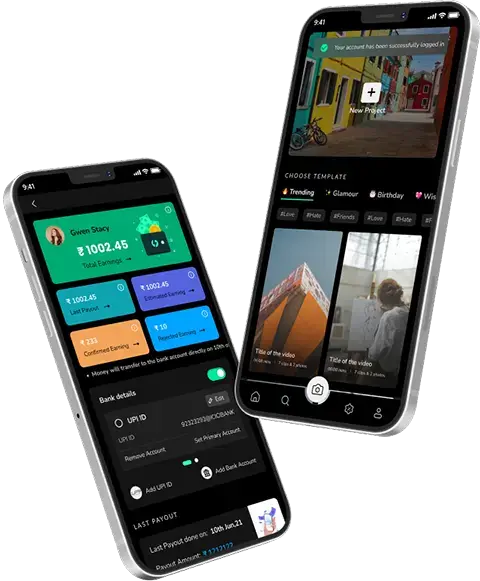
Let’s explore the business value and the actual development cost for a custom mobile app that drives your human capital strategy.
Overview of Human Capital Management Software Development & Cost Considerations
Building Human Capital Management (HCM) software is a strategic move. HCM reduces operational friction. It also trims compliance risk. HR converts from a cost center to a performance intelligence function. The ROI is clear and direct. You get fewer manual errors and faster onboarding. Performance visibility becomes clearer. Leadership gains workforce analytics instantly.
Cost Planning Anchors
| Build Tier | Cost Range | What You Get | Ideal For | Key Cost Drivers |
| MVP or Startup HCM | $60k–$150k | Core HRIS
Leave/time tracking Basic payroll sync Basic mobile portal |
Growing companies standardizing HR beyond spreadsheets |
|
| Mid-Market Solution | $150k–$450k | Applicant Tracking (ATS)
Performance & OKRs Role-based dashboards Mobile manager and employee app Basic analytics |
Companies scaling headcount and multi-team HR operations |
|
| Enterprise & Deep Integrations | $450k–$1.2M+ | Multi-country payroll
Complex compensation modeling Advanced analytics Compliance automation Full-featured mobile experience SSO/ID management Audit trails |
Large enterprises with geographic
Compliance and labor model complexity |
|
Why Now for Human Capital Management Software Solutions
Hybrid and remote setups killed the “just ask HR” convenience. Compliance rules have multiplied rapidly. Leadership must now prove that talent investment delivers measurable outcomes. They need more than just optimistic PowerPoint slides.
Realising skills requires new systems. These systems must intelligently track competencies and learning pathways. They must also manage internal mobility better than a shared Excel file named Final_v27(Updated)_USE_THIS.xlsx.
Historically, businesses simply rented HR platforms. Now, companies weigh convenience against control. Owning the Human Capital Management (HCM) software IP provides key benefits. It means owning workforce data. It allows tailoring workflows to real needs, not vendor defaults. It enables seamless integration with tools employees use daily.
Modern HCM companies are now evolving. They offer verticalized, API-first stacks instead of monolithic platforms. These solutions are tailored for specific regulations and workforce models. Examples include healthcare compliance-ready HR or scheduling for deskless workers. Another is manufacturing HR linked to IoT attendance.
Core Modules & Cost Impact Matrix
| Module | Cost Weight |
| Core HRIS | Low–Medium |
| Payroll & Statutory Compliance | High |
| Time & Attendance | Medium |
| Talent Acquisition (ATS) | Medium |
| Performance & OKRs | Low–Medium |
| Learning Management (LMS) | Medium |
| Compensation & Benefits Modeling | High |
| People Analytics & Dashboards | Medium–High |
| Mobile App (Employee & Manager Portals) | Medium–High |
| Integrations | Variable |
What it Takes to Build a Custom Human Capital Management Software
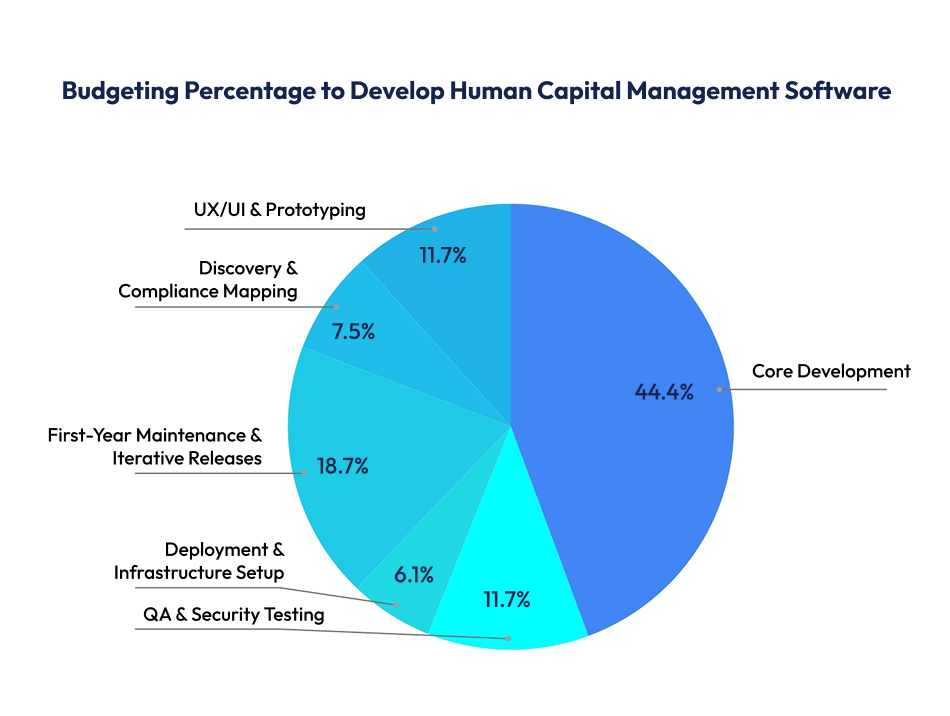
| Phase | Estimated Cost | What Drives Cost Up |
| Discovery & Compliance Mapping | $4,000–$45,000 | Number of countries
Industry-specific labor rules Data migration complexity |
| UX/UI & Prototyping | $8,000–$90,000 | Role-based workflows
Accessibility standards Complexity of mobile-first design |
| Core Development (Backend + Frontend) | $40,000–$600,000+ | Number of modules
Rules logic depth Performance requirements Mobile app feature parity |
| QA & Security Testing | $8,000–$90,000 | Penetration testing
Compliance audits Automated testing coverage |
| Deployment & Infrastructure Setup | $5,000–$60,000 | Hosting provider
Scaling strategy Authentication & SSO infrastructure |
| First-Year Maintenance & Iterative Releases | $25,000–$200,000+ per year | Update frequency
New feature rollouts Compliance patch cycles User support scope |
Tech & Team Stack That Drives Price
1. Team Composition
-
- Product manager
- Business analyst
- Backend and frontend developers
- Mobile app developer
- QA engineer
- DevOps engineer
- Security lead
- UI/UX designer
2. Tech Choices That Influence Cost
-
-
- Native iOS and Android or cross-platform
- Cloud provider
- Database and data lake scaling requirements
- SSO / OAuth / Role-based access control
- Payroll encryption
- PKI infrastructure
-
Cost Reduction Strategies to Build a Human Capital Management Software
Greenfield Custom Build
This approach means full custom software development. It gives total control over workflows. Data architecture and security posture are fully controlled. Integration depth is tailored exactly. This needs a higher upfront investment. Time-to-market is longer. However, the platform perfectly fits the business. The business is not forced to fit the software. Large enterprises often choose this path. This includes those with complex, multi-country payroll. Firms with specific industry compliance or IP needs also prefer it.
SaaS & Custom Extensions
This model blends two parts. It uses an existing HCM SaaS platform. It adds tailored extensions for specific needs. Upfront costs are lower. Deployment times are faster. Internal teams face less operational change. Customization is limited by the vendor’s plan. This suits organizations scaling their HR maturity. They are not yet ready for a full proprietary platform.
White-Label or OEM Platform
A white-label HCM product allows fast entry to the market. It requires minimal build effort. This is ideal for businesses needing a quick structure. They prioritize speed over deep differentiation. The trade-off is limited uniqueness. Influence over future features is also restricted. This works best for companies with simple HR processes. Their workforce patterns must be consistent. They should have minimal localization or regulatory variations.
Operating & Hidden Costs (Don’t Let Procurement Miss These)
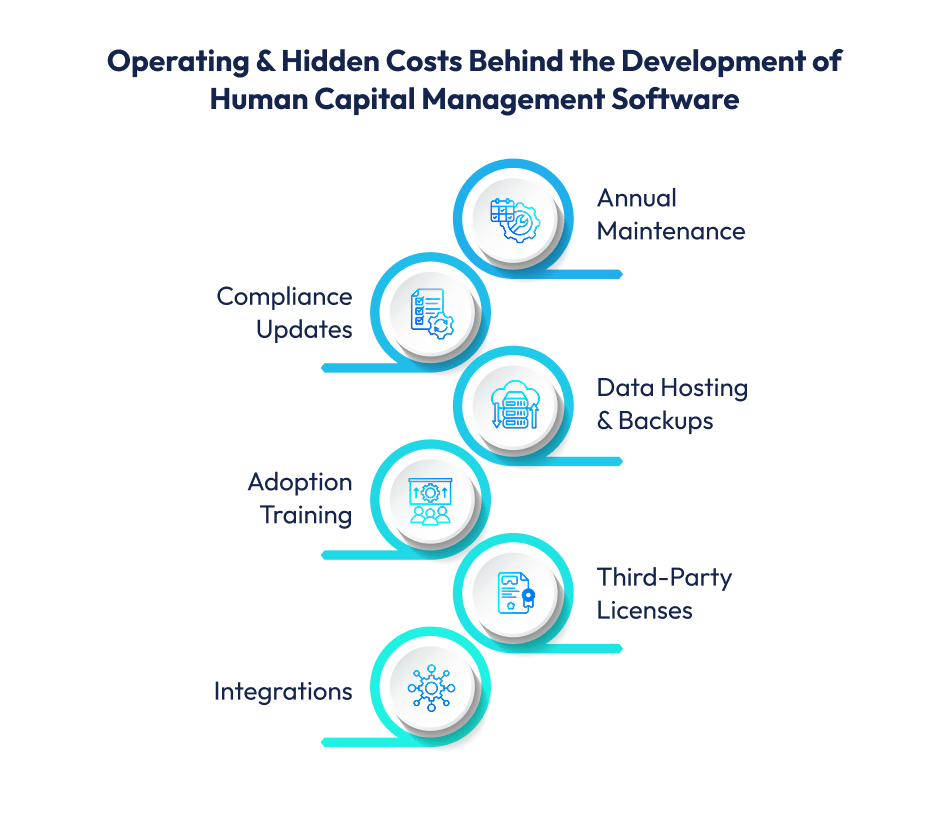
Building Human Capital Management (HCM) Software is just the start. It needs continuous investment. Many organizations underestimate these recurring costs. Their budgets then balloon after launch. Here is a closer look at essential, often-overlooked long-term expenses. These costs impact ownership and ROI.
Annual Maintenance & Support
Routine maintenance fixes more than just bugs. It keeps the system compliant and efficient. This covers patch updates and performance fixes. It includes updates for mobile OS compatibility. Version upgrades for new frameworks are also needed. Support team costs are included here. This minimizes downtime and resolves user issues quickly.
For example, a $300,000 HCM system needs about $45,000–$75,000 yearly. This maintains peak operational health.
Compliance Updates
Regulatory changes are constant. They include tax reforms and new payroll rules. Data privacy acts, like GDPR or India’s DPDP Act, also evolve. Each change demands code revisions, testing, and documentation. This keeps the system compliant. The cost shifts based on regional coverage. Global firms often allocate 5–10% of the annual budget just for compliance changes.
Data Hosting, Backups & Disaster Recovery Testing
Cloud infrastructure is cost-effective but has recurring fees. Expenses cover database hosting and regular data backups. They include redundancy architecture. Periodic disaster recovery (DR) simulations are also necessary. A mid-sized HCM deployment on AWS, Azure, or GCP costs $1,000–$5,000 monthly. DR drills and data replication add necessary security assurance costs.
Change Management & Adoption Training
Even the best HCM software fails without skilled users. Budget for change management workshops. Plan for training modules and onboarding sessions. Include user manuals. This ensures smoother adoption across all departments. Costs range from $10,000 to $50,000, depending on company size. Proper adoption lowers resistance. It also reduces future support requests, saving long-term money.
Third-Party Licensing
Most HCM systems integrate external tools. These include background checks, payroll, tax APIs, or testing platforms. These tools add recurring licensing fees. They may charge per-user or per-transaction fees. Over time, these “micro-costs” accumulate. They form 10–20% of total annual operating expenses (OPEX). Smart vendor choice and API architecture can control costs. They also minimize vendor lock-in as the system scales.
How to Evaluate the Human Capital Management Software Companies
Selecting the right partner is vital. It is not about the flashiest demo. Choose a partner who can build a robust system. The mobile app development company must align with your needs. This includes compliance and the workforce model. They should not force you into a pre-built workflow maze.
Techugo is a strategic build partner. They are not a standard vendor. Their team blends product strategy and compliance awareness. They also offer scalable engineering. This ensures your HCM software works how your organization works. The reverse should not be true.
What to Look For in a Vendor (and Where Techugo Checks the Boxes)
- We have engineered various solutions. This includes:
- Enterprise HR
- Labor management
- Employee platforms
- Employee adoption depends on mobile usability. Techugo builds secure, intuitive mobile portals. These reduce HR dependency.
- Your HCM must integrate cleanly. It needs to talk to payroll, ERP, and finance systems. Our experts build modular integration layers for scale.
- Payroll rules and HR laws change often. Techugo builds update-ready frameworks. These adapt to statutory changes without causing chaos.
- Expect clear sprints and measurable releases. There are zero “surprise invoices”. Ownership handover is predictable.
Why Techugo Should be Your #1 Choice
Techugo co-designs operational workflows. They do not just build platforms. The software becomes a strategic enabler. It is not another system that employees avoid. The result is a future-ready HCM solution. It features high adoption and a scalable architecture. Lifecycle stability is built in from day one.
FAQs
Q1. What is the cost to develop a mobile app for human capital management software?
The cost to develop a mobile app for Human Capital Management Software typically ranges from $30,000 to $250,000+, depending on:
- feature depth
- role-based access
- performance dashboards
- offline access needs
- integration with payroll
- attendance systems
- module complexity
- number of workflows
- security/compliance layers required for employee data
Q2. How do human capital management software companies price enterprise HCM builds?
Human capital management software companies typically price their enterprise solutions by employing a modular build and integration effort model. This approach is often combined with ongoing support or subscription fees. Costs rise with:
- Number of modules
- Multi-region compliance scope
- Data migration volume
- Integration points
Q3. What features make the best human capital management software?
The best human capital management software typically includes:
- Core HRIS
- Employee records
- Automated payroll
- Compliance workflows
- Time tracking and attendance
- Talent acquisition
- Performance and OKRs
- Learning & development module
- Compensation planning
- Mobile-first employee
- Manager self-service
- Centralized analytics dashboards
Q4. Should my organization buy a human capital management software solution or build one?
Choosing between buying vs building depends on operational complexity:
- Buy (SaaS) if HR workflows are standard and customization needs are moderate.
- Build (custom) if your organization has unique workforce policies or data residency and compliance mandates where flexibility is non-negotiable.
Q5. How much does ongoing maintenance cost for HCM software?
Most organizations budget 15–25% of the initial build cost per year for:
- Updates
- Feature enhancements
- Compliance adjustments
- Infrastructure scaling
- Support
Global payroll and regulatory-heavy environments trend toward the higher side of the range.
Q6. Can a mobile app development company build my HCM mobile experience?
Yes, but choose wisely. A mobile app development company building HCM mobile portals should offer:
- Secure authentication and role-based access controls
- Smooth workflows for employee and manager self-service
- Performance dashboards optimized for small screens
- Integration expertise with payroll and attendance
- Proven delivery in workforce or enterprise app ecosystems
Closing Note
The HCM Software conversation is about operating clarity and cultural maturity. It focuses on removing friction points. These points silently drain performance. Workflows become intuitive. Data becomes visible. People, systems stop acting like a maze. Organizations then gain a key advantage. Competitors cannot easily copy this. That advantage is scalable workforce intelligence.
Is your organization evaluating its HCM system? Are you deciding whether to build, extend, or modernize? Techugo brings the necessary engineering discipline. They offer product strategy depth. They also provide mobile-first execution maturity. This makes your vision real without costly detours.
Ready to transform HR? Move from “process management” to performance enablement. Techugo is the partner you need. They build software aligned with how your business actually operates.
Book your consultation session today!

Get in touch
We'd love to hear from you.