

 SA
SA
 KW
KW
 IE
IE AU
AU UAE
UAE UK
UK USA
USA
 CA
CA DE
DE
 QA
QA ZA
ZA
 BH
BH NL
NL
 MU
MU FR
FR















📌 Key Takeaways
- The cost to build an app like Poshmark ranges from $40,000 to $400,000.
- Social commerce apps grow through engagement and seller interaction driven by community.
- The global social commerce market is likely to cross USD 17.8 trillion by 2033.
- Features like chat, AI recommendations, and live selling improve user retention.
- Starting with an MVP helps reduce initial development costs.
Have you ever browsed Poshmark and wondered, I could create something like this?
You’re not alone.
The marketplace of social commerce is flourishing, with entrepreneurs all over looking into the possibilities of entering. However, the initial question is self-evident before leaping into it: What will it cost to build a social commerce app like Poshmark?
So depending on your desires for your app, an application that replicates a Poshmark-like marketplace can cost between $40,000 (for a simple MVP) and $400,000 (for a feature-rich platform).
To provide some perspective, the world social commerce market would have a size of around USD 17.8 trillion by 2033. (Source: Grand View Research)
That is huge, and it demonstrates the amount of potential a properly implemented social selling platform has.
Let’s get into it…
Inside the Poshmark-like app model: Why it works
The Poshmark-like application is effective as it is not just an online shopping platform: it is a social-based marketplace. Customers do not scroll through merchandise but engage with sellers, subscribe to favorite accounts, or join virtual parties, such as posh parties.
This interactive and shopping experience makes users want to keep coming back, building a loyal customer base. In case you want to build a social selling app, it is important to learn the following behavior: the application must look like a social network more than a marketplace.
The sellers are successful due to the exposure and interaction provided. Each like, comment, or share is a positive reinforcement for them to continue posting more products, which makes the inventory move and stay dynamic. This forms a circle of action that can be beneficial to all: buyers have more choices, sellers are motivated, and your site expands on its own. Major advantages of this model are:
- Promoting sellers to post regularly.
- Establishing confidence between the buyers and sellers.
- Developing a dynamic, interactive community that leads to retention.
At the core of this strategy is the mixture of business and socialization. Users do not simply purchase products, but they do feel that they belong to a community. Follows, likes, and comments transform transactions into social experiences and make them more engaging, retained, and repurchased. That is why Poshmark has been so successful and why e-commerce app development as a social marketplace should be thought of as a balanced approach to incorporating both social features and the functionality of a marketplace.
To any person intending to develop a social selling application, the moral is evident; you have to create an environment in which business and social interaction go hand in hand. When implemented right, this model not only generates sales but also generates a successful ecosystem that will make users return and establish loyalty among the sellers.
User-friendly core features of apps like Poshmark
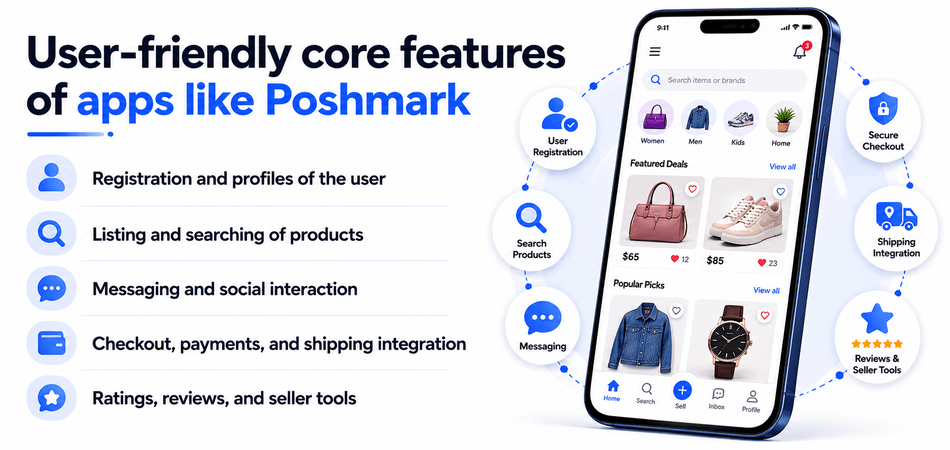
Do you know why Poshmark feels so effortless to use? It is because of its user-friendly features.
Check out the core features that make Poshmark such a user-friendly marketplace.
Registration and profiles of the user.
Users are the foundation of any social commerce app; it is essential to have an easy-to-use sign-up experience. Provide a variety of choices, such as email, phone, or social logins, to streamline onboarding. To sellers, the profiles must display their items, ratings, and sales history, where buyers can be assured of who they are purchasing their goods.
Buyers, in turn, require a dashboard that they can use to monitor orders, favorites, and browsing history. An intuitive, easy-to-set-up profile not only makes the app look friendly but also enhances interaction and retention immediately upon the first interaction.
Listing and searching of products.
Products are the core of any marketplace. The sellers must have the ability to post numerous pictures, descriptions, price tags, and classify products without difficulty. To buyers, it must be equally easy as well, with powerful search and filtering features such as categories, price range, size, brand, and trending products.
The more accessible it is to users to locate precisely what they seek, the higher the chances of remaining involved and purchasing. To sum up, smooth product listing and search are the fundamental aspects of a successful social selling app.
Messaging and social interaction.
Social commerce is based on communication and society. Your app must allow the buyers and sellers to chat with each other and ask questions, negotiate, and give feedback. More than that, the app makes it feel social and alive with the help of such features as following favorite sellers, liking listings, sharing items, or attending virtual events. Such interactions not only foster trust but also replicate the social experience that renders Poshmark addictive. The interaction is what will make users come back again and again.
Checkout, payments, and shipping integration.
The most interesting application will not prosper without a well-developed transaction system. Your platform should have secure checkout, which will be connected to popular payment gateways such as Stripe, PayPal, or Apple Pay. Shipment must be easy and efficient with automated labeling and tracking. With smooth payments and logistics, users are assured of making purchases, and sellers receive their orders on time. Easy checking out and delivery will be critical to gaining trust and encouraging repeat business.
Ratings, reviews, and seller tools.
Everything is trust in social marketplaces. The inclusion of ratings and reviews will provide confidence to the buyer and encourage sellers to ensure high quality. Meanwhile, sellers require dashboards and analytics software to be able to monitor inventory, sales trends, and user interactions. This information enables vendors to maximise their products and remain competitive. These characteristics result in a self-reinforcing and profitable marketplace by integrating seller empowerment and buyer trust.
Advanced features for growth:
- Social Feed and Engagement: Feature new products, popular vendors, and collections to make your app more than a marketplace.
- AI-Powered Recommendations: Take advantage of machine learning to recommend products based on user behavior, enhancing engagement and re-purchases.
- Loyalty Programs and Analytics: Reward users who make frequent purchases and provide sellers with dashboards to monitor sales trends, what people are buying, and who is buying.
- Live Selling / Video Commerce: Allows sellers to present products live via video listing or live streams, and allows sellers to be trusted and interacted with.
Cost to build an app like Poshmark: Realistic estimates inside
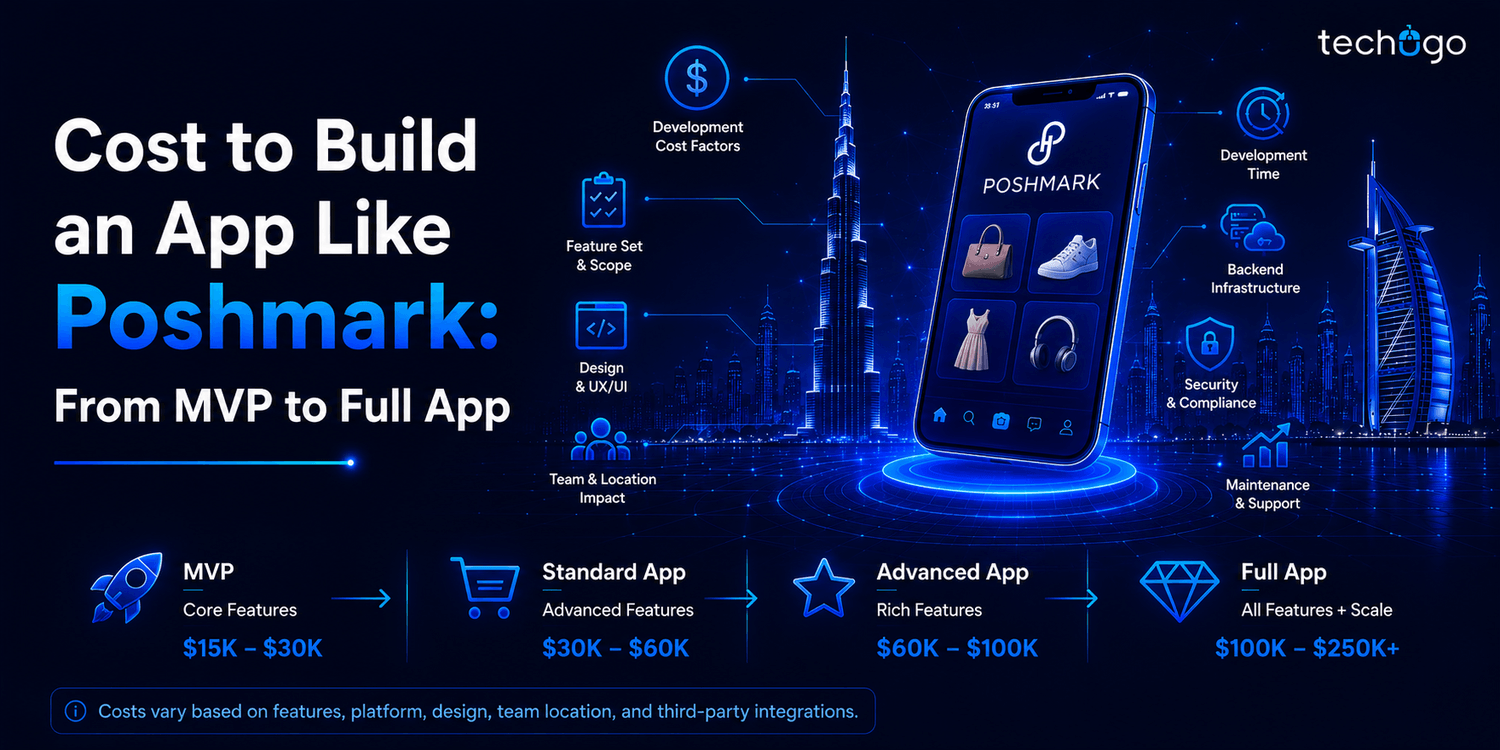
So, how much does it really cost to bring a social commerce marketplace like Poshmark to life? Understanding the cost to build an app like Poshmark means looking at every part of development (from design and features to backend systems and testing).
The Poshmark app development cost can vary significantly, generally ranging between $40,000 and $400,000, depending on the app’s complexity, features, and the team you hire. Here’s a closer look at the main components:
| Feature / Module | Estimated Development Time | Estimated Cost (USD) |
| User Registration & Profiles | 2–4 weeks | $2,500–$7,000 |
| Product Listings & Catalog | 3–5 weeks | $3,000–$9,000 |
| Search & Filtering | 4–6 weeks | $4,000–$10,000 |
| Chat & Messaging | 5–8 weeks | $5,000–$13,000 |
| Payment Gateway Integration | 3–5 weeks | $3,000–$9,000 |
| Shipping Integration | 4–6 weeks | $4,000–$10,000 |
| Social Feed & Engagement | 5–9 weeks | $5,000–$15,000 |
| AI-Powered Recommendations | 6–10 weeks | $8,000–$20,000 |
| Analytics Dashboard & Admin Panel | 4–8 weeks | $4,000–$12,000 |
| UI/UX Design | 5–9 weeks | $6,000–$20,000 |
Estimated Total Cost:
- Basic MVP: $40,000 – $70,000
- Feature-Rich Marketplace: $70,000 – $180,000
- Enterprise-Level App: $180,000 – $400,000
Want to know the factors that affect the cost?
Complexity of features: The more sophisticated your application, the more expensive it is. The live selling (or comprehensive social engagement functionality) will require additional development time and resources, but these capabilities can help to increase user retention and engagement.
Platform preference: iOS, Android, or both? Porting time is added to the development time per platform, and cross-platform solutions have trade-offs. Early decision-making can be used to control time and also the budget.
Design and UX level: This is a well-designed, user-friendly interface that not only looks good but also ensures their return. A solid design and user experience can also increase the amount of time you invest in the development process, but it is one of the main ingredients in creating a successful marketplace application.
Technology stack and integrations: The technologies that you are going to use (React Native, Node.js, or AI/third-party APIs) directly affect the cost and development speed. Elements such as AI recommendations in e-commerce apps and integrations such as payment, shipping, and chat systems can add to development time and costs. Nonetheless, they also enhance the app more powerfully, personalized, and scalable in the long-term.
Overall tech stack for marketplace apps in modern development
Why do certain marketplace applications feel fast, whereas others are sluggish or crash? Well, the solution is the technology stack of these applications.
Frontend technologies
The frontend is what dictates the actual experience of your users with your app, so it is critical to the success of any Poshmark clone app development project. An easy, quick, and user-friendly interface makes the user interested and will want to continue browsing and shopping.
One of the most successful options in cross-platform mobile development is React Native, which enables you to write a single codebase to support both iOS and Android, and save time and money. But, to be fully native, Swift (iOS) and Kotlin (Android) are good options, which are more performant and optimized to the platform.
React.js or Vue.js technology is popular for web-based versions of your marketplace. Such structures make your platform responsive, interactive, and attractive to all devices, which is key in retaining users in a competitive social commerce environment.
Backend and database
The backend is the driver of your whole platform. When building a Poshmark clone app, server-side logic, user authentication, and business workflows are typically handled with frameworks such as Node.js, Django, or Ruby on Rails.
To store data, including user profiles, product listings, and transactions, a database such as PostgreSQL or MongoDB is a better choice because of its scalability and flexibility. WebSockets or Firebase Realtime Database are also used to provide real-time functionality, such as chat between buyers and sellers, and the communication is not delayed. Cloud solutions like AWS S3 are normally used to store media files, like product images, and offer secure and scalable storage.
Payments and shipping APIs
Transactions that are safe and smooth are key in any marketplace application. Stripe and PayPal are payment gateways that are popular due to their reliability, worldwide support, and high level of security.
To automate label creation, carrier updates, and carrier integrations, shipping APIs like Shippo or EasyPost can be used to manage logistics. They guarantee a seamless after-sales experience, and this has a direct effect on user confidence and subsequent usage. Even the most well-constructed marketplace may not be able to maintain users without effective payment and shipping systems.
Hidden costs to consider in Poshmark-like app development
Most individuals, when planning the cost of building an app such as Poshmark, consider development only. However, the reality is that the cost of developing the Poshmark app is not just over as soon as the app is developed, but rather a series of recurring costs that people tend to ignore.
Recurring costs are associated with hosting your app in cloud servers, keeping the performance, and scaling the infrastructure as the number of users increases. Another significant aspect is security: securing user information, transactions, and compliance may be a costly affair, particularly in the case of a marketplace where payments are involved.
In addition to this, there are operational costs that continue after launch:
- Hosting/infrastructure: $300-1500/month for servers and storage.
- Security & compliance: $2,000 and up to audit, encryption, and protection systems.
- App store charges: iOS: 99/year, Google Play: 25/one-time.
- Marketing & user acquisition: $5,000+ to launch campaigns and promotions.
- Maintenance & updates: typically 15–25% of total development cost annually
Overlooking them may soon affect your budget and slow down the growth, particularly in a rapidly evolving domain such as social commerce.
How Techugo is the best fit for social commerce app development
Techugo is a world-renowned mobile app development company in USA and Canada with more than ten years of experience in developing scalable and high-performing digital solutions for startups, businesses, and Fortune 500 brands.
Our particular area of expertise lies in e-commerce mobile app development and social selling sites, where the aim is not only to make a purchase, but to interact. Whether it be product listings and chat in real-time, or secure payment and personalized feeds, we develop the aspects that make your app interactive, addictive, and user-first, as modern social commerce applications require.
To top it all, Techugo is reputed in the field of cutting-edge technologies, including AI integration, AR/VR applications, chatbots development, and cross-platform apps development based on Flutter and React Native. In the e-commerce and marketplace domain, the company focuses on building features like AI-based recommendations, secure checkout systems, real-time chat, and smart product discovery, making it a strong fit for projects like Poshmark clone app development.
So if a social commerce app is on your mind, let’s bring it to life with Techugo. Content now!
FAQ’s
Q1. What will it cost to build a similar App to Poshmark?
Ans) The mean expense of creating an application like Poshmark is $40,000 to $400,000, contingent on highlights, architecture, technology stack, and the development team you pick.
Q2. Is it possible to create a social commerce app such as Poshmark and not spend much?
Ans) Yes. You may begin with an MVP consisting of the basic functions such as listings, search, chat, and payments. And this is useful to get you started quickly and maintain low costs, and then you can add sophisticated functionality as your application evolves.
Q3. Which is the largest cost-adding factor to a social commerce app?
Ans) More advanced functions like AI recommendations, live selling, real-time chat, and complicated integrations tend to be more expensive to implement than a simple marketplace structure.
Q4. Do I have to develop Android and iOS apps in the first place?
Ans) Not necessarily. Most enterprises begin on a single platform or do cross-platform development initially, before proliferating when the business concept and customer base are confirmed.

Get in touch
We'd love to hear from you.