

 SA
SA
 KW
KW
 IE
IE AU
AU UAE
UAE UK
UK USA
USA
 CA
CA DE
DE
 QA
QA ZA
ZA
 BH
BH NL
NL
 MU
MU FR
FR







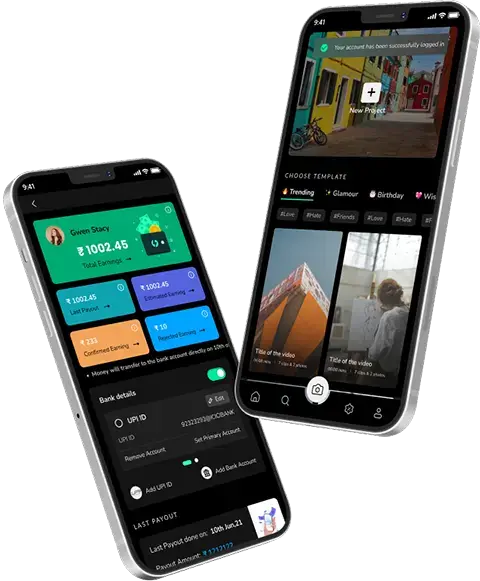







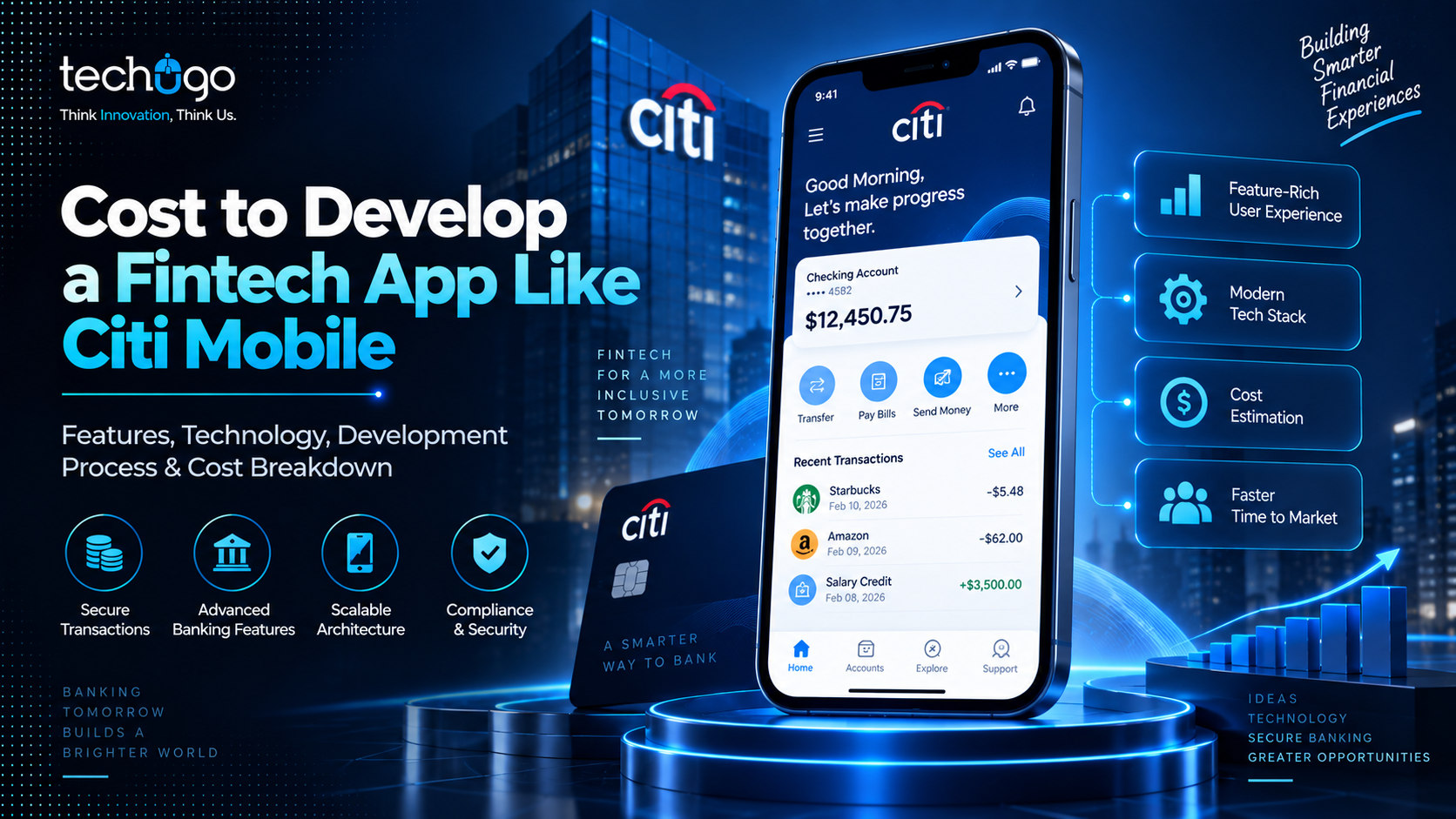


Do you think that building a fintech app like Citi Mobile requires a huge investment? What if we told you that you simply need $30K to get started? Yes, you have heard that right! Basic mobile applications with essential features can be developed for less than $30,000.
In today’s world, almost everyone is using digital mobile applications. This turns fintech into one of the most lucrative sectors worldwide. You are wrong, though, if you believe that creating a powerful and feature-rich fintech app necessitates an excessive budget. Proper preparation and a dependable mobile app development business will help to create a successful fintech app.
Before delving into sophisticated features, including backend development, API integration, and AI tools, one must grasp the cost structure. This will help you know which features have the most impact on the budget.
What is CITI Mobile App?
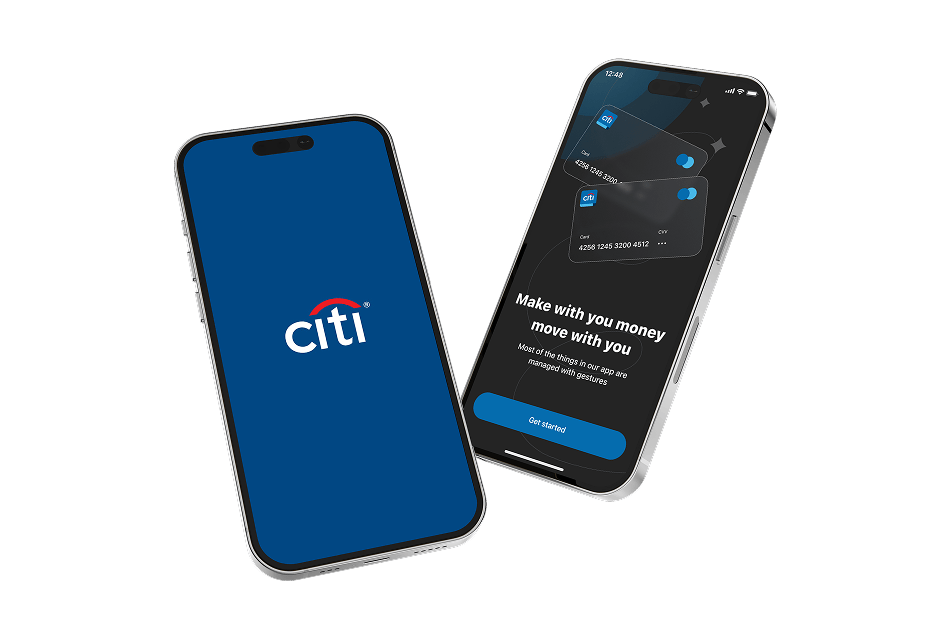
Designed by Citibank, the Citi Mobile App lets consumers handle their finances using their mobile devices through a digital banking program. Designed for everyday banking demands, it is a full-service fintech application. Real-time monitoring of credit cards, paying bills, money transfers, and checking account balances are among some of its functionalities. Citi first introduced the Citi Mobile App in the early 2010s as part of its digital revolution plan. Through an encrypted system and APIs, the app gives consumers a secure connection to their financial accounts, therefore guaranteeing safe financial activity. The app has added features including financial insights, instantaneous alerts, and biometric login over time, therefore becoming a practical and secure mobile banking tool for the modern mobile generation.
Why Fintech Apps Like Citi Mobile Are in High Demand
As the world is moving rapidly into a banking system, fintech apps have become a crucial tool in managing our financial lives. In the U.S., for example, 92% of people use payments and consumers use 3-4 fintech apps for various financial requirements. This presents a business opportunity in this area.
Moreover, younger generations like Millennials and Gen Z are accelerating this trend by using apps like Citi Mobile; 71% of Millennials are open to sharing data to improve their financial services.
1. Convenience of Anytime, Anywhere Banking
Banking Users can check their balances, transfer money and make payments on their mobile phones without having to go to a bank, making it easier and faster to manage finances.
2. All-in-One Financial Management
under one roof, Citi Mobile, for example, aggregates banking, credit card, investment and payment services on one platform.
3. Enhanced Security Features
There are also more sophisticated security features, including biometric logins, encryption and real-time alerts, that help build user confidence in mobile banking.
4. Personalized User Experience
As well as spending insights, trends and analysis, fintech apps also use data and AI to provide smart financial recommendations.
5. Faster and Seamless Transactions
Instant payments, quick transfers, and automated services significantly improve transaction speed compared to traditional banking.
How Does a Fintech App Like Citi Mobile Work?
You’ve got the idea now of how powerful fintech apps can be but let’s see how they work, really. If you’re under the impression you have to open a bank or become a financial institution to create an app like this, it’s not necessarily true. The vast majority of fintech applications are built on top of traditional banks and financial institutions rather than being entirely independent, serving as an intermediary between customers and those companies.
1.User Registration & Verification
Users sign up on the app and complete KYC (Know Your Customer) verification using documents and identity checks.
2.Secure Account Linking
The app connects with banking systems or financial institutions via APIs to access user account data securely.
3.Dashboard & Data Processing
All financial data (balances, transactions, cards) is. Displayed on a user-friendly dashboard in real time.
4.Transactions & Services Execution
Users can transfer money pay bills or manage cards while the app processes these requests through integrated payment gateways and banking APIs.
5.Security & Notifications
Every action is protected with encryption, OTPs or biometrics and users receive alerts for transactions and updates..
How to Decide the Budget for a Fintech App
Even after the pandemic rebounds, digital finance adoption is still increasing, which means investing in a fintech app today can be a highly scalable opportunity. But it’s wise to plan your budget well before you start working on your product to prevent overselling or underselling.
1.Begin with a clear app range (MVP vs. Full App)
Choose between launching a full-scale app like Citi Mobile App or a basic version (MVP) with few capabilities. Beginning with an MVP allows you to evaluate the market and lowers first cost.
2.Give user needs first priority features.
List must-have features (like login, transfers, dashboard) together with sophisticated features (AI, analytics). This lets you assign money only where it really counts.
3.Pick the Appropriate Approach for Development
Whether you recruit freelancers, have an in-house crew, or subcontract to an agency determines your cost. Your total budget is also greatly affected by your selection of the appropriate technology stack and location (India vs US).
Complete Cost Breakdown of Fintech App Development
1.Cost of Market Research and Planning.
Estimated Cost: $5,000 – $15,000
Features – The aim of this stage is to establish the competitor landscape, target users, business model and development plan. It makes sure your app fits market needs and has a well-defined strategic direction.
2.UI/UX Design for Fintech App Development
Estimated Cost: $8,000 – $25,000
Features – Wireframes, prototypes, and visual designs are included. A user-centered methodology is adopted to help increase engagement, usability, and user experience as a whole.
3.Third on the list is the cost of frontend development for your application.
Estimated Cost: $20,000 – $60,000
Features – Focus on building screens, navigation, and interactive elements for the user. Performs well on multiple devices and platforms.
4.Cost of Backend Development.
Estimated Cost: $25,000 – $80,000
Features – Manages server-side logic, databases, APIs and business rules. All the functionalities of the bootsapp runs on this engine.
5.Cost of API and third-party integration.
Estimated Cost: $10,000 – $40,000
Features – This includes the integration of payment gateways, banking APIs and KYC, AML verification, notification, and other necessary services from 3rd parties as required.
6.Conformance and legal fees.
Estimated Cost: $15,000 – $60,000
Features – Covers compliance for KYC, AML, GDPR, PCI-DSS and necessary approvals. A legal consultant assists in trouble-free app operations and functioning.
7.Cost of testing and quality assurance
Estimated Cost: $7,000 – $30,000.
Features – It includes manual, automated, and security testing. Ensured the app was free of bugs, reliable, and performed flawlessly on all devices.
8.Deployment and cloud infrastructure cost.
Estimated Cost: $5,000 – $20,000
Features – Set up of the server and hosting in Cloud (AWS, Azure, GCP), app store submission, and DevOps pipeline. Guarantees seamless adaptation and growth.
9.Yearly expenses for upkeep and post-launch additional expenses.
Estimated Cost: $15,000 – $50,000 per year
Features – Involves improvements, fixes, enhancements and addition of features. Maintains the app’s security and stability over time.
Factors That Affect Fintech App Development Cost
Several factors influence the overall cost of building a fintech app like Citi Mobile App. Understanding these helps you plan your budget more effectively.
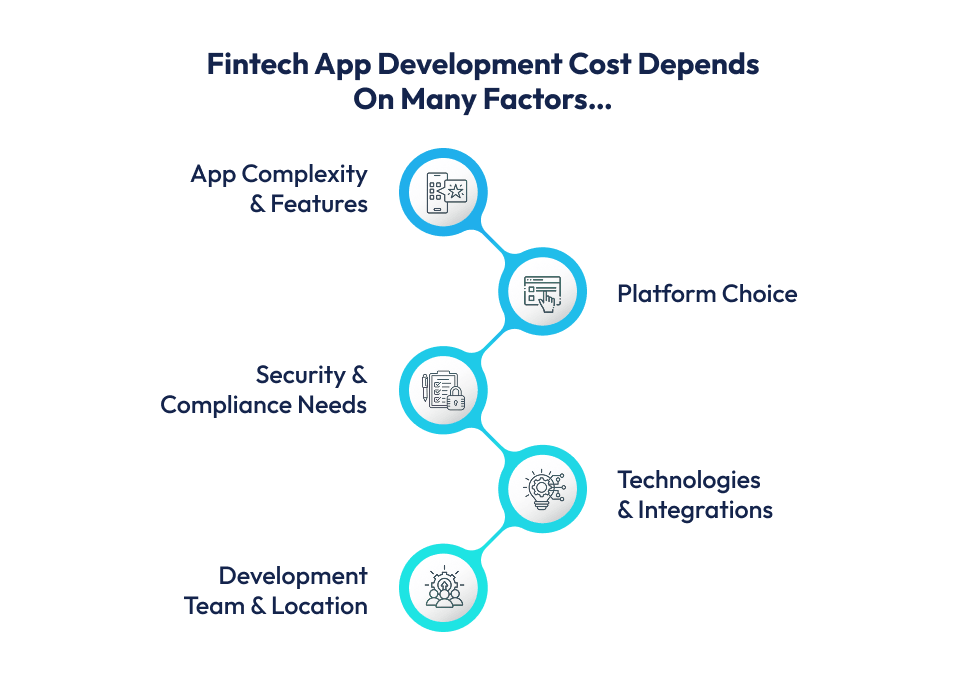
1. App Complexity & Features
- Why it affects cost: More features like AI-based insights, multi-currency support, or advanced analytics require additional development time and expertise.
- Benefit: A feature-rich app improves user engagement, provides competitive advantage, and delivers a better overall experience.
2. Platform Choice (iOS, Android, or Both)
- Why it affects cost: Developing for multiple platforms increases coding, testing, and maintenance efforts.
- Benefit: Releasing on both platforms expands your user base and increases adoption potential.
3. Security & Compliance Requirements
- Why it affects cost: Implementing encryption, fraud detection, and adhering to KYC/AML/GDPR regulations adds complexity and development hours.
- Benefit: Strong security builds user trust and ensures your app can legally operate in multiple markets.
4. Technology Stack & Integrations
- Why it affects cost: Choosing advanced backend technologies or integrating multiple third-party APIs (banks, payment gateways, verification systems) increases development time.
- Benefit: A robust tech stack ensures app stability, scalability, and smoother integration with financial services.
5. Development Team & Location
- Why it affects cost: Hiring experienced developers, outsourcing vs in-house teams, and regional rates (India vs USA) directly influence budget.
- Benefit: Skilled teams reduce errors, improve app quality, and shorten development timelines, offering long-term cost savings.
Timeline to Build a Fintech App Like Citi Mobile
| Development Phase | Estimated Timeframe | Description |
| Market Research & Planning | 2 – 4 weeks | Competitor analysis, user research, defining features and business model. |
| UI/UX Design | 3 – 6 weeks | Wireframes, prototyping, visual design, and user experience testing. |
| Backend Development | 8 – 12 weeks | Server setup, database design, API development, and core business logic. |
| Frontend Development (iOS & Android) | 6 – 10 weeks | Coding the user interface, app screens, navigation, and interactive features. |
| API & Third-Party Integrations | 4 – 6 weeks | Payment gateways, banking APIs, KYC/AML verification, and notifications. |
| Security Implementation | 3 – 5 weeks | Encryption, biometric login, fraud detection, and secure transaction setup. |
| Testing & Quality Assurance | 4 – 6 weeks | Manual testing, automated testing, security testing, and bug fixing. |
| Deployment & App Store Submission | 1 – 2 weeks | Publishing on iOS App Store and Google Play Store with final checks. |
| Maintenance & Post-Launch Updates | Ongoing | Regular updates, bug fixes, performance optimization, and feature enhancements. |
How to Reduce Fintech App Development Cost
Managing overall cost is also a crucial step when building a fintech app like Citi Mobile App. Smart planning and strategic decisions can help you save significantly without compromising quality.
1. Partnering with a Good Development Partner
Choose a development partner who has already built fintech applications. Such a partner removes the need for experiments, keeps the schedule intact and uses budget plus staff with maximum efficiency. The same partner already knows the compliance rules and the security requirements – the project avoids extra audits but also rework.
2. Start with an MVP (Minimum Viable Product)
Start with a fundamental version including only the fundamental features. Launch this edition first to gauge market interest and gather user feedback. Include the more advanced capabilities in later revisions. This method keeps you from spending big upfront on choices that eventually turn useless
3. Use Ready-Made APIs & Services
Rather than creating everything by yourself, utilize secure third-party APIs for payments, KYC identity verification, notifications and analytics. This ensures reliable performance at a lower development cost and faster time to market.
4. Optimize Features & Prioritize Core Functions
Concentrate on the core features that address the primary user pain point and push nonessential features to subsequent releases. Prioritization guarantees that your budget is used for features that actually provide value.
5. Outsource or Hybrid Development Approach
By hiring developers from cheaper countries or using a hybrid (on-site + outsourced) team, you may substantially reduce labor costs without sacrificing quality.
6. Plan for Scalability, Not Overbuilding
Develop the app’s framework for future expansion instead of overloading it at first. An extensible architecture helps to bypass expensive redesigns or server upgrades down the line.
This plan keeps the project within budget while still balancing usability, security, and quality.
Future Trends in Fintech App Development
One of the most important developments molding the fintech sector’s future is the inclusion of artificial intelligence (AI), especially generative AI, as it is changing quickly. These developments are changing user interactions with banking services, investment decisions, and money management style.
1. AI-Powered Personal Finance & Insights
AI algorithms can forecast upcoming expenditures, study spending patterns, and offer individualized budgeting guidance. Generative AI carries this even more by automatically producing personalized financial reports, notifications, and investment recommendations.
- Cost: Adding AI capabilities might increase your development budget by $15,000 to $50,000, depending on complexity.
- Future Result: Users get very customized financial advice, therefore increasing engagement and retention.
2. Smart Investment & Portfolio Management
Automatically suggesting asset allocations, risk analysis, and investment approaches are artificial intelligence-driven fintech applications. For consumers, generative artificial intelligence can generate predictive market insights and simulation models.
- Cost: Advanced investment AI modules can cost $30,000 – $80,000.
- Future Outcome: Investors gain smarter decision-making tools, potentially increasing app adoption among wealth-conscious users.
3. Automated Customer Support (Chatbots & Virtual Assistants)
Smart chatbots powered by generative artificial intelligence can process transactions, manage difficult questions, and even provide proactive recommendations.
- Cost: Depending on the complexity of the artificial intelligence used, implementation runs $10,000 to $40,000.
- Future Outcome: Reduced operational costs, faster support, and improved customer satisfaction.
4. Fraud Detection & Risk Management
Real-time prediction of credit risks, detection of suspicious transaction patterns, and detection of possible fraud are among AI’s uses. To improve security measures, generative artificial intelligence models can simulate possible fraud situations.
- Cost: Security AI integration could run between $20,000 and $60,000.
- Future Outcome: Safer transactions, reduced financial losses, and increased trust among users.
5. Voice & Conversational Banking
Generative AI can power voice assistants that understand natural language and execute banking operations seamlessly. Users can ask questions, make transfers, or check balances using simple voice commands.
- Cost: Voice AI integration can add $15,000 – $45,000.
- Future Outcome: Provides a futuristic, hands-free banking experience, attracting tech-savvy users.
Overall Trend: Integrating AI and Generative AI into fintech apps may increase initial costs by 20–40%, but it significantly enhances user engagement, personalization, security, and operational efficiency. In the next 3–5 years, AI-powered fintech apps are expected to dominate the market, with higher retention rates, smarter financial services, and stronger competitive advantage.
Conclusion
Almost 9 in 10 Americans now use some form of fintech service, showing the growing demand for digital banking apps. Building a fintech app like Citi Mobile App can cost anywhere from $50,000 for an MVP to $500,000+ for a full-scale app, depending on features and complexity.
Partnering with a reliable team like Techugo ensures your app is secure, compliant, and user-friendly while optimizing costs and time-to-market.
Ready to build your fintech app? Contact us Techugo today and turn your idea into a powerful digital banking solution!
FAQs
Q. How much does it cost to build a fintech app like Citi Mobile?
Developing a secure, feature-rich banking app generally ranges from $50,000 for a compliant cross-platform MVP to over $250,000 for a full-scale enterprise neobank. Replicating the exact feature depth of a global banking app requires an enterprise budget focused heavily on regulatory compliance, immutable databases, and custom legacy integrations. When scoping these projects, we break the investment down by architecture, security requirements, and API dependencies to ensure absolute transparency.
Q. How long does it take to develop a banking mobile app?
A standard fintech MVP typically takes our engineers 4 to 6 months to deploy. However, a highly regulated, full-feature banking application often requires 9 to 15 months from initial discovery to launch. This timeline accounts for custom zero-trust architecture, third-party integration approvals (like Plaid or Stripe), and mandatory vulnerability penetration testing.
Q. What makes fintech apps so expensive to build?
The line items that inflate budgets most are backend infrastructure ($25,000–$80,000), banking API integrations ($10,000–$40,000), and compliance engineering (like KYC and PCI-DSS, ranging $15,000–$60,000). Generalist quotes often miss these, but the solution architects at Techugo map them out during the discovery phase to prevent budget overruns.
Q. Native vs. Cross-Platform: Which is cost efficient for a fintech mobile app?
Yes. Using cross-platform frameworks like Flutter or React Native is generally 30–40% more cost-effective because our developers write a single codebase that deploys to both iOS and Android. Modern cross-platform engines are fully capable of handling complex financial data and biometric security without sacrificing native-like performance.
Q. What security features are essential for a banking mobile app?
At a minimum, we implement AES-256 end-to-end data encryption, multi-factor authentication (MFA), biometric tokenization (FaceID/TouchID), and role-based access control. Applications handling live funds must also pass a rigorous Vulnerability Assessment and Penetration Testing (VAPT) audit prior to deployment, ensuring the application stays outside PCI-DSS scope wherever possible.
Q. How much does it cost to Integrate AI to a financial app?
Integrating Generative AI for predictive market insights, risk scoring, or automated customer support typically adds $15,000 to $50,000 to the build. Because we take an AI-first approach to digital product engineering, we recommend phasing AI features seamlessly after the core transaction ledger is live and stable.
Q. What is KYC/AML, and why does it affect development costs?
KYC (Know Your Customer) and AML (Anti-Money Laundering) are mandatory identity verification protocols. Integrating automated ID verification (like Onfido or HyperVerge) requires secure document capture states, API bridging, and manual-review dashboards. We engineer these pipelines to be entirely frictionless for the end user, though they noticeably increase the backend engineering scope.
Q. Which third-party APIs are essential for fintech app development?
A robust financial app relies on several specialized aggregators. Our teams frequently integrate payment processors (Stripe, Cashfree), banking data aggregators (Plaid, Yodlee), cloud infrastructure (AWS, Google Cloud), and digital identity vendors to create a seamless, cohesive user experience.
Q. How much does it cost to maintain a fintech app?
Founders should budget 5% to 10% of the initial build cost for annual maintenance. In fintech, keeping up with OS updates, patching vulnerabilities, and managing shifting PSP (Payment Service Provider) APIs is a continuous engineering requirement that we manage through strict post-launch SLAs.
Q. How do I choose the right fintech app development company?
Look for a partner with a proven portfolio of regulated financial platforms, not just standard consumer apps. You need an engineering team that speaks the language of compliance (GDPR, PCI-DSS) and builds zero-trust architectures from the ground up. As a leading AI-driven product engineering agency, Techugo ensures your financial application is not only secure and compliant today, but scalable enough to integrate tomorrow’s technology.

Get in touch
We'd love to hear from you.