

 SA
SA
 KW
KW
 IE
IE AU
AU UAE
UAE UK
UK USA
USA
 CA
CA DE
DE
 QA
QA ZA
ZA
 BH
BH NL
NL
 MU
MU FR
FR
















📌 Key Takeaways
- DeFi development is transforming financial services by replacing traditional intermediaries.
- DeFi development costs typically range from $20,000 to $200,000+.
- Smart contract audits, regulatory compliance, and scalability are critical to building secure, trustworthy, and sustainable DeFi platforms.
- Non-custodial wallets and smart contracts give users direct control and ownership of digital assets.
- Smart contracts, permissionless access, transparency, interoperability, and self-custody form the core pillars of decentralized finance.
Decentralized finance is reshaping how the world thinks about money by replacing banks and intermediaries with blockchain-based smart contracts. DeFi development enables permissionless, transparent, and self-custodial financial ecosystems where users retain full control over their assets. From lending and borrowing to token swapping and yield farming, DeFi platforms are unlocking new possibilities for real-time, borderless financial transactions. As adoption grows, understanding the technology, costs, and considerations behind building a DeFi app has become essential for businesses looking to enter this space.
How Does DeFi Development Enable A Decentralized Financial Ecosystem?
By replacing traditional banking keepers with blockchain-based smart contracts is how DeFi development solutions construct decentralized financial ecosystems. To some, this might sound like the most complex thing, but to others, this is as easy as possible. Therefore, to not keep anyone in the limbo zone, let’s understand the core pillars of DeFi development:
1. Smart Contracts: Without human intervention, smart contract development enables self-executing contracts to digitally enforce themselves when certain transaction rules are breached or when a transaction is completed successfully.
2. Permissionless Access: The availability and usage of DeFi applications globally depend only on the internet connection in your area.
3. Interoperability & Composability: The continuous stacking and integration of open-source protocols enables developers to create new financial products on top of pre-existing ones.
4. Transparency: Every transaction is recorded on a public blockchain in trade finance, making activities fully auditable and verifiable by anyone.
5. Self-custody: Instead of relying on a bank, people retain complete control over their digital assets and private keys.
How Much Does DeFi App Development Cost?
DeFi app development costs are a crucial marker for the success or failure of the app. From the very basic to the advanced, each project type has its own challenges and features that determine its price. So, here are some of the price points under which a DeFi platform development company does its job:
| Project Type | Estimated Cost (USD) |
| Basic MVP | $20,000 – $70,000 |
| Mid Complexity dApp | $70,000 – $140,000 |
| Enterprise-Grade App | $140,000 – $200,000+ |
What Are The Key Benefits of DeFi Development Solutions For Financial Services?
DeFi solutions have their own compelling use cases which make them a viable option for the public. Some of these benefits are far from the usual benefits of fiat money, which include:
1. Transactions Happen In Real Time
The moment a blockchain transaction and the interest rate change happen, the underlying digital network is updated. In traditional finance, cross-border payments, loan approvals, or interest rate adjustments can take anywhere from several hours to multiple business days, largely due to intermediaries, banking hours, and manual reconciliation processes. But under DeFi, this is eliminated.
2. High Transparency
Whatever transaction happens on a blockchain network, it is transmitted and verified by the users. And those who are not directly involved in the transaction can see how many cryptos are transferred on the panel. This level of transparency comes in the way of traditional finance, where transaction records are siloed within private institutional databases and rarely accessible to the public.
3. User Retain Custody of Their Assets
With the help of non-custodial crypto wallets or smart contract-based escrow, it is possible for people to retain custody of their assets. Through this, the user maintains direct control over their private keys and, by extension, all of their assets. Thus, this is why you need to hire DeFi developers to make one for your own.
4. Many DeFi Protocols Are Open Source
When it comes to DeFi platform development, many of them are built from open-source code that can be viewed by anyone. This level of openness serves many purposes. Enabling independent security audits and community-driven code reviews, which help identify vulnerabilities that are part of DeFi software development.
What Are The Core Features of DeFi Software?
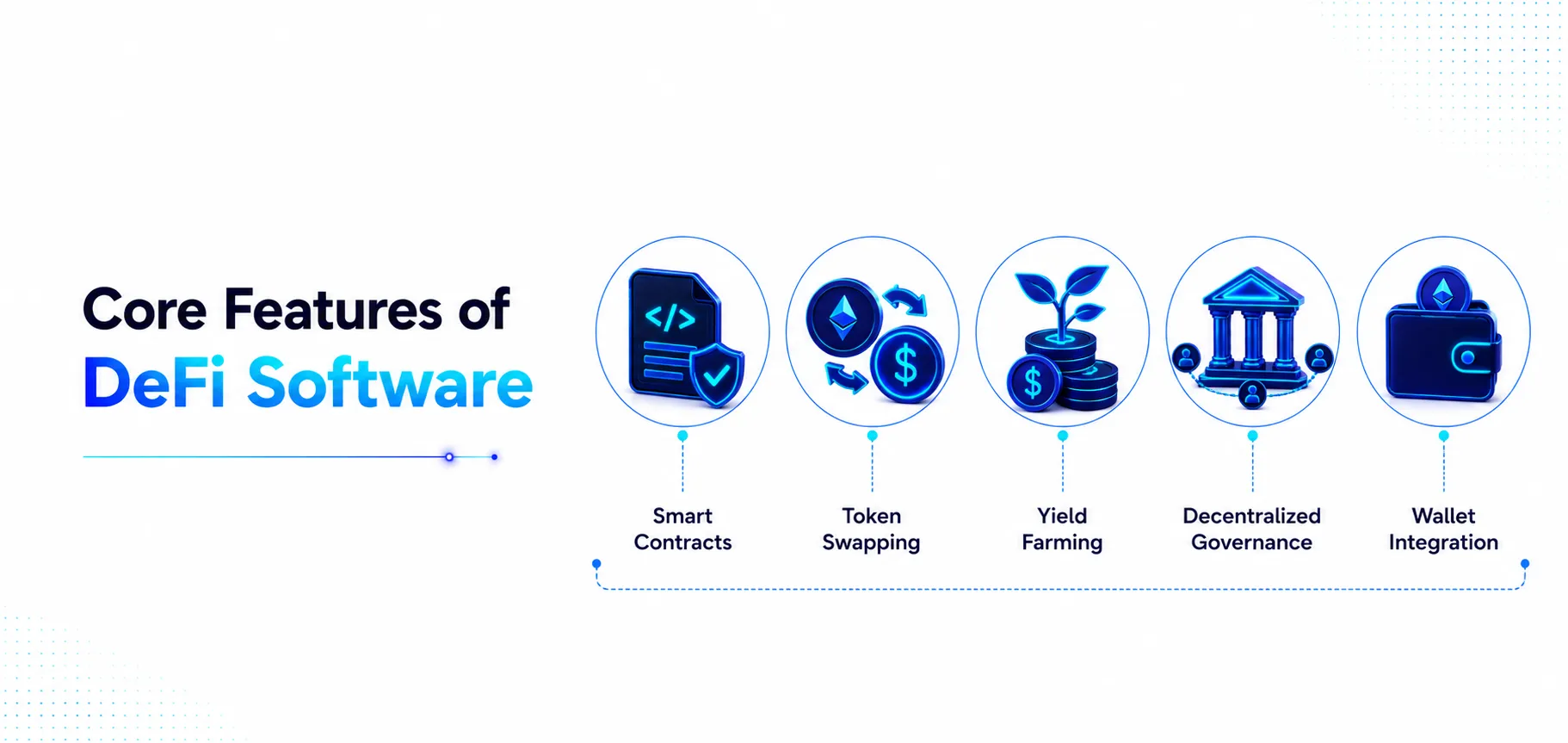
Within the fintech world, DeFi solutions have made a name for themselves in a very short time. But do you know why? It is due to the wide variety of features that are central to its functioning, that contain:
1. Smart Contracts: Contracts that are available on the blockchain and get executed when preset conditions are met are what a smart contract is all about. A much better thing about them is that they are self-executing.
2. Token Swapping: When decentralized finance app development happens, it opens the path for crypto swapping. With the help of automated liquidity pools, it removes the need for middlemen.
3. Lending & Borrowing: As the decentralized system makes them digital assets, DeFi can be easily lent and borrowed. Users deposit cryptocurrency to earn interest or lock in collateral to borrow assets, almost instantly.
4. Yield Farming: Have you heard of a scheme that offers you benefits if you provide liquidity? This might sound crazy, but it is actually a feature of DeFi applications. This is one of the ways to earn passive income where users can either lock or lend to smart contracts.
5. Decentralized Governance: DeFi users have the ability to make upgrades, decisions, and parameter changes on a collective or community basis. Hence, users on the DeFi development platform have voting rights, rather than a centralized board or council.
6. Wallet Integration: When it is about easy management and transactions of cryptocurrencies, wallet integration is a useful feature. It also acts as a secure bridge where tokens can be swapped, assets can be lent, and other wallet-related functions can happen.
What Technologies Power A DeFi Development Platform?
Many users don’t know what goes into making a decentralized finance platform. A DeFi application development company uses various tech stacks which consists of:
| Technology Layer | Tech Stack Used |
| Monitoring & DevOps | GitHub, Docker, Tenderly, Nansen |
| Web3 Indexing & Hosting | Alchemy, Infura, Vercel |
| Backend Development & APIs | Node.js, Python, REST APIs |
| Frontend Development | React.js, TypeScript |
| Smart Contract Development | Solidity, Viper, Hardhat, Foundry |
| Blockchain Layer | Ethereum, BNB, Avalanche |
How To Create A DeFi App: Key Development Steps
Building a DeFi application can be a tedious task, which makes it difficult for everyday Joe to keep up with it. But to tackle this, you can always ask for DeFi development services, which help you create it in the following manner:
1. Establish Project Objectives
In the beginning, define the goal and scope of the project. To do this, cover aspects like market research, competitor analysis, and planning how to limit the risks that the app may face.
2. Select A Blockchain Platform
Establish and choose the platform that meets your project goals. The platform of your choice makes it possible that your DeFi app will be well received by people. This decision should be based on taking into account scalability, developer community support, and transaction speed.
3. Design The UI/UX
A user-friendly design and interface make it possible for the person to navigate through the platform seamlessly. To make sure the UI/UX is working properly, you can look for platform consistency, usability testing, and user feedback. Thus, this is where DeFi app development services can be vital.
4. Develop Smart Contracts
Smart Contracts are the main triggers for executing transactions, which you, the developers, need to clearly define. In this stage, you can test error handling, go through security measures, and integrate contracts. To further improve it, various DeFi protocols such as liquidity pools can be deemed great to fetch real time data.
5. State The Tokenomics
To enhance your app’s functionality and enable smart contract execution based on real-world data like financial market information or climate forecasts, integrate external data sources. Explain precisely what the token is used for within your ecosystem: governance voting, staking, transaction fees, access to premium features, or more.
6. Integrate Wallets
Compatibility of your application with popular cryptocurrency platforms like Coinbase, MetaMask, and others is an important aspect to have. Also, make sure that you take measures to protect wallet information, such as voting rights, and other sensitive data. Therefore, DeFi app platform tools are a must in your application.
7. Do Thorough Testing
Testing is the stage where you want to cover every aspect of the application. If it’s the registration form or the functioning of the platform itself, you might need to tick every box for 100% performance. Seek feedback from users and immediately address any issue that arises during operation. You can also ask for help from a DeFi token development company to perform testing.
8. Launch & Monitor Your App
Once the testing is done, now is the time to launch your platform. A Beta version would be a great idea for the initial stages and check how the app is performing. Here, consistent updates can help and support to address issues and improve functionality. Moreover, you can take the help of a DeFi development company to do this.
9. Maintain Your App
Release new versions of the app and check regular security upgrades to ensure that the platform is secure and functioning well. Maintenance of the platform leads to higher DeFi app development costs that add to the overall development.
DeFi Software Development: Security, Compliance, And Scalability Considerations
Building a DeFi application isn’t just about shipping features; it’s about earning trust in an environment where a single vulnerability can drain millions of dollars in minutes. Therefore, three pillars determine whether a DeFi protocol survives in the long-term.
1. Smart Contract Security
Engaging reputable auditing firms before mainnet deployment is the key. A single audit is often insufficient for complex protocols. But for critical logic, mathematically prove contract behavior matches intended specifications rather than solely relying on test coverage.
2. Compliance Consideration
Regulatory clarity in DeFi is still evolving, but ignoring compliance is no longer a viable strategy for teams seeking longevity, exchange listings, or institutional partnerships.
3. Scalability Considerations
As user adoption grows, protocols that don’t plan for scale suffer from high gas fees, slow transaction times, and degraded user experience, all of which drive users to competitors.
How Can Businesses Choose The Right DeFi Development Company?
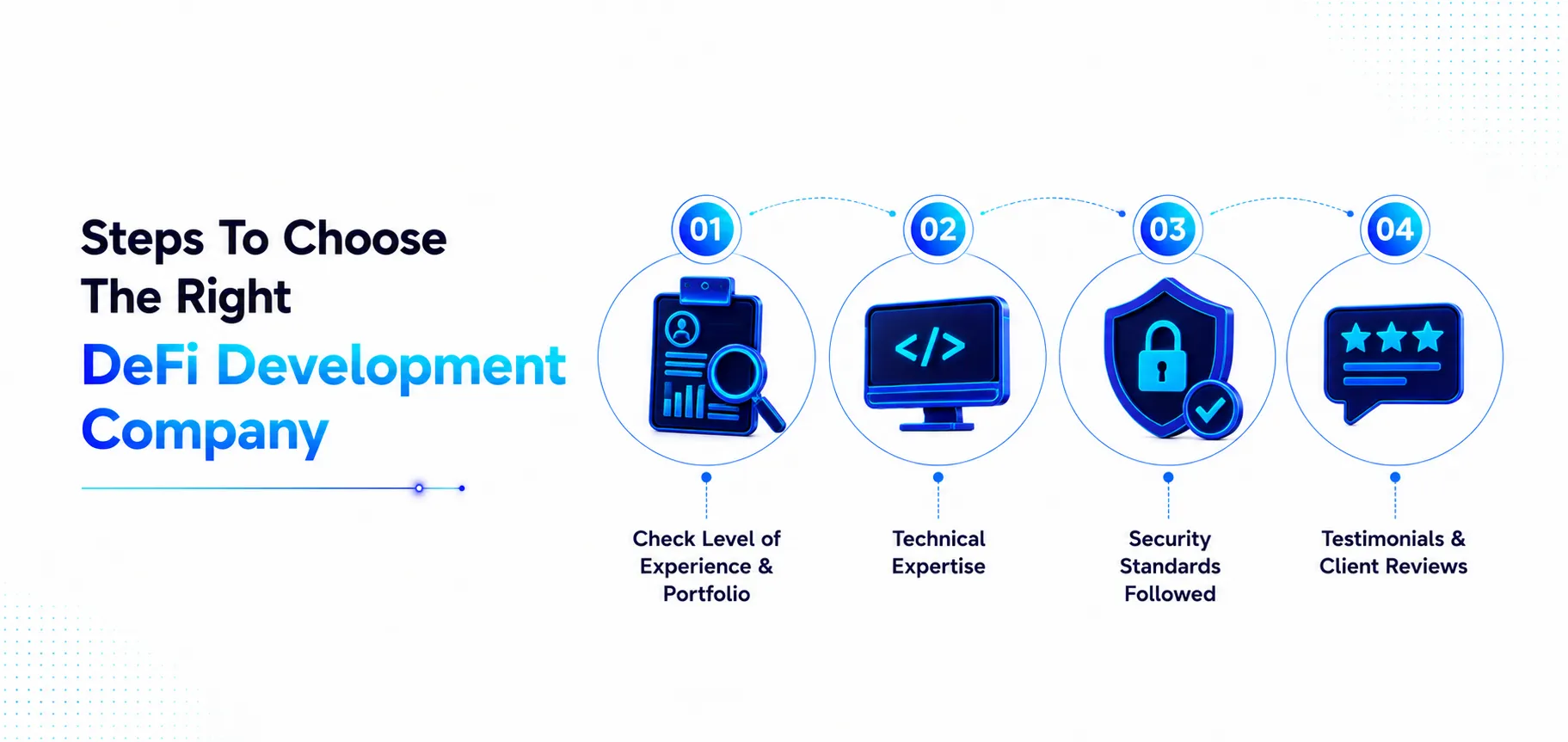
Who are you going to hire as a DeFi development company? How are you going to choose your respective partner? These are just some of the questions you must ask as a firm looking for professional assistance. So, here is the blueprint for choosing the right one:
1. Check Level of Experience & Portfolio: Level of experience in developing a platform coupled with a strong reputation is a recipe for success. A strong portfolio conveys know-how in the field and professional skills, which are a good practice method. Moreover, case studies can further depict detailed assistance.
2. Technical Expertise: Blockchain protocols like Ethereum, Solana, and BNB are areas where blockchain app development can be sought after. A well-trained developer or company can help you solve issues such as smart contracts, wallet SDKs, and safe integration procedures.
3. Security Standards Followed: Security protocols such as end-to-end encryption, multi-signature authentication, and biometric access are key to user safety. These are especially necessary when building a lending platform. Hence, DeFi lending platform development services are the ones you should go for.
4. Testimonials & Client Reviews: Taking customer opinion is a great indicator of service delivery and reliability. This is where third-party platforms like Clutch and GoodFirms can help you determine which eWallet app development company to choose and which ones to avoid.
What Are The Challenges And Risks of DeFi Development?
Decentralized finance has reshaped how people borrow, lend, trade, and earn yield, without banks or intermediaries standing in the middle. But behind every lending protocol, decentralized exchange, or yield aggregator lies a development process fraught with technical, financial, and regulatory landmines. Building DeFi products isn’t just about writing smart contracts: it’s about anticipating failure modes that traditional finance never had to consider. Here’s a breakdown of the biggest challenges and risks that DeFi developers and founders face today:
1. Smart Contract Vulnerabilities
Smart contracts are the backbone of DeFi, and they are also its biggest liability. Once deployed, code is often immutable or difficult to patch, meaning a single bug can be catastrophic. Flawed assumptions about how users or other contracts will interact with the system. Moreover, attackers borrow massive, uncollateralized sums within a single transaction to manipulate prices or governance votes.
2. Oracle Manipulation
DeFi protocols rely on price oracles to know the real-world value of assets. If an oracle can be manipulated, say by artificially moving the price on a thinly traded exchange, an attacker can trick a lending protocol into over-valuing collateral or under-valuing debt, draining the protocol.
3. Regulatory Uncertainty
Developers face ambiguity over whether tokens are securities, commodities, or something else entirely. Uncertainty about KYC/AML obligations for protocols with no central operator. Jurisdictional patchworks, where a protocol might be legal in one country and restricted in another.
4. Scalability & Network Congestion
High demand on base layer blockchains like Ethereum can drive gas fees to levels that price out smaller users, and network congestion can delay time-sensitive actions like liquidations. So, developers must make a trade off when building on Layer 2 rollups or alternative chains for lower fees, at the cost of fragmented liquidity.
5. Composability & Systematic Risks
DeFi’s design, where protocols plug into each other, is a double-edged sword. It enables rapid innovation, but it also means a failure in one protocol can cascade through everything built on top of it. A bug or exploit in a widely used lending protocol, stablecoin, or oracle can trigger contagion across dozens of dependent applications. This is much like interconnected risk in traditional banking, but often without circuit breakers or backstops.
What Are The Future Trends Shaping DeFi Development?
Over the course of time, trends in DeFi app development are shifting, causing a major change. Therefore, to get ahead of the curve and prance on the technologies of tomorrow is what is necessary. Hence, some of the future trends in DeFi include:
1. Real World Asset Tokenization: What do you think about traditional financial tools like bonds, private credit, and real estate being tokenised? And surely enough, we are heading in this direction, bringing physical assets to the blockchain world. This offers global liquidity and allows DeFi development companies to work on them effectively.
2. Institutional Adoption & Compliance: Moving away from anonymity towards a thorough built-in identification system is what is being worked on. Here, KYC/AML compliance needs to be done effectively. On the other hand, demand for liquidity pools is also reliable.
3. Cross-Chain Interoperability: Dismantling separate blockchains in fintech silos to enable smooth cross-network lending and trading. Using quick, low-cost networks (such as Base, Solana, and Atrium) to manage regular payments and high-frequency trading.
4. AI & Advanced Automation: Taking the help of AI agents to carry out intricate trading platform development strategies, automate risk assessment, and maximise yield farming is extensively done through smart portfolio management. Giving autonomous bots the ability to manage financial settlements and microtransactions without human assistance.
Why Choose Techugo?
Building a fintech app development platform like DeFi can be a challenging task when you just have too much to do. Thus, this is where Techugo can be a force for good. With our 10+ years of experience, our expertise from ideation to app maintenance can be invaluable.
The Final Word
DeFi development solutions are transforming financial services by offering real-time transactions, high transparency, and user-owned custody of assets through smart contracts and open-source protocols. Building a DeFi app involves key steps like defining objectives, selecting a blockchain, designing UI/UX, developing smart contracts, integrating wallets, and thorough testing, with costs ranging from $20,000 for a basic MVP to $200,000+ for enterprise-grade solutions. Thus, looking ahead, trends like real-world asset tokenization, institutional adoption, cross-chain interoperability, and AI-driven automation are set to shape the future of DeFi, making the right development partner essential for turning these opportunities into reality.
FAQs
Q) What are the core pillars of DeFi development?
Ans) The core pillars include smart contracts, permissionless access, interoperability and composability, transparency, and self-custodial financial services.
Q) What are the major benefits of DeFi solutions?
Ans) DeFi offers real-time transactions, high transparency, user custody of assets, and access to open-source protocols that allow for independent security audits and community-driven improvements.
Q) How to create a DeFi app?
Ans) To create a DeFi app, you need to follow:
- Establishing project objectives
- Selecting a blockchain platform
- Designing UI/UX
- Developing Smart Contracts
- Defining Tokenomics
- Integrating Wallets
- In-depth Testing
- Launching
- Support & Maintenance
Q) How much does DeFi app development cost?
Ans) Costs vary by complexity: a basic MVP app ranges from $20,000 to $70,000, a mid-level complexity dApp costs from $70,000 to $140,000, and an enterprise-level app can cost from $140,000 to $200,000+.
Q) What are some future trends of DeFi?
Ans) Emerging future trends consist of real-world asset tokenization, institutional adoption with KYC/AML compliance, cross-chain interoperability, and AI-driven automation for trading, risk assessment, and portfolio management.

Get in touch
We'd love to hear from you.