

 SA
SA
 KW
KW
 IE
IE AU
AU UAE
UAE UK
UK USA
USA
 CA
CA DE
DE
 QA
QA ZA
ZA
 BH
BH NL
NL
 MU
MU FR
FR


















📌 Key Takeaways
- Real-time GPS tracking updates vehicle locations every 5-10 seconds for full visibility.
- Predictive maintenance flags service needs before a breakdown happens, extending vehicle lifespan.
- Development costs range from $20,000 to $210,000+, depending on complexity.
- Custom software offers complete ownership and long-term flexibility vs. subscription-based vendor dependency.
- Route optimization factors in live traffic, delivery windows, and load capacity to cut fuel costs.
Fleet operations today run on tight margins, rising fuel costs, and increasingly strict compliance requirements, making manual oversight a costly liability. Fleet management software solves this by giving businesses real-time visibility into vehicle location, driver behavior, and maintenance needs through a single digital platform. While off-the-shelf tools offer a quick fix, many growing businesses eventually hit their limits in customization and scalability. Custom fleet management software, by contrast, is built around your exact fleet size, workflows, and compliance needs, offering full ownership and long-term flexibility. This blog breaks down the core features, real business benefits, costs, and challenges involved in building one.
What Is Fleet Management Software?
Helping businesses track mobile assets and fleet of vehicles, and manage and optimize them through a digital platform is what a fleet management software is. Such software helps organisations to know vehicle status, track location, and verify the condition of vehicles. No matter what the distance is, it is easy to know the details about the fleet, and hence, you are one step ahead in achieving success.
How Does Fleet Management Software Work?
To understand how fleet management software works, take a look at the following:
1. Data Capture: Through sensors, an endless flow of data is collected. Such data points are about location of the vehicle, engine status of fuel, and what is the driver behavior. However, to track the location of the fleet, it is better to opt for GPS tracking software development.
2. Analysis: The data gathered allows room for in-depth analysis against defined parameters and helps flag issues like harsh braking, fuel waste, or an upcoming maintenance need. To do this seamlessly, it is better to look for automotive app development, which is a pioneer in this.
3. Alert: AI agents are able to escalate critical issues to the appropriate person in real time, whether that person is a maintenance planner observing an asset entering an overdue status or a safety manager examining a violation.
4. Report & Act: Teams may examine performance over time using dashboards and reports, and automated workflows translate insight into action without the need for manual follow-up.
Types of Fleet Management Software
If your fleet is still running on spreadsheets, sticky notes, and a driver’s memory of when the oil was last changed, you already know the cost of not having the right system in place. To get this in the best shape possible, here are some of the major types of fleet management software on the market:
1. GPS Fleet Tracking Software
GPS tracking software uses hardware installed in each vehicle (or a mobile app) to report real-time location, speed, direction, and idle time back to a central dashboard.
What It Solves:
- Knowing exactly where every vehicle is at the moment.
- Verifying routes and stops for customer or compliance purposes.
- Reducing unauthorized vehicle use and after-hours driving.
- Improving dispatch decisions with live location data.
2. Vehicle Maintenance Management Software
Maintenance software shifts fleets from reactive repairs to proactive upkeep. It tracks service history, schedules preventive maintenance based on mileage or engine hours, and sends alerts before small issues become expensive ones.
What It Solves:
- Preventing breakdowns through scheduled maintenance.
- Extending vehicle lifespan and resale value.
- Centralizing service records for warranty and compliance needs.
- Forecasting maintenance budgets more accurately.
3. Fuel Management Software
This software tracks fuel purchases, flags suspicious transactions, monitors fuel efficiency by vehicle or driver, and can integrate with fuel cards for automated reporting.
What It Solves:
- Detecting fuel theft or card misuse.
- Identifying inefficient driving habits that waste fuel.
- Reconciling fuel spend against mileage automatically.
- Supporting sustainability reporting and emissions tracking.
4. Driver Management & Safety Software
This category focuses on the human side of fleet operations, monitoring driver behavior, managing licensing and certifications, and supporting safety programs. Many platforms include dash cams, driver scorecards, and automated coaching alerts for harsh braking, speeding, or distracted driving.
What It Solves:
- Reducing accidents and the liability that comes with them.
- Lowering insurance premiums through demonstrable safety improvements.
- Keeping their credentials, certifications, and hours of service compliant.
- Identifying coaching opportunities before incidents happen.
Fleet Management Software Cost Breakdown
Developing a logistics fleet management software can be a challenging task, especially when you are not aware of its minute components. So, what are you left with? It is to ask a fleet management software development company to do platform building on your behalf. So, what will be the cost? It is divided into 3 tiers, which cost:
| Software Type | Estimated Cost (USD) |
| Basic Platform | $20,000 – $70,000 |
| Mid Tier Software | $70,000 – $150,000 |
| Enterprise Level Software | $150,000 – $210,000+ |
Key Modules of Fleet Management Software
Most fleet management platforms look similar from the outside: a dashboard, a map, some charts. What separates a strong platform from a weak one is what’s happening under the hood. To understand this, we must first get into detail about the various modules available, and some of them include:
1. Vehicle Tracking Module
The vehicle tracking module pulls real-time GPS data to show location, speed, direction, and route history for every vehicle in the fleet.
What It Includes:
- Live map view with vehicle positions.
- Historical route playback.
- Geofencing and location-based alerts.
- Idle time and stop duration checking.
2. Fuel Management Module
The fuel module monitors consumption, spend, and efficiency across the fleet, often by integrating directly with fuel cards or onboard diagnostics.
What It Includes:
- Fuel purchase tracking and card integration.
- Fraud and anomaly detection.
- Fuel efficiency reporting by vehicle or driver.
- Idle time fuel waste analysis.
3. Maintenance Management Module
This module keeps vehicles road-ready by tracking service schedules, repair history, and part or warranty details. It shifts fleets from reacting to breakdowns to preventing them.
What It Includes:
- Preventive maintenance scheduling by mileage, time, or engine hours.
- Service history logs per vehicle.
- Automated alerts for upcoming or overdue service.
- Work order creation and tracking.
4. Driver Management Module
This module centers on the people behind the wheel, licensing, certifications, performance, and safety behavior.
What It Includes:
- Driver profiles with license and certification expiration tracking.
- Behavior scoring (harsh braking, speeding, acceleration).
- Hours of service and fatigue monitoring.
- Coaching and training assignment tools.
5. Route Planning & Dispatch Module
This module handles the logistics of getting vehicles where they need to go, in the right order, at the right time.
What It Includes:
- Route optimization based on traffic, distance, and time windows.
- Dispatch assignment and driver notifications.
- Real-time re-routing when conditions change.
- Delivery or job status updates.
What Are The Benefits of A Fleet Management Software Platform?
Going for fleet management software programs have their own benefits that make a business profitable and sustainable. Therefore, among the many, some of them include:
1. Improved Safety: To maintain optimal condition, all fleet cars must undergo regular inspections. You can identify problems early and lower the chance of a breakdown through fleet management software development. Moreover, extending security is also a benefit when talking about on-demand app development.
2. Easing Compliance: Organizing the necessary paperwork to be in compliance and stay out of trouble with the law is made easier with fleet management software development services. Documenting crucial data that managers and drivers require to comply is part of well-designed fleet management regulations.
3. Enhanced Efficiency: In addition to lowering expenses and increasing profit, good vehicle management may increase a vehicle’s lifespan, increase fuel efficiency, and even lessen your company’s carbon footprint.
4. Improved Service Delivery: A well-run convoy enables your business to fulfil orders and provide services on schedule, satisfying your clients. When your clients are satisfied with fleet management software solutions, you gain their trust and faith in your offerings, which promotes customer loyalty and repeat business.
5. Profitability Rises: Your expenses decrease and profitability increases when your fleet functions like a well-oiled machine. You can make more investments in growing your company by recruiting more drivers, purchasing new commercial vehicles, or perhaps extending your service offerings as your bottom line improves.
Core Fleet Management Software Features To Consider
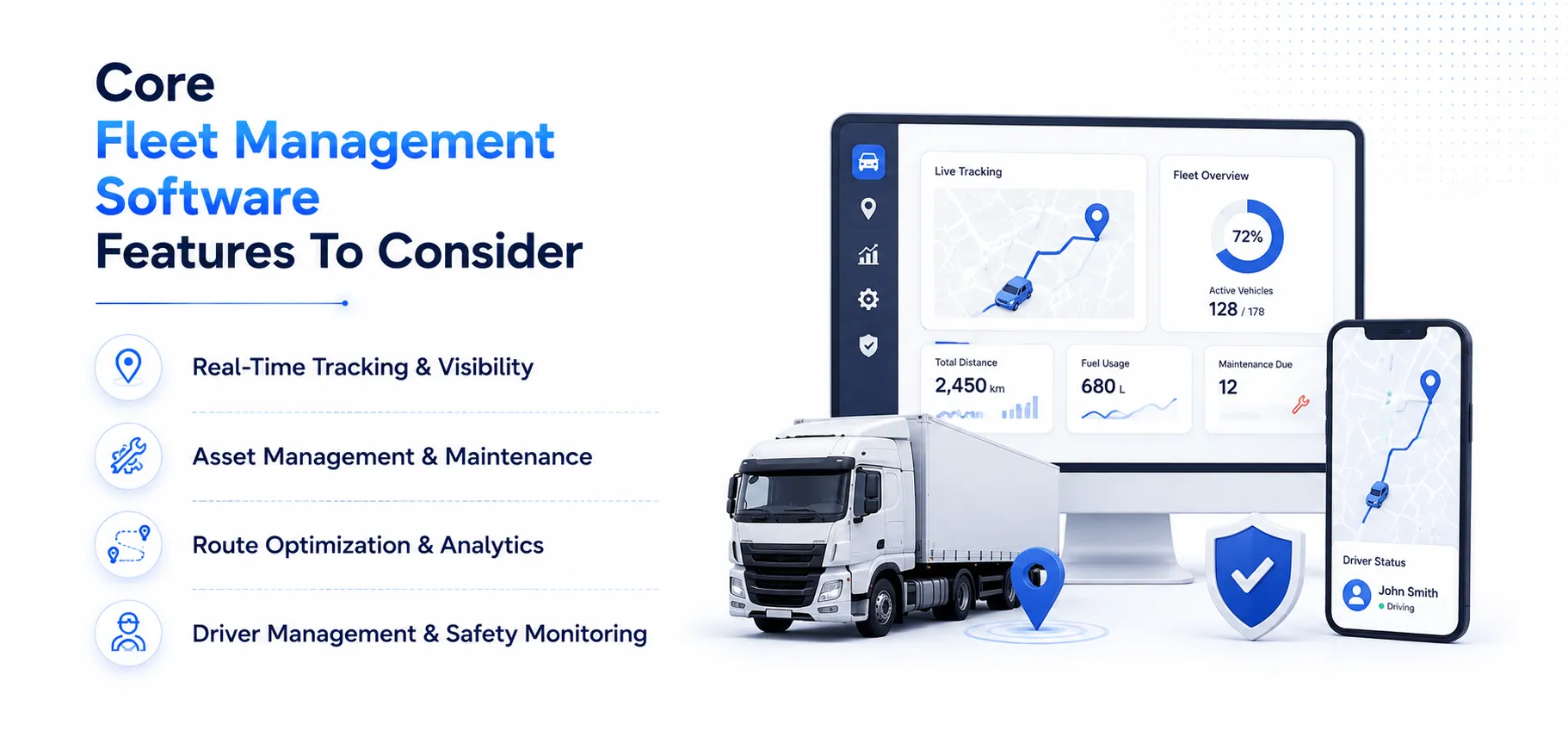
The success and failure of fleet management software depends on its features. These are added with the intent to make the application more useful and seamless for users. Hence, the following features, which are generally considered core to a fleet management platform, include:
1. Real-Time Tracking & Visibility
Live location with an interactive map is a feature that makes it easier for the business to know where each of the vehicles is. It is updated every 5-10 seconds, which lets business owners know the exact location. Another element of adding this is to check any historical events, like accidents or any other related incidents that may have occurred.
2. Asset Management & Maintenance
Before even a breakdown occurs, the asset management and maintenance mechanism will inform the driver and admin about an estimated service of the vehicle. Proactive maintenance is the best way to extend the life of the fleet. Moreover, spare parts, asset lifecycle tracking, and equipment assignment across multiple locations become easy.
3. Route Optimization & Analytics
Through analytics, it is quite easy to calculate the best route while travelling. This accounts for real-time traffic, delivery windows, and load capacity. Moreover, fuel consumption per vehicle and per-route efficiency helps in cost control.
4. Driver Management & Safety Monitoring
Maintaining accurate records of licensing, certifications, shift schedules, and other related aspects is covered under driver management and safety, which leads to safety monitoring.
This is a great element when focusing on administrative management, which contains driver behavior monitoring capabilities. Moreover, systems are robustly built to track speeding, rapid acceleration, harsh braking, excessive idling, and more.
Custom v/s Off-The-Shelf Fleet Management Software: Which One Is Better?
A famous dilemma faced by entrepreneurs around the world is the build v/s buy decision. According to the needs of your business, you can choose either of the paths, which leads to vehicle fleet management software. So, the difference between custom v/s off the shelf consists of:
| Factor | Custom Fleet Software | Ready-made Fleet Software |
| Deployment Speed | Longer Implementation | Fast Deployment |
| Customization | Completely Customizable | Limited Customization |
| Integrations | Built According To Business Needs | Vendor Dependent |
| Scalability | Highly Scalable | Depends on Platform Limit |
| Ownership | Complete Control | Subscription Based |
| Long Term Flexibility | Maximum Flexibility | Limited By Vendor Roadmap |
Steps To Build A Vehicle Fleet Management Software
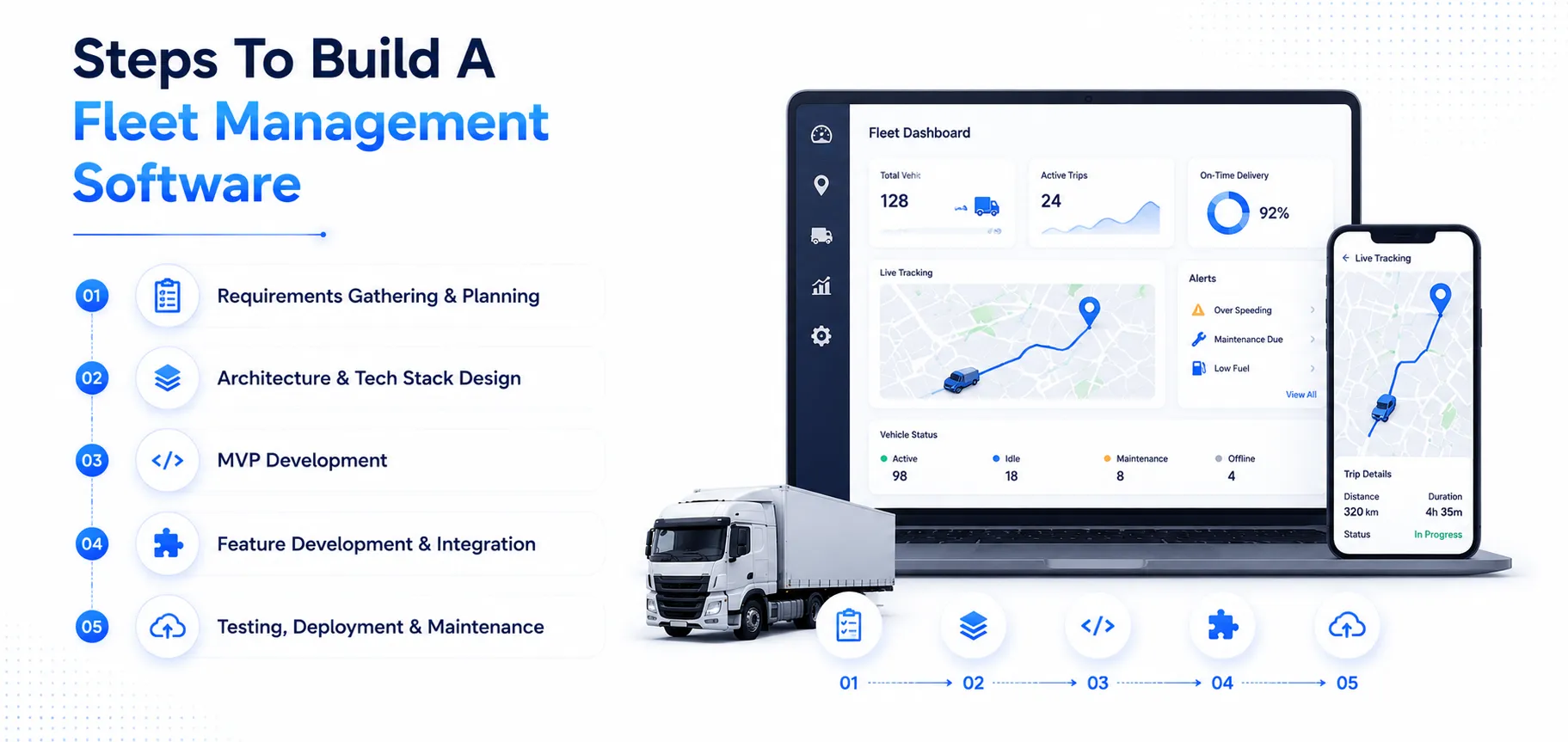
A cloud-based fleet management software will perform smoothly when it is tried, tested, and completely developed. However, the process is detailed, which might cause you to wonder, “How do fleet management software companies build such platforms?” So, for your curious mind, here are the steps developers go through:
1. Requirements Gathering & Planning
The initial stage is just all about collecting information about the project and how you can execute it. This involves documenting the fleet size, types of vehicles, and fleet management regulations that businesses must comply with. So, the necessary consulting can only be done with a sophisticated fleet management software company.
2. Architecture & Tech Stack Design
Configure the database architecture for transactional and telemetry data. Create the API layer for third-party integrations and Internet of Things devices. Also, describe the architecture for mobile devices. The blueprint is created as a result.
3. MVP Development
If you were wondering when the real development will happen, then this is the stage. Driver assignment, fleet dashboard, trip logging, real-time GPS tracking, and others will be integrated. The best thing is to deploy to staging, then test with real fleet users. Thus, you will realize that this is where software development consulting is most effective.
4. Feature Development & Integration
Features in the app are to be developed with the intent to satisfy compliance and maintenance needs. So, develop the AI analytics engine for predictive analytics, driver behavior scoring, and route optimization. Agile sprints last two weeks, with a demo following each. With iterative feature development, the software development company sees functional applications every two weeks rather than once a year. Gather user input at the end of each sprint to inform the next.
5. Testing, Deployment & Maintenance
In this stage, many of the tests are performed. Load testing, penetration testing, role-based access control validation, and user acceptance tests are just some of them. Moreover, to check system health and data pipeline integrity, it is essential to deploy cloud infrastructure and perform structured onboarding post-launch monitoring.
Fleet Management Software Compliance And Regulatory Requirements
Here’s a breakdown of the major compliance and regulatory areas fleet management software is built to handle.
1. Hours of Service (HOS) & Electronic Logging Devices (ELDs): In the U.S., the FMCSA requires most commercial drivers to log their hours electronically rather than on paper, and to stay within defined driving and rest limits
2. International Fuel Tax Agreement (IFTA) Reporting: Fleets operating across state or provincial lines in the U.S. and Canada must report fuel use and mileage by jurisdiction each quarter under IFTA.
3. DOT Inspections & Vehicle Maintenance Records: The Department of Transportation in the U.S. requires vehicle inspections and documented maintenance to ensure vehicles remain safe to operate.
4. Driver Qualification Files (DQFs): Regulations require fleets to maintain a qualification file for every commercial driver, including license status, medical certification, and driving record.
Tech Stack Used To Build Fleet Management Software Solutions
Take a look at the tech stack involved in providing fleet management software solutions:
| Layer | Common Technologies |
| Frontend | React, Angular, React Native |
| Backend / API | Node.js, Python, Java |
| Database | MongoDB, PostgreSQL |
| IOT / Telematics Integration | MQTT, CAN Bus |
| Mapping & Geolocation | Google Maps, API, Mapbox |
| Cloud Infrastructure | AWS, Google Cloud, Microsoft Azure |
| AI / ML | TensorFlow, PyTorch |
| Analytics & BI | Elasticsearch, Power BI, Tableau |
| Security & AI | OAuth 2.0, JWT |
| DevOps | Docker, Kubernetes |
How To Choose The Right Fleet Management Software Development Company?
When you are in fresh waters, you don’t know who to trust. But this risk can be mitigated with a series of steps which ends you with the right fleet management software development company. So, here are the steps:
1. Domain Expertise In Fleet & Logistics
General software development skills don’t automatically translate to fleet management. Look for a company that has actually built products in this space before.
What To Check:
- Case studies or portfolio specific to fleet, logistics, or transportation software.
- Familiarity with fleet-specific data (telematics, ELD feeds).
2. Technical Expertise In Relevant Technologies
Fleet software has some specific technical demands: real-time data processing, mapping, and geolocation, mobile apps that work with unreliable connectivity, and integrations with hardware.
What To Check:
- Cloud infrastructure experience suited to scaling with fleet size.
- Comfort working with IoT devices and onboard diagnostics hardware.
3. Understanding of Compliance Requirements
If the software needs to support ELD compliance, IFTA reporting, or DOT documentation, the development team needs to understand these requirements from the start – not retrofit from that.
What To Check:
- Prior experience building ELD-compliant or FMCSA – registered solutions.
- Awareness of regulatory differences across regions your fleet operates in.
4. Integration Capability
Custom fleet software rarely exists in isolation. It typically needs to connect with GPS hardware, fuel cards, accounting systems, HR platforms, and sometimes existing legacy tools.
What To Check:
- Track record integrating with common telematics and hardware providers.
- API development experience for connecting to third-party systems.
5. Scalability & Long-Term Architecture
A solution built for 20 vehicles needs different architecture than one built for 2,000. Choosing a partner who designs for growth avoids a costly rebuild later.
What To Check:
- Experience designing systems that scale with data volume and user count.
- A clear conversation about your growth plans and not just current needs.
Challenges In Developing Vehicle Fleet Management Software
Facing challenges while doing logistics software development is a common part of the process. But knowing about them gives you an edge in addressing them and saves your time and effort. Thus, a list of challenges includes:
1. Rise In Operational Cost: A major portion of the operational cost for a fleet business is fuel. But with unpredictable fuel rates and rising uncertainty, they are likely to be on the higher side. And even the smallest inefficiency might go on for days. Similarly, you will find rising operational costs when dealing with warehouse management software development.
2. Regulatory Compliance: Compliance requirements are so minute that even a single misstep can cost your business a fortune. And doing this manually doesn’t bring the risk-to-reward in your favor. On top of this, ensuring that the drivers and vehicles meet regulatory compliance adds to the complexity.
3. Driver Safety: Real-time insights make it viable for the business to check driver behavior. Therefore, without clear information, identifying and correcting unsafe practices often happens in reaction when an incident occurs.
4. Talent Retention: Drivers are motivated by recognition, new tasks, and comfortable environments. Any change in the status quo will cause dissatisfaction amongst them. Thus, building and maintaining morale amongst drivers is a constant struggle.
5. Operational Efficiency: Managing daily operations might frequently involve guesswork in the absence of visibility into fleet activity. Customer trust is damaged by ineffective dispatching or routing, which results in needless travel, fuel waste, and delayed delivery.
Future Trends In Fleet Management Software
Fleet management has already moved fleets away from paper logs and guesswork. But the next wave of change is less about digitizing existing processes and more about making fleets predictive, autonomous, and sustainable by design. So, here’s a look at the trends reshaping where fleet management software is heading.
1. AI-Powered Predictive Maintenance: Traditional maintenance scheduling relies on fixed intervals – mileage or time-based. AI is shifting this toward true prediction, using sensor data to flag issues before they cause a breakdown.
2. Electric Vehicle Fleet Management: As fleets add EVs, software is evolving to manage needs that don’t exist for combustion vehicles, charging schedules, battery health, and range planning.
3. Advanced Telematics & IoT Integration: Sensors are getting cheaper and more capable, and software is expanding beyond GPS location to capture a much richer data picture from every vehicle.
4. Autonomous & Semi-Autonomous Vehicle Support: While fully autonomous commercial fleets are still emerging, software is already adapting to support semi-autonomous features and eventually, driverless operations.
5. Sustainability & Emissions Reporting: Regulatory pressure and corporate sustainability goals are pushing emissions tracking from a nice-to-have into a core software feature.
How Techugo Helps Your Business?
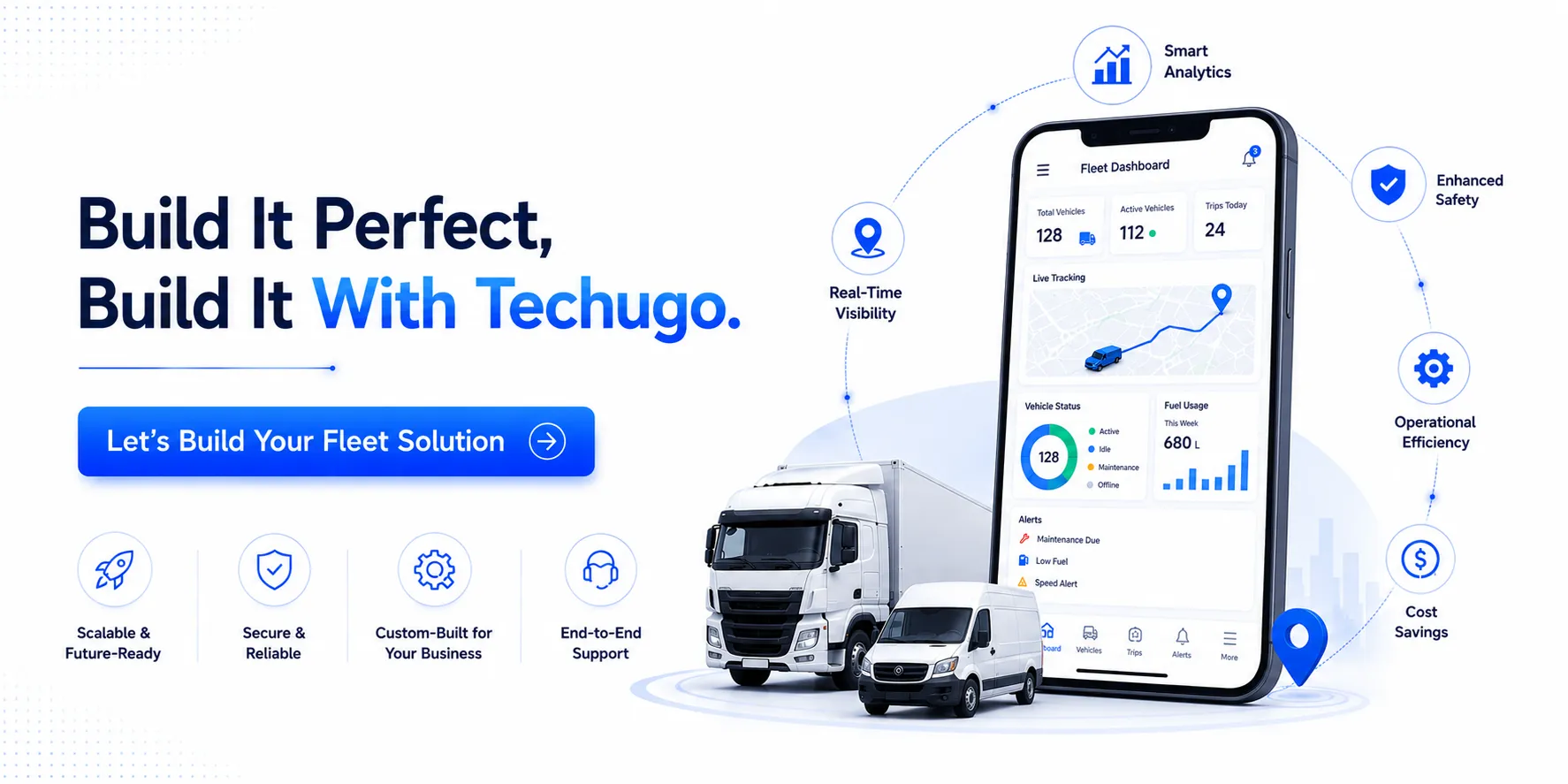
Feeling helpless or not being able to develop astute solutions for fleet management is a real problem. But don’t worry. Techugo has the expertise to deliver solutions to help startups and even a fully fledged enterprise.
The Final Word
Custom fleet management software gives businesses the tools to track vehicles in real time, automate maintenance schedules, optimize routes, and monitor driver safety, all tailored to their specific operations. While development costs range from $20,000 for a basic platform to over $210,000+ for enterprise-grade solutions, the lengthier payoff comes through reduced fuel waste, fewer compliance risks, improved driver accountability, and higher customer satisfaction. That said, building one isn’t without hurdles: integration complexity, regulatory demands, and driver retention all require careful planning. Ultimately, for businesses ready to move beyond the limitations of generic software, investing in a custom-built solution offers the scalability and control needed to stay competitive as fleets grow.
FAQs
Q) What is enterprise fleet management software?
Ans) Enterprise fleet management software is a large-scale, feature-rich platform designed for businesses operating extensive fleets across multiple locations, departments, or regions.
Q) How long does it take to build custom fleet management software?
Ans) Timelines vary based on complexity, but most projects move through requirements gathering, architecture design, MVP development, feature integration, and testing in agile sprints, often spanning several months from planning to launch.
Q) How does fleet management improve driver safety?
Ans) It monitors driver behavior in real time, which includes tracking speed, harsh braking, rapid acceleration, and excessive idling. This allows managers to identify risky patterns early and take corrective action before incidents occur.
Q) Can fleet management software help with regulatory compliance?
Ans) Yes! It automates documentation of licenses, certifications, inspections, and hours-of-service logs, reducing the manual effort and risk associated with staying compliant with transportation regulations.
Q) Should I choose custom software or off-the-shelf software?
Ans) It depends on your business needs. Off-the-shelf tools deploy faster and cost less upfront. But custom software offers full customization, better scalability, and complete ownership, making it a stronger long-term investment for growing fleets.

Get in touch
We'd love to hear from you.