

 SA
SA
 KW
KW
 IE
IE AU
AU UAE
UAE UK
UK USA
USA
 CA
CA DE
DE
 QA
QA ZA
ZA
 BH
BH NL
NL
 MU
MU FR
FR















📌 Key Takeaways
- The cost of HR software varies by business size and requirements, with typical pricing ranging from $2 to $100+.
- HR software development services help businesses automate HR processes, centralize employee data, and reduce manual, error-prone work.
- The main types of HR software include HRIS, HRMS, and HCM.
- Custom HR software development enables organizations to tailor workflows, integrations, permissions, and features to their specific operational and compliance requirements.
- HR software enhances compliance, decision-making, employee experience, efficiency, and long-term cost savings.
Managing a workforce today involves far more than payroll and paperwork. It demands real-time data, seamless compliance, and systems that scale with growth. This is where HR software development services step in, transforming manual, error-prone processes into automated, centralized workflows that give HR teams the clarity they need to make faster and smarter decisions. From employee records and payroll to recruitment and performance tracking, the right HR platform touches nearly every part of the employee lifecycle. In this guide, we break down what HR software is, how it works, what it costs, and how to choose the right solution.
What Is HR Software Development?
The step-by-step process of designing, building, and deploying a digital platform that helps businesses manage activities related to people, it is widely known as HR software development. The HR information system helps businesses maintain employee records such as payroll, performance, attendance, offboarding, and other aspects. All in all, it assists the HR department in automating tasks that were previously manual. Commonly speaking, it is SaaS in nature, and examples include UKG, ZOHO People, and Oracle HCM Cloud.
How Does HR Software Work?
While eliminating the need for paperwork, HR software development solutions work on a digital front. But not many people know how the software functions. So, here is a detailed breakdown of how the application functions:
1. Data Collection & Centralization
When an employee is added to the system, their information (personal details, job role, salary, documents, tax info) is stored in a centralized database. This becomes the single source of truth from which other modules pull.
2. Role-Based Access
The software assigns different permission levels. Employees can log into a self-service portal to view salary slips or apply for leave. Managers can approve requests or review performance. HR admins get full access to configure policies, run payroll, or generate reports.
3. Automation of Routine Processes
Instead of manual data entry, the system automates repetitive tasks:
- Leave requests are automatically checked against the policy and balance, then routed for approval.
- Payroll is calculated based on attendance, tax rules, and deductions, often on a set schedule.
- Onboarding tasks trigger automatically when a new hire is added.
4. Integration With Other Systems
HR software typically connects with other tools via APIs, accounting software for payroll sync, Slack/email for notifications, calendar apps for scheduling interviews, or biometric devices for attendance tracking.
5. Data Processing & Analytics
As data flows through the system, it’s aggregated into dashboards and reports, turnover rates, attendance trends, and headcount costs, giving HR teams real-time insights instead of manually compiling numbers.
HR Software Development Process: Step-By-Step
Developing HR software requires more than simply building a platform for storing employee information. Modern HR systems often bring together recruitment, onboarding, payroll, attendance, performance management, and other HR functions. So, here is a step-by-step overview of the development process of HR software.
1. Define Business Requirements: The initial step is to identify the organization’s HR challenges and determine what the software needs to solve. Start by consulting HR teams, managers, employees, and other stakeholders. Identify existing workflow gaps, manual processes, reporting requirements, and integration needs.
2. Conduct Market Research & Competitor Research: Before development begins, analyze existing HR platforms and competing solutions. This helps identify common features, usability standards, pricing models, and opportunities for differentiation. The research should help answer an important question: What unique value will the new HR software provide?
3. Choose The HR Software Type & Features: Next, determine whether you are building an HRMS, HRIS, HCM platform, recruitment system, payroll solution, employee engagement platform, or a more specialized product.
4. Design The UX & UI: HR software is used by employees, HR professionals, managers, recruiters, and administrators with different technical abilities. The interface should therefore be simple and intuitive.
5. Develop The Software: Once the designs and architecture are approved, development begins. For the frontend, developers implement dashboards, employee profiles, forms, reports, approval workflows, and other interfaces based on the approved designs.
6. Test The Application: A thorough testing of the software needs to be done. Comprehensive testing helps identify functional, security, performance, and usability problems before release.
7. Launch The MVP: Instead of waiting until every planned feature is complete, many businesses launch an MVP with the highest priority functionality. An HR application might include employee engagement, attendance, leave management, employee self-service, and basic reporting.
8. Maintain, Monitor & Improve: HR application development does not end at launch. Continuous maintenance is necessary to keep the platform secure, reliable, and compatible with changing business requirements.
How Much Does HR Software Cost?
One of the important aspects of asking HR software development companies to build this sophisticated program is understanding the cost element. But the important thing to know is that the cost may vary depending on the size of the organization, and it will increase as the number of people goes up. So, the cost looks like this:
| Company Size | Price Range (Per Employee Per Month) | Monthly Cost Estimate (USD) |
| Small Business | $2 – $10 | $50 – $300 |
| Mid-Level Business | $10 – $25 | $500 – $2,500 |
| Enterprise-Level Business | $25 – $100+ | Custom Quote |
Take A Look At The Different Types of HR Softwares
If you didn’t know, there are various types of HR software that are being used in organisations around the world. Between the three, there is some level of overlap, but they cannot be used interchangeably. Thus, the list looks like this:
1. Human Resource Management System (HRMS)
HRMS contains the features of HRIS and HCM and is considered the powerhouse of HR software. The Human Resource Management System helps in maintaining and optimizing the core aspects of the HR process. The list involves benefits administration, employee data storage, time, attendance, and payroll. Hence, the aim here is to enhance efficiency by developing productivity reports and analyses.
2. Human Resource Information System (HRIS)
Probably the most widely used amongst the three, HRIS is a great tool that helps in collecting and storing employee data. The aim was to create a system that saves a lot of time, and businesses end up with efficient reporting processes. Through the Human Resource Information System:
- The induction process of onboarding
- Maintaining a pool of relevant employees
- Checking employee attendance
- Automated payments to keep in check that they are made on time
- Keeping a record of employee performance, which can later be easily accessed
3. Human Capital Management (HCM)
When you ask, “What is human capital management?” Just remember it is an extension of HRIS, but it takes the same features to the very depth and makes them a bit more complex. Human Capital Management highlights an employee’s journey within the organization from the day they are hired till management optimization. So, here’s what this involves:
- HCM helps in recruiting and onboarding a candidate, which makes the process smoother.
- Keeping a tab on employee performance assessments and reviews is what is done through management.
- Elements such as learning & development, employee engagement, and remuneration competency are taken into account.
HR Software Features You Must Ask For
Features are a critical part of any application, and so is for HR software. At any point during the service stage, it cannot be missed. Hence, when you are actively looking for HR software development services, ask for this lot:
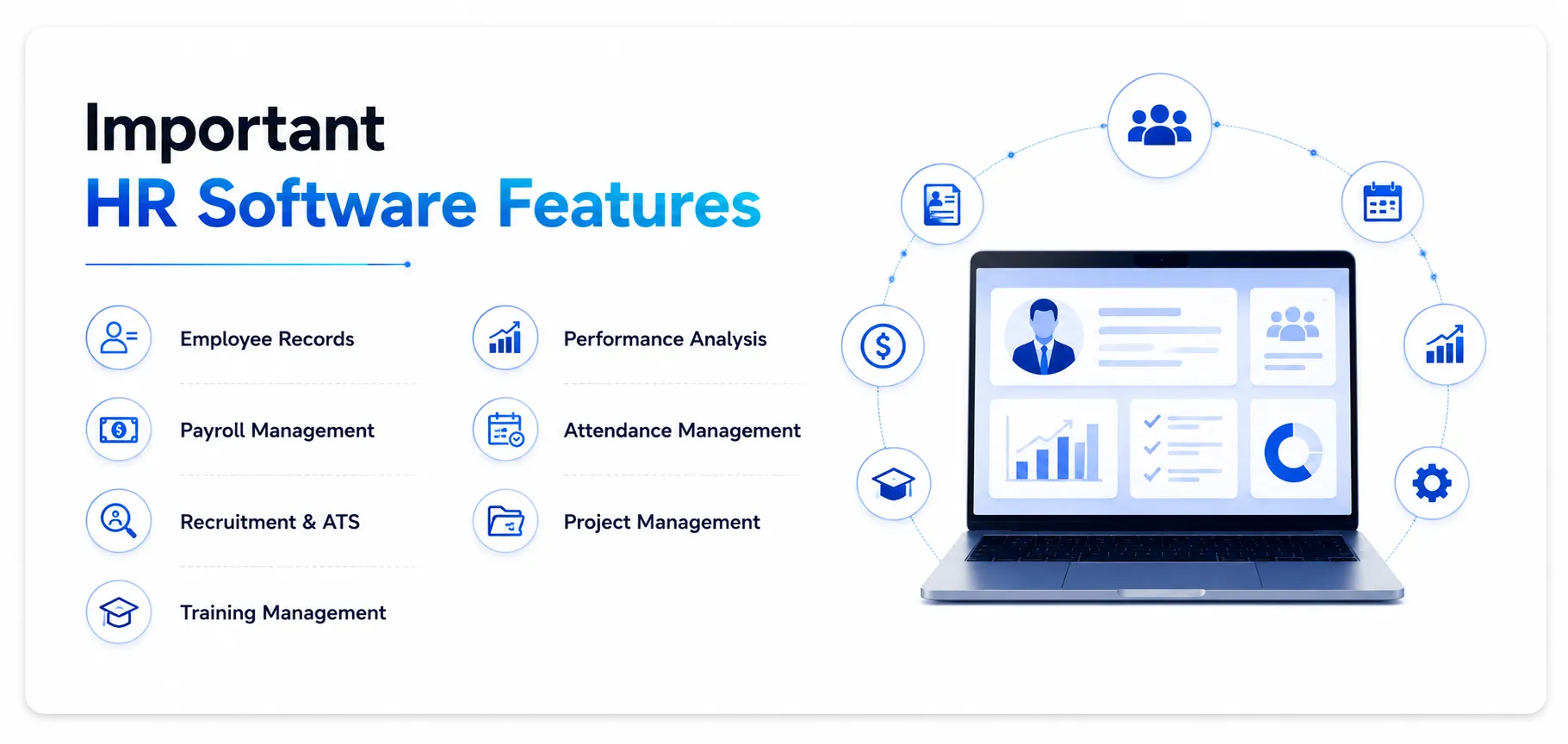
1. Employee Records: Having multiple kinds of details about the employees, like medical insurance, attendance, and tax information, is just a few of many. The employee records element also maintains employees’ personal information, previous job data, recognition, awards, and performance. Employee records may be just one reason to ask for software development consulting.
2. Payroll Management: Managing employees’ salaries, bonuses, tax deductions, health insurance, and paychecks is part of the payroll management feature. The HR tech software development services calculate each employee’s paycheck properly and effectively.
3. Recruitment & ATS: Streamlining the process of recruitment from the job posting stage till the offer letter is released can also be easily managed. Applicant Tracking Systems make sure the candidate is always connected through continuous communication, interviews are scheduled, and application assessment is somewhat automated. When this is the requirement, you can ask for job portal app development.
4. Training Management: Constantly updating the talent pool is an important aspect of the going concern concept for businesses. To make this a regular practice, an element of upskilling the staff through remote learning and live training must be added. Thanks to the custom HR software development company, they are among the best experts in adding training management tools and modules.
5. Performance Analysis: Utilising this feature, a senior team member can evaluate junior employees’ performance. Moreover, HR can easily assess employee performance, ability, and skills.
6. Attendance Management: Through the implementation of the attendance management feature, the HR team can check when employees checked in and checked out. Also, tracking leaves, leave time, and arrival at the office premises is easy. This feature of HR is important to implement through enterprise mobile app development.
7. Project Management: This feature aims to check how much time is deployed to a particular project. Going a step further, timesheets and projects can be easily managed. Similarly, if you want a learning system, then you can ask for LMS software development.
Custom HR Software vs. Off-The-Shelf HR Software
The main difference is flexibility. Custom HR software is designed around the organization, whereas off-the-shelf software requires the organization to work within the capabilities and configuration options provided by the vendor.
| Factor | Custom HR Software | Off-The-Shelf HR Software |
| Development | Built for specific business requirements | Pre-built for a broad market |
| Customization | Highly customizable | Limited to available configurations |
| Implementation | Usually takes longer | Generally faster |
| Initial Cost | Typically higher | Usually lower |
| Scalability | Can be designed around future requirements | Depends on the vendor’s roadmap and plan |
| Integrations | Can be developed for specific systems | Supports available integrations |
| User Experience | Designed around specific workflows | Based on the vendor’s standard UX |
| Maintenance | Managed by the organization or development partner | Typically handled by the vendor |
| Updates | Controlled by the business/development team | Controlled by the vendor |
Benefits of Using HR Software For Your Business
Have you considered why you want to use HR software, or are you just jumping on the bandwagon of trends? If you still don’t know the answer to this, then take a look at the list of benefits of using one:
1. Helps In Improving Regulatory Compliance: Regulation is something that needs to be taken care of in the first place. Through customized HR software development, your teams will get automated reminders and even notifications if any regulatory breach occurs. Hence, with the HR information system, you get ahead of things even before they happen.
2. Enabler of Better Decision Making: Keeping every source under a centralized system makes it effective for the team to work efficiently. Team members don’t have to waste hours going through each library of documents. Therefore, you are in a position to make better and calculated decisions swiftly.
3. Saves Cash or Redeploy Resources: A one-time or yearly fee is just a small price to pay when you compare it to the long-term benefits your firm will have. Doing this in the long term opens the door to saving cash and improving efficiencies while reducing staff costs or redeploying your HR team on strategic projects.
4. Improves Digital Employee Experience: Advancement in the technological aspects allows employees to become more efficient. They can easily apply for leave, check their login and logout time, gather payslips, look for project timelines, and more.
5. Enhances Efficiency of Team: Repetitive, admin-intensive tasks such as asking managers for probation, annual performance reviews, or approval of holidays can be delegated to managers.
How To Choose The Right HR Software Services In The USA?
When you look at the market, not every HR software development service in the USA delivers quality products. So, we have created some pointers that will definitely help you to choose the right one:
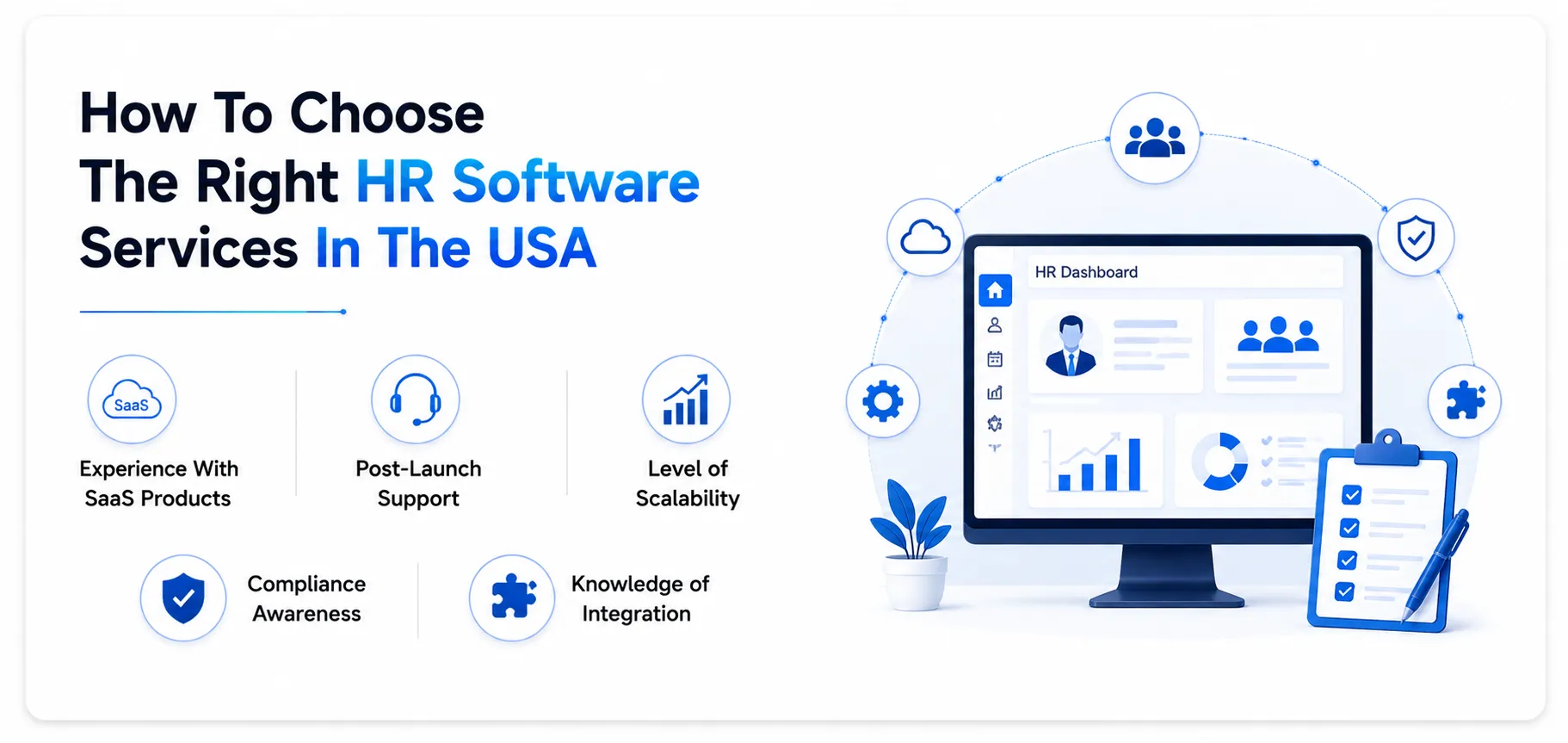
1. Experience With SaaS Products
One of the challenges of HR software is not creating custom products; it is the diverse approach that makes it useful to all. Due to SaaS’s multi-tenant approach, which makes it useful to almost every organisation, some customer-configurable workflows can be customized accordingly.
2. Post Launch Support
Sales is where every vendor looks great. But the thing is, HR software isn’t a one-time build. So, before signing the contract, you must ask if help is available 24/7, and whether it is available via phone, chat, email, or all. Hence, the software development services you get will be of an exceptional level.
3. Level of Scalability
The HR software that fits a 50 person business may not necessarily do good to a 200 headcount firm. So, choosing a platform that grows or slows with your business is a key indicator of success. Thus, when you are looking for a human resource management system, do ask the service provider about:
- Can the HR software handle the jump in employee headcount?
- If you plan to expand the location, can it support multi-state payroll, localized benefits, and tax compliance?
- Can the HR document management software provide advanced features?
4. Compliance Awareness
Exposing your business to compliance issues and regulatory irregularities can be a costly affair you don’t want to have. This can even go further down the line and may rescind your licenses if you are in that line of business. So, look for evidence, take compliance seriously, and ask HR software development companies:
- Does the platform automatically update tax tables and filing requirements as regulations change?
- Does it support state-specific requirements?
- Is there a dedicated compliance or legal team behind the product?
5. Knowledge of Integration
Human capital management software doesn’t work in isolation. It needs to talk to various elements of your business to make it work successfully. This is why poor integration is a matter of concern, as it creates data silos, duplicate manual entry, and reconciliation headaches. Therefore, when evaluating integration capability, you can ask:
- Does the platform offer pre-built integrations with tools you already use?
- Is there an open API for custom integrations if your tech stack includes niche or proprietary tools?
- What happens when an integration breaks? Is there a dedicated team to diagnose it?
Security And Compliance Requirements For HR Software
From handling data like employee personal details to compensation data, each piece of information is sensitive. A security breach is the worst scenario an employee can imagine, which results in legal consequences, financial loss, reputational damage, and more. For these reasons, security and compliance should be considered from the beginning of HR software development rather than added after the product is built.
1. Data Encryption
Sensitive employee information should be protected both while it is being transmitted and when it is stored. Encryption in transit helps protect information as it moves between users, applications, and servers, while encryption at rest protects stored information if unauthorized access to the underlying storage occurs.
2. Strong Authentication & Access Control
HR software ensures that users can access only the information and functions relevant to their roles. Here, multi-factor authentication (MFA) can provide an additional layer of protection, particularly for administrative and privileged accounts.
3. Secure Employee Data Management
HR platforms should follow the principle of collecting and retaining only the information that is necessary for legitimate business purposes. Data retention policies can help reduce the risk associated with storing unnecessary employee information for extended periods.
4. Audit Logs & Activity Monitoring
HR systems should maintain detailed records of important user and administrative activities. These records can help organizations investigate suspicious activity, detect unauthorized changes, and demonstrate accountability during security reviews or audits.
Common Challenges In HR Software Development
HR applications can help organizations automate repetitive processes, improve employee experiences, and centralize workforce data. However, challenges are a common part of the process that can be avoided if you are aware of them. Thus, these include:
1. Managing Complex HR Workflows: HR processes vary significantly between organizations. Recruitment, onboarding, leave approvals, attendance, performance reviews, payroll, and employee offboarding may all follow different rules and approval structures. A major development challenge is translating these business processes into software without making the system unnecessarily complicated.
2. Protecting Sensitive Employee Data: Unauthorized access or data breaches can have serious consequences. Security needs to be considered throughout the development lifecycle rather than added after the core functionality has been completed.
3. Ensuring Regulatory Compliance: Here, the issue arises when the platform serves organizations operating in multiple countries because requirements can vary by location.
4. Integration With Existing Systems: An HR application often needs to exchange data with payroll, accounting, ERP, recruitment, attendance, identity management, and other systems. Poorly designed integrations can lead to duplicate data, synchronization problems, failed transactions, and additional manual work.
5. Designing For Multiple User Roles: Each user group needs different levels of access and different functionality. Giving every user the same interface can make the application confusing and increase the risk of unauthorized data access.
Future Trends In HR Software Development Solutions
Over a period of time, HR management software features and development solutions change or evolve. To keep up with them, it is necessary to first know about them and then implement them. Hence, some of the aspects that are leading future trends in the HR domain include:
1. Agentic AI Automation
HR chatbots and basic automation rules are giving way to something more powerful: agentic AI that can independently plan and execute multi-step tasks and not just respond to prompts. Instead of an HR admin manually triggering each step of onboarding, an AI agent can handle the entire workflow. So, if you are looking to integrate AI into your HR systems, then AI software development services are what you should be looking for.
2. Skill-Based Ecosystem
Traditional HR systems are organized around jobs and titles. The next generation is organised around skills. As roles evolve faster than job descriptions can keep up, HR platforms are shifting towards skill-based ecosystems that map, track, and act on the actual capabilities employees have and can develop. To help employees through a skill-based ecosystem,
3. Extensible & Open Architecture
The days of monolithic, all-in-one HR suites are fading. Companies increasingly want the flexibility to mix best-in-class tools rather than being locked into a single vendor’s ecosystem. This is driving demand for extensible, open architecture built around APIs and interoperability.
4. Hyper Personalised Interfaces
Generic, one-size-fits-all dashboards are giving way to interfaces shaped around each individual’s role, habits, and preferences. Hyper personalisation uses behavioral data and AI to tailor what an employee sees, when they see it, and how information is presented.
5. Continuous Listening And Well-Being
Annual engagement surveys are increasingly seen as too slow and too infrequent to reflect how people actually feel day-to-day. Forward-looking HR platforms are building in continuous listening tools that capture sentiment in real time and connect it directly to well-being initiatives.
6. Mobile-First Accessibility
The workforce is more distributed and deskless than ever, and HR software is finally catching up. Mobile-first design is moving from a nice-to-have to a baseline expectation, particularly for frontline, retail, healthcare, and field service employees who may never log in from a desktop.
How Can Techugo Help You?
Automation can be a challenging task when you don’t know what the outcome will be. So, isn’t it a better idea to partner with an HR software developer who knows everything about this?
 The Final Word
HR software has evolved into an essential digital backbone for modern businesses, centralising employee data, automating routine processes, and connecting seamlessly with other business tools through APIs. Costs vary by organisation size, ranging from a few dollars per employee monthly for small businesses to custom enterprise pricing for larger firms with complex needs. Choosing the right provider comes down to evaluating their SaaS experience, post-launch support, scalability, compliance awareness, and integration capabilities. For businesses ready to modernise their HR operations, partnering with an experienced development company like Techugo can turn these capabilities into a tailored, future-ready solution.
FAQs
Q) What are the key features I should look for in HR software?
Ans) Some of the core features include employee records management, payroll processing, recruitment, applicant tracking system (ATS), training management, performance analysis, and many more.
Q) What’s the difference between HRMS, HRIS, and HCM?
Ans) HRIS focuses on collecting and storing employee data with efficient reporting. HRMS builds on HRIS with added functionality like benefits administration and productivity analytics. HCM goes deepest, covering the full employee journey – recruitment, performance reviews, learning & development, and engagement.
Q) How much does HR software cost?
Ans) Pricing depends on company size: small businesses typically pay $2 – $10 per employee per month (PEPM), mid-level businesses pay $10 – $25 PEPM, and enterprise businesses pay $25 – $100+ PEPM, usually through custom quotes.
Q) How does HR software help with compliance?
Ans) Good HR software automatically updates tax tables and filing requirements as regulations change, supports state-specific rules, and is often backed by a dedicated compliance or legal team.

Get in touch
We'd love to hear from you.