

 SA
SA
 KW
KW
 IE
IE AU
AU UAE
UAE UK
UK USA
USA
 CA
CA DE
DE
 QA
QA ZA
ZA
 BH
BH NL
NL
 MU
MU FR
FR














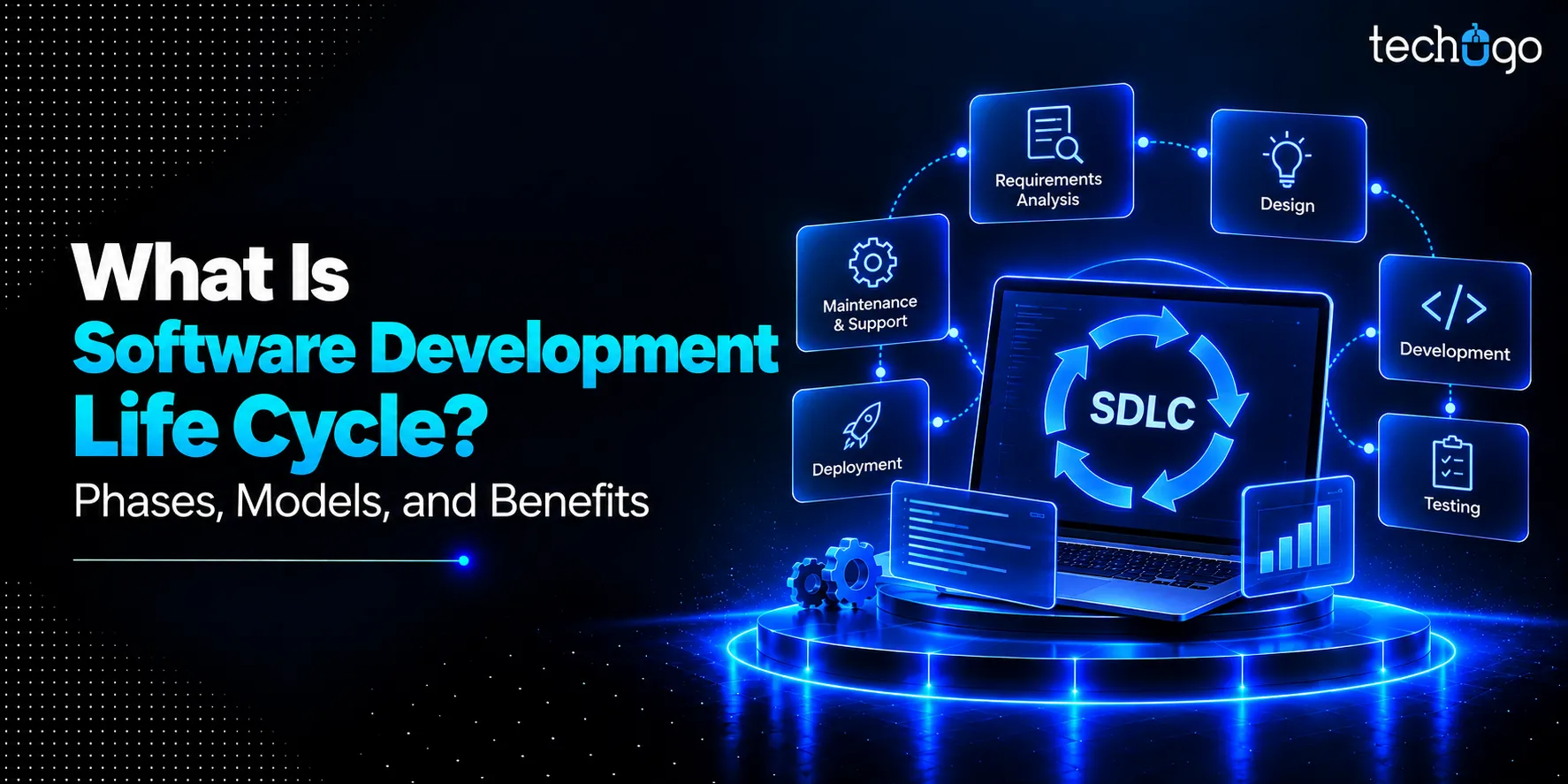


Every piece of software you use today, from the app on your phone to the platform running your business, followed some version of the same journey before it ever reached you. That journey is the software development life cycle (SDLC), and understanding it is the difference between projects that ship on time and ones that spiral into missed deadlines and rebuilt features. So, on this page, we will walk you through what SDLC means, its 7 core phases, the models teams use to structure it, how AI is shaping it, and more.
What Is The Software Development Life Cycle?
An iterative methodology used by development teams to build, deliver, and maintain high-quality and cost-effective software systems is what the software development lifecycle is all about. In simple words, it is just a step-by-step process which mentions the whole lifecycle of an application, from planning to maintenance. The goal of an overview of the software development life cycle is to minimize project uncertainties by developing a forward-looking plan.
Why Is SDLC Important For Software Development?
Building software without a structured process is a bit like constructing a building without a blueprint. You might end up with something, but it’s unlikely to be stable, scalable, or built on time and budget. The SDLC exists to solve exactly this problem by:
1. Reduces Project Risk & Uncertainty: SDLC breaks a complex project into manageable phases, so issues are identified and addressed early rather than discovered after launch. This structured approach minimizes the risk of costly surprises, scope creep, and last-minute failures.
2. Improves Planning & Resource Allocation: With clearly defined phases, teams can accurately estimate timelines, budgets, and staffing needs. This leads to better resource utilization and fewer bottlenecks caused by poor planning.
3. Ensures High-Quality Software: Each phase of the SDLC, especially design, testing, and QA, acts as a checkpoint to catch bugs, security flaws, and usability issues before they reach end users. The result is more reliable and polished software.
4. Enhances Communication & Alignment: SDLC provides a common framework that developers, project managers, stakeholders, and clients can follow. This shared understanding reduces miscommunication and keeps everyone aligned on goals, timelines, and deliverables.
How Much Does The Software Development Life Cycle Cost?
The total cost of software depends on the project complexity, team location, chosen model, app type, and industry for which the software is being developed. Below is a breakdown to help you estimate a realistic budget:
| Project Type | Estimated Cost (USD) |
| Basic / MVP | $20,000 – $60,000 |
| Mid-Level Software | $60,000 – $130,000 |
| Advanced Software | $130,000 – $220,000+ |
How Long Does The SDLC Process Take?
There is no one-size-fits-all answer. The SDLC timeline depends on your project’s complexity, the model you choose, team size, and how clearly your requirements are defined upfront. That said, here is a realistic breakdown to help you set expectations:
| Project Type | Estimated Timeline |
| Basic / MVP | 1 – 3 Months |
| Mid-Level Software | 3 – 8 Months |
| Advanced Software | 8 – 14+ Months |
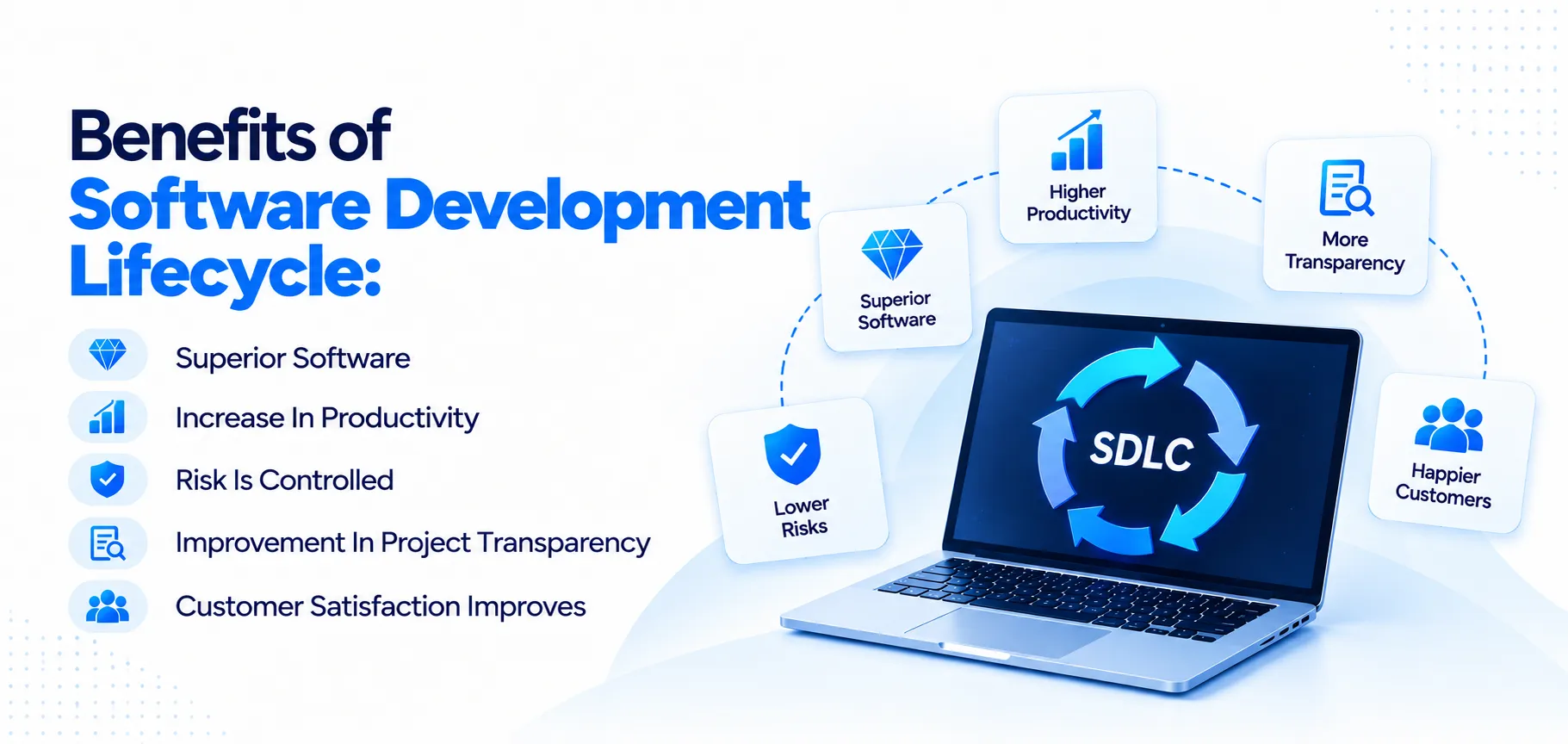
Benefits of Software Development Lifecycle
Going through the stages of the software development life cycle has its own set of benefits. So, first, you need to know about its different stages; it is important to understand the benefits it offers, which include:
1. Superior Software
Being able to do complex software development projects within the scheduled time and cost estimates is a superpower possible with SDLC. Moreover, quality assurance and testing are parts of the overall software development lifecycle process, which results in superior software.
2. Increase In Productivity
Within the SDLC framework, each stage is thoroughly laid out, which leaves no room for guesswork. Thus, with clear documentation to guide progress between phases, the SDLC can help to reduce software development time and enhance development productivity.
3. Risk Is Controlled
Throughout the stages of the software development life cycle, in some SDLC cases, risk assessment is done throughout the process. So, during development, the team can single out those risks and control them when they occur. Thus, you don’t have to struggle in later stages.
4. Improvement In Project Transparency
Many of the SDLC models are big on transparency at every step of the process. When developing software, the development company can communicate regarding the requirements at each specific stage, which keeps both parties informed.
5. Customer Satisfaction Improves
Throughout the stages in the software development life cycle, steps such as rigorous planning, building, and testing the software take place. Hence, a more thorough and developed lifecycle helps reduce unnecessary aspects and ease the use of software. In the end, when the intangible asset is thoroughly tested and has gone through various stages, then the satisfaction is also amplified.
What Are The Common Software Development Lifecycle Models?
Doing software development is not an easy process to undertake. But to make it simple, the software development lifecycle models are quite easy once you get into their depth. Some of the common models include:
1. Waterfall
It is a linear model of development in which one stage is completed, and then the next stage is undertaken. For well-defined, stable projects where stakeholders desire to be involved solely during the evaluation of significant milestones, it provides an organized and predictable procedure. Waterfall was one of the breakthroughs in the app development process.
2. V-Model
A variation of the waterfall model, here each stage of development has its own testing phase. This is also called the V-shaped model, as it is sometimes called verification and validation due to its assessment at each stage. The V, like the waterfall model, is less flexible due to its linear structure.
3. Iterative
The iterative model involves the rapid creation of an initial software version, sometimes known as the minimum viable product (MVP), and subsequent rapid improvements. This methodology focuses on building the software forward from a tiny starting point.
4. Agile
The continuous improvement and development cycles, often referred to as “sprints,” that underpin the agile method include developers making and releasing small, incremental changes on a regular basis. It works best for projects where clients are able and ready to take part in regular progress evaluations and conversations.
5. Lean
To reduce waste in the full lifecycle software development process, the lean model applies manufacturing principles to software development. The aim under this model is to improve business operations, especially during development. At every stage of development, teams consistently set short-term objectives with rigorous criteria for quality assurance.
How To Choose The Right SDLC Model For Your Project?
The choice of the right one will affect your timeline, budget, flexibility, and ultimately how successful your product turns out to be. Hence, you must keep in mind the following steps to select the correct SDLC model, that includes:
1. Define How Clear / Unclear The Requirements Are
If you have a fully detailed roadmap with fixed features and no expected changes, a Waterfall model may work well because it is linear, predictable, and easier to budget for. However, if your idea is evolving, or you expect to pivot based on user feedback, an Agile model is much better.
2. Consider Your Budget Flexibility
Waterfall or V-model offer more predictable costs since everything is planned upfront. Agile or Iterative models let you invest incrementally, paying for what’s built sprint by sprint rather than committing to the entire project cost upfront.
3. Factor In Speed To Market
If you need to launch quickly to test demand or beat competitors, look for models built for speed:
1. Agile enables faster releases through short sprints.
2. Rapid Application Development (RAD) is designed specifically for quick prototyping and faster delivery.
4. Assess Your Involvement Level
1. Want to review progress and give feedback regularly? Agile is built around continuous stakeholder collaboration; you will see working software every few weeks.
2. Prefer to hand off requirements and receive the finished product? Waterfall requires less ongoing involvement but leaves less room for mid-project changes.
5. Evaluate Risk Tolerance
New or complex products carry more risk. The Spiral Model, which combines iterative development with risk analysis at every stage, is ideal for projects with significant technical or financial risk, such as new technology integrations or heavily regulated industries.
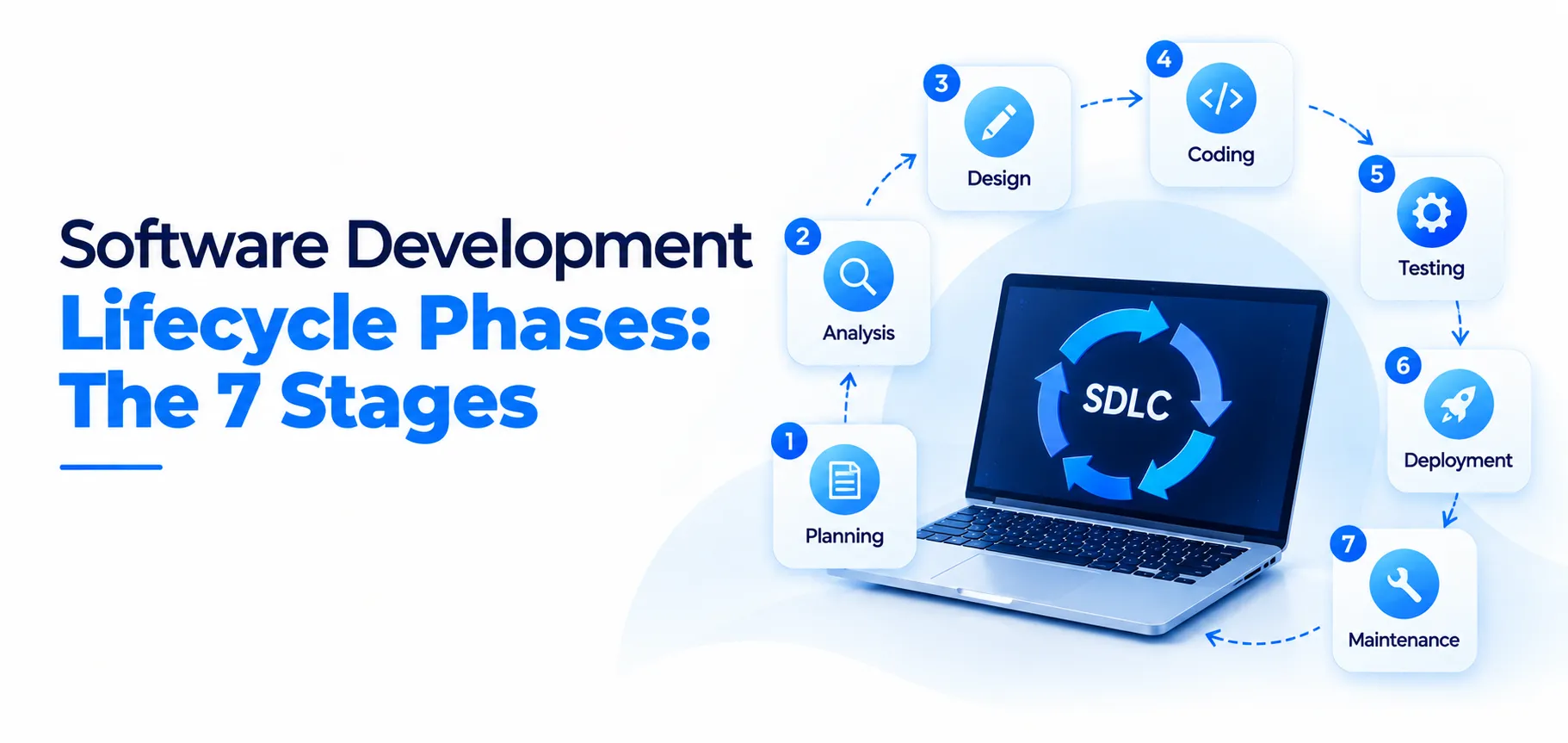
Software Development Lifecycle Phases: The 7 Stages
Any development team can agree that there are multiple software development lifecycle methodologies. However, each of those steps broadly falls into these 7 stages, which include:
1. Planning: Underlining and understanding the specifics of the project is the first stage of the development process. Here, teams will talk about the problems of the project or how the use case of the application will solve issues. This also includes how the platform will perform in relation to other systems. Another side of the argument also talks about what can be avoided to make the process a success.
2. Analysis: Gathering information about the intended platform and analyzing it is the next step. Analysis builds on the planning stage and highlights areas that need more attention. Information collected can include user requirements, conducting market research, and feasibility testing to assess prototypes and allocate resources.
3. Design: Defining what the architecture is is the next step of the process. Some of the core steps include outlining software navigation, database design, UI, and much more. To decide how to construct the best program, software engineers take a look at the requirements. They take into account the software’s compatibility with the organization’s current upstream and downstream apps.
4. Coding: Choosing the right programming language for coding and simply developing it helps managers to delegate tasks and divide them into smaller projects. In coding, using web pages or APIs is quite common in building additional systems. Moreover, the coding aspect of DevOps in software development must be respected at this point.
5. Testing: Once functional software is developed, the testing team becomes active and evaluates it under various circumstances. Under this stage of the life cycle of software development, bugs and any other inconsistencies that prevent the platform from functioning will be found and eliminated.
6. Deployment: Now, the software will be sent to the real world for users to test. Deployment is not just about making applications for the world; it is also about educating the user on how the app can be useful to them. Proper deployment is also a requirement of the website design and development process that needs to be taken care of.
7. Maintenance: Did you think deploying the software in the ecosystem was the final step? No, it is not. Maintenance of the app is the final stage of the software development lifecycle. Users give their feedback on what the possible problems are, and software developers fix them with updates. Sometimes, regardless of the users facing problems, developers bring out new versions. Thus, when you know all this, it is essential to take care of software development cost as well.
How AI Is Impacting SDLC?
According to the data published by the Institute of Electrical and Electronics Engineers, almost 35% of businesses are incorporating AI in their software development process. The impact of AI is pervasive; thus, it is important to know how it impacts the stages:
| SDLC Phase | Impact of AI | Example Tools / Techniques | Key Benefit/s |
| Planning & Requirements | Converts rough briefs into structured user stories and flags vague requirements | AI-assisted backlog grooming, requirements analysis tools | Faster sprint planning, fewer clarification cycles |
| Coding | Shifts senior engineers towards reviewing | AI pair programming assistants | Quicker ramp-up for juniors, more time spent on architecture |
| Testing & QA | Generates test cases, maintains regression suites, predicts which changes are likely to introduce defects | Self-healing test scripts, AI-driven test prioritization | Less time on test maintenance, more targeted QA effort |
| Code Review & Security | Catches style issues, common bugs, and known vulnerability patterns before human review | AI code reviewers static analysis + AI triage | Senior developers focus on design decisions, not its |
| Deployment & Operations | Detects anomalies, predicts scaling needs, summarizes logs, and suggests root causes during incidents | AI-driven observability, incident triage assistants | Shorter mean time to resolution without bigger on-call teams |
Challenges In The Stages of The Software Development Lifecycle
Every stage of the full lifecycle software development has its own issues that are important to understand. But why? Because when you know about them, you will not commit them. Thus, saving you time, effort, and money.
1. Unclear or Shifting Requirements: Vague requirements at the start of the project or any changes made during the project lead to wasted engineering resources. Sometimes teams build the wrong product only to later rebuild it, leading to “scope creep” as the common reason for missed deadlines. Thus, it is never too late to opt for software development consulting.
2. Communication Gaps Between Teams: Different people in Dev, QA, operations, and the product often have different views on what “done” means. This leads to features that pass development tests but break in staging, or to deployments that surprise the operations team. Hence, confusion will still be a greater part of custom software development.
3. Technical Debt Accumulation: Debt is usually incurred under time constraints without repayment happening voluntarily. This leads to each and every sprint taking longer until finally the project is dead and a reckoning must occur. Organizations whose leaders allocate time for repayment see far fewer instances of such reckonings.
4. Testing Bottlenecks: Using only manual testing doesn’t get you the results you want. This is because without an ongoing commitment to caring for your testing suite, it cannot be relied upon anymore; it is then ignored altogether. So, if you are in this phase, it is better to go for agile software development.
How Can Techugo Help You With SDLC Requirements?
Getting the SDLC written on paper is one thing, but actually running it within the requirement gaps, communication breakdowns, and testing bottlenecks covered above is another. So, whether you need a dedicated team to own a phase of the lifecycle or specialized software development outsourcing to fix a process that’s already breaking down, Techugo brings the structure and hands-on experience to keep your SDLC moving.

Conclusion
The SDLC isn’t just a diagram teams draw up and forget; it’s the backbone that determines whether a software project ships on time, on budget, and actually solves the problem it set out to solve. From planning through maintenance, each phase carries its own risks, and skipping the discipline of any one of them tends to show up as rework, missed deadlines, or bugs down the line. AI is now changing how much manual effort each phase demands, but it hasn’t changed the fundamentals – clear requirements, tight communication, and disciplined testing still separate smooth releases from chaotic ones.
FAQs
Q) Why is SDLC important for a software project?
Ans) SDLC minimizes project uncertainty by giving teams a forward-looking plan. It leads to superior software quality, increased productivity through clear documentation, better controlled risk, greater transparency between stakeholders, and higher customer satisfaction.
Q) What are the main phases of the software development life cycle?
Ans) Main phases of the software development life cycle include:
- Planning
- Analysis
- Design
- Coding
- Testing
- Deployment
- Maintenance
Q) What is the difference between Waterfall and Agile models?
Ans) Waterfall is a linear model where one stage must finish before the next one begins, making it predictable but inflexible. Agile instead uses short, repeated sprints with incremental releases, making it better suited to projects where requirements or priorities may shift.
Q) What are the benefits of using the software development lifecycle?
Ans) Using the software development lifecycle improves software quality, lowers costs, improves time efficiency, enables better risk management, enhances transparency and communication, and more.
Q) What are the most common SDLC models?
Ans) The most widely used models are Waterfall, V-Model, Iterative, Agile, and Lean. Each suits different project types. Waterfall works best for stable, well-defined projects, while Agile fits projects needing frequent client input and incremental releases.

Get in touch
We'd love to hear from you.