


 SA
SA
 KW
KW
 IE
IE AU
AU UAE
UAE UK
UK USA
USA
 CA
CA DE
DE
 QA
QA ZA
ZA
 BH
BH NL
NL
 MU
MU FR
FR













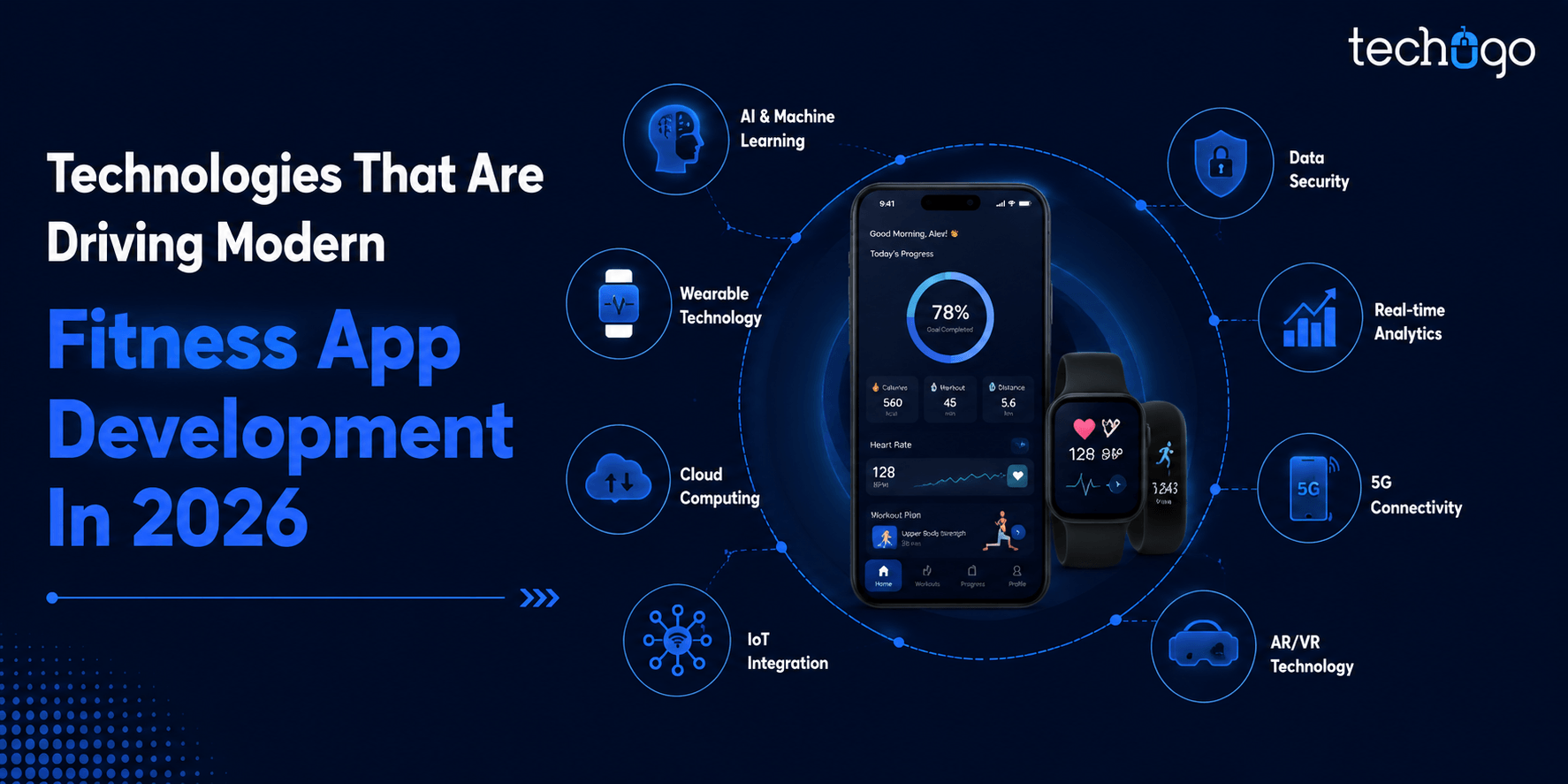


📌 Key Takeaways
- Apps use AI to create tailored workouts and nutrition plans based on user behavior and goals.
- Fitness apps sync with smartwatches and IoT devices for real-time health tracking.
- Apps convert fitness data into actionable insights and visual progress dashboards.
- AR/VR, AI coaching, and real-time feedback enhance engagement and motivation.
- Cloud solutions and secure data handling ensure app performance and user trust.
The fitness app and wearable industry is growing at a rapid-fire speed, and to make this work on the right path, app technology continues to prove its worth. Over the years, brands like Fitbit, Jawbone, and Nike entered the healthcare and fitness market, and soon they were joined by Samsung, LG, Pebble, and other companies that helped shape the early wearable ecosystem.
Although the recognition Apple Watch has gained is worth noticing, as it has significantly boosted the popularity and adoption of wearable devices, making them a core part of modern digital health tracking.
Today, the fitness and wearable industry has further evolved into an AI-powered, data-driven ecosystem, with continuous health monitoring and real-time analytics becoming standard expectations in fitness app development.
This post unravels some of the most mind-blowing hardware technologies that help redefine fitness app development in 2026.
Key technologies powering modern fitness app development in 2026
Here are some of the most impactful technologies that are shaping how fitness apps track, analyze, and improve user health in real time in 2026, so let’s read about them…
GPS in fitness tracking
GPS (Global Positioning System) remains one of the most important fitness app development technologies powering modern fitness tracking apps and wearable devices. It is often considered the backbone of outdoor activity tracking, helping users monitor their fitness routines with precision.
If you wonder how GPS works, then you would be surprised to know that within the GPS technology, there are more than 30 satellites, which come forward and create an efficient space for the users to map their routes, know their exact position, and measure their speed.
According to industry insights from the GPS.gov program (U.S. government), GPS accuracy has improved significantly over the years, now offering location precision within a few meters for most consumer devices.
Some of the most popular Smartwatch series like Apple Watch Series 4, Sony SmartWatch 4, Fitbit Ionic, and Mobvoi TicWatch E2 have built-in GPS functionality that allow users to track running, cycling, and outdoor workouts without needing a smartphone.
Galvanic skin response sensors
Do you wonder how much you sweat and how frequently your body temperature shifts during fitness activities?
Well, this is very much possible with F7 Real-time GPS Watch and Huawei Watch 2 4G. These wearable devices let the users monitor their Galvanic skin response and further measure stress levels.
Galvanic Skin Response (GSR) sensors are emerging as an important part of modern health monitoring apps and wearable fitness technology in 2026. These sensors help measure subtle changes in skin conductivity, which are often linked to sweat levels, emotional stress, and physiological arousal during workouts.
This technology is increasingly being used in fitness app development services focused on mental wellness and stress management, not just physical fitness.
Barometric altimeters
Well, not many of us know that a barometric altimeter is an efficient alternative to GPS, and is widely used in fitness tracking app development to measure elevation and altitude tracking. With the help of this technology, the device collects data on elevation and allows users to garner the most accurate information related to their movements. Instead of relying only on satellite signals, these sensors measure air pressure changes to calculate altitude and elevation gain with higher accuracy, especially during hiking, trekking, and mountain sports.
This allows fitness apps to provide more precise insights into workout intensity, elevation climb, and performance metrics which are the key features in modern fitness and wearable app development.
Accelerometers, gyroscopes, and compasses
Indeed, this set of technology is utilized by every modern wearable device and is essential in fitness app development technologies. Let us give you a quick tour of these technologies.
- Gyroscope- It is a device, utilizing the earth’s gravity which further determines the orientation of an object in space.
- Compass (Magnetometer)- On the other hand, a compass determines the cardinal direction of an object.
- Accelerometer- It helps in measuring the acceleration of an object based on motion, end of the motion, and its intensity.
With the help of these technologies, the motion of the users, while walking, running, cycling, and swimming gets measured. Further, with this collected data, fitness devices collect and calculate speed, distance traveled and calories burnt.
These 3 technologies can be utilized as separate pieces of hardware, or can also be integrated within one device as well. This is what Apple Watch Series 4 has embraced, where you can find an improved gyroscope and accelerometer.
Ambient light sensors
These are the sensors, which detect and measure the amount of light present in the environment. This enables human eyes to reduce eye strain and keep using the phone without hurting their vision. Although this sensor is quite popular in Samsung and iPhone range, wearables are also adopting this technology to make a difference. These sensors are increasingly being adopted in wearable fitness devices to enhance user comfort and battery efficiency in fitness app development solutions.
Optical heart rate monitors
Calling it a blessing from the technology pool wouldn’t be wrong! Optical heart rate monitoring is one of the most widely used technologies in modern fitness tracking apps and wearable devices.
With this very hardware technology, it becomes easy to track changes in blood saturation by passing light through the skin in specific places. It is commonly placed on the wrist, finger, or chest, and can also support SpO2 (blood oxygen saturation) monitoring, which has become a standard feature in many advanced fitness wearables. This enables one to monitor heart rate pulse with LED beams at a wavelength of 525–535 nanometers (exceptions are there). Pulse Ox Acclimation helps users to keep track of how their body is acclimatizing with higher altitudes by tracking the blood oxygen levels.
According to research published by the National Institutes of Health (NIH), continuous heart rate monitoring significantly improves workout optimization and health awareness, especially for endurance training users.
Advanced devices like Apple Watch also integrate ECG (electrocardiogram) capabilities, enabling users to detect irregular heart rhythms and track cardiovascular health more effectively.
Just Read : Our Guide on the Cost of Building a Fitness App Like Garmin Connect
AI and machine learning in fitness apps
AI and machine learning are becoming a core part of modern fitness app development, moving these applications beyond basic tracking into intelligent health companions. Instead of only recording steps or calories, AI now helps apps understand user behavior, predict fitness patterns, and deliver highly personalized workout recommendations.
With machine learning models analyzing continuous user data such as heart rate trends, sleep cycles, activity levels, and recovery patterns, fitness apps can now suggest adaptive workout plans that adjust in real time based on performance and fatigue levels. This makes fitness experiences more personalized, efficient, and goal-driven.
These capabilities are increasingly being built through advanced AI app development services, enabling fitness platforms to offer features like predictive health insights, injury risk alerts, and smart coaching assistants that respond to user progress dynamically.
As a result, AI and machine learning are no longer optional enhancements but are becoming essential components of next-generation fitness tracking apps and wearable ecosystems.
Wearable ecosystem integration
Modern fitness app development is no longer limited to standalone apps or single devices. Today, the real value comes from seamless integration across the entire wearable ecosystem, where multiple devices and platforms work together to deliver unified health insights.
Fitness apps now connect with smartwatches, fitness bands, smart scales, and even health platforms like Apple Health and Google Fit to create a continuous flow of real-time data. This interconnected setup allows users to track workouts, sleep, heart rate, and recovery metrics in one centralized system without data gaps.
For developers, this has made wearable app development a critical focus area, where ensuring cross-device compatibility, low-latency syncing, and secure data exchange becomes essential for delivering a smooth user experience.
As this ecosystem expands, integration is becoming the backbone of smarter, more connected fitness tracking apps, enabling users to get a complete picture of their health across devices and platforms.
Cloud computing and real-time data sync
Cloud computing plays a crucial role in modern fitness app development, especially when it comes to handling large volumes of real-time health and activity data generated by wearable devices. Instead of storing data locally on a device, cloud infrastructure enables secure, scalable, and always-available data storage that can be accessed across multiple platforms.
With real-time data synchronization, fitness apps can instantly update user metrics such as steps, heart rate, calories burned, and sleep patterns across devices like smartphones, smartwatches, and fitness bands. This ensures users always see up-to-date health insights without delays or manual syncing.
Together, cloud computing and real-time sync capabilities power the backbone of advanced fitness tracking apps, enabling seamless performance tracking, better data accuracy, and improved user engagement through continuous monitoring and instant feedback.
IoT and edge computing
The evolution of fitness app development is increasingly being shaped by IoT (Internet of Things) and edge computing, which together are making fitness tracking more connected, intelligent, and real-time than ever before.
IoT enables seamless communication between multiple health devices such as smartwatches, fitness bands, smart scales, heart monitors, and even connected gym equipment. These devices continuously generate health data and share it across a unified ecosystem, allowing users to track everything from body composition to workout intensity in one place. This interconnected setup is now a core part of modern fitness tracking apps, where real-time data consistency is expected rather than optional.
Edge computing takes this a step further by processing data directly on the device or closer to the data source instead of relying entirely on the cloud. This reduces latency and enables instant feedback—such as real-time heart rate alerts, movement correction during workouts, or immediate stress detection insights. For wearable devices, this becomes critical because even a few seconds of delay can impact user experience in health monitoring scenarios.
Together, IoT and edge computing are transforming fitness app development technologies by improving speed, reducing dependency on constant cloud connectivity, and enhancing data privacy. This combination is helping developers build smarter, faster, and more responsive fitness ecosystems that align with the expectations of modern health-conscious users.
Just Read : Guide to Developing a Fitness App Like Classpass
What developers must pay attention to while developing fitness trackers in 2026?
Well, it is a million-dollar question, because users are the only deciding factor in whether your integrated technology has truly won their attention or not. Apart from technical features, there are other essential aspects that must be considered while building a scalable and market-ready fitness tracking app and wearable solution.
- Wireless syncing allows the device to send data to a mobile app in real time, ensuring seamless fitness app development integration between wearable devices and smartphones.
- Push notifications help keep users informed and updated about their achieved goals, while also motivating them to stay consistent with their fitness journey through timely reminders and insights.
- Water resistance is a must-have feature in modern fitness wearables, enabling users to track their activities in different environments and weather conditions without limitations.
- Unisex and ergonomic design plays a key role in adoption, making the device appealing to a wider audience and improving overall usability and comfort.
Being an experienced mobile app development company, Techugo has witnessed how the beautiful evolution of technologies in the fitness app domain continues to reshape the way users approach health and wellness. The creative side of development truly comes alive when new devices, sensors, and innovations come together to help users build a more active and healthier lifestyle through advanced fitness app development.
How can Techugo help?
Building a successful fitness tracking solution requires more than just integrating sensors or wearable features. It needs a strong product mindset, scalable architecture, and seamless user experience design backed by deep technical expertise in fitness app development.
As a trusted fitness app development company, Techugo helps businesses transform fitness ideas into fully functional digital products by combining advanced technologies like AI, IoT, and cloud computing with robust engineering practices. From wearable integration to real-time data sync and personalized fitness insights, the focus remains on building high-performance solutions that users actually engage with.
With expertise in wearable app development, Techugo enables end-to-end development of fitness ecosystems that covers mobile apps, wearable connectivity, backend infrastructure, and analytics dashboards. The goal is to ensure smooth device synchronization, accurate health tracking, and scalable performance even with millions of users.
Whether it is launching a new fitness startup or upgrading an existing product, Techugo supports the entire journey, from strategy to deployment to help brands deliver reliable fitness solutions.
If you’re ready to make a meaningful impact in the health and fitness industry, then do not hesitate to reach out to us. We’d love to hear your idea and collaborate with you to turn it into a real-world product.
Give us a call today and secure a FREE 30 min app consultation.
FAQS
Q 1. What key technologies are shaping fitness app development in 2026?
Technologies like artificial intelligence (AI), wearable device integration (IoT), real‑time data analytics, and immersive experiences such as AR/VR are major drivers of fitness app innovation and user engagement.
Q 2. How does AI improve fitness app user experience?
AI enables personalized workout plans, adaptive coaching, predictive recommendations, and intelligent analytics that tailor fitness journeys to individual habits and goals.
Q 3. Why is wearable integration important for modern fitness apps?
Connecting with wearables like smartwatches and fitness bands allows apps to collect real‑time health metrics (e.g., heart rate, steps, sleep) and deliver up‑to‑date feedback and insights to users.
Q 4. Are AR and VR really useful in fitness apps?
Yes — augmented and virtual reality can make workouts immersive and interactive by simulating real environments and visual guidance, boosting motivation and engagement levels.
Q 5. How do advanced analytics benefit fitness app users and businesses?
Advanced analytics turn raw fitness data into actionable insights, helping users track progress and helping businesses understand behavior, retention, and feature performance to improve the product.

Get in touch
We'd love to hear from you.