

 SA
SA  KW
KW  IE
IE AU
AU UAE
UAE UK
UK USA
USA  CA
CA DE
DE  QA
QA ZA
ZA  BH
BH NL
NL  MU
MU FR
FR 






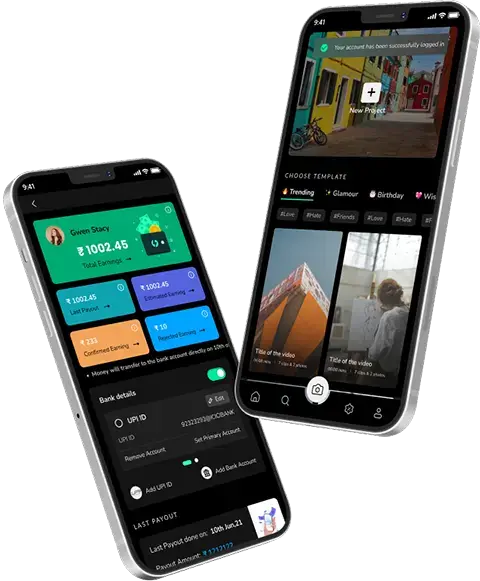






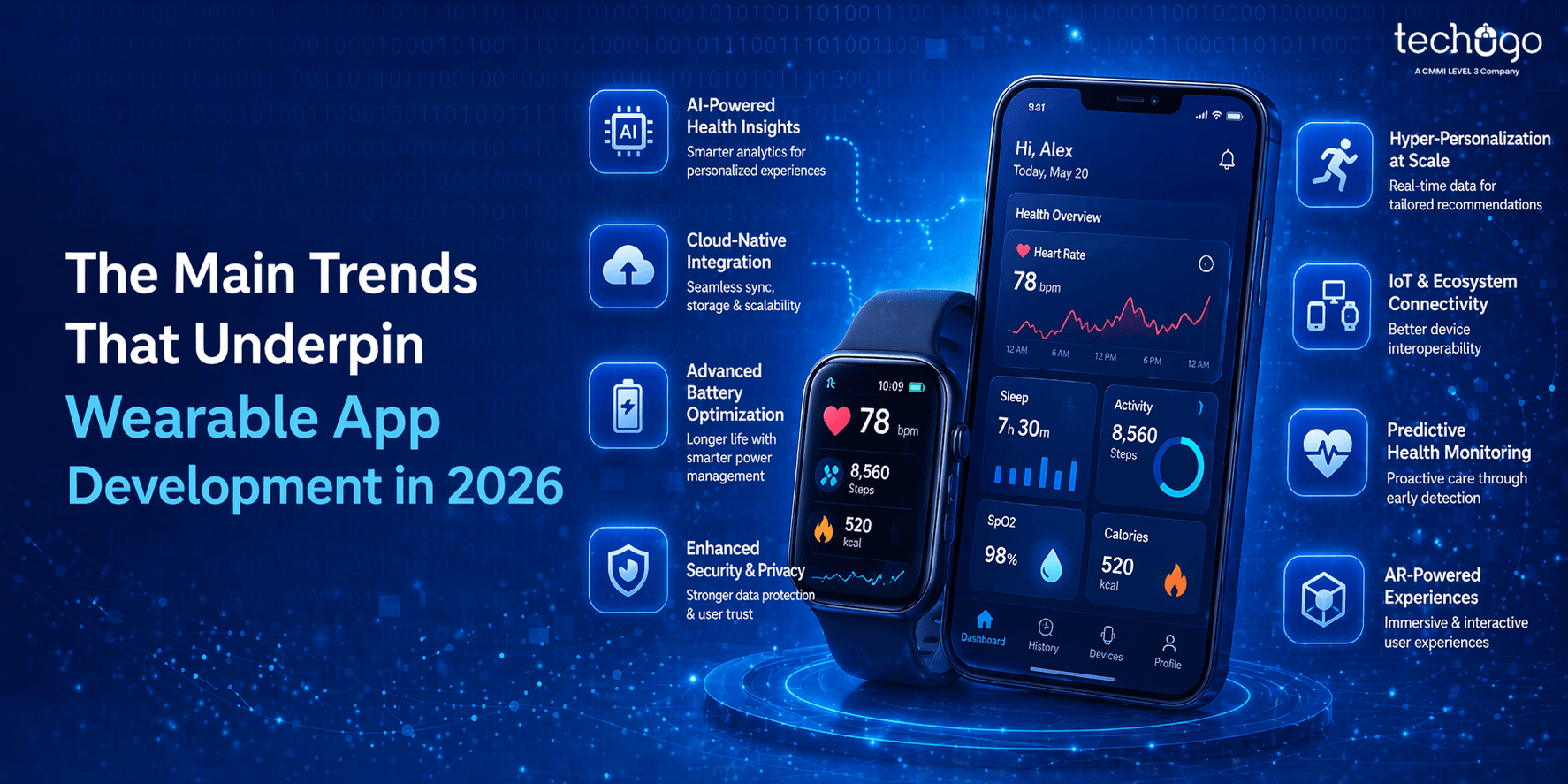


Wearable technology is rapidly changing the way we develop mobile apps in 2026. With the rise of wearable app development, businesses are exploring new ways to deliver real-time, personalized user experiences across industries such as healthcare, fitness, fintech, and enterprise solutions.
Our current era is defined by the shift from futuristic ideas to practical innovation. Technologies such as AI, IoT, and 5G are now actively shaping how wearable devices function and how businesses build scalable digital solutions around them. This evolution is pushing companies to invest in wearable app development services that improve user engagement and continuous connectivity.
Wearable technology is no longer just an extension of mobile apps; it is becoming an independent ecosystem. From smartwatches and smart rings to AR/VR headsets, the market is witnessing rapid growth, transforming how modern applications are designed, developed, and experienced.
Wearable devices are now widely adopted across global markets, driven by faster connectivity like 5G and increasing demand for real-time data processing. While North America continues to be a strong market, regions like Asia and the Middle East are also emerging as key hubs for wearable app development and innovation.
If you are planning to invest in wearable applications, it is essential to align your strategy with the latest wearable app development trends in 2026, user behavior, and regional adoption patterns to build scalable and future-ready solutions.
What’s Wearable Technology?
Wearable technology is exactly what the name suggests – smart electronic devices designed to be worn on the body. Although it is a concept that has existed for years, now it has evolved rapidly into a key part of modern wearable app development and connected ecosystems.
Today’s wearable devices are powered by advanced sensors that track movement, biometrics, and real-time user data. These devices seamlessly connect through Bluetooth, Wi-Fi, or mobile networks, enabling continuous data exchange with smartphones, cloud platforms, or standalone applications.
Earlier, wearable technology was limited to basic motion-sensing devices attached directly to the body. However, with the advancement of AI-driven sensors and miniaturized hardware, wearables can now be integrated into everyday items such as smartwatches, rings, glasses, and even clothing.
As demand for real-time health tracking, fitness monitoring, and connected experiences grows, wearable technology continues to see rapid a
Types of Wearable Devices Transforming User Experiences
Modern-day wearables mean people don’t have to use outdated armband holders for their smartphones. Smartwatches allow people to keep their smartphones in their pockets and bags. They can also communicate with their phone via screen phone calls or phone notifications. Smart glasses and fitness trackers are also compatible.
– Smart Glasses
Smart glasses include augmented reality (AR), which enhances the line of sight. Ray-Ban, a brand with front-facing cameras, has recently launched smart glasses to compete with GoPro.
– Smartwatches
For several years, Apple and Samsung have flooded the market with new versions of their Galaxy Watch and Apple Watch. The current smartwatches are equipped with LTE and GPS and can communicate seamlessly with the OS smartphones they replace. Smartwatches can track biometrics, making them obsolete. Fitness trackers will continue to be popular until then.
– Fitness Trackers
Fitbit fitness trackers, such as the FitBit, are worn around the wrist and provide a wealth of biometric readings, including heart rate and steps taken. These devices can be used alone to record internal data. In addition, the data can be exported to a smartphone or computer. Apart from tracking biometrics, the purpose of dedicated fitness trackers is to remove the need to carry an extra piece of tech, such as a smartphone.
– Smart rings
Smart rings are emerging as compact and powerful wearable devices. These small devices can track biometrics such as heart rate, sleep patterns, and activity levels, while also supporting contactless payments and notifications. With growing demand for discreet and always-on tracking, smart rings are becoming an important category in wearable app development.
– Medical wearables
Medical wearables are designed to monitor health conditions in real time and support preventive care. These devices can track vital signs such as blood pressure, glucose levels, oxygen saturation, and ECG data. Widely used in healthcare, they play a key role in healthcare wearable app development by enabling remote patient monitoring and improving clinical outcomes.
– XR wearables
XR wearables combine augmented reality (AR) and virtual reality (VR) to create immersive user experiences. These devices are used in gaming, training, education, and enterprise applications. As businesses explore interactive environments, XR devices are opening new opportunities in wearable app development solutions, especially for simulation-based and real-time experiences.
These are only a few examples. There are many more wearables that I have not included. This long list also includes VR headsets and consumer health tech. Wearable technology is a promising area of research if history is any guide.
Top Wearable App Development Trends in 2026
Below are some of the top wearable app development trends in 2026 that businesses need to look at…
1) AI-Powered Wearables (Predictive Insights)
AI is changing the way wearable app development works, and it is not just about tracking anymore, but also about predicting what users might need next. These devices are using data, and they are learning from it, so that they can give early health warnings and better fitness suggestions. Because of this, businesses have been focusing more on building wearable apps that are not reactive, but proactive… and that shift is clearly visible now.
2) Edge Computing for Faster Processing
Wearable apps are becoming faster, and it is mainly because of edge computing. Instead of sending all data to the cloud, devices are now processing it locally, and therefore reducing delays. This matters a lot, especially when you are dealing with real-time data like health stats or navigation. It was not this efficient earlier, but now the experience feels smoother, and more reliable too.
3) 5G-Enabled Low Latency Applications
With 5G expanding, wearable devices are getting better connectivity, and the apps are becoming more responsive. Data transfer is faster, and it allows real-time interactions without lag. Because of this, industries like healthcare and fitness have been adopting wearable app development services more actively… and honestly, this trend is only growing.
4) Contactless Payments and Wearable Fintech
Wearables are not just about health anymore, they are also entering fintech. Devices now support contactless payments, and users can pay directly through smartwatches or rings. It makes transactions quicker, and more convenient, but also raises the need for secure systems. Therefore, businesses are investing in wearable fintech app development so that users can trust these platforms.
5) Voice and Gesture-Based Interfaces
The way users interact with wearable apps is changing, and it is moving beyond touch. Voice commands are being used more, and gesture controls are also becoming common. Because screens are small, it makes sense to reduce manual input… and this is why wearable app UI/UX design has been shifting towards more intuitive interactions.
6) Hyper-Personalization Through Data
Wearable devices collect a lot of user data, and it is being used to create personalized experiences. Apps are now able to suggest workouts, send reminders, and adjust insights based on behavior. It feels more relevant to the user, and therefore increases engagement… but at the same time, it also depends heavily on how well the data is handled.
7) Growth of Digital Health Ecosystems
Wearables are now part of larger health ecosystems, and they are connecting apps, devices, and healthcare providers together. This has been especially important for remote monitoring and preventive care. Because of this, healthcare wearable app development has grown rapidly, and more companies are entering this space.
8) Data Privacy and Compliance (GDPR, HIPAA Evolution)
As wearable apps handle sensitive data, privacy has become a serious concern. Companies have to ensure encryption, and secure connections, so that user data is protected. Regulations like GDPR and HIPAA are evolving, and businesses have to follow them… otherwise, it can lead to serious risks. Therefore, security is not optional anymore, it is a core part of wearable app development.
The Most Promising Industries for Wearable Apps
Wearable apps are fashionable and beneficial to a brand in targeting customers who use wearables regularly and want their functionality to be available on them. But first, look at some industries that are emphasizing wearable app development.
1. Healthcare
Wearable devices have a lot of potential for the healthcare industry. They enable doctors to monitor and diagnose patients’ health. These devices can gather data from various sensors such as heart rate or glucose levels. These applications can be used to quickly diagnose rare diseases and improve healthcare services.
Healthcare can be provided by many wearable devices such as smart watches, glucose monitors and diagnostic chips.
Examples: VeriSense, Aira Tech, Quardio, Hexoskin
2. Fitness
Fitness apps are the most popular wearable application on the market. You can use apps to track your health and body. Smartwatches and fitness trackers can track your daily activities such as exercise and jogging, and calculate calories and distance.
Examples: Strava, Runkeeper, Google Fit, Nike+
3. Outdoor Navigation
Google Maps, the leader in mobile technology is compatible with all platforms. These smartwatches have more options than ever, with GPS, Gyroscopes and other technology. It is possible to create standalone outdoor navigation apps.
Also Read : Mobile App Development Companies Are Integrating Wearable & App
Google Maps is an example
4. Messaging
Smartwatches allow you to leave your home without using a smartphone. They can be used entirely without a smartphone and are therefore more useful than messaging apps.
Examples: Telegrams and Coffee, Skype
5. Education
Wearable devices don’t just have to be for smartphones. These applications can be used to create augmented or virtual reality glasses, such as Google Glass, and for education. AR and VR enable students to explore the world and examine molecules in detail. They can also study diseases and the human body.
Examples: ImmerseMe. Ocean Rift. Mondly
6. Entertainment
Wearable devices can be used for many reasons. One reason is to listen to music or podcasts while you commute, run, or exercise. There are many ways to approach creating the next Spotify for your smartwatch.
Examples: Spotify. Apple Music. Shazam.
7. Insurance
Fraudulence is a major problem in the insurance industry. Wearable devices could be a boon for insurance companies if they could access data from smartwatches or fitness trackers. These solutions exist already, as shown by the collaboration between UnitedHealthcare and Fitbit, an insurance company that makes fitness trackers.
Examples: Attain
8. Fintech
Wearable technology can also be a benefit to the banking system. Smartwatches and fitness trackers today have NFC sensors, which enable contactless payments.
Examples: Apple Pay and Google Pay
Want to get in on the action?
Before developing wearable applications, here are five things you need to know.
1. Be sure to understand your use case
Computer scientists use many academic definitions of “use case” to describe how a product is used. For example, the use case for your wearable app describes how the user will use the app and the expected outcome.
It’s the story of the user and the app. What pain point motivated them to download the app? How does the app help that pain point?
What is your app’s use case? Examples might include:
- An AI personal training app that speaks to users through earbuds uses a smartwatch for vital measurements like heart rate and respiration and provides suggestions and encouragement to improve the workout.
- A data-recording application that transforms a pair of smart glasses into an audio-recording device. This can be used to transmit data about car accidents to insurers for claims processing.
- Smart ski goggles can detect dangerous conditions and warn skiers to avoid them.
Also Read : How to Develop an App like MyFitnesspal?
An elevator pitch is an excellent way to describe a use case. It should be easy for anyone to understand the use case and what it means for users, even if they are not industry experts.
Understanding users themselves is an important aspect of creating a use case. Therefore, you should conduct thorough market research before you start any app development project.
- User Personas – Identifying your ideal user–age, gender, demographics, and occupation.
- Product/Market Match – determining if your target users would use this solution, which confirms the viability and viability of the product.
2. Determine which platforms your app will need to live on
Every app requires a platform and an operating system, if possible. Pre-wearables were limited to Windows, Mac, Android, or iOS. The landscape has changed with the growing number of wearable options. Identifying the platform for which you must design may not be easy. In addition, your app may become more complex if it relies on the interaction between two wearable devices, such as a smartwatch or a pair of smart glasses.
These are some options to consider when developing wearable applications.
– Smartwatch Platforms
Smartwatches are the dominant wearable device market: flexible, versatile, and a real competitor to tablets or smartphones in terms of functionality.
– Fitness Tracker platforms
Smartphones don’t have to be outdone by activity and fitness trackers. They are designed to fulfill certain functions.
Smart Glasses Platforms
Smart glasses use AR technology to augment the real world as seen through the glasses. In addition, the glasses provide additional information.
Smart Ring Platforms
Although smart rings are still not widely accepted, there are two options for smart ring platforms: Talon Ring and NFC Ring.
3. Starting to Think About Security from the Beginning
Every new technology brings with it unknown security risks, especially digital. Considering that many wearable apps are derived from the medical and health industry, there are often strict regulations regarding data security. Many wearable app developers will need to validate their app security in order to comply with HIPAA.
You should consider the following security concerns when using wearable apps:
– Native Data. Data is stored more often on wearable devices than in the cloud. Unfortunately, not enough wearable apps offer encryption as a standard feature. Make sure you avoid this mistake: encryption yesterday, today, and forever.
– Camera Access. Cybercriminals can hack many wearable devices that use video and photo cameras to steal images. So pay attention to how your app uses the camera.
– Wireless connectivity. Many wearable devices can connect to the Cloud or other devices via Bluetooth and WiFi. Secure connections are essential if your app uses wireless connectivity.
4. Understanding that UX and UI are two different things
App developers used to creating apps for mobile OS environments, and desktops may need to learn UI/ UX. Wearable devices are smaller and have fewer controls. When developing wearable apps, there are some UX and UI principles you should keep in mind:
Make it easy to see. It should be easy to see the most important information within the UI “at a glance.”
– Make it Responsive: If interacting with a wearable device takes longer than ten seconds, more work must be done. You might consider replacing typing inputs with one-touch quick responses or voice commands.
Make it simple: Provide only the information and interactions that users need.
Minimalist: Keep it Simple. You can adapt to the limited display area by using a minimalist design. This includes sharp contrast and readable fonts. There is also enough space between elements to make it work (even if you have limited space).
5. Take into consideration the battery and memory consumption
Wearable devices often have less memory and battery life than their mobile counterparts. It is undoubtedly less than desktop and notebook computers. Wearable app developers should not be confused with mobile and desktop app development.
Developers need to use a simple, minimalist approach. No extra code will slow down the app, and No processes are more energy-intensive than necessary. For example, it would be a mistake to release an app that takes too long to load or drains its battery within an hour.
What does the future hold for wearable technology?
Failures and successes will be part of the future of wearable tech. Wearable tech will likely follow the same minimalist trends that cell phones did when they started to grow in popularity. Wearable tech will become more popular as they are less visible. This means that their visual elements will change and look as ordinary or extravagant as clothing or jewelry.
– Energy Harvesting
Wearable technology has also seen improvements in battery life. It is annoying to have to take your watch off to charge. These devices could be the future of energy harvesting, which converts body heat, movement, or solar energy into power.
– Medical Wearables
There is already a large market for medical devices monitoring biometrics in real-time. There is a high chance that wearables will continue to innovate in ways that monitor our health. Companies are already exploring diagnostic wearables that can monitor, diagnose and offer some kind of treatment, such as insulin. Others are exploring ways to embed devices beneath the skin to monitor vital signs and track blood oxygen levels. This would be very helpful for people with chronic diseases.
Also Read : How to Create a Telemedicine App in 2023?
– Identification and authentication
Two-factor authentication is required for most apps and online accounts. Smart car manufacturers like Tesla use digital keys to replace physical keys. Most smartwatches can authenticate. Wearable tech will continue to grow and allow you to prove that you are who you say you are through biometrics and other features. Smart tattoos, which can transfer relevant identification information to the scanner, are being considered by some innovators.
Step-by-step guide on how to make a wearable app
Because of some limitations, creating a wearable app can be difficult. It’s, therefore, essential to think about development from a technical perspective. The business aspect of your app is crucial because it will be the basis for all the features and business logic. Let’s look at how to create a wearable app from conception to release.
Step 1.
Knowing what you are looking for in a wearable app developer is important before you start searching. A use case is an outline of how the application will be used and how it will benefit you and your users. There are many use cases for different devices. We recommend starting with a simple idea covering only one or two of these use cases.
You must get to know your users to define the app’s purpose. Then, you can do a variety of research to help you determine your app’s use case.
- User personas study
- Market research
- Research on competitors
- Analysis of the target audience
- Product-market fit analysis
You should now be able to create a business plan based on your initial idea of a need.
Step 2.
You will need to hire a vendor if you need a team of skilled developers developing wearable apps. This could be an outsourcing company or a group of freelance developers.
There are many ways to find the perfect company to develop wearable apps for your needs and budget.
- Ask friends and partners for recommendations
- Reviewers can search online for Clutch.co and Goodfirms.
- Look at the portfolios of potential vendors by visiting their websites
- Contact potential vendors to find expert content
You can create an RFP (request to the proposal) to help find the right company. This will allow you to explain your idea, ask questions about the process, and get a preliminary estimate.
Step 3.
It’s easy to get lost among the many types of wearable tech. Mobile apps can be used on either Android or iOS. But wearable applications can also exist on different platforms with their unique features. Platforms are often device-specific. This means you must create a separate application to cover all the device manufacturers you wish.
Step 4.
Wearable UI/UX design differs from mobile UI/UX design. Therefore, finding a designer with experience in building UI/UX on wearable devices is essential.
Not only are they smaller than mobile phones, but they also have fewer controls. However, you can’t make UI elements too small because users will have trouble using your app with their fingers.
These are some guidelines for the UI/UX design of wearable devices.
Make your screen easy to read: You need to ensure that all key elements are visible at a glance. If you create a wearable fitness app, for example, the user should be able to see their steps, heart rate, distance, and other key elements when they glance at the screen.
Simplify the user interface: Your app should be simple and concise. The interaction should not take more than ten seconds. In addition, you should make it easier for users to locate a function or input type. When it comes to simplification, voice commands can be very helpful.
Make your interface clear: Simple fonts, minimal shapes, clear colors, and high contrast make a significant impact.
Step 5.
Wearable devices’ batteries aren’t as powerful as mobile devices, so developers must make extra efforts to reduce battery consumption. In addition, it is important to remember memory consumption, as it can slow down the loading process.
Developers should cut down on the number of processes, leaving only the most important parts, and optimize code to make it lightweight and easy to load.
Step 6.
As with all IoT devices, security breaches can occur on wearable devices. Therefore, planning your security strategy before starting the development process is important. This is particularly important for healthcare app development, which must comply with HIPAA regulations.
Step 7.
There are many approaches to developing wearable apps. These types differ in their independence from mobile devices, operation logic, and functionality.
Step 8.
To determine the functionality of your future app, prioritize features and decide what to focus on first. These are the features of a typical wearable app:
- Push notifications
- Navigation and controls
- Voice commands
- UI UX elements
- Sensor data
- Settings
If you are creating a companion app, you will also need to create a smartphone application. A container app is required to set up standalone wearable apps. Most smartwatches can connect to the internet to install apps from the app store.
Step 9.
You must also choose the operating system for your target devices.
Step 10.
The hard part begins after all the technology, features, and platforms have been decided upon. It’s now time to create and test your app, then publish it to the App Store.
Launching your application is only the beginning of the work. You must maintain your application regularly, as it is crucial for your app’s security, usability, and relevance. Therefore, regular security and performance checks will be required. You will also need to adapt your application to new operating systems.
Cost of Wearable App Development in 2026
The cost of wearable app development in 2026 is not fixed, and it depends on multiple factors, because every app is built differently, and the complexity keeps changing based on features, devices, and integrations. However, if you look at current market trends, you will notice that wearable apps are becoming more advanced, and therefore, the cost has also increased over time.
On average, the cost of wearable app development can range between $10,000 to $200,000+, depending on the level of complexity, features, and use case.
But again, this is just a broad estimate… the actual cost depends on what you are trying to build.
| App Type | Estimated Cost (2026) | Key Features Included |
| Basic Wearable App | $10,000 – $30,000 | Step tracking, notifications, basic sync |
| Mid-Level App | $30,000 – $70,000+ | Sensor integration, real-time tracking, UI/UX |
| Advanced App | $75,000 – $200,000+ | AI features, analytics, cloud, health data |
– Basic Wearable Apps ($10,000 – $30,000)
These apps are simple, and they usually include features like step tracking, notifications, or basic data syncing. They are easier to build, and require less backend and fewer integrations, so the cost stays on the lower side.
– Mid-Level Wearable Apps ($30,000 – $70,000+)
These apps are more feature-rich, and they include sensor integration, real-time tracking, and better UI/UX. Many fitness and lifestyle apps fall into this category, and they take more development effort, therefore increasing the cost.
– Advanced Wearable Apps ($75,000 – $200,000+)
These are complex applications, and they often include AI, real-time analytics, cloud infrastructure, and healthcare-grade monitoring. Because of compliance requirements and high data accuracy, these apps are more expensive, and sometimes even go beyond this range.
The cost is also influenced by several factors, and you cannot ignore them while planning your budget.
- Device Type and Platform – Whether you are building for smartwatches, smart rings, or medical wearables, and whether it is for iOS, Android, or multiple platforms, will directly affect the cost.
- Features and Complexity – The more advanced features you add, like AI, voice control, or real-time tracking, the higher the development effort will be.
- UI/UX Design – Wearable apps require very precise and minimal design, and sometimes this takes more effort than mobile apps.
- Third-Party Integrations – Integrating APIs, cloud systems, or health platforms like Apple Health or Google Fit can increase costs.
- Security and Compliance – Especially for healthcare apps, compliance with regulations like HIPAA or GDPR is necessary, and it adds to the development cost.
So, if you are planning to build a wearable app, it is important to define your scope clearly, because the cost is not just about development… it is about scalability, performance, and long-term maintenance as well.
Conclusion
Wearable technology is a strong and growing industry, it has already become a core part of how modern digital products are being built and used. As devices become smarter, and more connected, the demand for wearable app development is only increasing across industries like healthcare, fitness, and fintech.
At the same time, there are challenges, especially around data privacy, device limitations, and security… but businesses are still moving forward, because the benefits clearly outweigh the risks. Wearables are enabling real-time insights, continuous user engagement, and more personalized experiences, and that is something traditional apps could never fully achieve.
For businesses, the opportunity is clear, but it also depends on how well the software and hardware work together. A well-built wearable app is not just about features, it is about performance, usability, and long-term scalability.
If you are planning to build a wearable application, or even exploring the idea, working with the right wearable mobile app development company can make a real difference. With the right strategy, and the right team, you can turn your concept into a scalable and future-ready solution that actually delivers value.

Get in touch
We'd love to hear from you.