


 SA
SA
 KW
KW
 IE
IE AU
AU UAE
UAE UK
UK USA
USA
 CA
CA DE
DE
 QA
QA ZA
ZA
 BH
BH NL
NL
 MU
MU FR
FR

















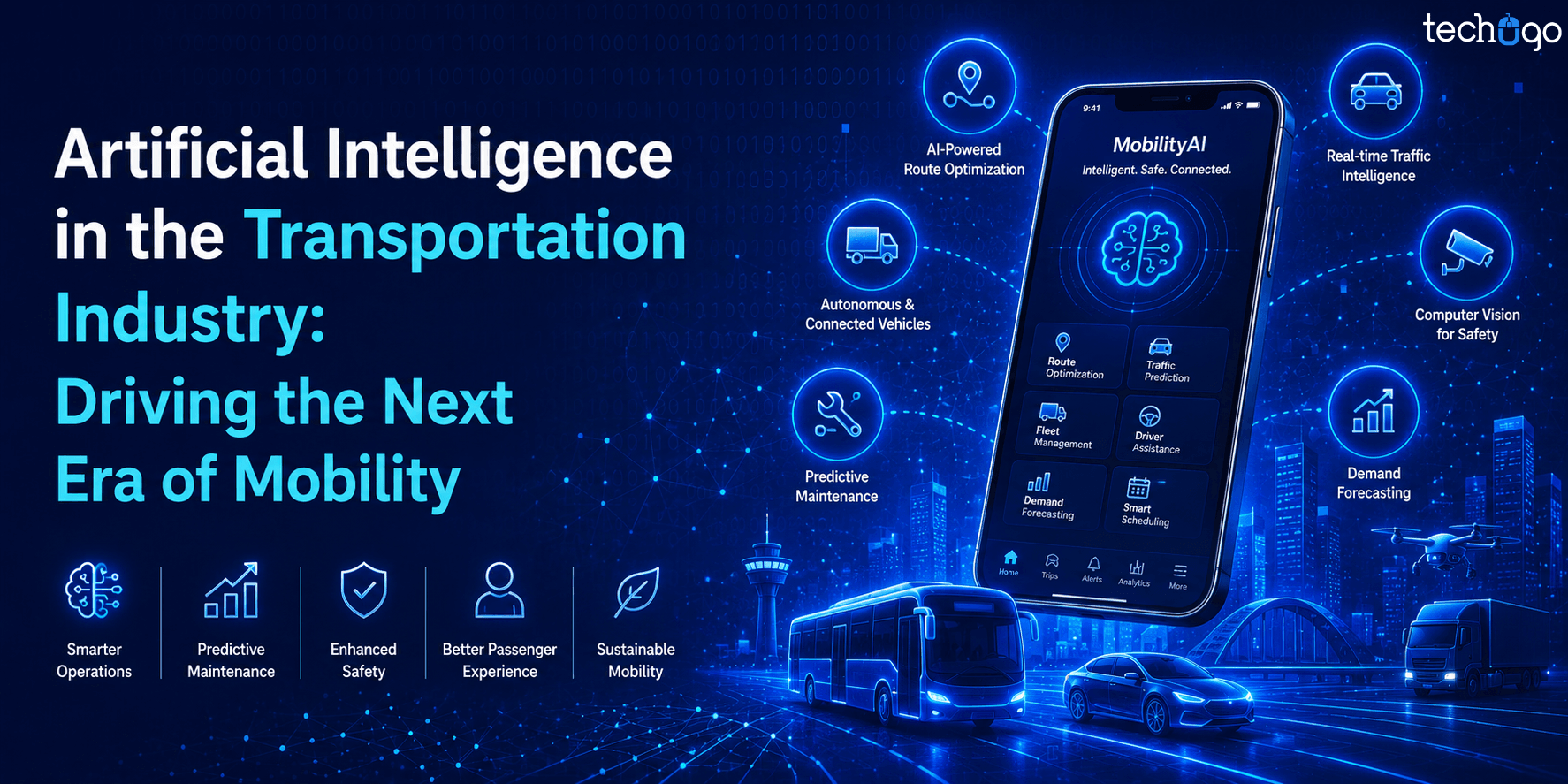


📌 Key Takeaways
- AI is making transportation smarter, faster, and way more efficient.
- Logistics companies are using AI to optimize fleets, deliveries, and fuel usage in real time.
- While AI adoption comes with challenges like cost and integration, the long-term benefits are hard to ignore.
- Businesses investing in AI for transportation now are positioning themselves ahead of the curve.
Every delay costs money. Every wrong route wastes fuel. Every missed delivery hurts customer trust. Now imagine cutting all three at once.
Artificial intelligence in the transportation industry is making possible. There is no trend in the increasing demand for smarter, faster, and safer transportation, but rather a need.
Cities are becoming congested, customer demands are increasing, and companies are constantly being pressured to do more with less time.
AI is not a far-off dream any longer. It is already changing the movement of people and goods. Predicting traffic jams even before they occur, to guiding companies to find optimal delivery routes in real-time, AI is slowly becoming the backbone of modern mobility.
To the businesses, this is not only interesting but also important. Regardless of your industry, logistics, ride-hailing, or public transport, AI adoption becomes the only way of remaining competitive and not falling behind.
What is artificial intelligence in the transportation industry?
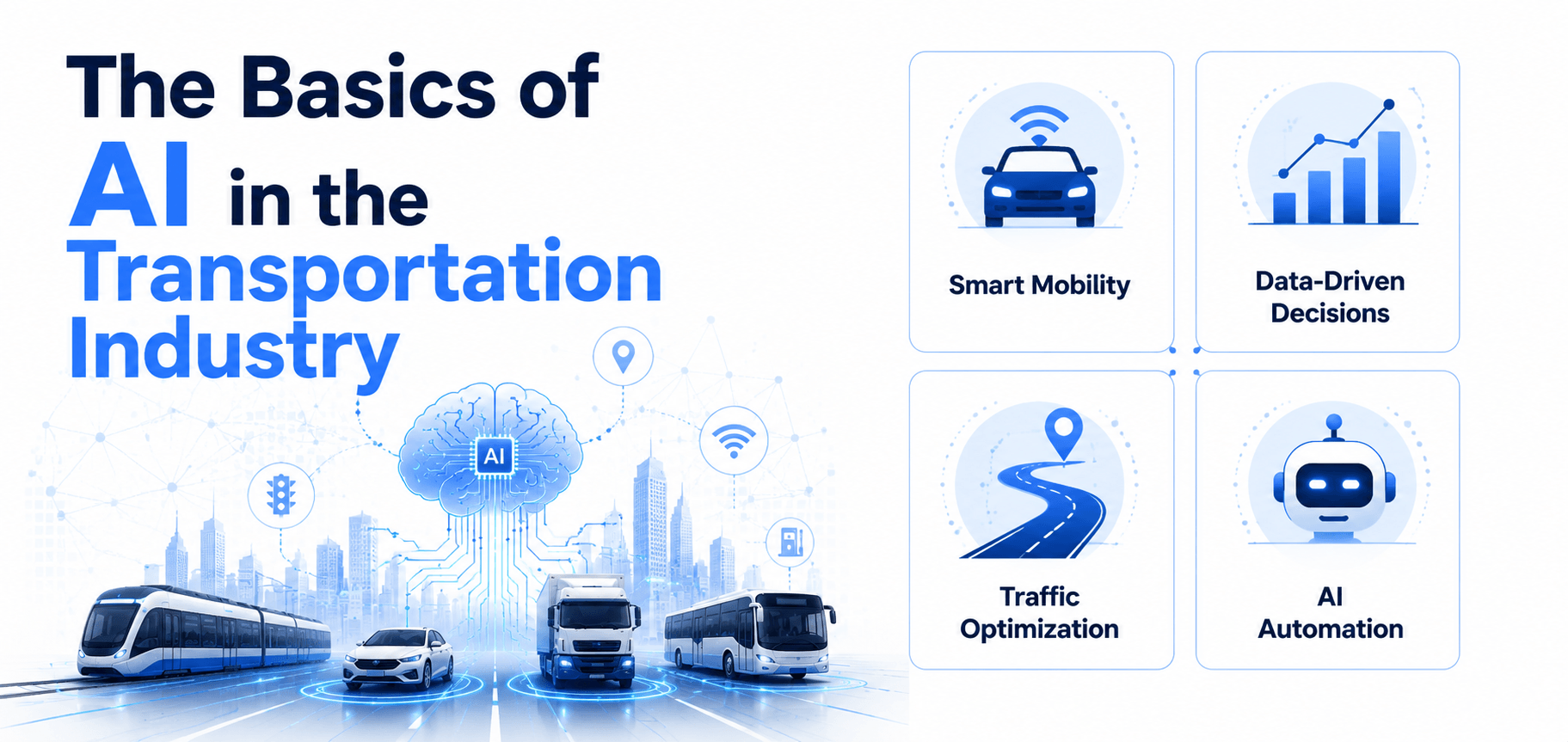
We will make it simple. The whole concept of artificial intelligence in transportation is about using intelligent systems that are capable of learning, analyzing, and making decisions without always being accompanied by a human being.
Previously, the transportation systems were reactive. If there was a delay, people reacted. If one of the vehicles broke down, it got repaired. All this depended on human intervention and conjecture.
It is no longer reactive but proactive, with AI in the transportation industry.
Instead of waiting for problems:
- AI anticipates congestion in traffic even before it forms.
- Autonomous vehicles and smart cars notify drivers of an impending malfunction.
- Systems propose superior paths in real-time in accordance with current circumstances.
The development has been colossal. What initially began as a simple GPS navigation system has now evolved to smart systems capable of processing large volumes of information within a few seconds.
Nowadays, AI has become the key component of contemporary mobility. It integrates vehicles, infrastructure, and users into a single smart system. It can be an app that delivers and calculates the time of arrival, or traffic control that changes the lights automatically, but the truth is that AI is behind the scenes to ensure that things run smoothly.
How is AI used in transportation? (Real-world applications)
In case you are curious about what this actually resembles in practice, here are some of the most effective applications of AI currently:
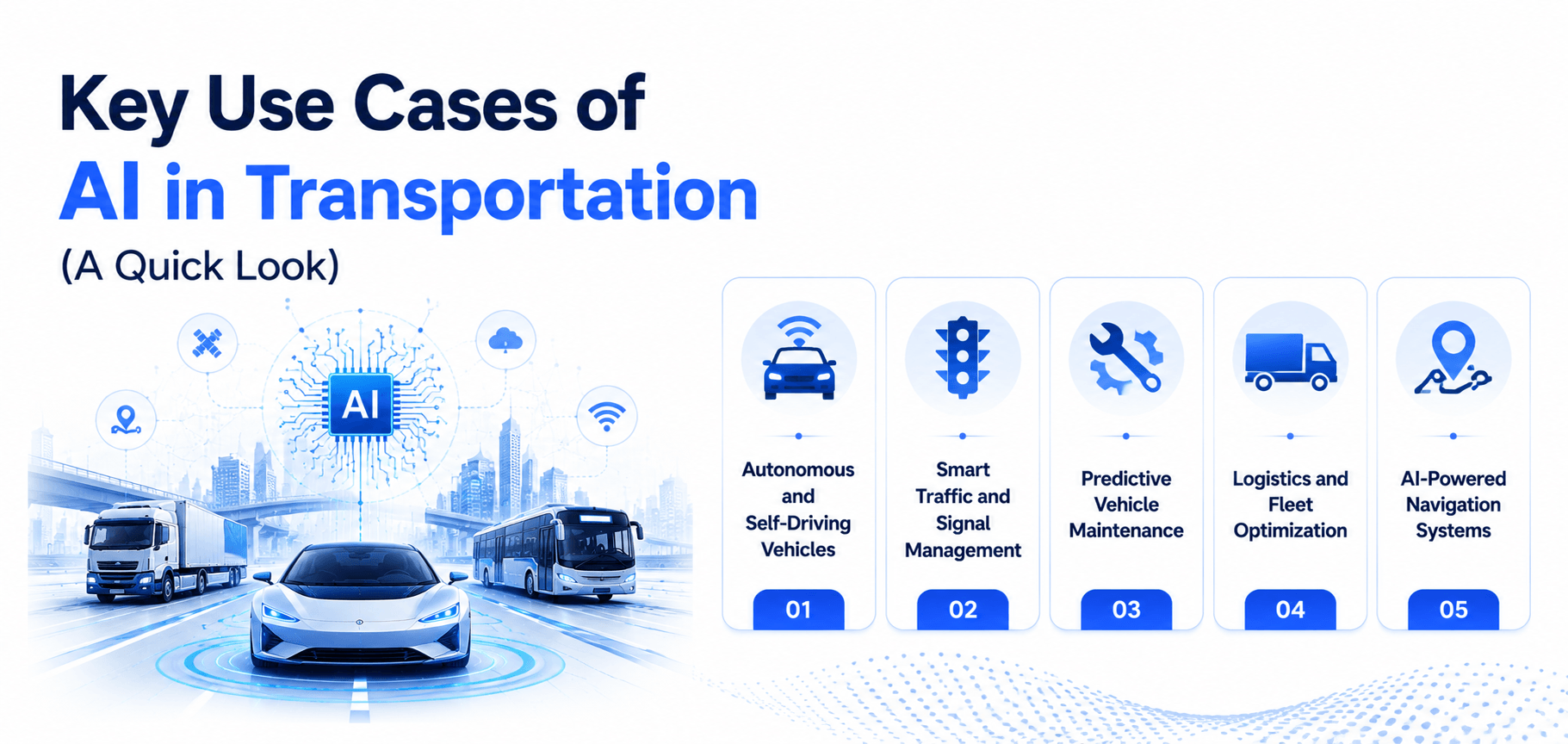
1. Autonomous vehicles
You no longer have to look to movies or tech demonstrations to see self-driving cars. They are gradually being incorporated into the actual, day-to-day transportation. Their work is AI, the brain behind the wheel. It assists these vehicles in knowing what is going on around them, whether it is in terms of identifying people on the road and interpreting other road signs, or responding instantly when something out of the ordinary occurs.
Consider it: a human driver may become distracted, fatigued, or make the incorrect decision. AI doesn’t. It continuously scans the surroundings, processes information within a few seconds, and makes decisions based on patterns and learning.
2. Smart traffic management
Traffic is a problem that everybody has to deal with, but nobody enjoys. The good news? It’s getting smarter. AI is assisting cities in abandoning old-fashioned, unchangeable traffic arrangements, which depend on set timers and intuition.
AI-powered systems monitor real-time traffic flow, instead of switching lights at the same time every day. In case one road is congested more than usual, the signals automatically change to reduce the congestion. When there is light traffic, the wait time is less. It is all about reacting to what is really going on the road, rather than what was forecasted hours ago.
This not only saves time in the long run, but frustration will be minimized, fuel will not be wasted, and everyday commuting will be a little less hectic.
3. Predictive maintenance
Breakdowns of vehicles are costly (and occasionally hazardous).
Good thing? We have AI for predictive maintenance. And they do not wait until something goes wrong, AI systems check the health of vehicles at any time. They follow the engine, brake, battery, and other important components. When something begins to wear out or act in a different manner, the system notifies it in time.
This way, companies will be able to respond to a breakdown but will be able to rectify problems before they occur. It implies that there are fewer surprises in terms of delays, less expense on repairs, and safer cars on the road. It is like a mechanic who is continually staring and never overlooks anything.
4. Logistics & fleet optimization
In the case of delivery and logistics companies, the second and the kilometer count. The slightest delay may have a ripple effect on the whole operation. This is why AI is gaining such a potent weapon in this sphere.
AI simultaneously considers various parameters (traffic conditions, weather updates, delivery priorities, fuel efficiency) and then recommends the most appropriate routes. And it doesn’t stop there. In case of an occurrence during the journey, such as an increase in traffic or roadblocks, it has the ability to reroute immediately.
This optimization allows firms to provide quicker service, achieve lower fuel usage, and operate their fleets more efficiently. This type of intelligent decision-making is crucial in a world where consumers demand rapid and precise deliveries.
5. AI-powered navigation
Today, navigation is not what it was. It no longer involves the idea of getting from point A to point B. It is fundamentally concerning how to arrive there using the cleverest means.
Intelligent navigation systems have the ability to learn based on real-time traffic information and historical trends. They know the routes that are most likely to be congested, the busiest times, and how things vary during the day. On this basis, they will recommend paths that will save time and not distance.
You have likely observed your navigation application rerouting on the way. Well, that is AI at work in the background, and always seeking an improved alternative. It is as though you have a guide that keeps learning and becoming better each time you are on the road.
Pro Tip: Start small. You don’t need to implement everything at once. Focus on one use case that solves your biggest problem and scale from there.
Here are the major benefits of AI in transportation
The value that AI provides is the actual reason why it is gaining so much traction. Here are the major benefits it provides:
1. Enhanced safety
We do know that the majority of accidents occur due to human error. Distraction, tiredness, or slow responses may have severe consequences. AI will minimize that danger.
Cars have capabilities such as real-time warnings, automatic braking, and driver assistance technology that allow a car to respond more quickly to an emergency than a human driver. It is as though you have an additional sense of being on the road. The trust in smarter systems of transportation is built over time.
2. Reduced congestion
Traffic is among those issues that everybody grumbles about but seldom notices any improvement. AI is changing that.
AI can be used to minimize unnecessary congestion by examining traffic routes and changing signals or recommending alternative paths. Traffic is spread out more efficiently than everybody being in the same bottleneck. And the result? It means less time spent on the road and smoother commutes, but, probably, it means much less frustration.
3. Cost savings
To companies, each additional mile, each time lag, each malfunction counts. AI assists in reducing such unnecessary expenses in a simple yet effective manner. Streamlined paths entail reduced fuel use. Predictive maintenance implies less costly repairs. Planning implies less delay. All this added up, the savings are difficult to neglect.
This is precisely the reason why AI in transportation management is taking center stage among companies seeking to scale without necessarily augmenting the cost of operation.
4. Faster logistics
There is nothing like speed, particularly in logistics. Customers are demanding fast deliveries, and companies must follow suit. That is possible with the help of AI, which facilitates operations. It makes sure that the deliveries follow the shortest routes, it prevents delays and changes instantly, such as due to traffic or weather.
What once took hours of manual planning occurs in seconds. And the bottom line is the same: everything works faster, and companies do better.
5. Improved customer experience
All these affect the customer at the end of the day. And the customers of today demand not only a service, but also convenience, speed, and transparency. AI can assist companies to do just that. With proper arrival time to real-time information and the ease of the trip, the overall experience is enhanced greatly.
It could be a ride that comes on time, or a package that comes at the very moment it was promised. AI in automotive industry is making experiences more reliable and far less stressful.
How AI transforms transportation management step by step
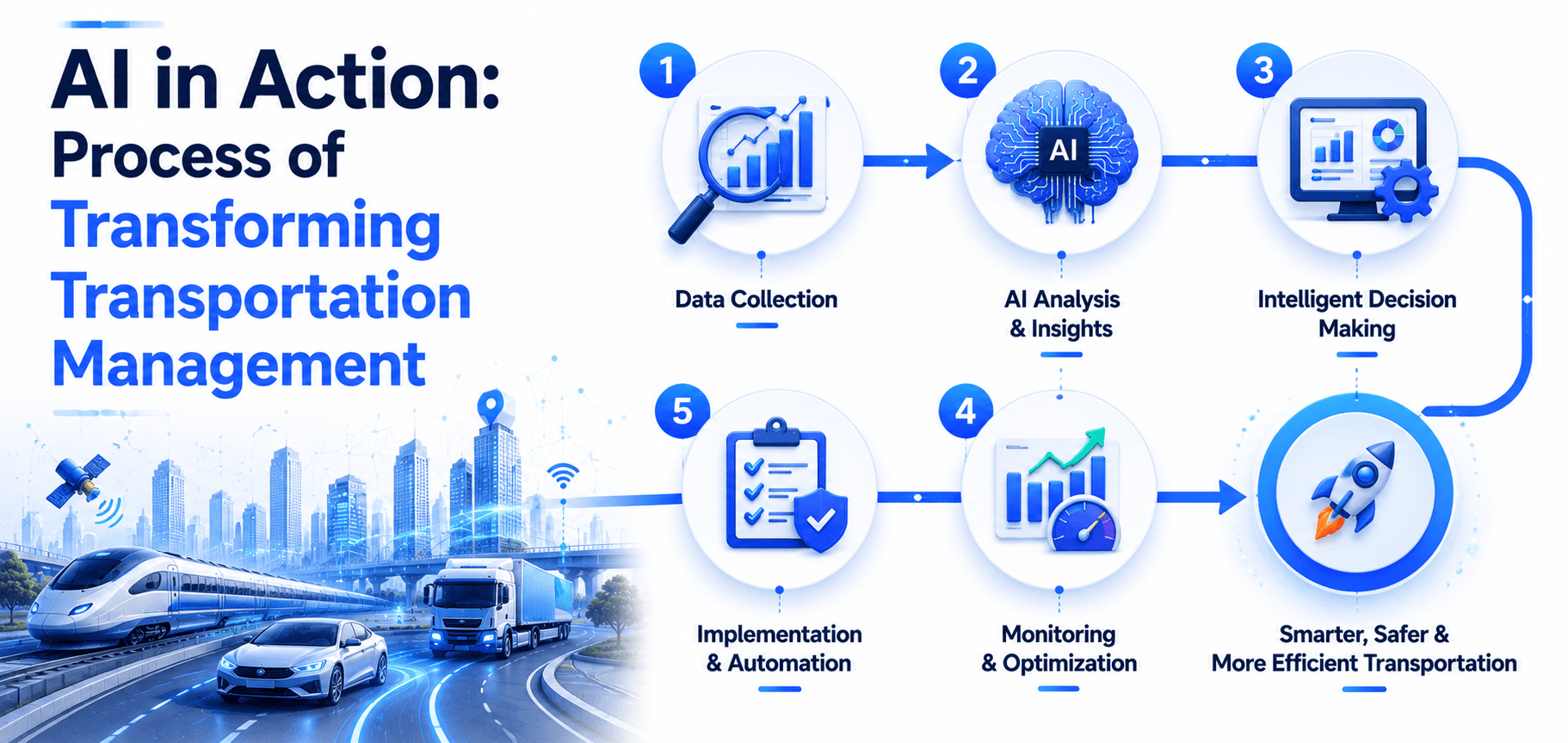
To gain a clearer picture of the effect of AI in transportation, it is best to take a step further and see how it all goes together behind the scenes. AI is not a system or tool, after all.
It is an ongoing process.
In conventional systems, the majority of decisions made were reactive. Something had gone wrong, and then something was done. This is not the case with AI in the transportation industry. Decisions are made in real-time, with live data, making operations quicker and more efficient.
With this change, businesses can eliminate delays, enhance planning, and better manage resources without the use of guesswork.
AI in transportation management: Process flow
Data Collection → Data Analysis → Smart Decision Making → Action Execution → Continuous Learning
It begins with gathering information from various sources such as traffic, vehicles, weather, and user demand. This provides AI with a full picture of what is going on at any given time.
The system then examines this data to identify patterns, delays, or inefficiencies. This is the stage in which raw data are transformed into valuable information.
Based on these insights, AI makes smart decisions. It is able to make the right decisions on routes, schedule adjustments, or resource allocation.
Such decisions are then implemented on-the-fly: vehicles are diverted, alerts are dispatched, and systems adapt automatically.
Lastly, AI is a learner of all actions and results. This is what makes AI in transportation more accurate and effective as time goes by through continuous learning.
Artificial intelligence in the transportation market: trends & growth
AI is not slowing its growth in transportation but accelerating it.
It is not slowing down anytime soon. The artificial intelligence in the transportation market is advancing at a high rate, as more industries realize its potential. Ride-sharing services, governmental bodies, logistics companies, and even governments are spending a lot of money on AI solutions.
1. Key Growth Drivers
- Growing need to deliver products faster.
- Increasing urban population and traffic problems.
- Growth of e-commerce
- Move towards smart cities.
- Require cost-effective operations.
2. Market Trends
- Integration of AI in connected vehicles
- Use of real-time analytics for decision-making
- Growth of automation in logistics.
- Greater emphasis on sustainability.
3. Future Projections
The future looks promising. The future of AI in transportation systems is not only as an add-on but as an inseparable component of the worldwide transportation system. The advantages of early investment in businesses are expected to have a high competitive advantage over others since the market is expected to expand.
Are there challenges to implementing AI in transportation?
Yes. Although AI may be the ideal answer to a variety of transportation issues, the truth is more moderate. As with any powerful technology that is powerful, it is accompanied by its challenges. These are better understood early on, and this assists the businesses in better planning and avoiding unnecessary roadblocks.
1. High implementation costs
First of all, the obvious: AI is not an inexpensive solution to adopt, particularly at first. It may be an expensive undertaking to establish smart systems, construct infrastructure, and to connect them with the existing operations.
In the case of a smaller business, this may seem like a giant leap. The trick is to view it as a long-term investment and not a single expense. Numerous businesses begin small and grow over time, thus making it easier.
2. Data privacy and security concerns
AI operates on data, plenty of data. Transportation systems gather and process sensitive information at all times, starting with the user locations and vehicle performance.
This brings up a major concern: how safe is this information?
Companies should make sure that they have robust data security. Any violation or abuse may not only result in financial loss but also loss of customer confidence. Thus, as much as AI is efficient, it also requires responsibility.
3. Infrastructure limitations
Not all areas are prepared to be completely AI-powered transportation. There are also some regions that do not have the digital infrastructure, which will support higher systems.
As an illustration, lack of reliable internet access or obsolete systems may curtail the effectiveness with which AI can be practiced. That is why it is possible that businesses will have to invest in improving their infrastructure before they can fully utilize AI.
4. Complex integration with existing systems
Systems are available in most transportation businesses. It is not only about developing AI solutions but also about ensuring that they will be compatible with the existing ones.
If integration isn’t done properly, it can lead to disruptions instead of improvements. This is why the planning and appropriate technical support should be considered carefully during the implementation.
These problems may seem complicated, but they are simple to deal with when one has the right support. An AI App Development Company can assist you in addressing them with the appropriate strategy, tools, and scalable solutions.
Why choose Techugo for transportation app development
With over a decade of experience and 2000+ apps delivered, Techugo brings strong expertise in building AI-powered digital products across industries.
As a mobile app development company, we build apps that make transportation faster, smarter, and more efficient.
What makes Techugo stand out is its approach. Instead of pushing one-size-fits-all solutions, the team takes time to understand your business, your challenges, and what you’re trying to achieve. From there, they design AI-driven systems that fit naturally into your existing operations.
From development to deployment, Techugo supports you at every stage. This includes building intelligent features, integrating AI with your current systems, and ensuring everything runs smoothly as your business grows. The goal isn’t just to launch a solution, it’s to build something that continues to deliver value over time.
And the best part? You don’t need to go all in from day one. Techugo helps you start small, test what works, and scale when you’re ready. This makes adopting AI for transportation a lot more practical and far less overwhelming.
So, are you ready to work with Techugo to build your AI-powered transportation app? Get in touch.
FAQs
Q1. What is artificial intelligence in the transportation industry?
Ans) It is basically about implementing intelligent systems, which can learn with the help of data and make decisions in order to enhance the way transportation functions. Rather than using manual planning as a standalone tool, AI can make things run more efficiently, be it traffic management, better delivery time, or making traveling safer and more efficient.
Q2. How is AI used in transportation today?
Ans) AI is currently utilized in more ways than most individuals are aware of. It can be seen in the self-driving capabilities of vehicles for applications that propose quicker routes. It is used by businesses in managing fleets, anticipating delays, optimizing deliveries, and even real-time control of traffic lights.
Q3. What are the main benefits of AI in transportation?
Ans) The greatest benefits are fairly simple. It simplifies it and makes it more efficient, quicker, and safer. It can ease traffic, save money, increase the rate of delivery, and enhance the overall experience of the users. To companies, it becomes easier to operate and have fewer headaches.
Q4. How does AI improve transportation management?
Ans) AI takes a lot of the guesswork out of managing transportation. It assists in the better planning of routes, real-time tracking of vehicles, demand forecasting, and responsiveness when an event occurs. Businesses can be one step ahead of the problems instead of responding.

Get in touch
We'd love to hear from you.