


 SA
SA
 KW
KW
 IE
IE AU
AU UAE
UAE UK
UK USA
USA
 CA
CA DE
DE
 QA
QA ZA
ZA
 BH
BH NL
NL
 MU
MU FR
FR


















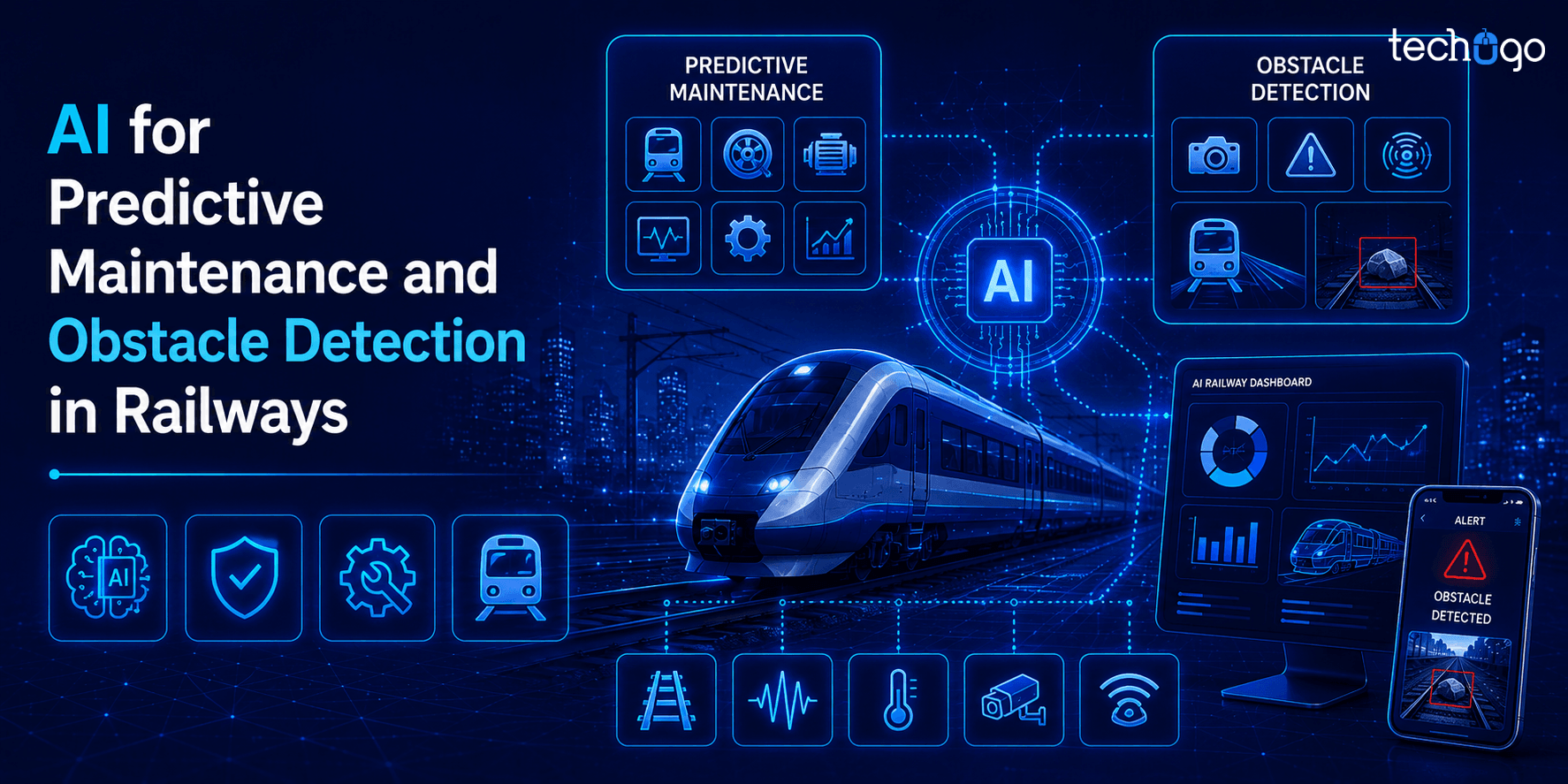


📌 Key Takeaways
- AI-powered predictive maintenance is helping railways identify equipment failures early, reducing costly downtime and unexpected operational disruptions.
- Railway operators are using AI, machine learning, and IoT sensors to monitor tracks, trains, and critical infrastructure in real time.
- Obstacle detection systems powered by computer vision and intelligent analytics improve railway safety by identifying risks before accidents occur.
- Predictive analytics enables railways to shift from reactive maintenance to proactive maintenance planning and smarter asset management.
- AI-driven railway monitoring improves operational efficiency, extends infrastructure lifespan, and reduces long-term maintenance expenses.
- Technologies like cloud computing, edge computing, data analytics, and automated inspection systems are transforming modern railway ecosystems.
- Real-time data collection through IoT-connected railway assets helps improve decision-making, safety compliance, and service reliability.
- AI-powered automation minimizes manual inspection efforts and allows railway authorities to respond faster to system anomalies and failures.
- Smart railway solutions support safer transportation networks by improving track monitoring, train diagnostics, and predictive risk management.
- Partnering with an experienced AI development company helps railway organizations implement scalable, secure, and future-ready intelligent transportation systems.
Railways have always depended on routine checks and manual inspections to keep things running. The tracks are inspected and the components are replaced on schedule but the issues are fixed only when they appear. Because of this, there is a gap and it often shows up when things start going wrong.
A small fault in a track, or even in a component, can turn into delays and safety risks and also unexpected costs. Since railway networks are becoming larger and more complex, it becomes harder and sometimes slower to manage maintenance in the same old way so that everything keeps working smoothly.
Now with AI in railways, the maintenance is not just reactive or even time-based but it is becoming faster and more accurate because systems are now able to learn from data. And through AI-powered predictive maintenance in railways, you can analyze real-time data and detect early warning signs so that failures can be predicted before they actually happen.
Instead of asking, “What went wrong?” you are now able to ask, “What is about to go wrong?”, and therefore, you can fix it before it causes bigger problems.
In this blog, you will see how this change has been happening and what technologies are behind this change, and how it is creating real impact across railway operations, even if the change may seem gradual at first.
Why traditional railway maintenance is no longer enough
For years, the railway systems have relied on the reactive and the scheduled maintenance, and it worked earlier but the reality has been changing and it is not the same anymore.
In the reactive maintenance, the issues are fixed only after they occur, and because of that, the fault is detected after it has already disrupted the operations so that delays happen and the repair costs increase and sometimes there are safety risks as well. And the traditional systems – they often fail to detect the early signs of damage because the focus is on fixing, not predicting, therefore unexpected failures are more common.
So then, the change was made towards the scheduled or the preventive maintenance, and here the components are checked and replaced at fixed intervals but this also creates another issue. Many parts are serviced even when they are still working fine, and because of that, there is unnecessary spending and the resources are not used efficiently, and the planning becomes difficult.
And then comes the scale which makes everything more complex.
The railway networks are large and they have been expanding. And there are tracks, signals, trains, and multiple components, all working together, and they are constantly under stress because of heavy usage. Over time, there are cracks and wear and tear but not everything is visible during the manual inspections so some problems stay hidden.
At the same time, the weather conditions, the temperature changes, and the environmental factors – they also affect the infrastructure and it becomes harder to predict when something might fail because there are too many variables involved.
So what happens then is that the maintenance teams are trying to manage everything but with limited budgets, increasing demand, and growing infrastructure, it becomes difficult to balance it all. Sometimes the critical areas are missed and sometimes the less important ones are maintained more than needed, therefore the system is not optimized. This creates a gap and it is quite clear.
The traditional maintenance is either too late or it is too early, but it is rarely at the right time and because of that, in a system where safety and timing matter so much, it is no longer enough.
What is predictive maintenance in railways?
Predictive maintenance in railways is a smarter approach, and it is built on the idea that you should fix a problem before it actually happens, not after it has already caused disruption. It uses data, and analysis, and advanced technologies so that you can understand the condition of railway assets in real time and act at the right moment.
Not like traditional methods where maintenance was either reactive or scheduled, predictive maintenance depends on continuous monitoring. Sensors are installed on tracks, trains, and also on critical components; they collect data such as vibration, temperature, pressure, and wear levels. This is where Internet of Things (IoT) in railways becomes important because it connects physical assets with digital systems and makes sure that data is always flowing.
Now, the data alone is not enough, and this is where data analytics in railways comes in. The collected data is processed and analyzed, and patterns are identified so that even small irregularities can be detected early. Over time, these systems learn what “normal” looks like and what signals a potential failure.
And this is exactly where AI in railways becomes powerful.
AI models and machine learning algorithms are trained on historical and real-time data and they can predict when a component is likely to fail. According to a report by McKinsey & Company, predictive maintenance can reduce maintenance costs by 10–40% and cut equipment downtime by up to 50% which shows how impactful this shift can be when applied at scale.
So instead of replacing parts too early or reacting too late, railway operators can take action exactly when it is needed, and that makes the entire system more efficient.
In simple terms, railway predictive maintenance is about using data, AI, and connected systems, so that you can move from guesswork to precision. It helps railways become more reliable, and safer, and cost-efficient, even as the networks continue to grow and become more complex.
Also Read: Business Analytics in the Airline Industry: Use Cases, Tools, Benefits & ROI Explained
Key technologies behind AI in railway maintenance
AI in railway maintenance does not work alone, and it depends on a mix of technologies, because each one plays a role, and together they make the system work. The data is collected, and it is processed, and then it is turned into insights, so that you can take action at the right time, but none of this happens in isolation.
1) IoT in railways
The Internet of Things, or IoT, is where everything starts because it connects the physical assets with digital systems, and it allows data to be collected continuously. Sensors are installed on the tracks, and the trains, and the engines, and even the signaling systems so that they can monitor things like vibration, and temperature, and pressure.
Because of this, you are not depending only on manual inspections anymore and the system is always active, and it keeps tracking everything in real time. Even small changes are captured, and therefore issues can be noticed early but only if the data is used properly. Implementation requires expertise, so working with an IoT app development company can simplify the process
According to Deloitte, IoT-enabled monitoring has been helping improve asset visibility, and it has been reducing unexpected failures, which shows how important this layer has become.
Also Read: Benefits of IoT Energy Management Solutions (Use Cases, Challenges & Future Trends)
2) Data analytics in railways
Once the data is collected, it needs to be processed and that is where data analytics in railways comes in because without analysis, the data is just numbers, and it does not add much value.
Large volumes of data are analyzed and patterns are identified but it is not always straightforward because the data can be complex and sometimes inconsistent. So the systems compare current data with historical data, and they try to find deviations so that early warning signs can be detected.
Because of this, decisions are not based on assumptions anymore, and they are based on actual insights which makes the process more reliable.
3) Artificial intelligence and machine learning
AI and machine learning are the core technologies and they are the ones that actually make predictions possible because they go beyond analysis, and they learn from the data.
These systems have been trained on historical data and they understand how components behave over time so when new data comes in, they can detect patterns and sometimes even subtle ones, that humans might miss. Therefore, they can predict failures before they happen, but the accuracy depends on the quality of data as well.
As per IBM, AI-driven predictive maintenance has been improving forecasting accuracy, and it has been reducing unplanned downtime which makes it highly valuable for large systems like railways.
4) Cloud and edge computing
The amount of data that is generated in railway systems is massive and it needs to be handled properly because delays in processing can reduce its usefulness. Cloud computing is used to store and process large datasets, and edge computing helps in processing data closer to the source.
Because of this combination, responses can be faster, and decisions can be made in real time so that critical issues are addressed quickly. It also helps the system scale as the infrastructure grows and the data increases.
5) Computer vision and automated inspection
Computer vision is another important part and it is used for inspections because cameras and AI models can detect issues that are not always visible to the human eye.
These systems can identify cracks, and misalignments, and wear but they do it faster and often more consistently than manual methods. In many cases, drones and high-speed cameras are used so that large areas can be covered, and inspections do not interrupt operations.
All these technologies are connected, and they depend on each other, because the data is collected through IoT, and it is analyzed through data analytics, and then it is interpreted through AI. And because this integration has been improving over time, railway maintenance is becoming more predictive and less reactive which is what modern railway systems need now.
Top AI use cases in railway maintenance
This is where things start to become more practical and more visible because the AI use cases in railways are no longer limited to concepts, and they have been applied in real environments, across different systems. And because of that, you can actually see how AI is transforming railway maintenance, not in one single way but across multiple layers of operations.
Instead of reacting to failures or depending only on fixed schedules, the systems are now learning from the data, and they are predicting issues in advance, so that action can be taken at the right time, but this depends on how well the data is used.
-
Track fault detection and monitoring
The railway tracks are under constant stress, and even a small defect can create serious problems, but earlier, the inspections were manual, and they were done at intervals, so some issues were missed.
Now, AI systems use sensors and cameras, and continuous data, so that the track conditions are monitored in real time, and even small cracks and misalignments can be detected early. Because of this, maintenance teams are able to act faster and prevent disruptions.
For example, Deutsche Bahn has been using AI-based monitoring systems, and it has helped in identifying faults before they turn into larger issues, therefore improving reliability.
-
Predictive maintenance of train components
Train components, such as wheels, and brakes, and engines, are critical, and their failure can affect the entire system, but with predictive maintenance in railways, things are changing.
AI models analyze both historical and real-time data, and they try to understand how these components behave over time, so that failures can be predicted in advance. This approach, which is also known as railway predictive maintenance, ensures that parts are repaired or replaced only when needed.
For instance, Siemens Mobility has been applying AI-driven analytics, and it helps in reducing downtime, and improving operational efficiency, but the success depends on consistent data flow.
-
Smart monitoring of railway assets
The railway infrastructure includes many assets, and not just trains or tracks but also signals, switches, and overhead systems, and managing all of this manually has been difficult.
With the help of data analytics in railways, AI systems monitor these assets continuously, and they identify unusual patterns so that issues can be detected early. Because of this, maintenance becomes more targeted, and resources are used more effectively but it requires proper integration.
-
AI-powered visual inspection
The manual inspections have been time-consuming and sometimes inconsistent because small defects are not always visible to the human eye, and this is where AI-powered inspection comes in.
Using cameras, and drones, and computer vision models, the systems scan infrastructure, detect cracks, and corrosion, and structural damage as well, so that inspections become faster and more accurate. SNCF has been using AI-based visual inspection systems and it has improved both speed and accuracy, but the implementation requires investment.
-
Failure prediction and risk management
One of the most important applications of AI is failure prediction, because it allows systems to act before problems occur. By combining IoT in railways with AI models, continuous data is analyzed, and risk levels are assessed.
If unusual behavior is detected, alerts are generated, and maintenance teams can respond early, so that failures are avoided. Therefore, safety is improved and disruptions are reduced, but it depends on real-time responsiveness.
All these use cases show that AI in railways is not just improving maintenance processes but it is changing the entire approach because instead of reacting late or acting too early, systems are now working with precision. And because of that, railway operations have been becoming more reliable and efficient, even as the complexity continues to grow.
Benefits of predictive maintenance in railways
Predictive maintenance in railways is not just an operational upgrade, and it is a shift in how the entire system is managed, because instead of reacting to failures or following fixed schedules, you are making decisions based on actual conditions, and that changes everything.
One of the most immediate benefits is the reduction in unexpected failures because systems are continuously monitored, and early warning signs are detected before they turn into serious issues. So, the downtime is reduced, and the disruptions are minimized, but more importantly, the maintenance teams are no longer working in crisis mode all the time. According to McKinsey & Company, predictive maintenance can reduce equipment downtime by up to 50% which shows how significant the impact can be.
At the same time, there is a clear improvement in cost efficiency because maintenance is performed only when it is actually needed, and not too early or too late. This means fewer unnecessary replacements, and better use of resources, therefore overall operational costs are reduced. Studies have shown that predictive maintenance can lower maintenance costs by 10–40%, and that is a substantial saving for large-scale railway networks.
Safety is another critical area where the impact is visible, because railway systems operate under high pressure, and even small failures can lead to serious consequences. With AI in railways and continuous monitoring, risks are identified earlier, and corrective actions are taken in advance, so that accidents and system failures are less likely to occur. And because of this, both passenger safety and operational reliability are improved.
There is also a noticeable improvement in asset lifespan, because components are maintained based on their actual condition, and not just on predefined timelines. So parts are not overused but they are also not replaced unnecessarily, and this balance helps in extending the life of critical assets, which has long-term financial benefits.
Another important advantage is better planning and decision-making, because with data analytics in railways, maintenance teams have access to real-time insights, and they can prioritize tasks based on urgency and impact. This leads to more efficient scheduling and better allocation of resources, but it also reduces the chances of human error because decisions are supported by data.
And as railway networks continue to grow, scalability becomes important, and predictive maintenance supports this growth because it allows systems to handle increasing complexity without a proportional increase in manual effort. Therefore operations become more streamlined and the overall system becomes more resilient.
So, when you look at the bigger picture, the benefits of predictive maintenance in railways are not limited to cost or efficiency alone, but they extend to safety, reliability, and long-term sustainability, and that is why it is becoming a key part of modern railway systems.
Challenges in implementing AI in railways
AI in railways is powerful, but the implementation is not always easy because the systems are complex and they have been built over many years. So when new technologies are introduced, challenges start to appear.
Old Systems and New Technology – Most railway networks still use legacy systems, and they were not designed for AI. Because of this, integration becomes difficult and sometimes slow so that everything does not work smoothly together.
Data Issues – AI needs data, but the data is often scattered, incomplete, or not structured properly. So before using it, the data has to be cleaned and organized and that takes time and effort.
High Initial Cost – AI implementation requires investment in sensors, systems, and integration. Because of this, the upfront cost is high and many organizations hesitate, even if the long-term benefits are clear.
Skill Gap – AI systems need skilled people, but not all teams are trained for it. So companies need training or new talent, and that adds to the complexity.
Real-Time Processing – Railway systems need fast decisions, but processing large data in real time is not always easy. It requires strong infrastructure so that delays do not reduce efficiency.
Security Concerns – As systems become connected, security risks increase. So data protection becomes important because sensitive information is involved.
Resistance to Change – People are used to traditional methods and change can feel difficult. So adoption can be slow, even when the technology is available.
So, implementing AI in railways is not just about technology, but also about systems, people, and processes and because of that, the transition takes time.
How to implement AI-based predictive maintenance in railways
Implementing AI-based predictive maintenance in railways is not just about adding AI, but about building a connected system, where data, technology, and operations work together, so that decisions are timely and accurate.
1. Start with data and IoT
The process begins with data because AI depends on it. Using IoT in railways, sensors are installed across tracks and trains, so that real-time data like vibration and temperature is collected. But the data also needs to be cleaned and structured, otherwise it will not be useful.
2. Build data infrastructure
Once data is available, it needs to be stored and processed efficiently. With data analytics in railways, patterns are identified, and insights are generated so that systems can understand asset behavior.
3. Develop AI models
Here, AI in railways comes into action. Models are trained on historical and real-time data so that failures can be predicted in advance and maintenance can be planned more accurately.
4. Integrate with existing systems
AI should connect with current railway systems and not work separately. This is where AI integration services help, because they ensure smooth communication between AI tools and operational systems.
5. Partner with experts
Implementation requires expertise, so working with an AI development company for railways can simplify the process. A smart mobility app development company can further help in building user-friendly dashboards for better decision-making.
6. Monitor and improve
AI systems need continuous updates because they learn over time. Regular monitoring ensures better accuracy and long-term performance.
So, implementing predictive maintenance in railways is a structured process, and when done right, it improves efficiency, reduces failures, and makes railway operations more reliable.
Choosing the right technology partner
Implementing AI in railways is not just a technical task so choosing the right partner matters; you need a team that understands both AI and real-world railway challenges because the solution has to fit into existing systems, and not disrupt operations.
Look for experience in predictive maintenance in railways, along with strong capabilities in data handling, system integration, and scalability. Any experienced AI and mobile app development company can help a lot as they can design solutions tailored to your infrastructure, integrate AI and third-party tools so that everything works together without friction. At the same time, they can help in setting up connected systems that collect and manage real-time data efficiently, and they can build intuitive dashboards and applications for on-ground teams for better accessibility and monitoring.
With the right partner, transformation becomes easier, and results are more practical. So, without further ado, connect with Techugo today.
With over 10 years of experience in the web and app development industry, their team has hands-on experience with emerging technologies also like AI, ML, IoT, blockchain, and cloud. You’re just a call away from clearing your doubts. Schedule a call and discuss whatever’s confusing you. We’re waiting.
FAQs
Q. How is AI transforming railway maintenance?
AI is changing railway maintenance from reactive to predictive because systems can now analyze real-time and historical data, and identify issues before they become serious. Instead of fixing problems after failure, railways are able to detect early warning signs so that maintenance is done at the right time, and disruptions are reduced.
Q. How does AI improve railway safety?
AI improves safety by continuously monitoring tracks, trains, and critical systems and detecting risks early. Because of this, potential failures are identified before they escalate, and corrective actions are taken in time so that accidents and disruptions are minimized.
Q. What are the benefits of AI in railway operations?
AI helps in reducing downtime, improving efficiency, and optimizing maintenance schedules. It also supports better decision-making through data insights, therefore railway operations become more reliable, cost-effective, and scalable.
Q. How is IoT used in railways?
IoT in railways is used to connect physical assets like tracks and trains with digital systems, through sensors that collect real-time data. This data is then used for monitoring, analysis, and predictive maintenance so that railway systems can operate more efficiently and safely.

Get in touch
We'd love to hear from you.