

 SA
SA
 KW
KW
 IE
IE AU
AU UAE
UAE UK
UK USA
USA
 CA
CA DE
DE
 QA
QA ZA
ZA
 BH
BH NL
NL
 MU
MU FR
FR
















📌 Key Takeaways
- Enterprises are investing in AI training apps because employees still lack practical AI skills despite rising AI adoption.
- Dubai AI+ Programme proves that role-based, practical AI learning works better than generic training.
- AI training apps should focus on real-world usage and daily workflows, not just theory.
Many AI training platforms fail because they’re too generic, complicated, or disconnected from employees’ actual work. - The main lesson from Dubai’s approach is – AI training should help employees use AI naturally in daily tasks.
AI is becoming part of daily work for enterprises but there is a clear gap. Many employees still lack the skills to use AI effectively. To fill this gap, AI training apps for enterprises come in and help teams learn AI in a practical way based on their roles and real tasks, not just theory. Businesses are now moving from one-time training sessions to continuous learning systems that evolve with technology.
A strong example of this shift is the Dubai AI+ Programme. It focuses on training entire workforces through structured, role-based learning. The goal is simple: make AI usable for everyone, not just technical experts.
Through this blog, we’re going to explore how to build AI training apps for enterprises. We will also break down key lessons from Dubai’s approach to help you create effective AI learning platforms in 2026.
Why enterprises are investing in AI training apps in 2026
AI adoption is not the problem anymore. The real problem is workforce readiness.
Across industries, companies have already started using AI in daily operations. In fact, McKinsey Global Survey on AI says that around 88% of organizations are now using AI in at least one business function. But adoption alone is not enough. Without proper training, employees struggle to use these tools effectively.
This has created a massive skills gap. By 2026, over 90% of enterprises are expected to face AI-related skill shortages, and nearly 67% of employees still have no formal AI training. At the same time, 59% of leaders say their organization already has an AI skills gap, even after investing in training.
The impact is real. Businesses risk losing up to $5.5 trillion globally due to workforce skill gaps.
This is why enterprises are shifting toward AI training apps. These platforms offer continuous, role-based learning instead of one-time sessions. They help employees apply AI in real tasks, not just understand concepts.
Simply put, companies are no longer asking, “Should we use AI?”
They are asking, “How do we train everyone to use it well?”
What is Dubai’s AI+ Programme and why does it matter?
The Dubai AI+ Programme is a large-scale initiative launched to make AI skills a core part of everyday work across government departments. It is led by Digital Dubai, in partnership with key public-sector bodies, with a clear goal – train 50,000 government employees in AI.
But this is not a traditional training program. It is designed as a practical, role-based learning system. Employees are trained based on what they actually do. For example, leaders focus on AI strategy and decision-making, while operational teams learn how to use AI tools, automation, and prompt engineering in their daily workflows.
The programme is part of Dubai’s broader push to become an AI-first city, where technology is deeply embedded into public services. Instead of limiting AI to innovation teams, the idea is to make it accessible and usable for the entire workforce.
Must Read: How Dubai’s Smart Government Vision 2030 Is Fueling AI App Development in UAE
Why it matters for enterprises building AI training apps
1. It shows how to scale AI training across entire workforces
Most companies struggle to move beyond pilot AI training programs. Dubai’s approach proves that enterprise AI training platforms can scale to tens of thousands of users when structured properly.
2. It prioritizes role-based, practical learning
One key takeaway for AI training apps for enterprises is clear – generic content does not work. The programme focuses on real job roles and use cases, which improves adoption and outcomes.
3. It shifts AI from theory to daily usage
Many corporate AI training apps fail because they stay theoretical. Dubai’s model ensures employees actually use AI in their daily tasks, which is exactly what modern AI employee training software should aim for.
4. It aligns training with business (or government) goals
The programme is not just about learning AI. It is tied to operational efficiency, better decision-making, and smarter services. This is a key lesson for any business investing in enterprise AI training platforms.
5. It highlights the role of government-led AI training programs
Dubai is showing how government-led AI training programs can accelerate large-scale adoption. For enterprises, this sets a benchmark. AI training needs leadership support, clear goals, and long-term vision.
In simple terms, the Dubai AI+ Programme is not just a training initiative. It is a working model of how to build, scale, and sustain AI learning across an entire organization.
Key lessons from Dubai’s AI+ Programme for building AI training apps
The Dubai AI+ Programme is not just a training initiative. It is a clear example of how AI learning can scale across an entire workforce. For businesses building AI training apps for enterprises, the lessons are practical and directly applicable.
1. Start with roles, not content
One of the biggest reasons the programme works is its role-based approach. Instead of giving the same training to everyone, it focuses on what each role actually needs. Leaders learn AI strategy, while teams focus on execution.
This improves both engagement and outcomes. For any enterprise AI training platform, this means moving away from generic modules and designing learning paths that match real job responsibilities.
2. Focus on real use cases, not theory
The programme does not spend time on abstract AI concepts. It focuses on how AI is used in daily work. Employees learn through practical scenarios such as automation tasks, decision-making support, and real tools. This is exactly where most AI training app development efforts fall short. If the learning is not immediately useful, employees lose interest.
Also Read: 6 Ways AI & App Innovation Are Powering Driverless Cars in UAE & Saudi Arabia
3. Design for continuous learning
AI is not static, and training cannot be either. Dubai’s model treats learning as an ongoing process rather than a one-time event. For AI training apps for enterprises, this means:
- Regularly updated content
- AI-driven recommendations based on user progress
- Learning journeys that evolve over time
This approach ensures that skills stay relevant as technology changes.
4. Make learning simple and accessible
Another key lesson is simplicity. The programme is designed to fit into busy work schedules. Content is short, clear, and easy to access. This is critical for adoption. Even the best AI employee training software will fail if it feels complex or time-consuming. Microlearning and mobile-first design powered by AI play a big role here.
5. Measure real impact, not just completion
Most platforms focus on course completion rates. But that does not reflect real success. Dubai’s approach looks at how AI is actually being used after training.
Are employees applying what they learned?
Is productivity improving?
For enterprise employee AI training platforms, tracking should go beyond dashboards and include real performance outcomes.
6. Leadership drives adoption
AI training works faster when leadership is involved. In this case, the initiative is backed at the highest levels, which creates alignment across departments. This is a critical lesson. Without leadership support, even the best corporate AI training apps struggle to scale.
7. Build for scale from the beginning
Training 50,000 employees requires strong infrastructure. The programme is built to scale without losing personalization. For businesses, this means:
- Cloud-based systems
- Scalable architecture
- The ability to support large user bases while maintaining relevance
8. Integrate learning into daily work
The most important takeaway is that AI training should not feel separate from work. Dubai’s model ensures employees learn while they work. AI becomes part of daily tasks, not an extra activity. For AI learning platforms for businesses, this means integrating with existing tools and workflows, so learning happens naturally.
The pattern is clear. Successful AI training apps for enterprises are not just learning platforms. They are systems that enable employees to use AI in real work, every day.
Must-have features in AI training apps for enterprises
If you look at initiatives like the Dubai AI+ Programme, one thing becomes clear- successful AI training is not about content alone. It is about how the platform is designed, delivered, and used in real work environments.
Here are the features that truly define effective AI training apps for enterprises:
Personalized learning
Not every employee needs the same training. The platform should adapt based on role, experience, and learning pace. This is what separates basic tools from strong enterprise AI training platforms. They guide users instead of overwhelming them.
Role-based content
Each user should see what matters to them.
- Leaders → AI strategy and decision-making
- Managers → workflow optimization and productivity
- Teams → hands-on tools and real use cases
This keeps learning relevant and improves adoption.
AI learning assistants
Modern AI employee training software should include AI copilots that support users in real time. They can answer questions, suggest learning paths, and help apply AI during tasks, making learning more interactive.
Progress tracking
Enterprises need visibility beyond course completion. The platform should track skill development, usage patterns, and performance improvements to connect training with business outcomes.
Hands-on practice
Theory alone does not work. Employees need to apply what they learn. Interactive scenarios and simulations ensure that learning translates into real capability, which is essential for AI learning platforms for businesses.
System integration
An AI training app should not exist in isolation. It must integrate with HRMS software and systems, LMS platforms, and collaboration tools so learning becomes part of daily workflows.
Microlearning design
Employees prefer short, focused learning experiences. Microlearning modules and mobile-first design make training easier to adopt without disrupting work.
Certifications
Enterprises need structured ways to measure progress. Assessments and certifications help validate skills and motivate employees to complete their learning journeys.
Continuous updates
AI is evolving quickly, and training must keep pace. Regular content updates and AI-driven recommendations ensure relevance over time.
Security controls
Since enterprise data may be involved, security is critical. The platform should include strong data protection, access control, and compliance measures.
When these features come together, the platform becomes more than just a training tool. It becomes a system that helps enterprises actually use AI in everyday work.
Step-by-step process to build AI training apps for enterprises in 2026
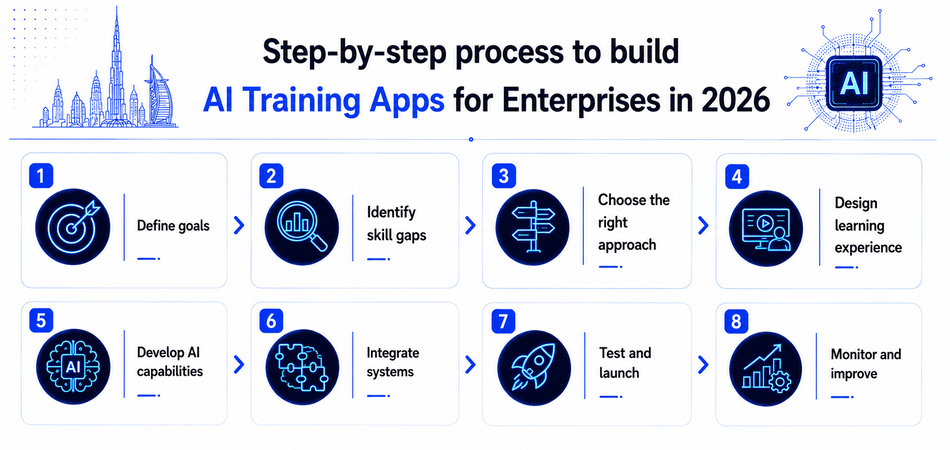
Building effective AI training apps for enterprises is not just about adding learning modules. It requires a structured approach that aligns technology, user needs, and business goals. Here’s a clear step-by-step process to follow:
Step #1. Define goals
Start by identifying what the business wants to achieve. Is the goal to improve productivity? Automate workflows? Upskill non-technical teams?
Clear outcomes will shape the entire platform.
Step #2. Identify skill gaps
Assess the current capabilities of your workforce. Understand which teams need training, what level of AI knowledge they have, and where the gaps exist. This ensures your platform is relevant from day one.
Also Read: AI Investment Trends from Dubai AI Festival 2026 | What They Mean for App Developers
Step #3. Choose the right approach
Decide whether to build a custom solution or use an existing platform. Many enterprises prefer working with experienced AI mobile app development companies to create tailored solutions that match their workflows and long-term goals.
Step #4. Design learning experience
Focus on user experience and engagement. Create role-based learning paths, simple navigation, and microlearning modules. The goal is to make learning easy and accessible.
Step #5. Develop AI capabilities
Integrate core AI features into the platform. This may include recommendation engines, AI assistants, personalized learning paths, and analytics systems that track progress.
Step #6. Integrate systems
Connect the training app with existing enterprise tools. Integration with HRMS, LMS, and collaboration platforms ensures that learning becomes part of daily workflows.
Step #7. Test and launch
Before full deployment, test the platform with a smaller group. Gather feedback, fix usability issues, and ensure performance is stable at scale before rolling it out across the organization.
Step #8. Monitor and improve
Post-launch, continuously track performance. Analyze user engagement, learning outcomes, and business impact. Use these insights to update content and improve the platform over time.
A structured approach like this ensures that your AI training app is not just built but actually used, adopted, and aligned with real business needs.
Common mistakes enterprises make while building AI training apps
Building AI training apps for enterprises sounds straightforward until adoption drops, engagement fades, and the platform quietly becomes unused. Most failures are not technical. They come from wrong assumptions. Here are the most common mistakes, with real-world context:
Must Read: 10 Common AI App Development Mistakes (And How to Avoid Them)
1. Treating it like a traditional LMS
Many enterprises simply add AI courses to an existing learning system and expect results.
The problem?
AI learning is not static. It requires interaction, experimentation, and real-world application.
For example, a company uploads recorded AI tutorials and expects teams to learn. Completion rates look fine but employees still don’t use AI in their work.
2. Ignoring role-based learning
A one-size-fits-all approach rarely works. Different teams need different levels of AI exposure. When content is not relevant, users disengage quickly.
For example, marketing, HR, and engineering teams are given the same AI modules. Within weeks, most users drop off because the content does not match their daily tasks.
3. Focusing too much on theory
Enterprises often over-explain AI concepts instead of showing how to use them. Employees do not need deep technical knowledge. They need practical skills.
For example, an app teaches machine learning concepts but does not show how to use AI tools for writing, analysis, or automation. The result – low real-world usage.
4. Overcomplicating the platform
Trying to include every AI feature can make the platform difficult to use. Complex interfaces and heavy workflows reduce adoption, especially for non-technical users.
For example, an enterprise builds a feature-rich system with dashboards, tools, and reports but employees find it confusing and avoid using it altogether.
5. No clear success metrics
Many organizations track only course completion but completion does not equal impact. Without clear KPIs, it is impossible to measure ROI.
For example, a company reports 80% training completion but cannot show improvements in productivity or AI adoption.
6. Lack of leadership involvement
When leadership is not actively involved, AI training feels optional. Adoption slows down because teams do not see it as a priority.
For example, a training app is launched, but no leadership communication or incentives follow. Employees treat it as just another internal tool.
7. No integration with daily workflows
If the platform sits separately from daily tools, employees rarely return to it. AI learning needs to happen alongside work.
For example, an AI training app is built, but it does not integrate with tools like Slack or internal systems. Employees forget about it after initial use.
8. Treating it as a one-time project
AI evolves quickly but many enterprises build training apps and leave them unchanged. Outdated content leads to declining relevance.
For example, a platform built in early 2025 still teaches old tools and workflows in 2026, which makes it less useful for employees.
The pattern is simple. Most enterprise AI training platforms fail not because of technology, but because they are built like static learning systems. To succeed, the focus needs to shift from “delivering content” to enabling real AI usage in every product for everyday work.
How much does it cost to build AI training apps for enterprises in 2026?
The cost of building AI training apps for enterprises in 2026 depends less on “development” and more on how deeply AI is embedded into the platform. A basic learning app with limited AI features can be built relatively quickly. But once you move toward personalization, integrations, and large-scale deployment, both cost and timelines increase significantly.
At a high level, enterprises are not just building apps. They are building AI learning ecosystems. This is why budgets vary widely, from pilot projects to full-scale transformation programs.
| Project level | Estimated cost (AED) | Timeline | What you get |
| Basic / MVP | AED 110,000 – AED 295,000 | 2-4 months | Core learning modules, simple UI, limited AI features |
| Mid-level platform | AED 295,000 – AED 1.1 million | 4-8 months | Personalized learning, integrations, analytics dashboards |
| Enterprise-grade platform | AED 1.1 million – AED 1.8 million+ | 8-14 months | Advanced AI, role-based systems, scalability, security |
| Large-scale transformation | AED 1.8 million – AED 3.7 million+ | 12-18+ months | Custom AI models, deep integrations, global deployment |
What actually drives the AI training app development cost?
AI complexity
The level of AI you choose has the biggest impact. Using existing APIs for recommendations or chat assistants keeps costs controlled. But building custom models, fine-tuning, or advanced personalization systems increases both development time and budget.
Data readiness
AI systems depend on clean, structured data. In many cases, enterprises spend more time preparing data than building the app itself. This includes collecting, cleaning, labeling, and organizing internal data for training and recommendations.
Integrations
Enterprise environments are complex. Connecting the app with HRMS, LMS, CRMs, and internal tools requires additional effort. The more systems involved, the higher the cost and longer the timeline.
Scale and performance
A platform built for 500 users is very different from one designed for 50,000+ employees, like the Dubai AI+ Programme. Scalability, performance optimization, and cloud infrastructure significantly impact cost.
User experience and personalization
Designing intuitive interfaces, role-based journeys, and adaptive learning paths requires deeper product thinking and development effort. This is often underestimated but plays a major role in adoption.
Also Read: Why AI Chatbot App Development in Dubai is Essential for Outstanding Customer Service
-
Security and compliance
Enterprise-grade platforms must meet strict security standards. Data protection, access control, and compliance requirements add both development complexity and cost.
In simple terms, the cost is not just about building features. It reflects how serious the organization is about AI adoption. A smaller budget may get you a working platform, but a higher investment builds a system that actually changes how teams learn and use AI.
How Techugo can help
By this point, the challenge is clear that creating AI training apps for enterprises is not just about features. It is about adoption. Many companies invest in platforms that look good on paper but fail in real usage, and that usually happens when the product is not aligned with actual workflows, user behavior, and long-term AI goals.
Here you need an experienced AI app development company to make a difference. Techugo focuses on building solutions that are designed for real enterprise environments, not just demos or pilot projects. The approach is simple: build systems that employees actually use, and that leadership can measure.
What Techugo brings to the table as a leading mobile app development company in Dubai:
- Custom AI app development aligned with your business goals
- Enterprise-grade mobile app development services
- Role-based AI learning platform design
- Scalable architecture for large user bases
- Seamless integration with existing systems
- Clean, user-friendly UI/UX for better adoption
- End-to-end development and ongoing support
Ready to build something that actually works?
If you are planning to invest in an AI training platform, the real question is not whether to build, but how to build it right the first time.
Partner with Techugo to create a solution that is not just functional, but fully adopted across your organization. Consult the experts today!
FAQs
1.What are AI training apps for enterprises?
AI training apps for enterprises are platforms designed to help employees learn and use AI tools in their daily work through role-based, practical learning modules.
2.How do enterprise AI training platforms work?
Enterprise AI training platforms use personalized learning paths, real-world use cases, and AI-driven recommendations to train employees based on their roles and skill levels.
3.How much does it cost to build an AI training app for enterprises?
The cost typically ranges from AED 110,000 to AED 1.8 million+ for enterprise-grade solutions, depending on AI complexity, integrations, and scale.
4.How long does it take to develop an AI training app?
Development can take anywhere from 2–4 months for an MVP to 12+ months for a full-scale enterprise platform.
5.Should enterprises build or buy AI training platforms?
It depends on business needs. Enterprises with specific workflows often prefer custom AI app development, while smaller teams may opt for ready-made solutions.
6.What industries benefit most from AI employee training software?
Industries like healthcare, finance, retail, logistics, and government sectors benefit significantly due to their increasing reliance on AI-driven processes.

Get in touch
We'd love to hear from you.