


 SA
SA
 KW
KW
 IE
IE AU
AU UAE
UAE UK
UK USA
USA
 CA
CA DE
DE
 QA
QA ZA
ZA
 BH
BH NL
NL
 MU
MU FR
FR




















Ever wonder why some airlines are always on time, offer the best deals, and seem to know exactly what passengers want?
In the meantime, other people are faced with delays, overbooking, or lost luggage. Spoiler: it’s not luck. Spoiler: it’s not luck.
It is business analytics in the airline industry.
Airlines today collect massive amounts of data every second. Bookings, check-ins, in-flight purchases, aircraft performance, weather patterns, fuel usage, you name it.
Fun fact: data alone doesn’t help. The data is useless unless it’s analyzed, interpreted, and turned into action. That’s where data analytics in the airline industry comes in. By understanding this process, airlines can improve efficiency, enhance passenger experience, cut costs, and even predict problems before they happen.
This blog will address how aviation can make smarter decisions with the help of data, the tools airlines apply, the pitfalls, and why analytics is the difference between an average airline and a great airline.
Let’s get started…
What is Data Analytics in the Airline Industry?
One thing behind all the great airlines is smart data.
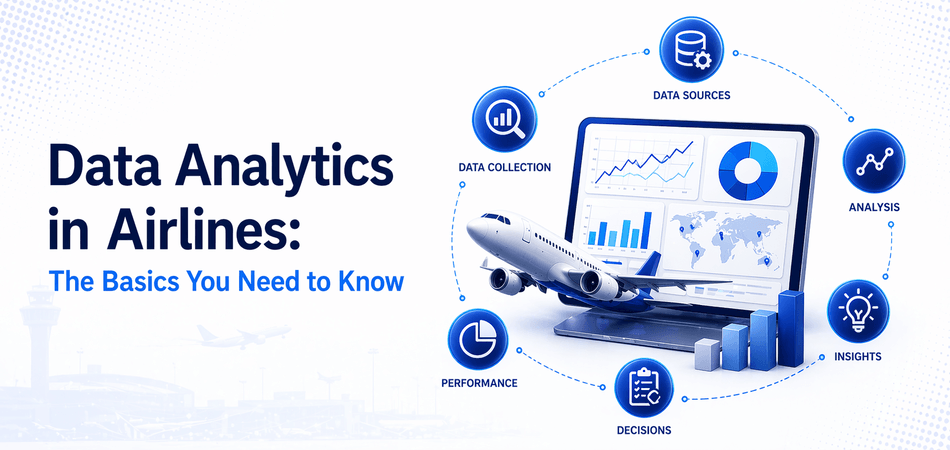
Imagine an airline as a massive machine that contains hundreds of moving components. Tons of data are yielded every second. Booking of tickets, check-in, in-flight/aircraft purchases, flight schedules, fuel consumption, services, maintenance records, and even weather. All these data are mere numbers and records on their own. It doesn’t do anything.
Data analytics is the process of taking all that raw information and turning it into useful insights. Airlines use it to:
- Flight schedules and occupancy rates
- Passenger booking patterns and preferences
- Aircraft maintenance logs and sensor data
- Weather conditions and air traffic control updates
When airlines dig into all this data, they start to see patterns. They can run things more smoothly, make passengers happier, and save a ton of time and money. Basically, analytics takes a mess of numbers and turns it into a clear, smart flight plan
Why Airlines Need Data Analytics: Unlocking Airline Performance Optimisation
Analytics isn’t just a buzzword; it’s a lifeline for modern airlines. Here’s why:
- Operational Efficiency: Flight schedules, crew allocation, and gate management are optimized.
- Predictive Maintenance: Detect potential mechanical failures before they cause delays.
- Passenger Experience: Tailored offers, personalized services, and smooth check-ins.
- Revenue Management: Smart ticket pricing based on demand, competition, and trends.
- Safety Compliance: Ensuring regulatory requirements and safety protocols are followed meticulously.
It’s not just about numbers. It has got to do with experience. Customers receive improved check-ins, even better offers, and seats that they prefer. The airlines save on fuel optimization, avoiding delays and smart pricing on tickets. Essentially, analytics helps airlines transform their uncontrollable chaos into decision-making that transforms flights into safer, faster, and more enjoyable experiences. In its absence, the airlines are flying blind. With it? They are all over it, anticipating issues, pleasing clients, and keeping the show running like clockwork.
Without analytics, airlines are flying blind: risking delays, losses, and unhappy passengers.
Key Applications of Data Analytics in Airlines: Aviation Analytics Use Cases
Airlines deal with a lot of moving parts. Planes, crews, passengers, and routes, all at the same time.
Let’s break down the ways airlines are using data to fly smarter.
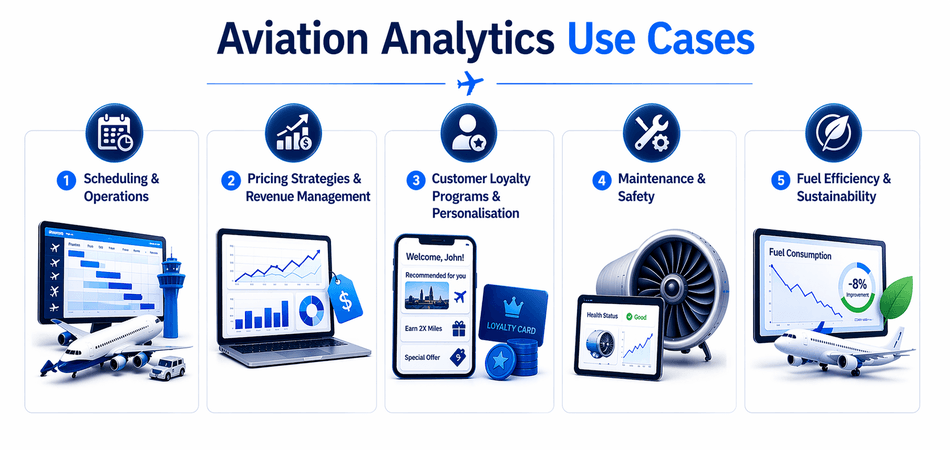
1. Scheduling & Operations
It is not as easy as it may seem to run flights on time. Airline operational analytics assists carriers in planning better schedules based on previous flight operations, weather, and even local occurrences. The result? Fewer delays, better rotations of the crews, and planes in the air that spend more time in the air and less time on the tarmac.
2. Pricing Strategies & Revenue Management
Why does the price of the tickets vary so much? Information-based pricing strategies consider the demand, booking patterns, and the fares of their competitors to change prices on the fly. Airlines have the ability to sell the right seat at the right price and maximize their revenue without necessarily pushing the passengers away.
3. Customer Loyalty Programs & Personalisation
Passengers love feeling seen. Following the preferences and booking history enables the airlines to provide upgrades, personal notifications, and loyalty rewards that really count. Contented customers are recurring customers.es and booking history allows airlines to offer upgrades, personalized notifications, and loyalty rewards that actually matter. Happy passengers are repeat passengers.
4. Maintenance & Safety
Safety is non-negotiable. Predictive maintenance involves sensors and analytics to identify potential problems even before they develop into a real problem. It will reduce cancelations, make the airplane safer, and give more confidence to both passengers and crews.
5. Fuel Efficiency & Sustainability
Planes consume a lot of fuel and efficiency is a major concern as far as cost and the environment are concerned. Analytics assists in maximizing routes, cutting unwanted weight, and tracking fuel consumption, which contributes to greener operations and cuts down the costs.
Think about it. Would you rather fly blind, guessing schedules, fares, and passenger needs, or ride with an airline that almost knows what you want before you do? Here is the thing. Aviation analytics use cases are not just fancy charts. They are decisions coming to life.
All pathways, all prices, all safety inspections are more intelligent. Delays are minimized. Fuel wasted is reduced. The passenger experience is customized. What it has created is a smoother, safer flight.
The next time you fasten your seatbelt on takeoff, do this. Information is not lurking in the background. It is your invisible co-pilot. It is working as you are sipping your coffee, calculating, forecasting, and planning. And that is just what we all want to do on the trip, right? Isn’t that exactly the kind of travel we all secretly wish for?
How Airlines Implement Data Analytics in the Aviation Industry
“How do airlines seem to know everything?”
A question that you must have thought of at least once while flying. And that’s actually a valid question. How do they know when flights will be busy, which routes will sell out, or even what passengers want before they ask? Well, it’s a carefully planned airline data strategy in action.
Let’s break down the steps so you can see how the process really works.
1.Define Objectives & KPIs
Firstly, airlines should be aware of what they are solving. Do they want to eliminate delays, increase revenue, enhance customer satisfaction, or reduce fuel expenses? These are turned into Key Performance Indicators, or KPIs. Consider them the scoreboard. The analytics are nothing without it.
2.Data Collection from Multiple Sources
Then there is the collection of the raw material. Airlines are drawing information from the booking systems, in-flight sensors, weather reports, social media, and even baggage handling logs. The challenge? There is so much of it. The beauty of a good aviation analytics implementation is in gathering all the things that are important, not all the things that are there.
3.Data Cleaning & Preparation
Raw data is messy. Wrong spelling of names, flight numbers confused, and duplicates. Airlines normalize, clean, and organize the data to make it reliable. Such a step will not be glamorous, but it is the foundation of any successful analysis. In is in and out is out, as the old adage goes.
4.Analytics and Modeling
Now comes the fun part. Airlines predict delays, optimize revenue using dynamic pricing algorithms, and predict passenger behavior using clustering models. It is here that the seeds begin to take shape and show the possibilities that are just there in front of us.
5.Insights Generation
Analytics alone isn’t enough. When insights are derived and turned into actionable recommendations, that is where the real value lies. As an example, the data could indicate that a certain route is always late in the afternoon because of weather conditions. The insight? Reassign or re-book flights or reassign staff.
6.Decision-Making & Monitoring
Finally, it’s time to act. Airlines combine intuition to operation, modify arrival and departure times, or enhance customer experience. But it doesn’t stop there. Checking regularly will mean that the strategy will be adjusted to reflect the real world. Analytics is not a one-size-fits-all trick.
Data analytics is akin to teaching an airline to think. An effective airline data strategy and the use of intelligent aviation analytics implementation convert raw numbers into decisions that enhance safety, efficiency, revenue, and passenger joy. The next time your flight comes in on time, is fairly priced, and is pleasant to fly, just remember it is data, or data working behind the scenes like an invisible co-pilot, in charge of every turn.
Tools & Technologies Behind Airline Analytics
Airlines rely on a mix of big data, AI, and BI tools to make sense of their information.
Airlines don’t just rely on intuition anymore. Behind every on-time flight, dynamic price, and personalized passenger experience, there’s a set of powerful airline analytics tools at work.
Some popular technologies include:
| Category | Tools & Platforms | Purpose |
| Big Data | Hadoop, Spark | Handle large datasets efficiently |
| Cloud | AWS, Azure | Store, process, and scale data |
| BI Tools | Tableau, Power BI | Visualize insights for decision-makers |
| AI/ML | Python, R, TensorFlow | Predict delays, maintenance needs, and passenger
behavior |
Had a look at the overview? Now let’s have another look at what keeps the wheels turning behind the scenes.
Big Data Platforms: Hadoop & Spark
Airlines produce gigantic loads of data in a second. Booking systems, flight sensors all the way to social media chatter. Big data processing engines, such as Hadoop and Spark, can process this deluge of data efficiently and enable quick processing. These tools transform heaps of raw data into something that airlines can utilize.
Cloud Platforms: AWS & Azure
It would be impossible to run all of this data locally. That is where cloud platform providers, such as AWS and Azure, come in. They enable airlines to scale both storage and computing power as needed, access information, and work with teams of people anywhere. None of that without huge initial investments in hardware.
BI Tools: Tableau & Power BI
When the data is prepared, then visualization plays a major role. Applications such as Tableau and Power BI enable airlines to convert complex data into insights in a way that is easy to understand and act upon. Everything, including performance of routes and passenger satisfaction, can be viewed on dashboards and allows quick responses on the part of decision-makers.
AI & Machine Learning in Aviation
Artificial intelligence is the crown jewel of contemporary analytics.
Machine learning models are used to predict delays, maintenance requirements, and crew schedules. Airlines will even be able to foresee passenger demand, enabling smarter pricing and personalized experiences. AI not only analyzes the past but also predicts the future.
Aviation business intelligence is what ensures modern airlines are smart, agile, and passenger-friendly, whether it comes to processing big data and predicting passenger needs. When airlines use the appropriate airline analytics tools, data ceases to be numbers and begins to become a competitive edge, quietly working to enhance operations, safety, and customer satisfaction.
ROI and Benefits of Airline Analytics: How Airline Analytics Turns Data Into Dollars
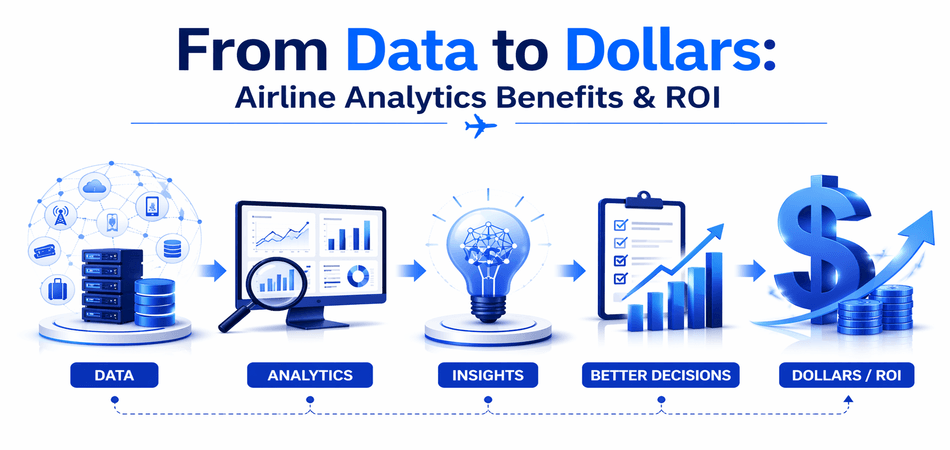
Investing in analytics is costly, but the returns are substantial. Here’s a quick snapshot:
| Analytics Type | Investment | Benefits |
| Basic Reporting | $10K–$50K | Efficient scheduling & operational reporting |
| Predictive Analytics | $50K–$150K | Reduced delays & improved maintenance |
| Advanced AI Analytics | $150K+ | Dynamic pricing, personalization, and optimized fuel |
By using analytics effectively, airlines save money, improve operational efficiency, and deliver better experiences to passengers.
Common Challenges in Airline Analytics
Analytics can be powerful, but it’s not without challenges:
- Data Silos: Information trapped in separate systems prevents holistic insights.
- Overcomplicated Dashboards: Too many KPIs can confuse decision-makers.
- Ignoring Real-Time Data: Delayed insights can mean missed opportunities.
- Lack of Skilled Personnel: Advanced analytics require trained data scientists.
Overcoming these challenges is essential to fully leverage analytics in aviation.
Suggested Read: Aviation App Development: The Future of the Aviation Industry
How Techugo Supports Airlines with Smarter Aviation Solutions
Airlines are sitting on a goldmine of data. But raw numbers don’t create value on their own.
That’s where Techugo steps in. We help airlines turn data into actionable insights using airline analytics tools and aviation business intelligence solutions.
Techugo is a globally recognised mobile app development company in USA and UAE with deep experience in building intelligent, scalable digital platforms that help organisations solve real problems. Their team has delivered hundreds of successful apps and software solutions across industries, using cutting‑edge technologies like AI/ML, cloud, and big data analytics to drive smarter outcomes for users and businesses alike.
As a trusted aviation software development company, Techugo knows the specific issues airlines have, including dealing with complicated processes and making instant decisions as well as safety, on-time scheduling, and easy passenger experience. We don’t just build software. We develop bespoke solutions and apply machine learning in aviation, predictive insights, and intuitive dashboards to empower airlines to make smarter and faster decisions.
Techugo ensures your data works as hard as you do.
So, why wait when you can start? Start with Techugo and turn your airline data into smarter operations, safer flights, and happier passengers.
FAQs
Q.What is airline data analytics and why do we need it?
Airline data analytics is the identification and analysis of flight, operational, and passenger data to make smarter decisions. It assists in the optimisation of airline performance, minimises delays, improves safety, and provides passengers with a better experience.
Q.What is predictive analytics in the field of aviation?
Predictive analytics represents a technology that uses past data, weather trends, and operational benchmarks to predict the results, such as flight delays, maintenance requests, or demand. We use machine learning in the aircraft sector to transform these projections into meaningful actionable insights with the aim of changing the world around us through Techugo.
Q.Which tools are airlines using to perform analytics?
Airlines are using a mix of airline analytics applications such as Hadoop, Spark and cloud computing (AWS, Azure), and a business intelligence application such as Tableau or Power BI to process data, trend, and make decisions.
Q.Is it possible to enhance passenger experience with analytics?
Yes! With the help of Techugo aviation business intelligence solutions, airlines can tailor offers based on booking trends, preferences, and behavior and make traveling with the company easier and more enjoyable.
Q.What is the benefit of machine learning to an airline?
Machine learning is applied to improve the maintenance requirements of an airline, the crew scheduling, the demand forecasting, and to minimize the operating expenses. Techugo incorporates machine learning into the aviation industry to aid airlines in being smarter and safer.
Q.Is airline analytics costly or cumbersome to implement?
Although analytics is also an investment-intensive business, it has a considerable payback. Techugo makes it easy to implement, it can be easily scaled, and it is specific to your airline, which makes the benefits more than worth it.
Q.What is the fastest way Techugo can assist airlines in utilizing data analytics?
Our team is highly efficient at platform, dashboard, and predictive model integration. Airlines can begin to realize actionable insights within weeks, rather than months, depending on the size of the project.

Get in touch
We'd love to hear from you.