


 SA
SA
 KW
KW
 IE
IE AU
AU UAE
UAE UK
UK USA
USA
 CA
CA DE
DE
 QA
QA ZA
ZA
 BH
BH NL
NL
 MU
MU FR
FR


















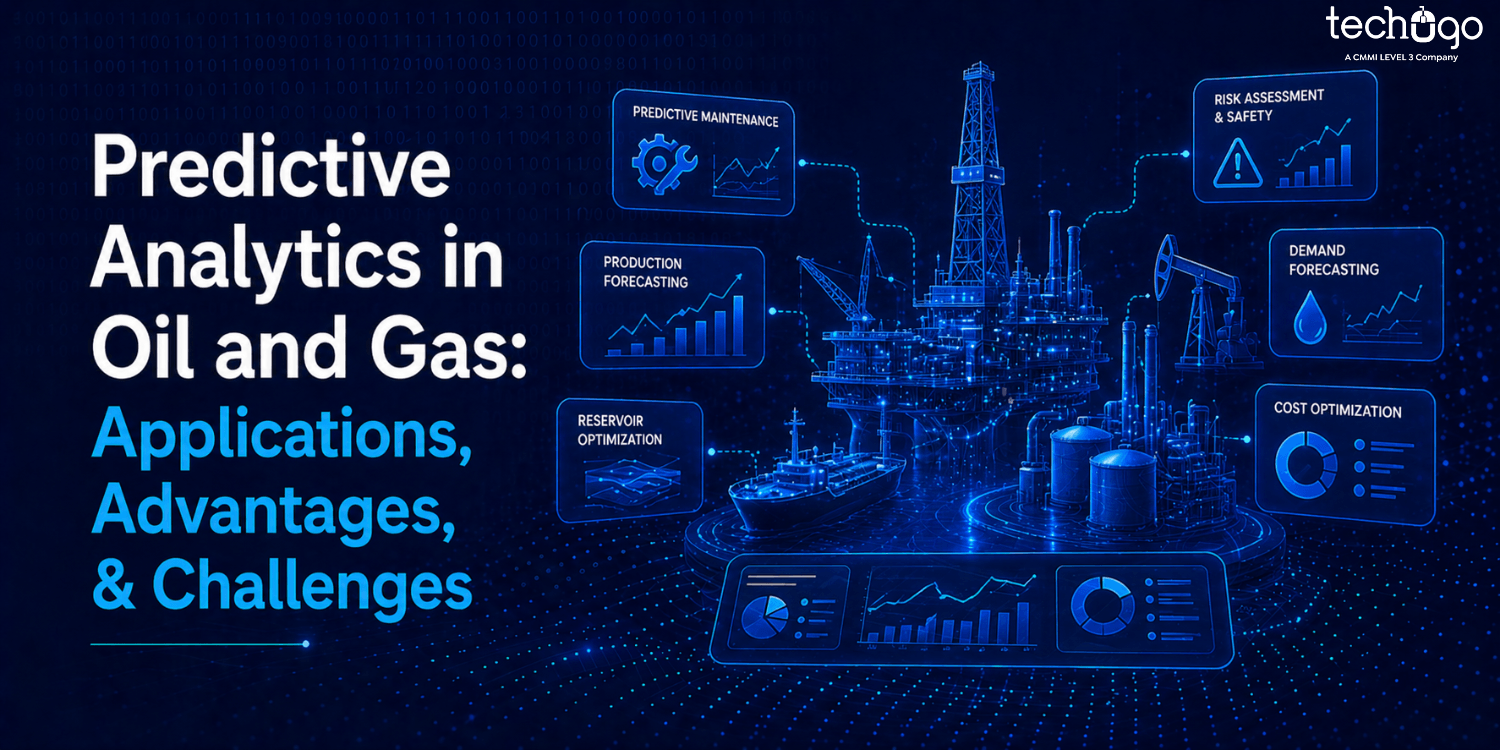


The oil and gas industry has always been complex, and unpredictable and many decisions were made after things had already gone wrong.
An equipment failure happens, and production stops. A drilling decision goes off, and costs rise quickly. As these operations depend on timing and precision, even small delays can turn into bigger problems, so the pressure has always been there to react faster, but also to avoid reacting too late. Now predictive analytics in oil and gas industry has started to make a real change for the better.
Companies are now using data so that they can predict what might happen next instead of waiting for failures. The data was always there but it was not fully used. And now with sensors and machine learning in oil and gas sector, patterns are being identified earlier which means decisions are becoming less reactive, and more predictive.
In fact, Quytech says that predictive analytics has been helping companies reduce downtime and improve operational efficiency, and the global market is likely to reach around $60 billion by 2026.
Predictive analytics for oil and gas operations is becoming necessary, therefore, today we’ll see the applications of predictive analytics in oil and gas and the real benefits of predictive analytics in oil industry that are driving this change.
So let’s get started…
What is Predictive Analytics in the Oil and Gas Industry?
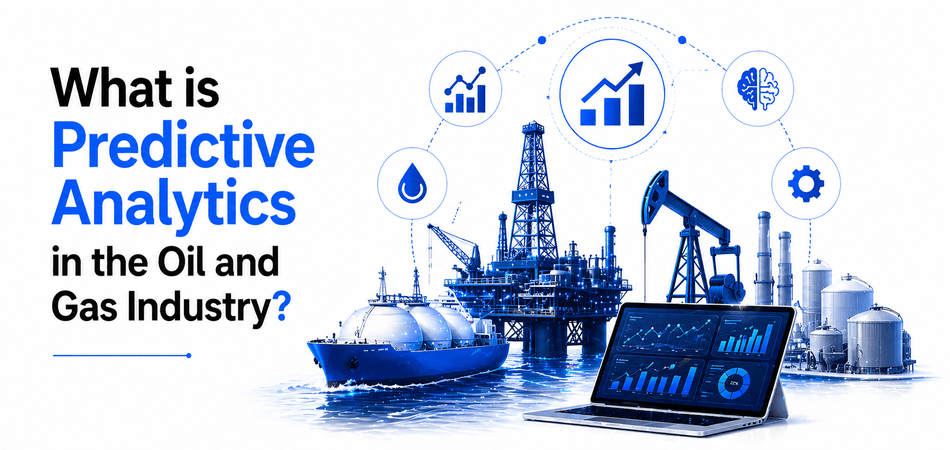
Predictive analytics in oil and gas industry is all about using data and using it in a smarter way so that companies can understand what is likely to happen next, before it actually happens.
In simple terms, it takes past data and combines it with real-time inputs, and then uses advanced models to predict future outcomes. The industry has been generating huge amounts of data for years from drilling operations, equipment sensors, and production logs but it was not always used effectively. Now, it is being analyzed more deeply.
These systems take help of machine learning in oil and gas sector so that they can identify patterns, detect unusual behavior, and even predict failures. For example a machine can signal that it might fail in the next few days or a well can show signs of declining performance early on… and that gives teams time to act.
And it is not just about prediction, it is also about better decision-making because when you already know what could go wrong, you can plan better, reduce risks, and improve efficiency as well. This is why predictive analytics for oil and gas operations is becoming so important. It connects data with action and turns everyday operations into something more intelligent, more controlled and far less reactive.
At the core, it relies on different oil and gas data analysis techniques, such as data modeling, statistical analysis, and AI-driven algorithms – all working together to turn raw data into meaningful insights.
Why the Oil and Gas Industry Needs Predictive Analytics in 2026 and Beyond
The oil and gas industry in 2026 is not what it was before. The pressure is much higher, huge amounts of data are available, and the risks are still very real.
The situation becomes even more complex when global events occur like ongoing Iran-Israel conflict that has already started impacting oil supply and pricing; therefore companies are under constant pressure to predict demand, manage supply risks, and respond faster than before.
Every operation generates huge volumes of data (sometimes reaching petabytes over time) but not all of it has been used effectively. Since only a small % of companies have fully adopted advanced analytics, there is still a gap… a big gap. At the same time, the cost of getting things wrong is also rising.
Unplanned downtime, for example, is one of the biggest challenges because a single hour of downtime can cost around $125,000 or even more especially in heavy industries like oil and gas. And what makes it more critical is that many of these failures are not random; they can actually be predicted.
As a result, predictive analytics for oil and gas operations is becoming essential, not optional.
The industry is dealing with:
- Aging infrastructure which increases failure risks
- Price volatility, which demands faster and smarter decisions
- Safety and environmental concerns which cannot be ignored
- And massive operational complexity where even small inefficiencies add up
The best part? Most of these problems have patterns behind them. Studies show that nearly 60–70% of unplanned downtime is caused by issues that could have been predicted earlier using data and analytics.
So, instead of reacting after something breaks, companies are now shifting toward predicting failures, optimizing production, and reducing risks before they even appear. Predictive analytics in oil and gas industry fits in perfectly here. It helps companies move from reactive operations to proactive decision-making… and that shift is everything. Because in 2026, it is not just about producing more but more about producing smarter and with far less uncertainty.
Key Applications of Predictive Analytics in Oil and Gas
When you really look at the oil and gas industry, you start to notice something… most problems don’t just happen instantly, they build up, slowly and quietly and then suddenly they show up. And because of that, the applications of predictive analytics in oil and gas have been getting more attention because they help you see those patterns early, so that you can act before things go wrong.
Let’s break this down, not in theory but in real-world use cases.
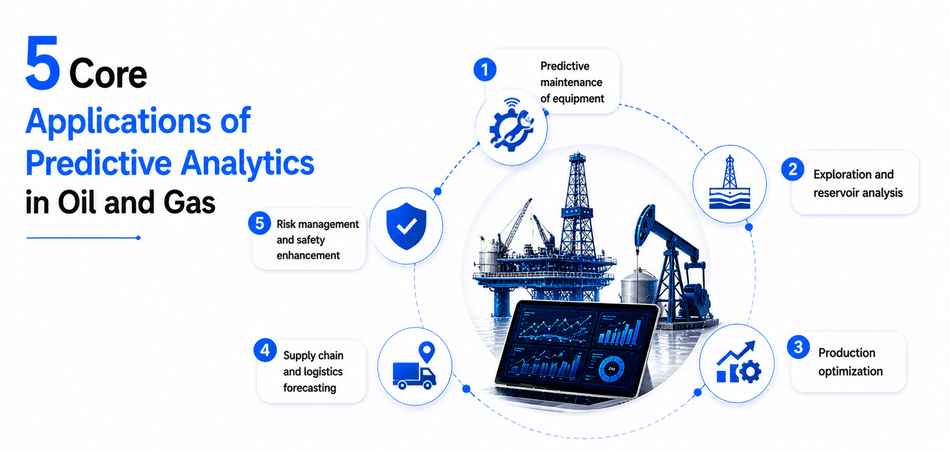
1. Predictive maintenance of equipment
Equipment failures were always a major issue, and they were expensive, and often unexpected… or at least, that’s how it felt earlier.
But now with sensors and predictive analytics for oil and gas operations, machines are constantly being monitored. Data like temperature, pressure, and vibration is collected and then analyzed so that early warning signs can be detected. Because machines don’t fail instantly, rather, they show signals and those signals are now being tracked.
For example, companies like Shell have been using predictive maintenance systems, and they have been able to reduce unplanned downtime which means fewer shutdowns and lower costs.
2. Exploration and reservoir analysis
Drilling was, and still is, risky… and costly too. Earlier, decisions were based on surveys and assumptions but now things are changing. With machine learning in oil and gas sector, companies are analyzing past drilling data, seismic activity, and geological patterns so that they can predict where oil reserves are more likely to be found.
Because of this, the chances of drilling dry wells are reduced and decisions are becoming more data-backed, not just experience-based. Companies like BP have been using these approaches and they have improved their exploration accuracy over time.
3. Production optimization
Once production starts, the focus shifts to maintaining output and improving it but without causing long-term damage.
Here predictive models are used to track performance continuously. And when the system detects that performance might decline, it signals early so that adjustments can be made.
So instead of reacting after the drop, companies act before it happens and therefore, production stays more stable and efficient as well.
4. Supply chain and logistics forecasting
The supply chain in oil and gas is complex, and interconnected and even a small delay can affect everything. Companies can forecast demand and manage inventory better and plan logistics with predictive analytics so that resources are available at the right time. Not too early, not too late but exactly when needed.
And this is where platforms built by a mobile app development company have been playing a role by developing and providing real-time visibility, and dashboards, and tracking systems so that teams, even in different locations, are connected and informed.
5. Risk management and safety enhancement
Safety has always been critical in this industry, because the risks are high and the consequences can be serious.
So predictive analytics is used to analyze past incidents, and current conditions so that potential hazards can be identified early. Because most accidents also have patterns behind them; they don’t just happen randomly. For example companies like Chevron have been using data-driven systems to monitor operations, and improve safety standards across their sites.
So when you step back and look at all of this, one thing becomes clear that predictive analytics in oil and gas industry is not limited to one function or one process. It is being used everywhere in exploration, in operations, in logistics, and in safety, hence it is slowly changing how the entire industry works.
Not in one big shift, but in small continuous improvements which, over time, can make a very big difference.
What are the Technologies Behind Predictive Analytics in Oil and Gas
Predictive analytics may look simple from the outside but it runs on a mix of technologies working together, and each one plays a role because the data is complex, and the operations are even more complex. Here are the key technologies behind it:
Machine Learning and AI Models
These are the core of machine learning in oil and gas sector, where systems learn from past and real-time data so that they can predict failures, risks, and performance trends.
IoT Sensors (Internet of Things)
Sensors are installed across equipment, pipelines, and drilling sites… and they continuously collect data like temperature, pressure, and vibration.
Big Data Analytics Platforms
Tools like Hadoop and Spark are used to process massive datasets, because traditional systems cannot handle such scale. This is a key part of modern oil and gas data analysis techniques.
Cloud Computing (AWS, Microsoft Azure, Google Cloud)
Cloud platforms are used to store and process large volumes of data, and they allow companies to scale operations easily… without heavy infrastructure.
Data Visualization Tools (Tableau, Power BI)
These tools turn complex data into dashboards and visuals, so that teams can understand insights quickly, and make faster decisions.
So, it is not just one system but a combination of tools and technologies, working together that makes predictive analytics possible in the oil and gas industry.
What are the Benefits of Predictive Analytics in Oil Industry
The oil industry has always been about managing risk, cost, and uncertainty, and for years, most decisions were reactive. But now things are shifting because benefits of predictive analytics in oil industry are becoming very clear and they are hard to ignore. Let’s look at the key ones.
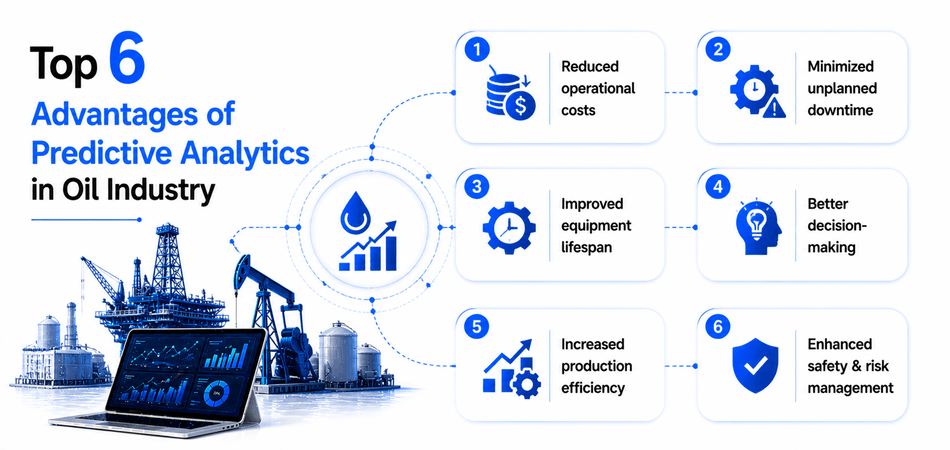
1. Reduced operational costs
Unexpected failures are expensive and they often come with repair costs, downtime, and lost production. With predictive analytics, issues are identified early so that companies can fix them before they turn into major problems. And because of that, maintenance becomes more planned and less costly.
2. Minimized unplanned downtime
Downtime was one of the biggest challenges and it still is but now it can be controlled better through redictive models as they detect early warning signs so that equipment can be serviced before it fails. Therefore, operations continue smoothly and disruptions are reduced significantly.
3. Improved equipment lifespan
If you think that machines fail instantly, then you’re not right because machines degrade over time and that process can be tracked through continuous monitoring. Companies can maintain equipment properly and avoid overuse or sudden breakdowns through regular monitoring. So the lifespan of assets increases and investments last longer.
4. Better decision-making
Decisions in the oil industry were often based on experience and assumptions but now they are supported by data because predictive analytics provides insights in advance. As a result, companies can plan better, allocate resources efficiently, and avoid unnecessary risks also.
5. Increased production efficiency
Production processes can be optimized when you know what is coming next. Predictive systems help identify performance gaps, and suggest improvements… so that output can be increased without increasing costs unnecessarily.
6. Enhanced safety and risk management
Safety is critical and risks are always present in oil operations. Predictive analytics helps detect unsafe conditions early because it analyzes patterns from past incidents and current data. So preventive actions can be taken and accidents can be avoided.
Due to all these benefits, predictive analytics is becoming a core part of the modern oil industry.
What are the Challenges in Implementing Predictive Analytics
Implementing predictive analytics sounds promising but it is not always straightforward because the systems are complex and the data is not always ready, and the shift itself takes time.
Here are the key challenges:
Data Silos and Poor Data Quality
Data exists but it is often scattered across systems, and sometimes incomplete so it becomes difficult to use it effectively.
Integration with Legacy Systems
Many oil and gas companies still rely on older systems and integrating new analytics tools with them is not easy and in fact, they can slow things down.
High Initial Investment
Setting up infrastructure, tools, and models requires investment and therefore, companies hesitate before adopting it fully.
Lack of Skilled Talent
Predictive analytics needs expertise in data science, and AI but skilled professionals are limited and not always easy to find.
Resistance to Change
Teams have been following traditional methods for years, so shifting to data-driven decision-making takes time, and effort.
So, while the value is clear, the journey is not simple but once these challenges are addressed, the long-term benefits usually outweigh the initial hurdles.
How to Implement Predictive Analytics in Oil and Gas Operations
Implementing predictive analytics is not just about adding a tool and expecting results. It is a process that takes time because the systems are complex and the data is not always ready. So companies have to move step by step, here’s how it usually happens.
Step 1. Collect & organize data
Everything starts with the data because nothing really works without it. Oil and gas companies already have huge volumes of data but it is often scattered and unstructured so the first step is to collect it, and clean it, and organize it properly. Because if the data is not reliable then the predictions won’t be either.
Step 2. Choose the right tools and models
Once the data is ready, the next step is choosing the tools and building the models. This is where machine learning in oil and gas sector comes in because models are trained on past and real-time data so that they can predict future outcomes. But every company is different and every operation has its own needs so the models have to be aligned carefully. And therefore, many companies have been working with an AI development company, so that the models are built correctly and actually solve real problems.
Step 3. Start with a pilot project
It is not practical to implement everything at once and it usually doesn’t work that way. So companies start small with a pilot project, like monitoring a specific piece of equipment. This way, they get a good understanding of what is working and what is not before scaling further.
Step 4. Integrate with existing systems
Predictive analytics cannot work in isolation and it should not. The insights need to be connected with existing systems, and dashboards, and workflows so that teams can actually use them in daily operations. Because if the insights are not used then the effort does not create value.
Step 5. Scale across operations
Once the pilot shows results, the next step is scaling. The same models, and processes, are applied across multiple locations, and assets so that the benefits are not limited to one area but spread across the entire operation.
Step 6. Continuously monitor and improve
And this does not stop after implementation. The models have been designed to learn but they also need updates and monitoring because conditions change, and data keeps evolving. So the system must keep improving over time.
That’s why, implementing predictive analytics for oil and gas operations is not a one-time effort. It is a continuous process that requires the right approach and patience, and once it is in place, it changes how decisions are made – slowly, but significantly and this change creates long-term value.
Future of Predictive Analytics in Oil and Gas
The future of oil and gas now depends on more and more understanding and prediction because the industry is changing and the pressure is increasing from every side.
And when you add global uncertainties such as supply disruptions and geopolitical tensions, the need to predict what comes next becomes even more important.
Predictive analytics in oil and gas industry comes as a core part of operations. Companies are moving toward more connected and data-driven operations where systems don’t just analyze the past but continuously predict what could happen next.
And with advancements in machine learning in oil and gas sector, along with technologies like digital twins and real-time data systems, decisions are expected to become more immediate, and in some cases, even automated.
At the same time, factors like global supply disruptions and changing energy demands are pushing companies to rely more on predictive models so that they can respond faster and plan better. Therefore predictive analytics for oil and gas operations is becoming a core part of how the industry will function in the coming years.
Suggested Read: AI in kuwait’s Oil Industry for Operating Towards a Sustainable Future
To Sum Up
Predictive analytics is an added advantage. It is becoming the foundation of smarter and more efficient oil and gas operations because the industry has been changing and the challenges are increasing. And as uncertainty continues to grow, those who can predict better and act earlier, are the ones who perform better and stay ahead.
Connect with us to turn complex data into predictive, and scalable solutions so that you can make better decisions.
FAQs
Q. How is predictive analytics used in oil and gas operations?
Predictive analytics is used across oil and gas operations to analyze past and real-time data, so that companies can predict equipment failures, optimize production, and reduce risks. It helps in areas like predictive maintenance, reservoir analysis, and supply chain forecasting… because instead of reacting after a problem, companies can act before it happens.
Q. How much does it cost to implement predictive analytics in oil and gas operations?
The cost of implementing predictive analytics in oil and gas operations depends on multiple factors such as data availability, system complexity, and the scale of deployment. It can range from $50,000 to $500,000+, because it involves data infrastructure, AI models, and integration with existing systems… and therefore, larger operations usually require higher investment.
Q. Why is predictive analytics important for the future of the oil and gas industry?
Predictive analytics is becoming important because the industry is facing increasing uncertainty, and operational risks, and cost pressures. It helps companies move from reactive to proactive decision-making… so that they can improve efficiency, reduce downtime, and respond faster to changes, which is critical for future growth and stability.

Get in touch
We'd love to hear from you.