


 SA
SA
 KW
KW
 IE
IE AU
AU UAE
UAE UK
UK USA
USA
 CA
CA DE
DE
 QA
QA ZA
ZA
 BH
BH NL
NL
 MU
MU FR
FR

















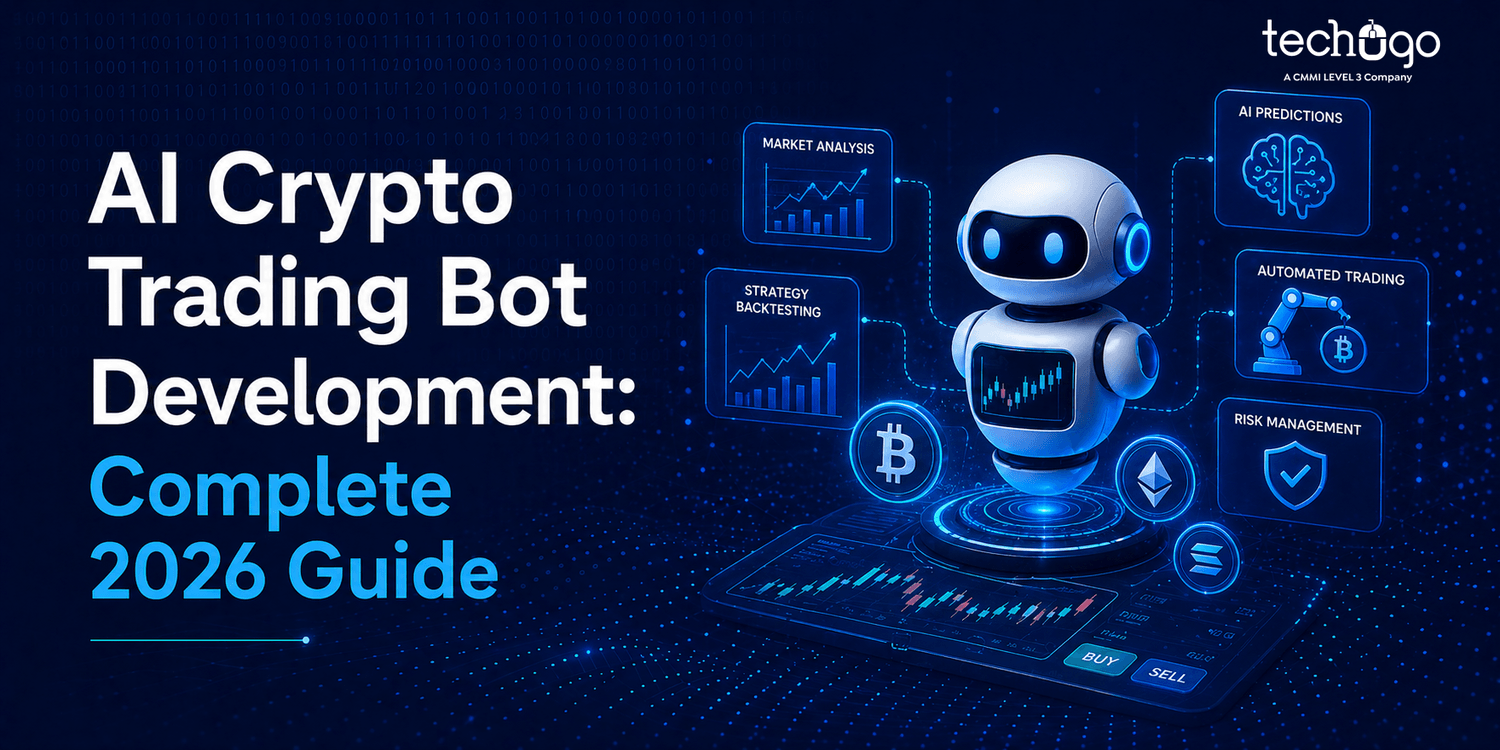


Crypto never sleeps. Prices move at 2 AM, trends flip in seconds, and opportunities don’t wait. Humans? We blink, we hesitate, we miss. Bots don’t.
That’s exactly why AI crypto trading bot development is exploding right now. Traders don’t have to rely on gut feelings anymore. They can use real-time data and automation to make smart decisions in seconds.
Instead of just following the rules, they learn from the market. They adapt to changes, improve their strategies, and get smarter over time.
2026 is the perfect moment to build one. Why? Because the tech is easier to access, the market is more mature, and competition is getting sharper. Depending on how complex your bot is, it can cost anywhere from $25,000 to $300,000+, which basically makes it a serious but doable investment for traders or businesses looking to level up.
In this guide, we will show you how these bots work, the strategies behind them, what it takes to build one, and how to pick the right crypto trading bot development company to bring your bot to life.
What is an AI Crypto Trading Bot?
An AI crypto trading bot is basically a smart software program that automatically buys and sells cryptocurrencies based on data, not emotions.
Unlike traditional bots that follow fixed rules (“buy if price drops 5%”), a machine learning crypto trading bot studies patterns, analyzes trends, and improves its decisions over time.
That’s the real difference.
With AI algorithmic trading crypto, the bot doesn’t just execute. It thinks. It processes massive amounts of market data, identifies opportunities, and reacts faster than any human possibly could.
Let’s make it simple:
- Traditional bot = follows instructions
- AI bot = learns, adapts, evolves
And this opens the door to real-world use cases like:
- Arbitrage trading: buying low on one exchange, selling high on another
- Scalping: making small profits from quick trades
- Portfolio management: balancing risk automatically
In short, it’s like having a trader that never sleeps, never panics, and keeps getting better.
Here is How AI Crypto Trading Bots Work
The AI crypto bots use data, analysis, and automation features to trade smarter and faster than any human. These companies collect a huge amount of market data, like prices, volumes, order books, news, and social media sentiment. The system employs techniques like a machine learning-based crypto trading bot to identify patterns and predict conditions while modifying its strategies.
Once the data gets analyzed, the bot generates trading signals and executes them automatically via exchange APIs. Here, we have AI algorithmic trading in crypto coming in, where the bot will not just follow rules picked beforehand, but instead apply its own trading reasoning based on trends it sees a lot. These bots are designed to be effective in real-time crypto markets thanks to modern data, predictive insights, and automated execution.
Key Features of an AI Crypto Trading Bot
When it comes to AI crypto trading bot development, a bot isn’t just a tool. It’s like having a full-time trading assistant that works 24/7, crunching data and executing strategies while you sleep. Here is what makes these bots unique:
Analysis of the Market in Real-Time
A smart bot is one that continuously monitors prices, trade volumes, and market movement across exchanges. The solution tracks more than one asset and one platform. It watches everything at once. As a result, traders can pinpoint opportunities in the moment and execute right away, without manually checking charts or news. In rapidly changing markets, this pace can make all the difference.
Predictive Analytics
Using past data and current market research, these types of bots make predictions and forecasts on trends. By taking a closer look at historical trade patterns, as well as the current market situation, they can suggest smarter decisions. Whether this entails recalibrating an entire strategy or refining risk exposure. Analytics helps you in planning ahead of time instead of reacting.
Tools for Managing Risk
Risk management is essential for crypto. The bot is armed with stop-loss, take-profit, and position sizing features. It essentially means this may automatically limit losses in case the market goes against you and secure your profits. Manage risk wisely to protect capital and maximize returns for your trading account.
Multi-Exchange Integration
Current bots can work on multiple exchanges at the same time. They track price discrepancies and opportunities across each platform, which is particularly helpful for strategies such as arbitrage. Traders can now capitalize on arbitrage opportunities exponentially and maximize their profits without the need to manually toggle between exchanges.
Automated Trading & Alerts
No need to keep checking your account. Because trades will run in the background as per your strategy. At the same time, the bot can send alerts for major market events or unusual activity, just so you stay informed without being glued to the screen.
Dashboard & Analytics
A contemporary dashboard displays everything, from overall performance to strategy efficiency and even trade history and analytics. You can steer strategies, check progress, and see what’s effective and what is not. It translates raw trading data into actionable insights; thus, your bot gets smarter and learns more over time.
These features combined lead to a bot that is efficient, adaptive, and dependable for traders on the volatile cryptocurrency landscape.
AI Trading Bot Strategies for Crypto: How Bots Maximize Trading Success by 85%
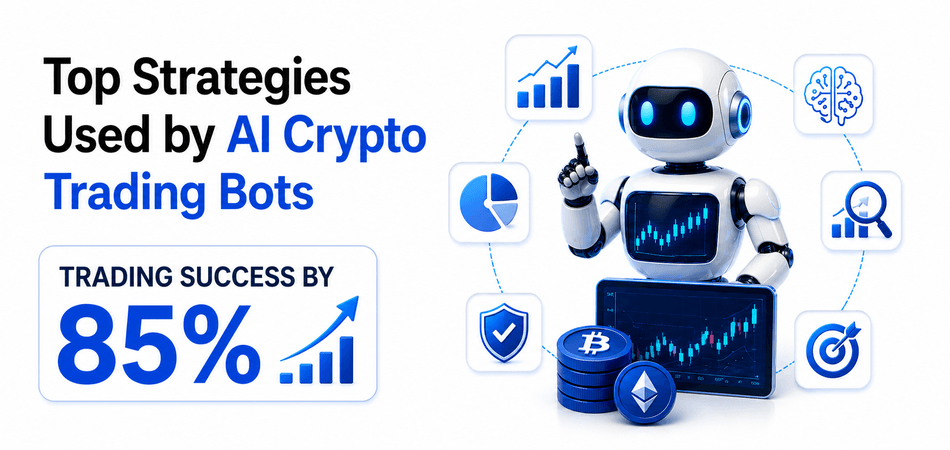
The right approach is what makes a bot succeed. When it comes to crypto trading, each one has its strengths and weaknesses based on the strategy and market scenario.
Here are the most powerful ones:
Trend Following
They say that trend following is all about swimming with the current rather than against it. It adopts the direction of the market if it is moving up or down.
The bot determines if a currency pair is trending upwards or downwards and whether the trade direction should be consistent with the trend direction. If a coin shows growth, the bot will place trades that benefit from the momentum created by that currency’s increase. If the trend direction changes as to how the currency pair is trending, the bot may need to make appropriate adjustments. The method itself is easy to understand and very effective due to the lack of emotion associated with the trades made by the bot; instead, it will follow the trend direction of the market at all times.
Arbitrage Trading
Price differences exist between exchanges for the same coin, and bots are perfect for spotting them instantly.
This provides bots with the opportunity to find these differences and perform arbitrage. Essentially, arbitrage involves buying a currency at a lower price on a specific exchange and selling it at a higher price on another exchange. If you try to take advantage of these price differences as a human being, you will never be able to do it fast enough. Because a bot can make trades in milliseconds, arbitrage provides small amounts of profit that can add up over time. For example, if a bot makes 50 arbitrage trades every day, at a profit of $0.01 per trade. You would have made $18.25 just from trading arbitrage in one year.
Mean Reversion
It’s common for the markets not to remain out-of-balance for very long. When there are extreme highs and lows in the market, mean reversion would suggest that prices will eventually return to their average value. Bots can sense when there is an outlier and make trades based on anticipated returns.
This mean reversion strategy works well in a steady and stable environment, which reduces the risk of sustained growth being impacted by sudden and extreme price swings from their average.
Bots can also recognize that price movement is not about numbers alone but about people’s reactions to those numbers as well. In order to help predict or anticipate price movements, bots can monitor social media, news sites, and forums for what others are saying, whether it be positive, rumor-based, or fear-inspired.
Sentiment Analysis
Bots are able to react to price sentiment before most traders even notice the sentiment signals in the market, thus giving them time to trade based on the arousal of the public’s perceptions about future prices. By combining sentiment analysis with market data, bots will have a predictive advantage that traditional trading systems could not provide.
High-Frequency Trading (HFT)
Some opportunities exist for being in the market for only fractions of a second. Bots that use high-frequency trading (HFT) will place a massive number of trades (dozens to hundreds) in a single second when they see minor price movements occur, thus allowing them to take very small profits that most human traders cannot.
Portfolio Rebalancing
Bots can also automatically adjust their portfolio by rebalancing their respective holdings, thereby allowing them to maintain target allocations based on changing prices. This ensures your portfolio stays balanced, risk is minimized, and you aren’t overexposed to any single coin. It’s like having a financial manager who never sleeps and constantly tweaks your investments to match your goals.
By mixing approaches like trend spotting, price arbitrage, and sentiment reading, it stays one step ahead, catching opportunities humans often miss.
How to Build an AI Crypto Trading Bot (Step-by-Step Process)
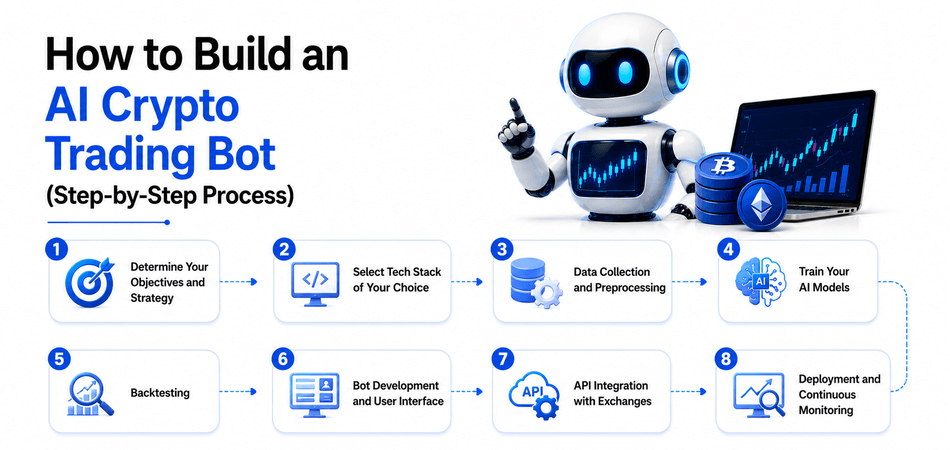
It might seem scary to build an AI crypto trading bot. However, it becomes easy when you have a clear crypto bot development process. This is how it works step by step.
1. Determine Your Objectives and Strategy
Even before you start touching code, you should clarify our goals for this bot. Are you interested in short-term, long-term portfolio-based trades, high-frequency trades, etc. If you have a clear goal in mind, your design decisions for the code will be easier to make as you choose algorithms, exchanges, etc. Remember that an unguided “bot” is nothing more than a very fast computer.
2. Select Tech Stack of Your Choice
Most of the bots are made using Python for ease of use and most exchange APIs are supported, along with libraries like TensorFlow or PyTorch for AI capabilities. The choice of technology stack is important to ensure that your bot is efficient, scalable, and easy to maintain.
3. Data Collection and Preprocessing
A bot is only as good as the data it sees. The organisation needs to gather and load historical price movements, volumes, and order book data, in addition to external sentiment such as social media comments. The organisation then needs to clean and format the vast amounts of available data so that the bot can consume and learn from it in order to make better decisions.
4. Train Your AI Models
In this step, you can train a Bot using machine learning techniques in order to let it recognise patterns in the past tick history and predict future trends. Different models can be tested and finely-tuned in order to obtain the highest accuracy in predicting movements in the market.
5. Backtesting
Before putting your bot into production, make sure to test it on historical data. This process, known as backtesting, allows you to check for bugs, fine-tune the parameters, and make sure your strategy actually works in reality before putting any of your clients’ capital on the line.
6. Bot Development and User Interface
Build the core trading logic and create a simple user interface (UI) / dashboard. A good UI allows you to monitor your trades, monitor your performance, and tweak your parameters without having to go back to the code.
7. API Integration with Exchanges
Integrate your bot with various crypto exchanges using their APIs, including Binance, Coinbase, Kraken, and more.
8. Deployment and Continuous Monitoring
Once live, keep an eye on performance. Markets change, and your bot should too. Update models, adjust parameters, and monitor for errors or unexpected behaviors. Continuous learning is what separates a good bot from a great one.
By following these steps, you can create a bot that doesn’t just trade. It learns, adapts, and operates like a tireless, data-driven assistant, giving you an edge in the volatile crypto market.
Cost to Develop an AI Crypto Trading Bot (Estimating Basic to High-End Bots)
Wondering how much it costs to build a bot that trades smarter than humans? The cost to develop an AI crypto trading bot can vary widely depending on features, complexity, and the level of AI intelligence you want.
On average, it ranges from $25,000 to $300,000+ for a fully-featured, secure, and scalable solution.
Here is a breakdown of the factors that influence the cost:
| Factor | Description | Impact on Cost |
| Features Complexity | Real-time analysis, dashboards, alerts, multi-exchange integration | High |
| AI/ML Model Sophistication | Basic predictive algorithms vs advanced machine learning | Medium–High |
| Team Size & Expertise | Developers, AI specialists, QA, and project managers | Medium–High |
| Integrations | APIs with multiple exchanges and third-party services | Medium |
| Security | Encryption, secure API handling, risk mitigation | High |
| Customization & Support | Tailored UI, updates, maintenance, and ongoing support | Medium |
Cost Breakdown by Bot Type
- Basic Bot: $25,000–$50,000
Simple automation, single exchange, basic analytics, limited AI. - Intermediate Bot: $50,000–$150,000
Multi-exchange support, predictive analytics, automated alerts, and risk management tools. - Advanced Bot: $150,000–$300,000+
Full AI/ML integration, high-frequency trading capabilities, sentiment analysis, sophisticated dashboards, and enterprise-grade security.
While the numbers might seem high, a well-built bot is not just software; it’s an intelligent assistant that trades 24/7, adapts to market changes, and can potentially increase profitability, making it a worthwhile investment for serious traders.
Biggest Hurdles in Building an AI Crypto Trading Bot
Building a crypto trading bot is exciting, but it’s not without hurdles. Even the smartest bots can face challenges if the development isn’t planned carefully. Here are the key issues:
Market Volatility: Crypto prices swing wildly, sometimes in seconds. Bots need to adapt instantly to avoid losses, which requires precise algorithms and robust predictive models.
Data Quality Issues: A bot’s decisions are only as good as the data it uses. Incomplete, outdated, or noisy data can lead to poor predictions and wrong trades.
Regulatory Concerns: Different countries have varying rules around crypto trading and automated bots. Compliance is crucial to avoid legal risks.
Overfitting in AI Models: Bots trained too heavily on historical data may perform well in tests but fail in live markets. Striking the right balance is essential for real-world performance.
Security Risks: Crypto bots interact with exchange APIs, making them a potential target for hacks or misuse. Strong security measures are vital to protect funds and data.
Building an AI crypto trading bot comes with challenges: market swings, data issues, security risks, and more.
That’s why it is important that you go for the right Trading software development company. The right partner can navigate these hurdles, design a smart, secure bot, and guide you through the entire development process.
Why Techugo is the Go-To Partner for Smart Crypto Trading Bots
Looking to turn smart ideas into intelligent crypto trading bots? Meet Techugo.
As a globally recognized mobile app development company, Techugo helps businesses build smart crypto bots.
We design trading bots that are always on, watching the market, and ready to act the moment opportunity strikes.
From crafting predictive algorithms to integrating multiple exchanges and building intuitive dashboards, our team covers every step of the crypto bot development process. We focus on security, reliability, and real-world usability, so your bot performs consistently (even when markets shift in the blink of an eye).
What makes Techugo stand out? We blend fintech expertise with AI know-how. Whether it’s optimizing for high-frequency trading, building risk management features, or creating seamless mobile and web dashboards, we transform complex technology into solutions that just work.
With Techugo, you are not just getting a bot; you’re gaining a trusted partner who guides you from concept to launch. So, it’s time to partner with Techugo.
FAQs
Q1. How much does it cost to develop an AI crypto trading bot?
A1. Depending on complexity, features, and AI sophistication, costs range from $25,000 to $300,000+.
Q2. Can a bot guarantee profits?
A2. No bot can guarantee profits. Bots reduce manual effort, act faster, and follow data-driven logic, but market risks still exist.
Q3. Which exchanges can bots connect to?
A3. Most bots support popular exchanges like Binance, Coinbase, Kraken and can integrate multiple platforms simultaneously.
Q4. How long does it take to build a crypto trading bot?
A4. Depending on features and complexity, development typically takes 3–6 months from planning to deployment.
Q5. Is ongoing maintenance required?
A5. Yes. Continuous updates, monitoring, and model retraining are essential for adapting to volatile markets and improving performance.

Get in touch
We'd love to hear from you.