

 SA
SA
 KW
KW
 IE
IE AU
AU UAE
UAE UK
UK USA
USA
 CA
CA DE
DE
 QA
QA ZA
ZA
 BH
BH NL
NL
 MU
MU FR
FR







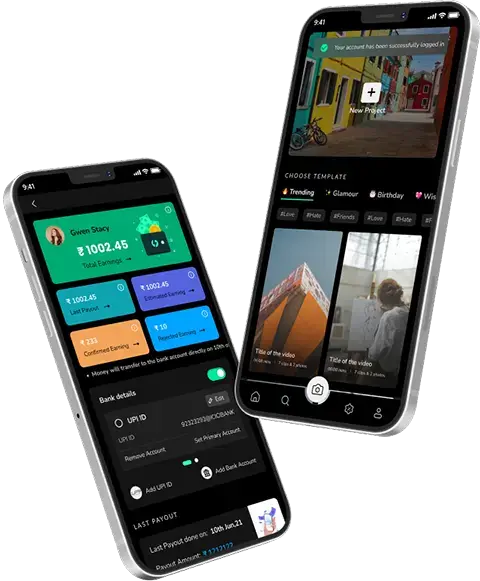








In the age of digital healthcare, apps like Vezeeta are changing the way patients book doctor appointments and access medical services, and it’s not just about convenience. If you are wondering how to build an app like Vezeeta, then you should know it’s more than a simple scheduling tool because it connects doctors, patients, and healthcare providers in one platform.
The Vezeeta app development process was designed to be intuitive but also packed with features like telemedicine app development and advanced doctor booking app features so that users can manage their health easily.
And the cost to build a healthcare app? Well, it varies, but typically, it starts from $30,000 and can go above $300,000 defending on the features and functionalities of the app.
Understanding the steps and the features will give you a clear picture of what it takes to build a healthcare app like Vezeeta, especially if you want to target the Middle East where demand for mHealth apps has been growing rapidly.
So, let’s get started…
Also Read: Understanding AI in Healthcare App Development in UAE
What is Vezeeta and How Does It Work?
Vezeeta is a healthcare platform that makes booking doctor appointments simple, fast, and convenient but it’s not just about convenience. It was launched in 2012 in Egypt, but later on, the app expanded its services to different countries across the Middle East and Africa, such as Saudi Arabia, Lebanon, Kenya, Jordan, and Nigeria.
It was created because patients were struggling to find the right doctor at the right time and the system connects you with clinics, hospitals, and doctors across the Middle East, so that you don’t have to wait in long lines.
But it’s more than booking because Vezeeta also offers telemedicine services, and you can have virtual consultations, and it keeps your medical records organized in one place. The process is simple – you search for a doctor or clinic, check available slots, and book an appointment. Some features were designed so that you can choose based on reviews, specialty, or location.
The platform works on both web and mobile apps and it ensures accessibility for everyone, and with AI-driven recommendations, it helps you find the best doctor for your needs. This makes it more than just a doctor appointment app, but it’s a full mHealth app experience that has been changing healthcare access.
Vezeeta App Business Model
Vezeeta didn’t grow by relying on just one way to make money. Instead, it built a model with multiple layers, earning from both patients and healthcare providers, while also improving the overall medical ecosystem. Each layer adds value and revenue in its own way.
- Appointment Fees for Providers: Patients can book for free, but doctors and clinics pay a fee for every confirmed appointment. This ensures they only spend when they actually get results, which makes the system fair and performance-driven.
- Subscriptions for Clinics and Doctors: Beyond individual bookings, Vezeeta offers subscription plans. These bring predictable monthly income and help maintain long-term relationships with healthcare providers, keeping them engaged on the platform.
- White-Label Technology for Hospitals: Hospitals and large healthcare networks can use Vezeeta’s platform under their own branding through B2B and SaaS solutions. This expands Vezeeta’s reach without needing to manage every hospital directly.
- Medicine Orders and Delivery: Vezeeta doesn’t stop at consultations. Patients can order medicines and get them delivered at home, generating revenue through margins or commissions while also making healthcare more convenient.
- Teleconsultations and Additional Services: With the rise of telemedicine and changing patient habits, offering virtual consultations and extra services creates new income streams, especially in regions where access and time are major constraints.
This multi-layered approach explains why Vezeeta’s business model works so well. It’s not just about making money, it’s about creating a system that benefits patients, providers, and the healthcare ecosystem all at once.
Reasons Why You Must Invest in Healthcare App Development Like Vezeeta
If you’re thinking about how to build an app like Vezeeta, then it helps to understand why this idea still makes sense in 2026, and it’s not just a trend. There are three big reasons and each one matters because it shows why this model works.
1. A Rapidly Expanding Market
The telehealth market is booming, and it’s not slowing down. Globally, it’s projected to reach hundreds of billions in the next few years, because digital healthcare is becoming the norm, and patients expect it. If we take about Middle East and Africa region, then the MEA mhealth market is likely to generate a revenue of USD 6,154 million in 2030. And country-wise, UAE is likely to register the highest growing rate from 2024 to 2030.
2. Proven Revenue Potential
You don’t have to guess if a Vezeeta-style platform can make money, because the numbers speak for themselves. According to business data, Vezeeta’s estimated revenue was around $73.6 million in 2025, and it keeps growing as the platform expands across countries and services. So, if users are engaged, and providers are paying for value, it’s clear the model works at scale, and that reduces risk for investors.
3. Strong Growth and Adoption
Growth is another reason. In just 3 years (2015–2018), Vezeeta’s doctors & clinics count increased from 1,000 to over 10,000. It is currently operating in over 4 countries and is getting close to 3 million appointments annually. Without pandemonium, doctors saw an increase in patients. Patients were able to receive care more quickly.
When adoption grows like this, it signals product-market fit, and that’s exactly what long-term investments depend on. And it’s not only about numbers – patients get faster access to care, and doctors get more patients without chaos.
So platforms like Vezeeta benefit naturally from this growth, and shows that expansion isn’t forced. It’s structural.
Hence building a Vezeeta clone app development isn’t just chasing a trend but it’s aligning with where healthcare delivery is clearly heading. And once you understand why this works, the next step is figuring out how to build a healthcare app like Vezeeta, step by step.
How to Build an App Like Vezeeta? (Step-by-Step)
Building an app like Vezeeta isn’t just about coding. It’s a process, and if done right, it can become a full-fledged telemedicine platform that patients and doctors rely on. Here’s a step-by-step look at the Vezeeta app development journey, so that you know where to start and what matters most. And yes, this is exactly how a mobile app development company in Dubai would approach it.
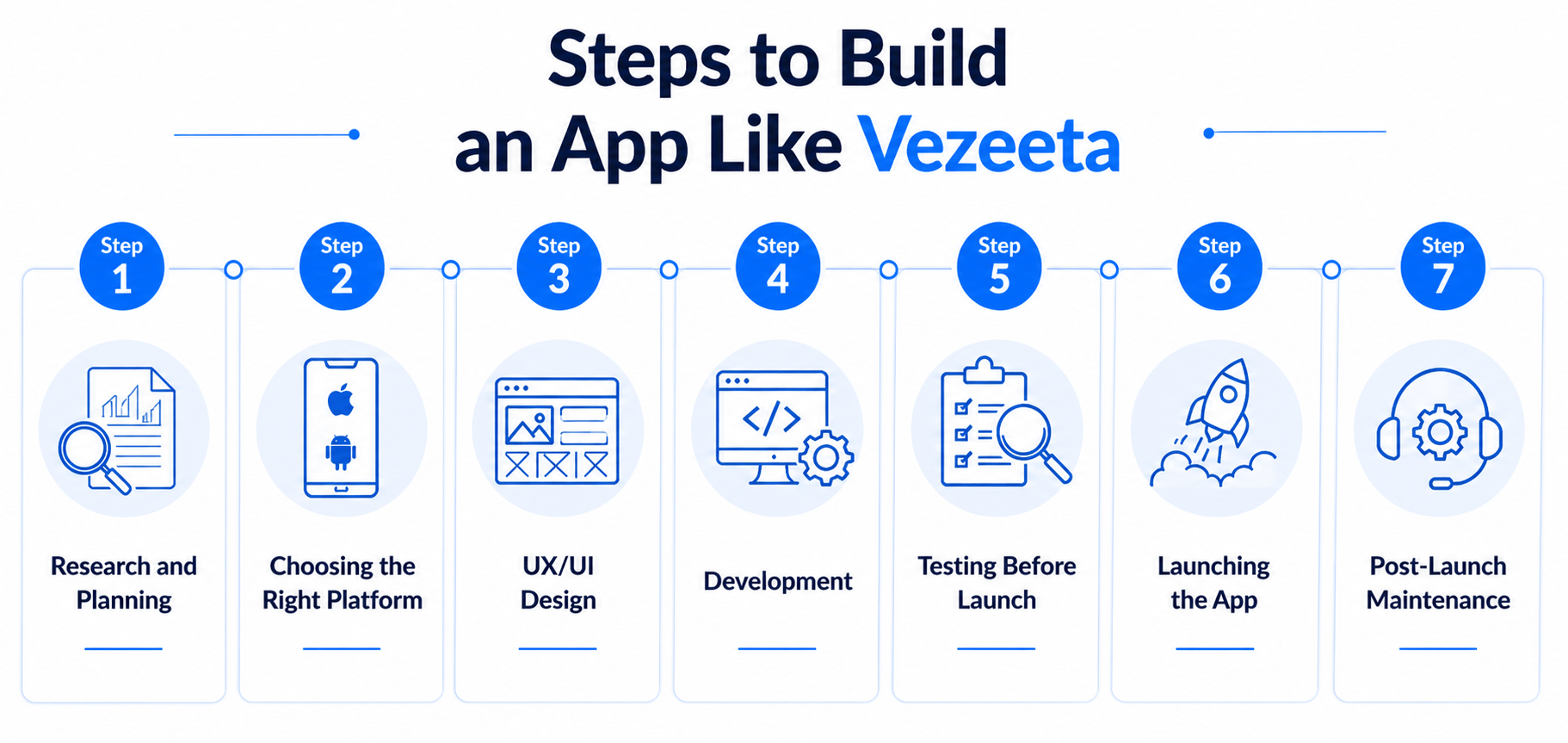
Step 1: Research and Planning
This is the stage where most apps either succeed quietly or fail later. You need to understand how patients book appointments, how clinics manage schedules, and where the friction points are.
Ask yourself:
- Who is the app for – patients, doctors, clinics, or all three?
- What problem are you solving first – appointment discovery, availability management, or teleconsultations?
- Where are you launching – because healthcare workflows in the Middle East differ a lot from Western markets.
In this region, many clinics still operate semi-digitally. That means your healthcare app development process must consider manual schedules, receptionist workflows, and local compliance standards. A solid plan here saves months during doctor appointment app development.
Step 2: Choosing the Right Platform
Platform choice affects reach, cost, and speed. Android dominates in some Middle Eastern countries, while iOS is preferred by private clinics and premium users. Cross-platform development can balance speed and coverage, but your decision should align with your target users, not just budget.
Choosing the right platform early ensures that your mHealth app can scale smoothly without constant rework, and it’s a key part of the how to build an app like Vezeeta process.
Step 3: UX/UI Design
Design isn’t decoration. In healthcare apps, it’s about trust, speed, and clarity. Patients should be able to:
- Find a doctor in seconds
- Check availability without confusion
- Book without calling or waiting
Doctors and clinics need dashboards that simplify their work. And remember, localization matters in Middle Eastern markets, language direction, appointment habits, and payment preferences influence healthcare app UI/UX design. Copying global designs without adapting can reduce adoption.
Step 4: Development
This is where your app takes shape, divided into two main parts:
- Backend Development
Handles appointments, user data, notifications, and integrations. It must be secure, scalable, and compliant. Key tasks include scheduling, conflict resolution, profiles, patient records, and payment processing. Backend stability matters more than flashy features because a missed appointment can cost trust.
- Frontend Development
Turns complexity into simplicity. Smooth flows, fast load times, and intuitive screens are critical. Patient panels let users search, book, pay, and review. Doctor panels help clinics manage availability and confirm visits efficiently.
Step 5: Testing Before Launch
Testing isn’t optional. You need to simulate real-world scenarios:
- Missed or rescheduled appointments
- Payment failures
- Network issues
- Peak usage spikes
Even minor bugs can ruin adoption. Testing ensures your telemedicine app development process is strong and that patients and clinics trust the platform from day one.
Step 6: Launching the App
A smart launch is gradual. Start with a limited number of clinics, gather feedback, and monitor real usage. This is especially crucial in the Middle East, where word-of-mouth drives adoption among providers. Adjust features based on feedback before scaling.
Step 7: Post-Launch Maintenance
Launching is just the beginning. Healthcare apps must be reliable, so ongoing maintenance is critical. Bug fixes, updates, and gradual feature additions such as video consultations, digital prescriptions, or insurance integration ensure long-term growth. The strongest platforms evolve based on real user behavior, not assumptions.
5 Key Features of a Vezeeta-Like Healthcare App
If you’re thinking about Vezeeta app development, then it’s not just about launching a booking system, because the app needs to work for patients, doctors, and clinics all at once, and it needs to be reliable, fast, and easy. The features of a Vezeeta-like app are what make it trustworthy, so that users keep coming back, and clinics actually use it without frustration.
1. Patient Registration and Profiles
Patients should be able to create profiles quickly, and store their medical history, and manage appointments, because without this, personalization is lost, and reminders don’t work as they should.
2. Doctor & Clinic Directory
A searchable, filterable list of doctors and clinics is essential; patients can search by specialty, location, or ratings. This directory is basically the backbone of doctor appointment app development, and without it, nothing else really functions.
3. Appointment Booking & Scheduling
This is the core feature – letting patients see availability and book instantly but it’s not just booking; you need reschedules, cancellations, and reminders, otherwise patients forget, doctors lose slots, and trust drops.
4. Telemedicine / Video Consultations
Virtual consultations are now expected because people want care at home, and clinics can’t always see everyone in person. Integrating secure video calls is a must, and this is a big part of telemedicine app development.
5. Payment Integration
Patients should pay online, and in ways that suit the region such as cards, wallets, or local gateways. If payment fails, you lose users, so it has to be smooth, and secure.
6. Reviews and Ratings
Patients need to leave feedback, because ratings build trust, and other patients can choose better doctors. Clinics also benefit, because they see where improvement is needed.
7. Doctor & Clinic Panel
Doctors need dashboards, and clinics need multi-doctor management. Since confirming appointments, seeing patient history, and sending notifications all happen here, so if the panel is messy, adoption will get slow.
8. Notifications and Reminders
Push notifications, emails, SMS – all of these help patients stay on track. Missed appointments mean wasted time and trust lost, so reminders are critical.
9. AI Features in Healthcare
AI in healthcare app can allow features and functionalities that suggest doctors, predict busy slots, or recommend services. It’s not just fancy. It makes your mHealth app smarter and helps both patients and clinics plan better, therefore improving adoption.
10. Medicine Ordering & Delivery
Adding pharmacy services and home delivery is optional, but powerful because it adds convenience for patients, and an extra revenue layer for your platform.
These features were designed so that the app isn’t just functional, but reliable, trusted, and scalable. And if you include them thoughtfully, your platform will work for everyone (patients, doctors, clinics) which is what makes a healthcare app development project successful.
How Much Does it Cost to Build an App Like Vezeeta in 2026?
So if you’re wondering how much it cost to build an app like Vezeeta today, well, it depends, and it’s not a single fixed number because every choice you make affects the final bill, and there are many moving parts. But that’s exactly why planning matters before jumping into healthcare app development.
In general, based on recent industry estimates, building a Vezeeta clone app development effort in 2026 can fall into a few broad ranges: the most basic versions with minimal features might start around $30,000–$60,000; more standard solutions with doctor appointment app development, secure payments, scheduling, and basic teleconsultations could range from about $60,000 to $150,000+; and full-scale, feature-rich platforms with advanced services such as thinking AI, telemedicine workflows, analytics, and heavy integrations can go beyond $150,000 to $300,000 or more.
| App Type / Feature Tier | Estimated Cost (USD) | Development Timeline | Notes |
| MVP / Basic Version | $30,000 – $60,000 | 2 – 3 months | Core booking, patient registration, doctor directory, simple dashboard; minimal AI or teleconsultation. |
| Standard / Growth-Oriented | $60,000 – $150,000 | 4 – 6 months | Includes appointment scheduling, teleconsultation, secure payments, notifications, basic analytics; suitable for multiple clinics and regions. |
| Full-Scale / Feature-Rich | $150,000 – $300,000+ | 6 – 12 months | Advanced Vezeeta clone app development, AI recommendations, video consultations, pharmacy integration, detailed analytics, multi-platform support (iOS & Android), compliance, and post-launch support. |
Why is there such a range?
Because there are some factors that influence healthcare app development cost.
The cost is shaped by what you want inside the app and how reliable it has to be. Things like UI/UX design, backend logic, API connections (video calls, messaging, payments), compliance requirements, and test coverage all add to the budget. And if you’re building something that’s not just functional but trustworthy… that adds even more to the investment.
Then there’s the platform choice: Android only, iOS only, or both. That alone can swing cost significantly because you’re basically building two native experiences if you do both separately which nearly doubles development time and effort, therefore cost.
And yes, you’re reading this from a perspective where local nuances matter, for example an mobile app development company in UAE might price slightly differently compared to a team in South Asia or Europe because hourly rates and compliance expectations vary region to region, and that reflects in the total.
On top of all that, don’t forget ongoing costs such as maintenance, updates, server hosting, security patches, as these continue after launch and a reliable telemedicine product isn’t a “one and done” build, it’s a living system that grows with users and features.
Because every project is unique, the best way to nail down a precise budget is to map your features first, understand your compliance needs, and then talk with a team that knows both telemedicine app development and regional market requirements
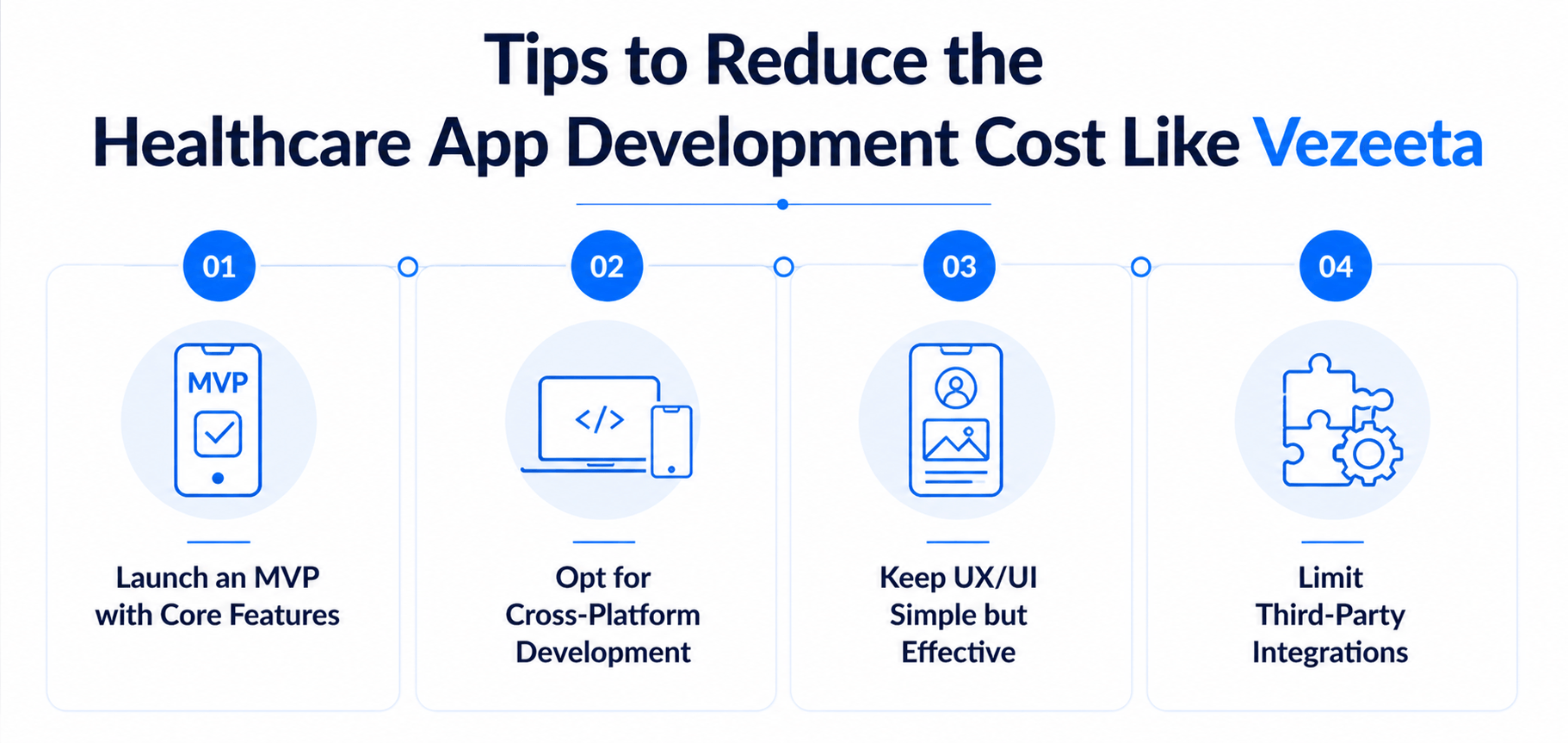
How to Reduce the Healthcare App Development Cost Like Vezeeta?
Let’s reduce of healthcare app development cost without decreasing the quality –
-
Launch an MVP with Core Features –
Focus on essential functions first (such as appointment booking, doctor profiles, and payments) as this approach lets you validate the idea, reduces upfront cost, and ensures scalability without overbuilding.
-
Opt for Cross-Platform Development –
Using frameworks like Flutter or React Native allows one codebase for both iOS and Android, cutting development time, minimizing bugs, and lowering maintenance expenses.
-
Keep UX/UI Simple but Effective –
Prioritize clarity and intuitive navigation over flashy visuals. A straightforward interface speeds up development, reduces redesign cycles, and aligns with what healthcare users value most.
-
Limit Third-Party Integrations –
Only integrate critical services such as payment gateways or SMS notifications. Avoid unnecessary tools that increase licensing fees and integration complexity.
Revenue Models of Healthcare Appointment Booking App in 2026
So, building a Vezeeta-like app isn’t just about connecting patients and doctors, because it’s also about creating revenue streams that actually work and grow with the platform. The goal is to serve everyone, but also make the business sustainable, and profitable, so that growth continues.
-
Appointment Booking Fees
Patients usually get to use the app for free, but doctors and clinics pay per confirmed appointment, and this works because the fee is only when value is delivered.
-
Provider Subscriptions
Monthly or annual plans for clinics, hospitals, or even individual doctors ensure predictable revenue, and it also locks in long-term relationships.
-
Teleconsultation Fees
Virtual consultations are rising in demand, and charging for them adds a flexible revenue layer, because patients want convenience, and doctors want efficiency.
-
Pharmacy & Medicine Delivery Commissions
Ordering medicines and delivering to home isn’t just convenient, it creates another income stream through commissions, and also improves patient experience.
-
White-Label Solutions for Clinics & Hospitals
Large healthcare providers can use the platform under their own brand, and this B2B SaaS model expands reach while adding revenue, and it’s a long-term play.
-
Premium Features & Add-ons
These features like AI suggestions, advanced analytics for doctors, priority appointment slots, can be monetized, and because they add real value, users often opt in.
-
Regional Partnerships
Especially in Middle Eastern markets, working with insurance providers or hospitals through a mobile app development company in Saudi Arabia creates strategic revenue, and it’s also good for credibility and growth.
So these models aren’t just separate, they work together, and when combined carefully, your healthcare app is profitable, scalable, and trusted by patients and clinics alike.
Why Choose Techugo for Vezeeta-Like Healthcare App Development?
If you’ve read this far, you’re clearly not just thinking about building a healthcare app…you’re ready to make it real. So, here’s why Techugo is the team to get you there. We handle everything from strategy, to design to launch and support. And because we’ve worked in the Middle East as a leading healthcare app development company, we know the local market, compliance, and user expectations. Plus, we stick around after launch with updates and support, so your app grows, scales, and stays reliable. Contact us to learn more. We’re just a call away.
FAQs
Q. Can I build a Vezeeta-like app for multiple countries in the Middle East?
Yes, you can, but it’s not just about copying features. Each country has its own healthcare regulations, language preferences, and payment systems, so your app must adapt. Launching in multiple countries means designing scalable workflows, supporting multi-currency payments, and localizing telemedicine app development features, so that patients and doctors across regions have a smooth experience. With careful planning and the right development partner, a Vezeeta-like app can serve clinics in Saudi Arabia, UAE, Jordan, and beyond.
Q. What technologies are used for telemedicine and doctor appointment app development?
Building a Vezeeta clone app requires a mix of technologies for frontend, backend, and integrations. Cross-platform frameworks like Flutter or React Native allow faster development for iOS and Android, while backend systems rely on Node.js, Python, or Java for scalability and security. Cloud services like AWS or Firebase handle storage, notifications, and video consultations. Integration tools for payments, SMS alerts, and AI-driven recommendations are also key, so your healthcare app works seamlessly for patients and clinics alike.
Q. How do healthcare apps like Vezeeta make money?
Revenue comes from multiple streams, because relying on just one rarely scales. Apps charge appointment booking fees from clinics, offer provider subscriptions, monetize teleconsultations, and earn through medicine delivery commissions. Some also provide white-label solutions to hospitals and clinics, or premium add-ons like AI recommendations. This layered approach ensures that the app is profitable while still serving patients efficiently, and it’s why Vezeeta app development is considered a long-term, scalable investment.

Get in touch
We'd love to hear from you.