

 SA
SA  KW
KW  IE
IE AU
AU UAE
UAE UK
UK USA
USA  CA
CA DE
DE  QA
QA ZA
ZA  BH
BH NL
NL  MU
MU FR
FR [ LET’S TALK AI ]
X
Discover AI-
Powered Solutions
Get ready to explore cutting-edge AI technologies that can transform your workflow!



Get ready to explore cutting-edge AI technologies that can transform your workflow!






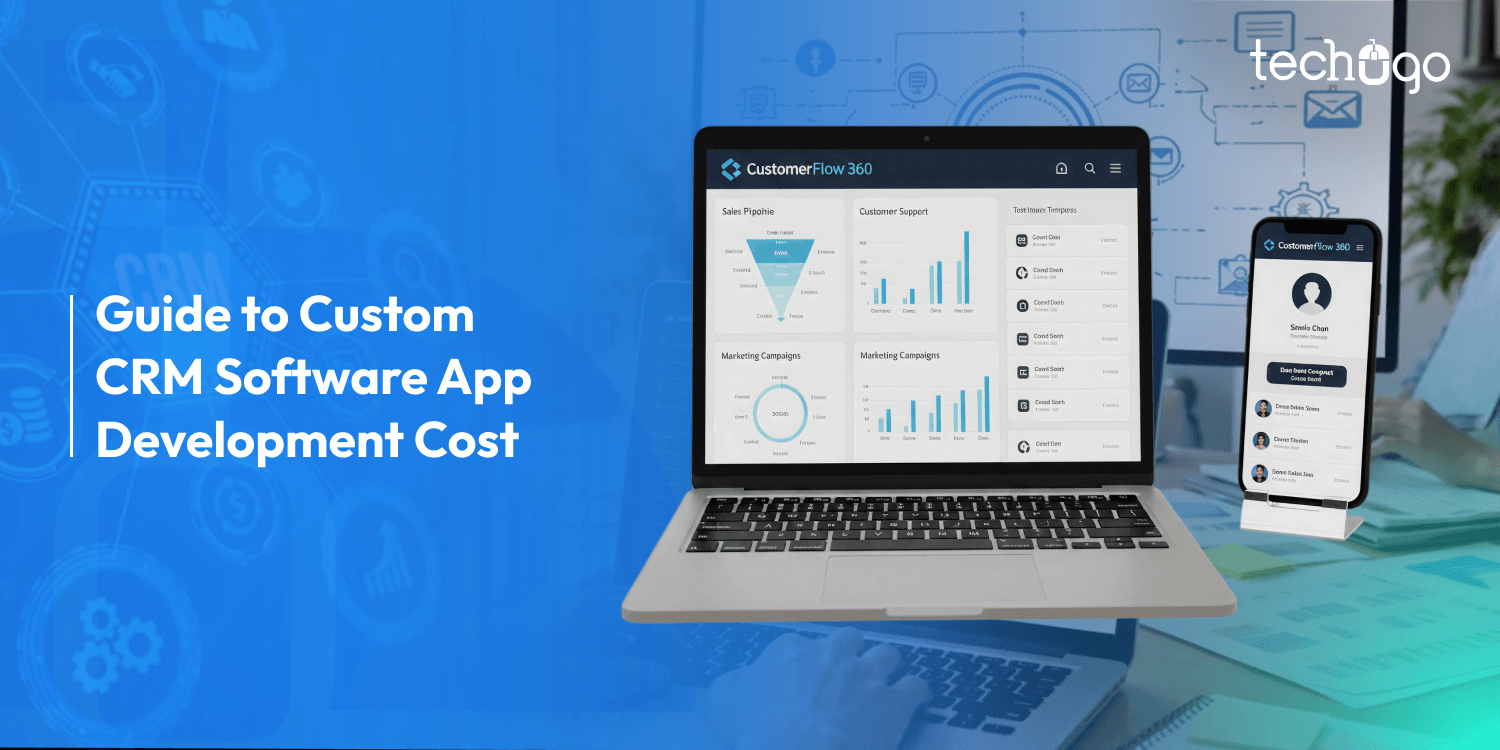
Having a Customer Relationship Management (CRM) software app can greatly improve your business operations. Businesses are using CRM systems because they help organize leads, track conversations, and manage the entire sales process in a much clearer way. And while there are many ready-made CRM tools available in the market, many companies still prefer custom solutions because they want something that actually fits the way their teams work.
But then, before moving forward, one question usually appears first – what is the cost to develop a custom CRM software app? The answer is not always simple, and it varies a lot. The custom CRM development cost depends on many things such as the features you want, the number of integrations required, the security standards, and even the development team you choose. Because of these differences, two CRM systems can look similar on the surface but still have very different development costs.
In general, the cost to build a custom CRM can range anywhere between $25,000 and $200,000 or even more. A small CRM with basic contact management and sales tracking may stay on the lower side but when businesses start adding automation, analytics dashboards, integrations, and AI capabilities, the investment naturally increases.
Therefore, understanding CRM development costs before starting the project becomes important. In this guide, we will break down what can influence custom CRM development cost and tips to optimize it so that you can estimate the real cost and avoid surprises later.
Also Read: Transform Financial Services With Leading CRM Solutions for Growth!
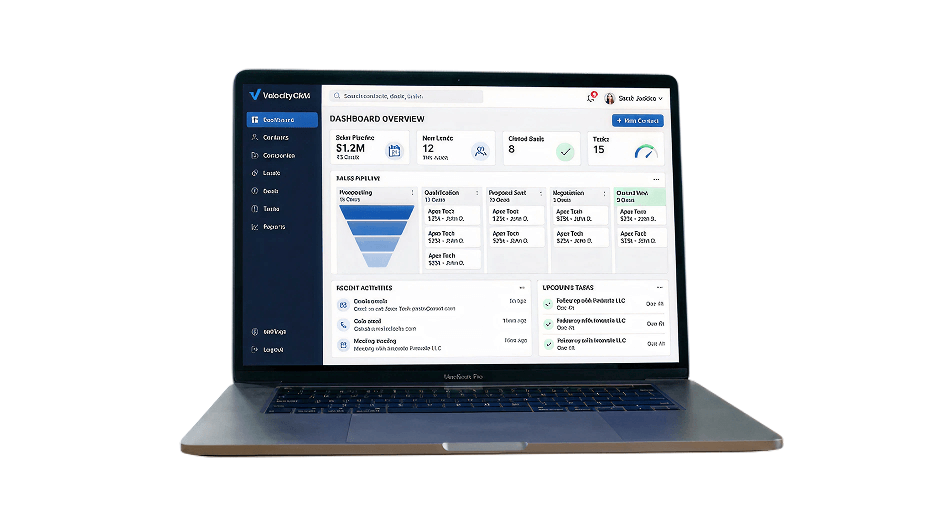
A custom CRM software app is a customer relationship management system that is designed specifically for a business, and it is not the same as the ready-made CRM platforms that many companies simply subscribe to. These systems are usually built from scratch, or they are heavily customized, because businesses often want the software to match their exact workflows and processes. And therefore, instead of adjusting your operations to fit a tool, the tool itself is created around the way your team actually works.
CRM systems in general have been widely used by businesses for many years, because they help organize customer data, track leads, manage sales activities, and store communication history. But many companies realize that standard CRM tools sometimes do not fully match their internal systems. The features may be limited, or the workflow may feel rigid, and it can slow teams down rather than helping them move faster.
This is where custom CRM software becomes useful. Because the system is designed for a particular business, it can include the exact features that teams need such as customized sales pipelines, automated follow-ups, role-based dashboards, and integrations with the tools they already use. And when the software is built this way, teams usually find it easier to manage customer relationships, because everything is structured around their existing processes.
Another important reason businesses choose custom CRM systems is integration. Most organizations today are already using multiple platforms (marketing tools, accounting software, communication apps, and analytics dashboards) but when these systems are not connected, information gets scattered. A custom CRM can therefore be developed so that all these tools work together, and the data flows between them smoothly.
Over time, many companies also start adding more advanced capabilities to their CRM platforms. These may include automation features, analytics dashboards, and even AI-powered insights. And while these additions make the system more powerful, they also influence the custom CRM development cost, because the complexity of the platform increases.
So, in simple terms, a custom CRM software app is not just a place where businesses store customer details. It becomes a central platform that supports sales teams, improves collaboration, and helps organizations make better decisions because the data, the processes, and the tools are all connected in one system.
The cost to develop a custom CRM software app in 2026 can vary quite a lot, and that usually happens because every business is different, and the systems they need are also different. Some companies only want a simple CRM where the contacts and the leads are managed, but others want a complete platform that includes automation, integrations, analytics dashboards, and sometimes even AI features. Because of this, the custom CRM development cost is rarely fixed — it changes depending on what you want the system to do, and how complex the platform becomes during development.
In most situations, the cost to build a custom CRM may fall somewhere between $25,000 and $200,000 or even higher. A small CRM system, which focuses mainly on contact management and basic sales tracking, can stay closer to the lower side of the range. But as more features are added such as workflow automation, reporting tools, integrations with marketing platforms, or mobile CRM access, the total development cost starts increasing, sometimes quite quickly.
| CRM Type | Estimated Development Cost |
| Basic Custom CRM | $25,000 – $50,000 |
| Mid-Level Custom CRM | $50,000 – $120,000 |
| Advanced / Enterprise CRM | $120,000 – $200,000+ |
For instance, a basic CRM platform with limited features may cost around $25,000 to $50,000, and it usually supports small teams with simple requirements. A more advanced system, where automation, dashboards, and integrations are included, can reach somewhere between $50,000 and $120,000. And then there are enterprise-level CRM platforms, which are built for larger organizations, and these systems often support complex workflows, strong security layers, and a large number of users, therefore the cost can move beyond $150,000 or even $200,000.
Another thing businesses sometimes overlook is that CRM development is not only about writing code. The process also includes planning the system architecture, designing the user interface, building the backend infrastructure, testing the platform, and deploying it properly. And because many companies have been using multiple digital tools already like marketing software, accounting systems, and customer support platforms, integrations are often required so that all the systems can work together.
So yes, the investment in a custom CRM can feel significant at the beginning, but many businesses still choose this path because the long-term benefits are stronger. Instead of adjusting their processes to fit a standard tool, they get a system that was built for them, and therefore the CRM supports their operations, their teams, and their future growth much more effectively.
Also Read: Investment Portfolio Management Software: Features, Cost, Development Steps
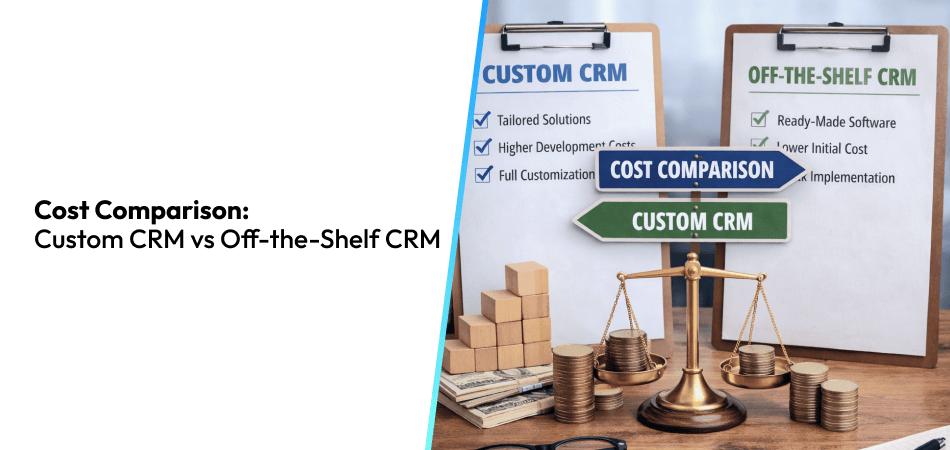
Businesses often compare the custom CRM software development cost with ready-made CRM platforms but off-the-shelf CRM tools are usually faster to adopt and the upfront cost is lower because businesses simply subscribe to the software. But when it comes to custom CRM systems, so they are built specially for a company’s workflows, hence they offer more flexibility and long-term control.
Most off-the-shelf CRM platforms operate on a subscription model where subscribers pay monthly/yearly fees depending on the number of users and features included. Simple, right? But at first, this option seems more affordable, especially for startups but over time as your business grows and you need integrations and advanced features, and then subscription cost increases significantly.
On the other hand, a custom CRM needs a larger initial investment. Because the system is designed and developed from scratch. So obviously, the development cost will include planning, design, development, integrations, and testing. But…once the system is built, businesses gain full control over the platform and can expand it according to their needs without depending on third-party software limitations.
To understand the difference more clearly, the table below highlights a simple comparison between both approaches.
| Factor | Custom CRM | Off-the-Shelf CRM |
| Initial Cost | Higher upfront development investment | Lower upfront cost with subscription |
| Customization | Fully customizable based on business workflows | Limited customization options |
| Scalability | Can be expanded as the business grows | Dependent on vendor limitations |
| Integrations | Flexible integration with internal systems | Integrations may be limited or paid |
| Long-Term Cost | One-time development with maintenance costs | Ongoing monthly or yearly subscription fees |
| Ownership | Full control and ownership of the software | Software owned and managed by the vendor |
In most cases, businesses pick an off-the-shelf CRM. Reason? It is easy to implement. But as their operations grow and their workflows become more complex, they often consider building a custom solution which is a right decision we believe as a leading mobile app development company in USA. The cost to build a custom CRM is higher at the beginning, but it can offer greater flexibility and efficiency in the long run.
When businesses try to estimate the custom CRM development cost, they often think it is only about coding the software. But that is rarely the case because building a CRM system usually involves several stages and each stage contributes to the total CRM development cost, from planning the system to building the backend. This is why the cost to develop CRM software is usually divided across multiple activities.
It is important to understand this cost breakdown because it will help businesses plan budgets more realistically, and it will also show where the investment is actually going, instead of treating CRM development as a single expense.
| Development Stage | Estimated Cost Share |
| Planning & Requirement Analysis | 5% – 10% |
| UI/UX Design | 10% – 15% |
| Frontend Development | 15% – 20% |
| Backend Development | 30% – 40% |
| Third-Party Integrations | 10% – 15% |
| Testing & Quality Assurance | 10% – 15% |
| Deployment & Maintenance | 15% – 20% (annual maintenance) |
Every CRM project begins with planning. During this stage, the development team works with the business team to understand how their sales process works, how customer data is handled, and what features are needed. The goal is to map the workflows clearly so that the CRM system supports the company’s real operations.
This stage includes defining user roles, system architecture, integrations, and security requirements. It may appear small in the overall process, but it plays an important role — because if the planning is weak, the development phase can become expensive later.
In most cases, planning and requirement analysis account for about 5% to 10% of the total custom CRM development cost.
The interface of CRM platforms needs to be clear and organized, and easy to navigate as well because they are being used daily by sales teams, managers, and support staff.
Firstly, the designers usually create wireframes, prototypes, and dashboard layouts as they help visualize how the CRM will function before the actual development begins. The goal is to make the system simple enough so that teams can access customer data quickly and complete tasks without confusion.
Depending on the complexity of the CRM platform, UI/UX design typically contributes around 10% to 15% of the CRM development cost.
Frontend development focuses on the visible side of the CRM – the part that users interact with and this includes multiple things such as dashboards, contact management screens, sales pipelines, forms, notifications, and reporting panels.
Frontend development requires careful structuring because CRM systems usually contain multiple modules and role-based views. Sales teams may see different dashboards, while managers may access analytics reports.
It is generally the 15% to 20% of the total cost to build a custom CRM, although it can increase if the CRM includes complex dashboards or mobile-responsive interfaces.
The backend is the core of the CRM platform that manages databases, system logic, authentication, automation workflows, and data processing, and in fact, all customer data flows through this layer, thus it needs to be secure.
Backend development also handles integrations with other platforms and ensures that large volumes of data can be processed efficiently; hence, this stage usually takes the largest share of the project budget because of the technical complexity involved.
In many cases, backend development accounts for around 30% to 40% of the total custom CRM software development cost.
Most businesses today use multiple digital tools such as marketing platforms, email systems, accounting software, analytics tools, and customer support platforms. Connecting these systems with the CRM helps centralize information and improves productivity.
However, integrations require API development, authentication management, and data synchronization. Some tools integrate easily, but others require custom connectors.
Because of this, integrations can add around 10% to 15% to the overall CRM development cost, depending on the number and complexity of systems being connected.
QA teams check the system for bugs, performance issues, etc before launch, and teams also make sure that all modules work properly on different browsers, devices, and user roles.
Though testing appears like a final step but it is essential for delivering a stable platform and without proper quality assurance, businesses may face disruptions once the CRM is live.
Typically, testing and QA contribute around 10% to 15% of the cost to develop a custom CRM software app.
Now at this stage, the CRM platform is deployed to the production environment which involves server configuration, database setup, cloud deployment, and final performance checks as well.
But the work does not end there. CRM systems continue to grow and update as businesses grow and therefore maintenance becomes necessary, and in many cases, businesses allocate around 15% to 20% of the initial development cost annually for maintenance and system upgrades.
Understanding this custom CRM development cost breakdown gives businesses a clearer perspective. Instead of viewing CRM development as a single large investment, it becomes easier to see how different stages contribute to building the system. And when each stage is planned properly, the CRM platform becomes far more scalable, and useful over time.
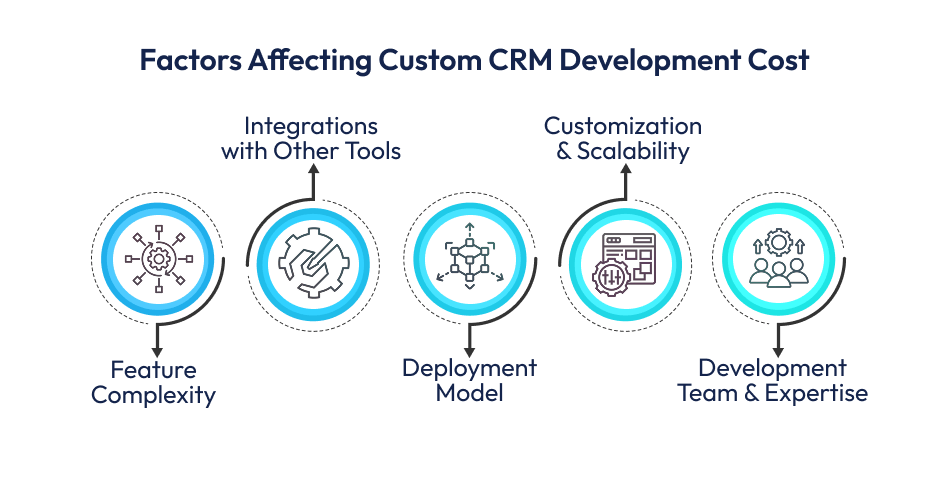
The custom CRM development cost can vary quite a bit and that usually happens because every business has its own processes, its own workflows, and different expectations from the system. Some companies only need a simple CRM where the contacts and the leads are managed but others want a more advanced platform with automation, integrations, and analytics tools, that’s why, the cost to develop a custom CRM software app is never exactly the same for everyone.
The features included in the CRM system play a major role in deciding the final CRM development cost as a basic system (where you only manage contacts and track leads), usually costs less but when businesses start adding automation tools, reporting dashboards, and AI-driven features, the development effort increases. And therefore, the total cost also grows.
Most businesses are already using several digital tools, such as marketing platforms, accounting software, and communication systems, and when you connect these tools with the CRM helps teams work more efficiently because the data flows between systems. But integrations require additional development work, and sometimes custom APIs. So the cost to build a custom CRM can increase depending on how many systems are being connected.
The hosting model also affects the cost to develop CRM software. Many businesses prefer cloud-based CRM platforms because they are easier to scale and maintain. But some companies still choose on-premise systems, especially when they want more control over their data, and since on-premise setups require extra infrastructure and configuration, the development cost may increase.
Some companies only want a CRM that supports their current operations, and that is enough for them. But others want a platform that can grow with the business. Therefore, they ask for more customization, flexible modules, and scalable architecture. And when the system is designed to handle larger teams and bigger datasets, the custom CRM software development cost naturally becomes higher.
Another factor that influences the cost to develop a custom CRM software app is the development team itself. Different regions have different development rates, and experienced developers often charge more. But at the same time, skilled teams have been able to build stronger architectures and more reliable systems which can actually save businesses time and money later.
The features included in a CRM system play a major role in shaping the custom CRM development cost. Some businesses only need a basic platform where contacts and leads are managed, and that works fine for smaller teams but many organizations want more than that; they want automation, analytics, integrations, and mobile access because the CRM becomes a central system for multiple departments.
Each module has to be designed, built, and tested properly, as a result, the cost to develop a custom CRM software app gradually increases as the system becomes more powerful.
Below are some essential CRM features that usually influence the overall development cost.
Contact management is the foundation of almost every CRM platform. It allows businesses to store customer details, communication history, purchase records, and other important information in one place. But businesses rarely want a simple database anymore. They want searchable profiles, custom fields, and interaction timelines so that teams can understand the customer better. Because of this, the design and structure of the contact management module can affect the CRM development cost.
Another core feature is lead and pipeline management. Sales teams use CRM platforms to track prospects, assign tasks, and monitor deals as they move through the sales funnel. Sometimes businesses want a simple pipeline view. But in many cases they request customized sales stages, deal tracking dashboards, notifications, and automated follow-ups which naturally adds more development work, and therefore increases the cost to build a custom CRM.
Automation is one of the most valuable CRM features today. It helps reduce manual work by automating tasks. Businesses can automate sending emails, assigning leads, updating records, and even triggering notifications. However, building flexible automation systems is not always simple. The CRM must support rules, triggers, and conditional actions. Because of this, automation modules often increase the custom CRM software development cost.
Many businesses want detailed insights from their CRM platforms. And features like reporting tools and analytics dashboards let teams monitor sales performance, track conversion rates, and analyze customer behavior. So advanced analytics features usually increase the custom CRM software development cost because apparently they require data processing and visualization components.
Sales teams often work outside the office and therefore many businesses prefer CRM systems that can be accessed through mobile apps. So developing a CRM interface that is mobile-friendly or creating a dedicated mobile app adds to the cost to build a custom CRM as it includes additional work related to design and development.
As you know, CRM systems often need to integrate with other tools such as marketing automation platforms, email services, etc. These integrations let businesses manage all activities related to customers in one place, but they also increase the development complexity.
CRM platforms have changed a lot over the years and they are no longer just systems where customer information is stored. Now users expect their CRM tools to analyze data, automate repetitive work, and provide insights as well, so that help teams make better decisions. And due to this change, AI and generative AI technologies are increasingly being integrated into modern CRM systems.
Artificial intelligence helps CRM platforms process large volumes of customer data. It can identify patterns that teams might otherwise miss, for example, AI can analyze past interactions, purchasing behavior, and engagement history so that sales teams understand which leads are more likely to convert. Hence businesses are able to prioritize the right opportunities and their sales efforts often become more efficient.
It can create content automatically, can generate follow-up emails, summarize customer conversations, draft responses, and even suggest personalized sales messages, instead of just analyzing information. As we know that many of these tasks were previously done manually, now teams can save time and respond to customers more quickly with generative AI.
AI systems can evaluate customer behavior patterns and predict future actions, for instance the CRM may identify customers who are likely to churn or it may suggest the next best action for a sales representative. And when businesses have access to these insights, they are often able to improve customer engagement and retention.
But integrating AI capabilities into CRM systems requires additional development work. The platform needs proper data pipelines, machine learning models, and secure infrastructure so that the AI features function reliably. Because of this complexity, many organizations prefer working with an experienced AI app development company as these companies can implement intelligent CRM features and provide generative AI integration services tailored to business needs.
Although these technologies can increase the custom CRM development cost, many businesses still choose to invest in them. Over time, AI-powered CRM systems help teams automate routine tasks, analyze customer data more effectively and build stronger relationships, therefore making the CRM platform far more valuable in the long run.
The custom CRM development cost can vary depending on the size of the business and the complexity of its operations. Startups and small businesses often have different priorities, budgets, and system requirements, therefore the cost to develop a custom CRM software app is usually different for both.
| Custom CRM Development Cost | |
| For Startups | $25,000 and $60,000 |
| For Small Businesses | $50,000 and $120,000 or more |
Startups usually prefer building a simple CRM with essential features such as contact management, lead tracking, and basic reporting. Because they focus on launching quickly and managing budgets carefully, many startups begin with an MVP-style CRM system. The cost of CRM development for startups can typically range between $25,000 and $60,000, depending on the features and integrations required.
Small businesses often need a more structured CRM platform because their teams, customers, and workflows have already grown. They may require features like workflow automation, analytics dashboards, integrations with marketing tools, and mobile CRM access. Because of these additional capabilities, the CRM development cost for small businesses usually ranges between $50,000 and $120,000 or more, depending on the system complexity.
The custom CRM development cost can increase quickly when businesses try to include too many features and integrations at once. But with the right planning and development approach, it is possible to control the cost to develop a custom CRM software app without affecting the system’s performance.
Here are a few practical ways to reduce the overall CRM development cost:
By following these strategies, businesses can manage the cost to build a custom CRM more efficiently while still developing a system that supports their long-term operations.
See, the true value of custom CRM software lies in its features as well as in how well it fits your business processes and supports your business objectives. When the system is planned carefully and developed with the right expertise, it can become an important part of your business infrastructure.
Choosing the right development partner is an important step when planning the cost to develop a custom CRM software app. The success of the platform often depends on the experience, technical expertise, and long-term support offered by the development team. Therefore, businesses should evaluate a few key factors before making a decision.
By partnering with an experienced mobile app development company like Techugo, businesses can build scalable CRM solutions that streamline customer management, automate workflows, and support long-term growth.
Techugo is ready to become your development partner. Fill out the form and get a free project estimation in 48 hours.
The time required to build a custom CRM software usually depends on the complexity of the system and the features involved. A basic CRM with core modules such as contact management and lead tracking may take around 3 to 4 months to develop. But a more advanced CRM with automation, integrations, analytics dashboards, and mobile access can take 6 to 12 months or more. The timeline also depends on planning, design, testing, and deployment stages, therefore each project timeline can vary.
Both options have their advantages. Platforms like Salesforce and HubSpot are ready-to-use CRM tools that are quick to implement and require lower upfront investment. However, a custom CRM can be designed specifically for a company’s workflows, integrations, and business processes. Therefore, businesses that require greater flexibility, scalability, and full control over their system often prefer building a custom CRM solution.
Many industries benefit from custom CRM platforms, especially those that manage large volumes of customer interactions. Sectors such as real estate, healthcare, finance, retail, education, and IT services often rely on CRM systems to track leads, manage communication, and analyze customer data. Because these industries have unique workflows and compliance requirements, custom CRM solutions help them manage operations more efficiently.
Yes, generative AI can be integrated into modern CRM platforms to improve productivity and customer engagement. AI tools can generate personalized emails, summarize customer interactions, suggest follow-up actions, and analyze large datasets for insights. Businesses often implement these capabilities through generative AI integration services, which allow the CRM system to automate tasks and provide intelligent recommendations for sales and support teams.

The most expensive part of healthcare AI isn’t always the algorithm. It’s the data. When we talk about AI in healthcare, we usually hear about brea..

Social media isn’t what it used to be. For years, platforms have relied heavily on ads, data tracking, and algorithms that shape what users see online..


Write Us
sales@techugo.comOr fill this form