

 SA
SA  KW
KW  IE
IE AU
AU UAE
UAE UK
UK USA
USA  CA
CA DE
DE  QA
QA ZA
ZA  BH
BH NL
NL  MU
MU FR
FR [ LET’S TALK AI ]
X
Discover AI-
Powered Solutions
Get ready to explore cutting-edge AI technologies that can transform your workflow!



Get ready to explore cutting-edge AI technologies that can transform your workflow!







“We are soon going to switch to microservices architecture.”
If you work in app development or software product engineering, you have probably heard this sentence more than once. It shows up in meetings, project roadmaps, and technical discussions more often than ever.
But what does it really mean? Why is microservices architecture a hot topic in the context of software application development?
For many teams, microservices development represents a shift away from traditional monolithic systems toward a structure that is more flexible, scalable, and easier to evolve over time. Instead of building one large application, businesses now focus on creating smaller, independent services that work together as a complete system.
Still, the concept can feel confusing at first. Terms like services, APIs, and distributed systems often make microservices architecture sound more complex than it needs to be.
That’s why, we are here to answer precisely what you have in mind, but in layman’s language.
Yes, that’s right.
So, if you are a developer, a product owner, or someone involved in software planning, this guide will help you understand the basics without getting lost in technical jargon.
Notably, microservices are a kind of architecture used by businesses for the development of software. Traditionally, the most common architecture for the IT industry involved Monolithic or service-oriented architecture; however, it is no longer considered fit for the growing complexities of modern infrastructures. Thus, microservices came into the picture.
It wouldn’t be wrong to say that microservices have multiple definitions. However, one of the most commonly used is that microservices is an architectural style for developing an individual app as a software suite that’ll incorporate numerous services.
What’s more? These services are fabricated based on an enterprise’s capabilities and can be positioned independently.
To explore how our experts approach modern application architecture and development, refer to the insights shared by one of our experts on our YouTube channel.
The next question that most developers come up with is:

First, APIs stand for application programming interfaces, and the two concepts are altogether different. How?
Talking about microservices is a framework for mobile apps that segregates an app into numerous independent web services.
On the other hand, APIs are programming interfaces and a framework that enables a developer to interact with a mobile app. These can be arranged in a set of functions, methods, classes, and constants that work as an interface via which software can deliver its services to other software.
Where does the confusion arise?
Notably, microservices utilize APIs for communicating with each other, which causes overlap between the two concepts, leading to confusion.
Additionally, how to develop API is another commonly asked question.
Before getting into details about the microservices architecture, a preconceived notion about the same needs to be clarified.
Do you think this is true?
Well, this is not entirely true. Sure, microservices comprise a small component; however, developers can effortlessly use the same for the simplest to the most complex business structures.
However, the concept is not new, nor is it a protocol. In reality, microservices is an architectural approach, not a communication protocol. It focuses on how an application is structured, not on how data is transmitted. The concept has evolved from earlier distributed systems and service-oriented architecture (SOA).
However, performance depends on how well the services are designed and how efficiently they communicate. Poorly planned microservices implementation can introduce delays instead of reducing them.
In practice, this is not always the case. For small applications with limited features, a monolithic structure may be easier to build and maintain. Microservices architecture shows its real value when systems need to scale, change frequently, and support independent deployments.
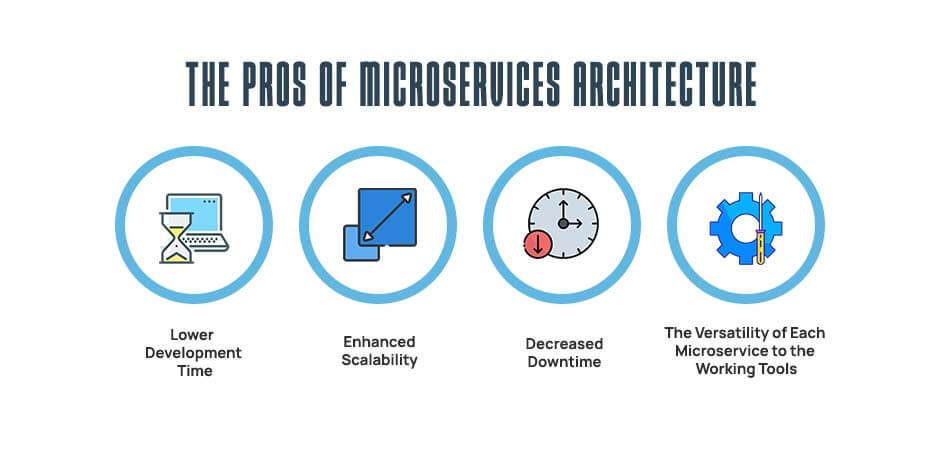
Indeed, microservices have countless advantages to offer, but it is vital for you to be familiar with the top ones. Hence, here’s the list:
The credit goes to distributed development that enables developers to emphasize multiple microservices simultaneously. Therefore, the development time of an application reduces as several developers come together to work on a project without interfering with each other’s production.
Microservices are independent of development and deployment; thus, developers can refurbish a component without influencing other components. The result? It enables mobile apps to evolve and meet the dynamic demand, eliminating any disruption.
Contrary to monolithic apps, a mobile app built using microservices architecture doesn’t stop working when an individual component encounters an issue. Not only this, but it becomes less complicated to monitor and fix issues in this ecosystem.

The independent components make it possible to construct microservices using varied programming languages. This is why the operational tools utilized by an organization are fit for the global solution.
Microservices architecture sounds exciting. Scalability. Flexibility. Faster releases.
But in real projects, it is not always as smooth as it looks in theory. Teams often discover that moving away from a monolithic system also means taking on a new kind of complexity.
Understanding these challenges early can save a lot of time, cost, and frustration later.
In a monolithic application, everything lives in one place. One codebase. One deployment.
With microservices architecture, the same application is split into many small services. Each service has its own logic, APIs, and sometimes even its own database.
This is powerful, but it also means there are more pieces to watch over.
Without proper planning and clear boundaries, microservices implementation can start to feel messy instead of modular.
Microservices development depends heavily on service-to-service communication. Every request may pass through multiple APIs before reaching the final result.
When one service slows down or fails, it can affect the entire flow.
Finding the exact source of the problem is also harder than in a monolithic system, because the issue might be hidden somewhere between services rather than inside a single block of code.
Microservices architecture is often linked with automation, containers, and cloud infrastructure. While these tools bring flexibility, they also come with higher setup and maintenance costs.
Each service needs to be developed, tested, deployed, and secured on its own.
For smaller teams or early-stage products, the cost of microservices development may feel heavy compared to a simpler monolithic approach.
In most microservices systems, each service manages its own data. This keeps services independent, but it makes data consistency more difficult.
When one user action touches several services, keeping all records aligned becomes a challenge.
Compared to a single monolithic database, distributed data needs more coordination and careful design to avoid errors and mismatches.
The choice between microservices vs monolithic architecture is not about trends. It is about fit.
For applications with limited features and stable requirements, a monolithic structure can be easier to build and maintain.
Microservices architecture makes more sense for complex systems that need frequent updates, separate scaling, and independent deployments.
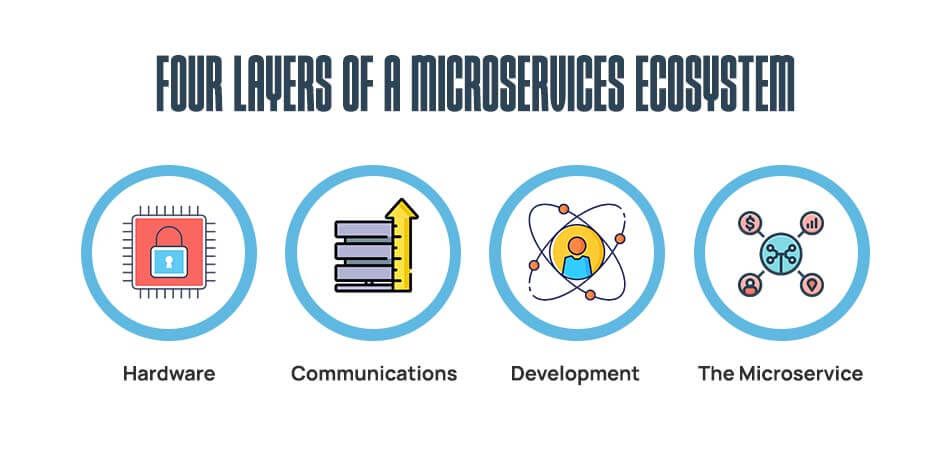
It won’t be wrong to say that the microservices ecosystem is massive and needs tremendous infrastructure. Thus, developers must begin working from scratch, and not compromise with the same as it works with a dedicated environment. The implementation has to be positive, and to ensure the same; sustainability is a must-have ingredient.
So, how to move ahead?
Listed below are the best practices for a microservices environment:
This microservices layer incorporates databases, OS, and physical host servers. No matter Windows, Solaris, or Linux, the OS must utilize a configuration management tool; for instance, Puppet or Chef. Additionally, it must be the agent that installs applications and defines configurations, or else, scalability issues might arise.
For scaling, the cycle of configuration has to be repeated, and host-level monitoring will be required for troubleshooting issues that encounter.
Notably, this microservices layer influences all other layers of the ecosystem.
How?
In the absence of a proper interaction, other components of the architecture stop working. For example, talking about data, microservices can utilize HTTP and RAF or a TIFF communicating channel. For messaging, the ecosystem can forward messages using HTTP or another chosen protocol.
This phase comprises the development of applications, and it is mandatory for this layer to host the self-service development tools for the creation of new databases, ports, tables, and more. Furthermore, the amalgamation of logging and monitoring tools is a crucial stage in the development layer.
The last and simplest layer is the microservice, where the entire mechanism runs. Here’s precisely where the configuration file lives and where the self-service tools from other layers should be placed.
Undoubtedly, architecture is becoming exceptionally popular, and it has become one of the top-notch reasons for businesses to adopt the functionality for app development and cloud microservices.
Constructing a microservices architecture demands the right expertise and technical skills. Not only this, but it also requires a transition in the manner that you conduct your projects internally.
So, do you want to reap many benefits offered by the microservices mechanism? It’s time to reach out to us at Techugo- a reliable mobile app development company for further guidance on the subject.
Remove the video from here and embed it above where I mentioned.
Designing a microservices architecture is not just about breaking an application into smaller services. It is about knowing where to break it, how those services should talk to each other, and how the system will behave as it grows. This is where real experience matters.
As a trusted software app development company, Techugo helps businesses adopt microservices architecture in a way that supports long-term performance and scalability, not just short-term delivery.
Our teams work closely with product owners and technical stakeholders to design systems that are easy to scale, easier to maintain, and aligned with business goals.
Whether it is building a new application from scratch or moving away from a monolithic structure, Techugo ensures that microservices implementation is structured, reliable, and future-ready.
Over the years, Techugo has helped startups, enterprises, and government organizations build digital products that scale with their users.
Some of our key achievements include:
This practical exposure allows our teams to understand not only how microservices architecture works, but also how it performs in real business environments.
If you are planning to build a modern application that can handle growth, frequent updates, and high user demand, a well-designed microservices architecture can be a strong foundation. With the right guidance and technical expertise, this transition becomes smoother and more predictable.
If you’re on the journey to developing an applaud-worthy mobile app for your business and are wondering about the investment, also read- AI Development Cost in 2026: What Businesses Should Expect.
Because building with microservices is not just a technical decision.
It is a business decision as well.
Message us with any query anytime, we’d be happy to assist.

‘What’s the cost to build an app like Yandex Go?’ is often the first question businesses ask. When you’re starting from zero, with no existing infr..


Marriage has always held a special significance in our lives, and it's something that families and individuals take very seriously, but over time, the..



Write Us
sales@techugo.comOr fill this form