

 SA
SA  KW
KW  IE
IE AU
AU UAE
UAE UK
UK USA
USA  CA
CA DE
DE  QA
QA ZA
ZA  BH
BH NL
NL  MU
MU FR
FR [ LET’S TALK AI ]
X
Discover AI-
Powered Solutions
Get ready to explore cutting-edge AI technologies that can transform your workflow!



Get ready to explore cutting-edge AI technologies that can transform your workflow!






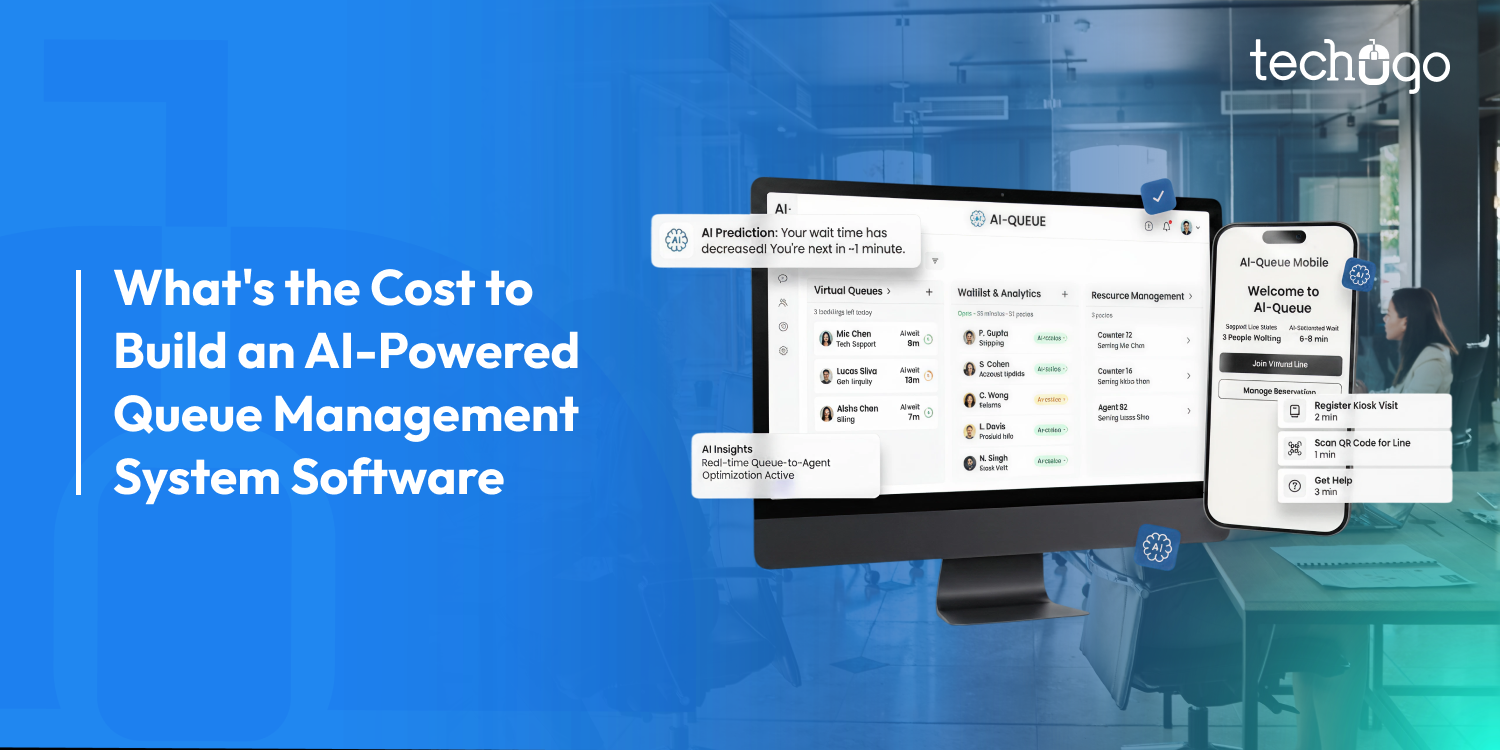
Watching a long queue build up (waiting in line) can be frustrating. Regardless of your location (New York City, Dubai, or Washington D.C.), traditional forms of queuing (using human beings to line people up) have become obsolete. Things are changing and companies are now looking at how they can use technology (such as Artificial Intelligence) to manage their queues and convert “wait time” into “engagement time.”
As a business decision maker, one of the first questions that you will want answered before making a decision regarding the use of this type of technology will likely be the bottom line:
“What is it going to cost?”
What does it take to build an AI-powered Queuing Solution Software?
We are going to detail all of the costs associated with developing this solution, some of the most basic features included, and what types of returns on investment (ROI) you can expect from using Intelligent Queuing Solutions (IQS) based on the use of emerging technologies such as generative AI and predictive analytics.
AI-Powered Queue Management System Software is a type of Intelligent Ecosystem designed to manage the movement of individuals, appointments, and resources through the use of Machine Learning. Unlike traditional systems (i.e., call a number) that typically require customers to wait for their turn, AI-based systems are inherently smarter because they are constantly receiving data and using that data in real time to make predictions about wait times, when resources should be allocated to staff and when to provide customers with personalized experiences.
Today, consumers are more impatient than ever before when it comes to efficiency and less when it comes to having to wait. According to studies, wait times over 14 minutes are responsible for 75 percent of retail sales loss. In addition, businesses that have implemented queue management system (QMS) software development methods in the United States have reported their service handling time has decreased by 35 percent.
To develop a successful solution, it’s necessary to combine advanced software development with advanced AI model creation. As a software development company focused on creating AI solutions, we divide this procedure into five different steps.

In this step, you look at the “why” of the system you want to build; are you creating a system for one location (like a hospital) or multiple (like a retail organization with several locations)?
In terms of designing the system for a software developer, the goal is to have the least amount of friction when accessing the system. Whether the access method is via a kiosk type of interface or a web mobile first application, the design must take into consideration multi-language users and be inclusive.
A custom-developed ML model constitutes the “brain” of your queue management system’s AI software.
To handle “bursty” or sudden traffic spikes, you will need to create a cloud-native architecture on either Amazon Web Services (AWS) or Google Cloud. In addition, ensure that your queue management system software will integrate seamlessly with your existing database.
Load testing is an absolute necessity. The queuing system must be able to handle these surges/crashes, especially during black Friday or seasonal spikes in the healthcare system.
Budgeting for a project depends on the complexity of the AI and the scale of the deployment. Below is a realistic cost breakdown for different tiers:
| System Tier | Complexity | Features Included | Estimated Cost |
| Basic Digital QMS | Low | QR Check-in, SMS Alerts, Basic Admin Dashboard | $15,000 – $30,000 |
| Mid-Level AI System | Medium | Predictive Analytics, CRM Integration, Multi-branch support | $45,000 – $120,000 |
| Enterprise AI Ecosystem | High | Computer Vision, Biometrics, Generative AI Assistants, Full ERP Sync | $150,000 – $500,000+ |
The majority of a queue management system’s efforts are often focused on the consumer; however, the most significant ROI for a software development company will typically come from employee optimization. In other words, instead of simply monitoring the line for customers waiting, AI is effectively managing the people behind the service.
Reactive staffing is the most significant drain on operational budgets: scrambling to add a terminal once the lobby is filled and people are already waiting. By utilizing predictive analytics, an AI-enabled queue management system can look back at historical foot traffic, seasonal trends (Black Friday, Ramadan), and weather patterns to accurately predict staffing levels 24 to 48 hours in advance.
Bottlenecks can occur within minutes in a large organization. When combining computer vision with a queue management system, you can measure when a specific abandonment percentage in a queue occurs (7 or more persons in a retail queue) and automatically push out to the staff in the back office to alert them to assist a terminal and increase productivity of staff members by up to 40%.
A queue management system software in the USA will have legal obligations concerning data privacy as opposed to optional features. Therefore, as a bank or healthcare provider, you must create an AI software development company with a “Security by Design” framework.
When your queue management system software in USA is designed for use, your clinic/hospital must ensure HIPAA compliant features including:
When dealing with government entities or defense contractors, Cloud-based AI will not be suitable. Techugo specializes in Sovereign AI model development that can be deployed either on-premise or in restricted private clouds to maintain the sovereign status of sensitive operational data.
As corporations around the world are committing to ESG principles, software “carbon footprints” will undergo scrutiny. The creation of an AI-based Queue Management System is no longer a process solely about moving people; it is also about being a good corporate citizen in the process of doing so.
Training large AI systems requires a lot of energy. At Techugo, we incorporate Green AI principles into the creation of your Queue Management System Solution.
A truly intelligent system should serve all individuals, no matter their physical or cognitive ability. We develop queue management system software (both in the USA and internationally) with the following established methods:
The most immediate environmental improvement regarding paper-making is the elimination of the use of paper tickets. For example, a high-volume city agency or a national retail chain could potentially save thousands of tons of thermal paper per year by implementing a “Digital First” queue management system. Working toward a “Zero Waste Lobby” is a definable measurement that you can provide within your annual sustainability report.
Different Industries have different wait-flow processes. In developing a generative AI, it is vital that with the generative AI development company‘s technology fits the needs of each individual Industry.
One hospital network in North America implemented an AI-based queue management system so patients could wait at home for their turn to go to the clinic. The result was a 22-minute reduction in average wait times for patients in the clinic and improved satisfaction ratings from patients.
Also Read: Generative AI in Healthcare: Top Applications and Use Cases
We merged the online order pickup experience and the walk-in customer experience for a particular retail brand using an AI-based queue management system. This way, staff always had at least 10% more staff than what was required during peak hours.
In high-volume venues like airports and the DMV, computer vision technology helps to pre-emptively identify potential bottlenecks and automatically redirect staff to the counters where they are most needed.
At Techugo, we do more than just develop software, we provide businesses with an edge over their competition. We are a leader in the industry, developing solutions that you can start using today and continue using in the months and years to come with a positive return on investment.
The investment in the creation of an AI based queuing system will not be an operational expense, but rather, an expenditure that will improve the customer experience at their respective establishments. The divide between companies that provide a “smart” service to their customers and those using manual lines will continue to grow through the coming years.
Whether your company is looking for a custom developed ai based queuing system application at a local establishment or to globally deploy a system across multiple locations, selecting the appropriate AI software development company is the initial action taken to work toward the year of no lines.
On average, a mid-level queue management system will take about 4 to 6 months to be developed. This can include between 2-3 weeks for the discovery stage, 6 to 8 weeks for developing and training the AI model, followed by 8 to 10 weeks to create the backend and integrate with your systems.
Yes. Most established software development firms will design their products with an API-first architecture; thus, seamless data exchange from your QMS to platforms such as Salesforce and HubSpot is easy.
Typically, you will see a return on investment (ROI) from three sources: improved efficiency in employee scheduling; improved sales since shoppers won’t leave without making a purchase (commonly referred to as “walk-aways”); and improved loyalty from customers over time. In most cases, enterprises see their ROI within 12 to 18 months of implementing the system.
Not necessarily. Many current systems utilize a “Bring Your Own Device” (BYOD) model that enables the customer to use his/her own phone, while staff can utilize whatever devices they have at their disposal, whether those devices are tablets, laptops or other forms of computing hardware.
Do you have thoughts on creating an app but don't know where to get started? If you are a real estate developer or technology entrepreneur in Riyadh, ..

Mobile apps in Saudi Arabia are not just digital tools anymore, and they are no longer limited to simple tasks either. Rather, they are becoming the m..


Write Us
sales@techugo.comOr fill this form