

 SA
SA  KW
KW  IE
IE AU
AU UAE
UAE UK
UK USA
USA  CA
CA DE
DE  QA
QA ZA
ZA  BH
BH NL
NL  MU
MU FR
FR [ LET’S TALK AI ]
X
Discover AI-
Powered Solutions
Get ready to explore cutting-edge AI technologies that can transform your workflow!



Get ready to explore cutting-edge AI technologies that can transform your workflow!






Today, managing investments is not only a matter of choosing the correct stocks or funds; you also have to deal with data as well. This includes market data, client data and risk data. And, it has to be done quickly. Very quickly.
That is where investment portfolio management software or IPMS becomes important for you. Not as an optional tool, but as the system that supports your entire investment workflow. From tracking assets to generating reports, a modern portfolio management system helps you stay in control without depending on endless spreadsheets.
But things are changing. You may already be using a tool. Or maybe several tools. Still, many firms are moving toward IPMS development and portfolio management software development because ready-made platforms do not always fit their business logic. You want software that works the way you work.
Regulations are stricter. Clients expect transparency. And manual processes slow everything down. A strong investment management software or digital portfolio management software brings automation, real-time insights, and compliance support into one place. No jumping between systems. No guessing.
In this guide, you will learn what an IPMS actually is, how it functions, and why more companies are investing in custom portfolio management software instead of relying on outdated tools. We will cover features, development steps, cost factors, and what lies ahead in fintech software development for investments.
So whether you are planning PMS development for the first time or working with a software development company to modernize your existing setup, this guide will help you understand what to build, why to build it, and how to approach it the right way.
Also Read – How Much Does Software Development Cost in Saudi Arabia?
The PMS market is projected to reach $13.12 billion by 2035, with a compound annual growth rate (CAGR) of 7.71%, highlighting the growing demand for sophisticated portfolio management solutions.
Investment portfolio management software is a digital system that helps you manage, track, and optimize your investment portfolios in one place. Instead of working with scattered files, emails, and manual calculations, you use a single portfolio management system to handle everything related to assets, performance, and client data.
Think of it as the control center for your investments. It stores portfolio details. Monitors market movements. Calculates returns. Flags risks. And generates reports when you need them. All without you having to switch between multiple tools.
At its core, this type of investment management software is built to support decision-making. You can see how each asset is performing. You can compare portfolios. You can rebalance when required. And you can do it based on real-time data, not outdated numbers.
Many firms now choose custom portfolio management software instead of generic tools. Why? Because every business follows a different strategy. Different asset classes. Different compliance rules. Different client structures. With proper IPMS development, the software is designed around your workflow, not the other way around.
In simple terms, a well-built digital portfolio management software helps you manage money smarter, reduce manual work, and bring clarity to complex investment data.
An IPMS works by collecting and organizing all your investment-related data into a structured system. This includes asset details, transaction history, market prices, risk metrics, and client profiles. Everything flows into one portfolio management software platform.
When you go for PMS development or full portfolio management software development, you can define how this workflow should look. What data to capture. What calculations to run. What dashboards to show. This is also why fintech software development for investments focuses heavily on integration, automation, and accuracy.
In short, IPMS works by turning raw financial data into usable insights. For you. For your team. And for your clients.
Not all investment portfolio management software is built for the same purpose. What you choose depends on who you are, how you manage money, and how complex your portfolios are. Some tools focus on individuals. Some are made for enterprises. Others sit somewhere in between.
Here are the main types you will come across.
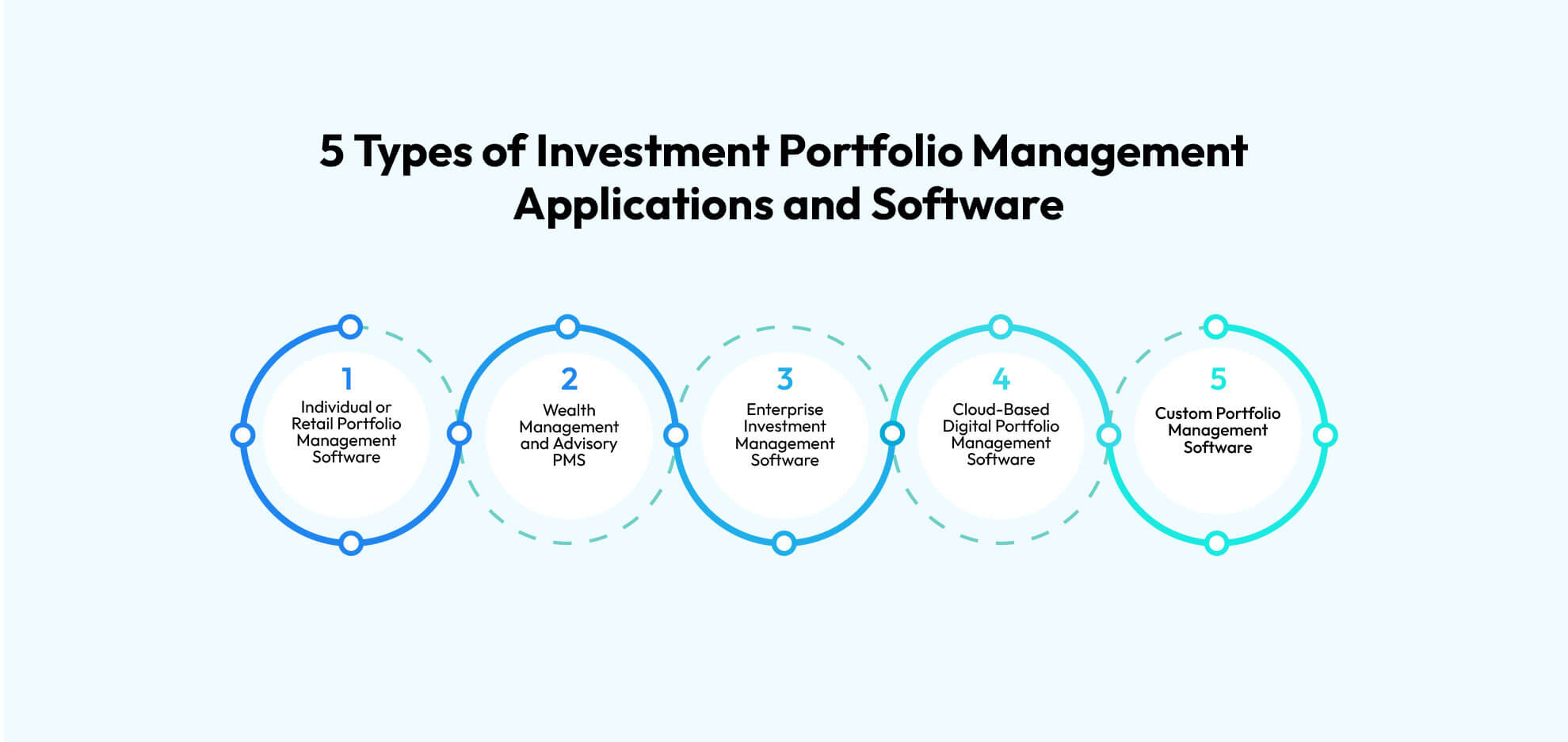
This type is designed for personal investors and small-scale users. It helps you track investments, view returns, and understand asset allocation. The features are usually simple. Basic analytics. Basic charts. Limited integrations.
Good for visibility. Not always enough for business-level operations.
These systems are built for financial advisors and wealth management firms. They manage multiple client portfolios at once. Handle reporting. Support goal-based investing. And often include compliance tools.
This is where portfolio management software becomes more client-focused, not just asset-focused.
Large financial institutions use this type. Banks. Asset management firms. Hedge funds. It handles high-volume data, complex portfolios, and strict regulatory needs.
Such a portfolio management system supports automation, advanced analytics, and deep integrations with trading and accounting platforms.
These platforms run on the cloud. You can access them from anywhere. Updates happen automatically. Scaling is easier.
Many businesses prefer this model today because it reduces infrastructure costs and improves collaboration. It is also popular in modern fintech software development for investments.
This is built specifically for your business. Your workflows. Your asset classes. Your reporting structure.
With proper IPMS development and portfolio management software development, you decide what features go in. What stays out. How the system behaves.
This option works best when off-the-shelf tools do not match your investment logic or compliance needs.
In practice, most firms start with ready-made tools. Then outgrow them. That is when PMS development becomes a strategic move rather than a technical one.
The type you choose should match your scale, your investment strategy, and how much control you want over your system. Because the right investment management software is not just about tracking assets. It is about supporting how you grow.
Key Features of Investment Portfolio Management Software
When you plan to build investment portfolio management software, features decide everything. Not just how the system looks, but how useful it is in daily operations. Some features are essential. Others are advanced. Both matter if you want a platform that grows with your business.
A strong portfolio management system does more than track numbers. It helps you analyze, control risk, execute trades, and stay compliant. All in one place.
Let’s break down the key features that make this possible.
At the base level, your software must show you what is happening inside your portfolios in real time.
You should be able to view portfolio value across different asset types. Track gains and losses. Measure performance over time. And generate reports without manual work.
Automated trade capture plays a big role here. It pulls transaction data directly into the system, reducing errors and saving time. Benchmarking is another important part. It lets you compare your portfolio against market indices or predefined goals so you know where you stand.
These features give you clarity. No guesswork. Just data that supports faster decisions.
Risk and regulation sit at the center of modern investing. Your investment management software must be able to monitor both.
Execution is where strategy meets reality. A reliable platform integrates smoothly with order and execution management systems so trades can be routed and processed automatically.
With proper integration, orders move faster. Manual steps are reduced. Settlement becomes more efficient. Communication between trading systems also improves, which lowers delays and operational risk.
For businesses handling high trade volumes, this feature is not optional. It is core to performance.
Modern portfolio management software development increasingly includes intelligent modules. These go beyond simple tracking and offer decision support.
These features help you move from reactive management to proactive strategy.
Security cannot be an afterthought. A well-built digital portfolio management software protects both business and client data.
In practice, these features work together. Portfolio tracking supports analytics. Analytics supports risk management. Risk management supports compliance. And all of it depends on secure system design.
Whether you choose ready-made tools or invest in custom portfolio management software, the goal remains the same. To give you a system that is accurate, secure, and flexible enough to adapt as markets and regulations evolve.
Running investment operations without a proper system quickly becomes messy. Too many files. Too many numbers. Too many chances for mistakes. This is where a well-designed portfolio management system changes how you work.
For businesses, the benefits go beyond simple tracking. It improves decision-making. It saves time. And it creates structure in places where chaos usually lives.
Here is how it helps in real terms.
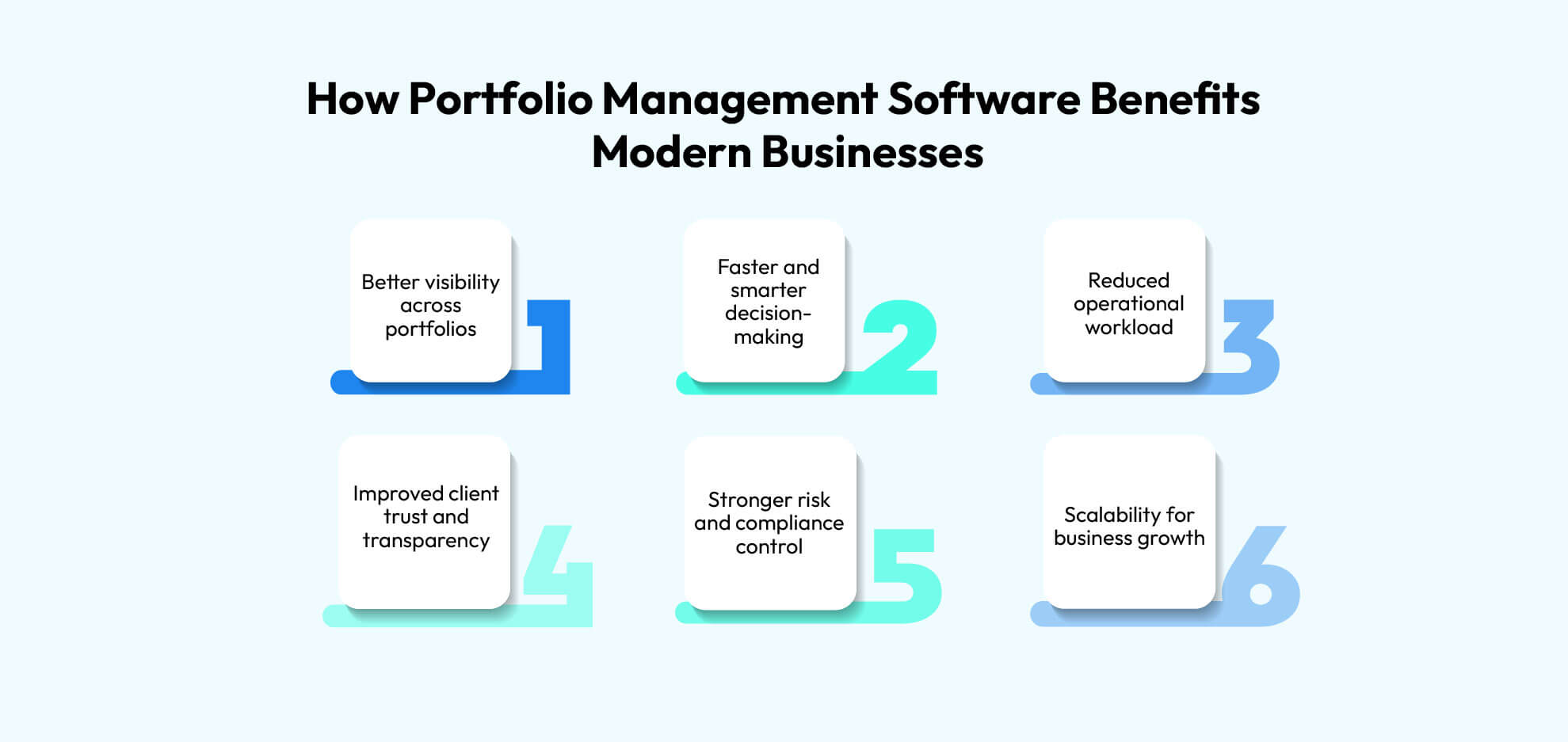
You can see everything in one place. Asset performance. Allocation. Risk exposure. Client holdings. No switching between tools. No waiting for manual updates.
This kind of visibility makes it easier to understand what is working and what is not. You spot underperforming assets faster. You respond to market changes sooner. And your strategy becomes based on facts, not assumptions.
When your data updates in real time, decisions become easier. You do not wait for end-of-day reports. You act when it matters.
With the right investment management software, you can compare scenarios, evaluate risks, and rebalance portfolios without starting from scratch each time. The system does the heavy lifting. You focus on judgment.
Manual processes eat up time. And they increase the chance of human error.
Automation reduces both. Trade capture. Calculations. Reporting. Even compliance checks can be handled inside the system. This frees your team from repetitive tasks and lets them focus on higher-value work, like strategy and client relationships.
Clients want clarity. They want to know where their money is and how it is performing.
A structured digital portfolio management software makes this easier. You can share accurate reports. Explain performance using real data. And provide timely updates when markets change.
Transparency builds confidence. And confidence keeps clients with you longer.
Managing risk manually is slow and unreliable. A centralized platform helps you monitor exposure, flag unusual patterns, and stay aligned with regulatory rules.
Built-in audit trails and reporting tools also make compliance less stressful. You are prepared for reviews. You are not scrambling for documents. Everything is already recorded.
As your client base grows, your systems must grow too. A spreadsheet-based setup will not scale. A proper platform will.
With flexible portfolio management software development, you can add new asset classes, onboard more users, and expand features as your business evolves. You do not need to rebuild everything each time you grow.
In short, using portfolio software is not just about managing investments. It is about running your business better.
You gain control over data. You improve accuracy. You build trust. And you prepare your operations for future expansion. For most firms today, that is not a luxury. It is a requirement.
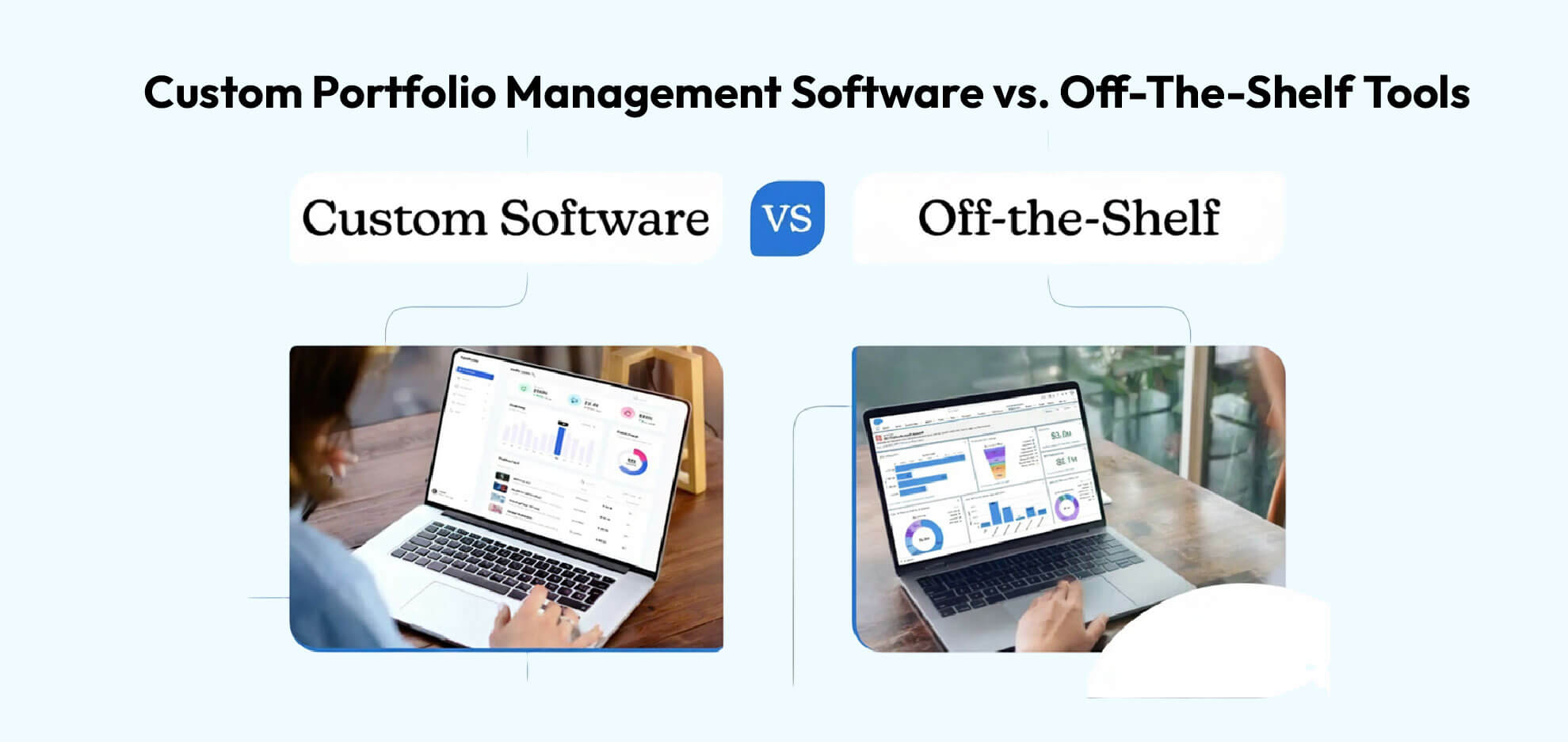
Off-the-shelf tools are quick to start with. You sign up. You log in. You begin tracking portfolios. For small teams or basic needs, that can be enough.
But as your business grows, limitations start to show. Fixed workflows. Limited integrations. Features you do not need. And missing ones you actually want.
This is where custom portfolio management software makes a difference.
With a tailored platform, the software follows how you work. Your asset types. Your reporting style. Your compliance rules. You decide what gets built and how data flows through the system. There is no need to adjust your process to fit the tool.
Custom solutions also scale better. You can add new modules over time. Integrate with your existing systems. And adapt to regulatory changes without waiting for a vendor update.
| Aspect | Custom Software | Off-the-Shelf Tools |
| Fit to your workflow | Built around how you work | You adjust to the tool |
| Features | Only what you need | Fixed feature set |
| Integrations | Designed for your systems | Limited or predefined |
| Scalability | Grows with your business | May hit limits over time |
| Compliance control | Tailored to your rules | Generic compliance support |
| Long-term flexibility | High | Low to moderate |
So which is better?
If your needs are simple, ready-made tools can work.
If your operations are complex or growing fast, a custom platform gives you control and flexibility.
In the long run, the real difference is not in features. It is in how well the system supports your business strategy.
This type of system is not limited to one kind of business. It is useful wherever money is being managed, tracked, and optimized at scale.
In simple terms, if you manage investments for more than a handful of users or assets, spreadsheets stop working. That is where a proper portfolio management system starts making sense.
Building a reliable platform is not just about writing code. It is about planning for security, scale, and regulation from day one. Investment portfolio management software development follows a structured path, where each step shapes how stable and usable the system will be later.
Here is how the process usually unfolds.
Everything starts with clarity. You define what the system must do and who will use it.
First, identify your users. Portfolio managers. Advisors. Traders. Operations teams. Each group works differently, so their needs must be mapped early.
Next comes compliance. You need to understand which financial and data regulations apply to your business and regions. These rules affect how data is stored, processed, and reported.
Then, list the systems your platform must connect with. Market data providers. Custodians. CRM tools. Accounting systems. Planning integrations at this stage avoids costly redesigns later.
Once requirements are clear, the technical structure is defined.
Most modern platforms use modular or service-based architecture. This makes it easier to scale different parts of the system, such as reporting or analytics, without affecting everything else.
Real-time processing is also important. Pricing updates, trade events, and portfolio values must flow quickly through the system. This is supported by event-driven design and data streaming layers.
At the interface level, responsive web dashboards allow managers to work efficiently. On the backend, the system handles calculations, transaction processing, and business logic.
A strong data layer unifies information from multiple sources into a consistent model. This ensures valuation, risk, and reporting are all based on the same numbers.
Security is designed into the foundation. Encryption, access control, and secure APIs protect sensitive financial data from misuse.
Now the system begins to take shape.
A prototype or MVP is built with only essential features. Portfolio tracking. Trade capture. Basic reporting. Nothing more than what is needed to make it usable.
This version is tested with real users. They interact with dashboards. They follow workflows. Their feedback highlights what works and what needs adjustment.
At this stage, early data integrations also begin. Market feeds and transaction sources are connected to confirm that external data flows correctly into the platform.
After the core system is stable, advanced modules are added.
Risk management tools help assess exposure and simulate market scenarios. Compliance modules check trades against defined rules automatically.
Analytics features grow more intelligent. Predictive models estimate performance based on historical patterns. Rebalancing logic suggests portfolio adjustments. Detection systems flag unusual behavior before it becomes a problem.
Backtesting tools are also introduced. These let users test strategies using past market data to see how portfolios might have performed under different conditions.
Before release, the system goes through strict testing.
Security testing looks for weaknesses. Compliance checks confirm that audit trails, reporting, and data protection work as required.
User acceptance testing ensures that workflows make sense in real-world use. Small groups try the system, report issues, and help refine the final version.
Only after this validation does the platform go live.
Launch is not the end. It is the beginning of improvement.
Performance and data accuracy are monitored regularly. As usage grows, infrastructure is scaled to handle higher transaction volumes and more users.
Regulatory updates require ongoing changes to reporting and controls. User feedback guides feature upgrades and usability improvements.
Over time, the platform evolves into a smarter and more capable system, aligned with business growth and market shifts.
When done right, portfolio management software development becomes a long-term asset, not just a one-time project. It gives you a system that adapts to regulation, supports strategy, and grows alongside your investment operations.
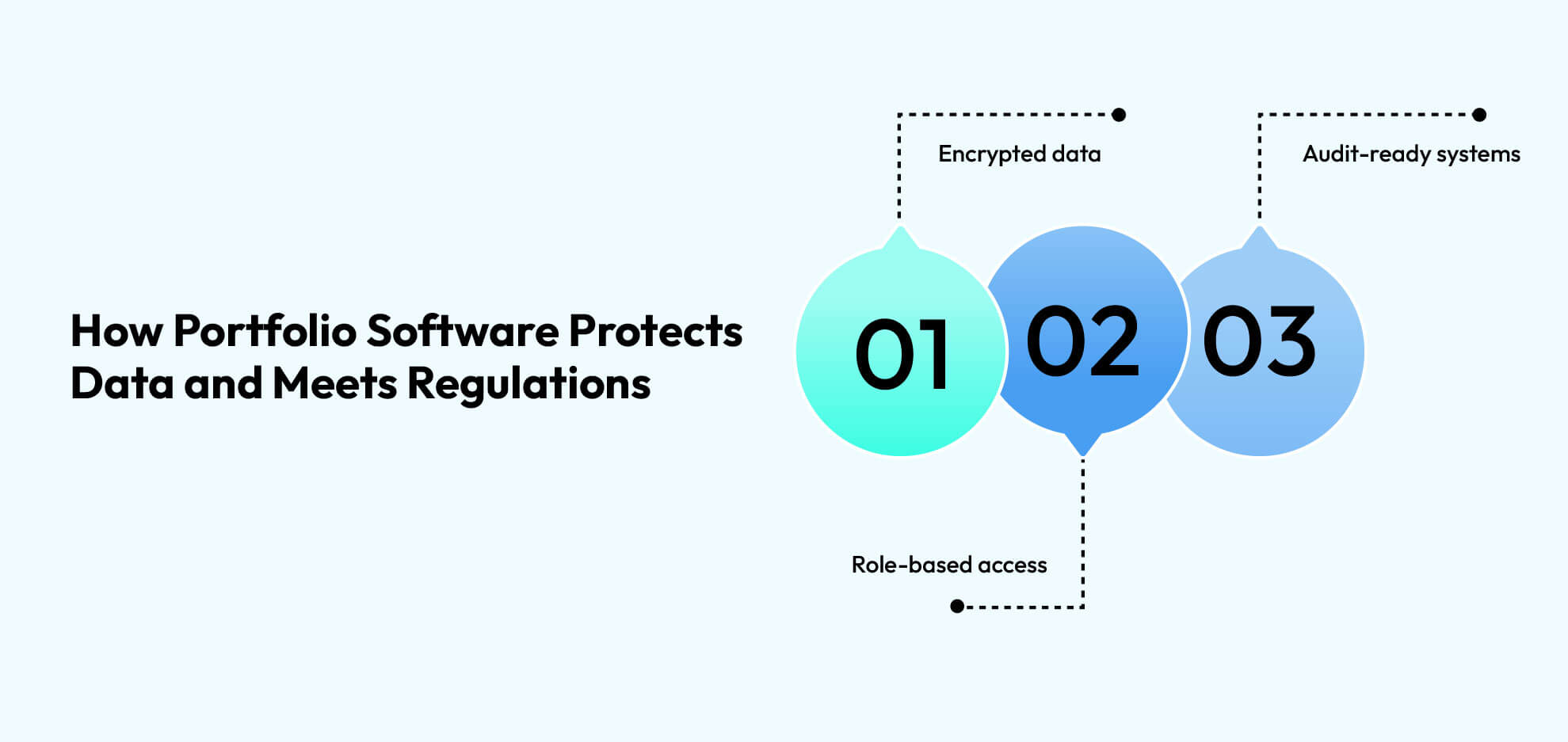
When you deal with investments, you deal with trust. And trust depends on how well your system protects data and follows the rules.
Security starts with access control. Only the right people should see sensitive information. Role-based permissions and multi-step login methods help prevent misuse. Data must also be encrypted, whether it is stored in the system or moving between services.
Compliance works alongside security. Your platform needs to follow financial and data protection regulations based on where you operate. This affects how long data is stored, how transactions are recorded, and how reports are generated.
Audit trails play an important role here. Every action taken inside the system should be logged. This makes reviews easier and reduces risk during regulatory checks.
In simple terms, security keeps your data safe. Compliance keeps your business safe. A strong platform must handle both from the beginning, not as an afterthought.
There is no fixed price tag for building this kind of system. The cost depends on what you want to build and how complex you want it to be.
A simple version with basic portfolio tracking, reporting, and user management will cost much less than a full-scale platform with risk analytics, real-time data feeds, and compliance automation.
Rough cost ranges you can expect:
(covers core portfolio tracking and simple reporting)
(adds analytics, role-based workflows, and external data feeds)
(for complex risk modules, real-time processing, advanced compliance, and AI features)
Creating a portfolio platform is more than simply an ICT project; it is also a strategic business decision. As such, it requires a partner with knowledge in both areas.
At Techugo, our first priority will be working with you to identify how your organization manages its investments – your processes, users, and regulatory requirements – in order to deliver a customized solution directly aligned with your processes from the outset.
Throughout the entire project lifecycle, we will help you with all aspects of planning, defining features, designing and developing your portfolio platform (including security) so it can accommodate real time data, extensive calculations and continued growth without impacting performance.
What also matters is long-term support. Markets change. Regulations evolve. User expectations shift. And Techugo, as a trusted partner for software and mobile app development services, helps you adapt your platform over time through upgrades, performance tuning, and new feature additions based on feedback.
So instead of forcing your business into a fixed tool, you get a solution shaped around how you operate. One that grows with you. And one that keeps your investment operations stable, compliant, and ready for what comes next.
A good system should first handle the basics well such as portfolio tracking, performance analysis, and reporting because these are non-negotiable. And beyond that, it should support risk monitoring, compliance checks, and integrations with market data or trading tools. Automation also matters. The less manual work your team does, the fewer errors you face. Most importantly, the PMS should match how you operate. Features are only useful if they fit your workflow.
It depends on what you build first. A basic version with core features can take a few months. A more advanced platform with analytics, integrations, and compliance modules takes longer. Sometimes much longer. The timeline also depends on how clear your requirements are and how many features you want in the first release. Many businesses launch a smaller version first and then expand it step by step.
Start with your needs, not the software. Look at how you manage portfolios today. Your asset types. Your reporting style. Your compliance requirements. A solution should support these, not force you to change your entire process. Next, check flexibility. Can the system grow with you? Can you add features later? Can it integrate with your existing tools like trading platforms or data providers? Security and compliance should come built-in, not added later. Make sure the platform supports access control, audit logs, and regulatory reporting from the start. Finally, think long-term. A tool that works today but cannot scale tomorrow will slow you down later. The right solution is one that fits your current operations and still makes sense when your business doubles in size.
It brings structure to both. Risk tools track exposure, test scenarios, and highlight unusual patterns early. Compliance tools check trades against rules and keep records of every action taken in the system. Audit logs and reporting features also make regulatory reviews easier. Instead of searching for data, everything is already documented inside the platform.
Both. Just in different ways. Startups use it to build digital investment products and manage users at scale from the beginning. Large firms use it to handle complex portfolios, strict regulations, and high transaction volumes. In short, if you manage more than a few assets or clients, a structured system becomes useful. The size of your business only changes how advanced the system needs to be.

Are you also Googling “cost to build an app like Wag in the USA?" Every big app starts the same way, with a late-night Google search. Most entrepr..
Suppose an Australian recruitment agency that is struggling to handle hundreds of job applications every day. And the manual processes of sorting resu..



Write Us
sales@techugo.comOr fill this form