


 SA
SA  KW
KW  IE
IE AU
AU UAE
UAE UK
UK USA
USA  CA
CA DE
DE  QA
QA ZA
ZA  BH
BH NL
NL  MU
MU FR
FR [ LET’S TALK AI ]
X
Discover AI-
Powered Solutions
Get ready to explore cutting-edge AI technologies that can transform your workflow!



Get ready to explore cutting-edge AI technologies that can transform your workflow!






AI models are cool. Scalable AI models? That is where things get real.
You can train a model. You can push an experiment. You can even deploy a proof of concept.
Then suddenly pipelines break. Models drift. Deployments fail. Versioning becomes chaos.
If you are here, you already know you need the right MLOps framework to survive that journey. The big question standing between you and smooth AI deployment is simple: Kubeflow vs MLflow – which MLOps framework fits your AI.
This is a crucial MLOps moment for engineering teams building enterprise-grade AI. This is not just a tool choice. It is a long-term strategy. You are essentially deciding how your machine learning lifecycle evolves, how teams collaborate, and how your models behave in the wild.
So let us explain Kubeflow vs MLflow with clarity and real-world logic.
Because if you want an AI-powered business that does not crack under production pressure, you need the right MLOps stack. No shortcuts.
👉Must Read: Xamarin Vs. React Native: Unlock The Secrets To Picking The Right Framework!
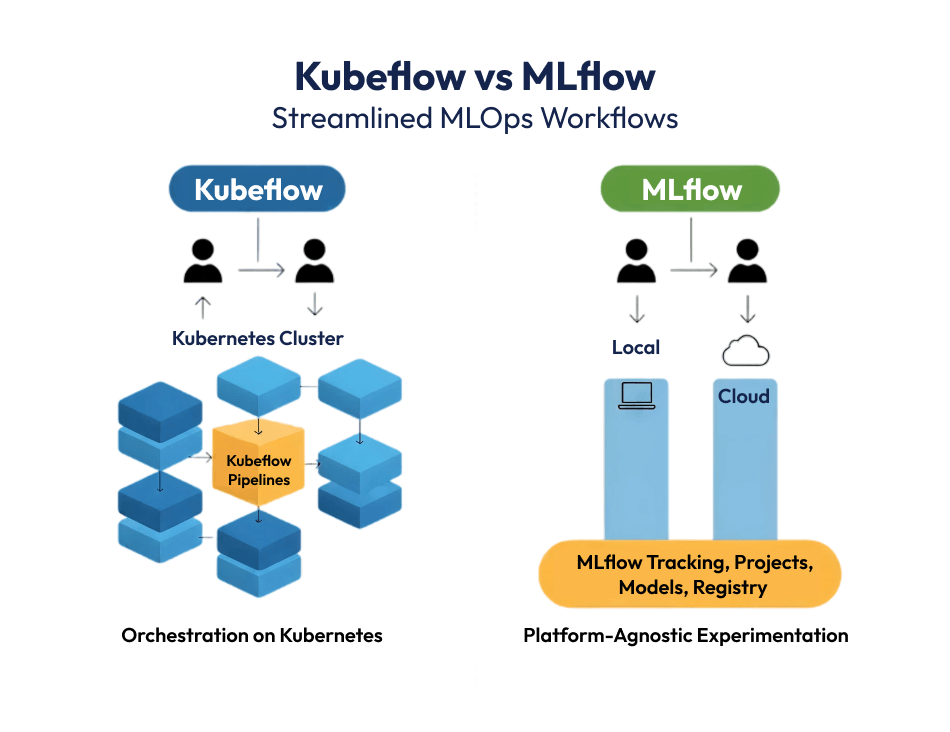
MLOps is the backbone of scalable AI. It covers orchestration, deployment, experiment tracking, model registry, versioning, and continuous monitoring. With so many global MLOps platforms out there, choosing MLOps framework options wisely matters.
Right now, 2 names dominate enterprise conversations:
The Kubeflow vs MLflow comparison reflects different philosophies. One focuses on containerised ML pipelines at global scale. The other keeps workflows simpler, perfect for teams building fast, iterating faster.
Kubeflow is a cloud-native platform designed to run machine learning on Kubernetes. It is built for complex, production-level automation. If your AI needs serious pipeline orchestration, Kubeflow is your friend.
Key highlights:
Think of Kubeflow as your high-performance engine. Robust, scalable, and ideal for enterprise teams building mature ML ecosystems.
Strong opinion time. If you love Kubernetes, Kubeflow will feel like home. If you do not, this tool may test your patience.
Kubeflow is not a single tool, but an ecosystem of tightly integrated modules built to streamline orchestration ML workflows at scale and support end-to-end model lifecycle automation.
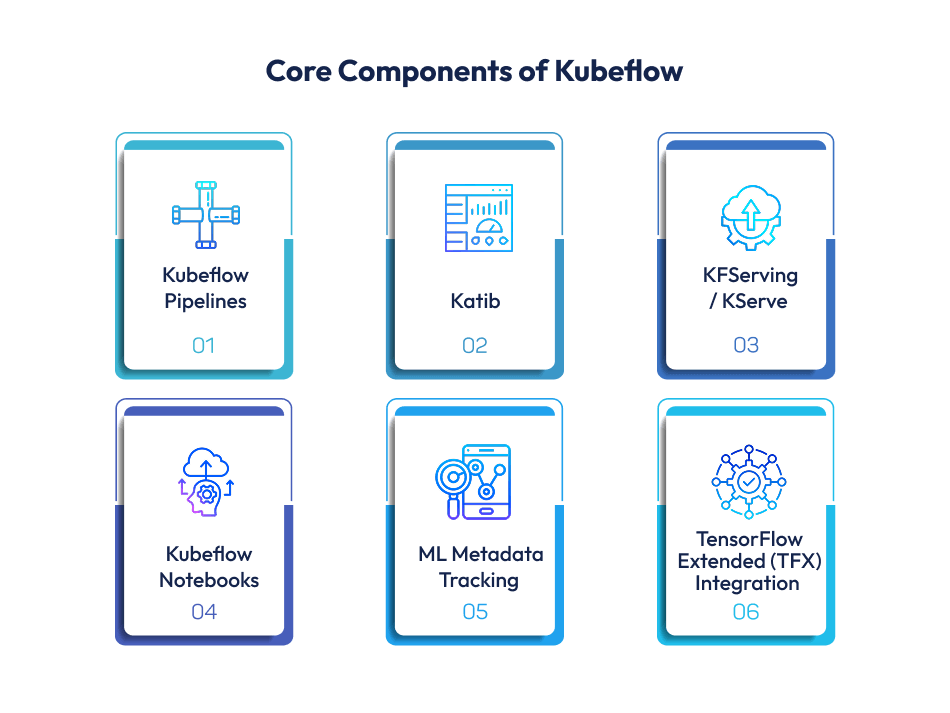
These components enable orchestration, automation, version control, and production-grade serving, making Kubeflow a top choice for enterprises building complex and containerised ML pipelines globally.
Kubeflow thrives where scale, automation, and Kubernetes obsession converge. It is not lightweight, it is industrial strength. Exactly why large enterprises prefer it for mission-critical AI workloads.
👉Suggested Read: RAG vs. Fine-Tuning vs. Prompt Engineering: Optimizing Large Language Models
MLflow is an open-source platform that makes experiment tracking and model lifecycle management easy. Developers adore it because it is lightweight, flexible, and cloud-agnostic.
Key highlights:
If your team is starting its MLOps journey or experimenting heavily, MLflow is sweet. It feels like that friend who always helps without overcomplicating things.
MLflow is structured into modular components, giving you full control of the model lifecycle without forcing specific tools or cloud environments. These components enable experiment tracking, reproducibility, model deployment, and structured collaboration, making MLflow ideal for scaling MLOps for AI application development teams.
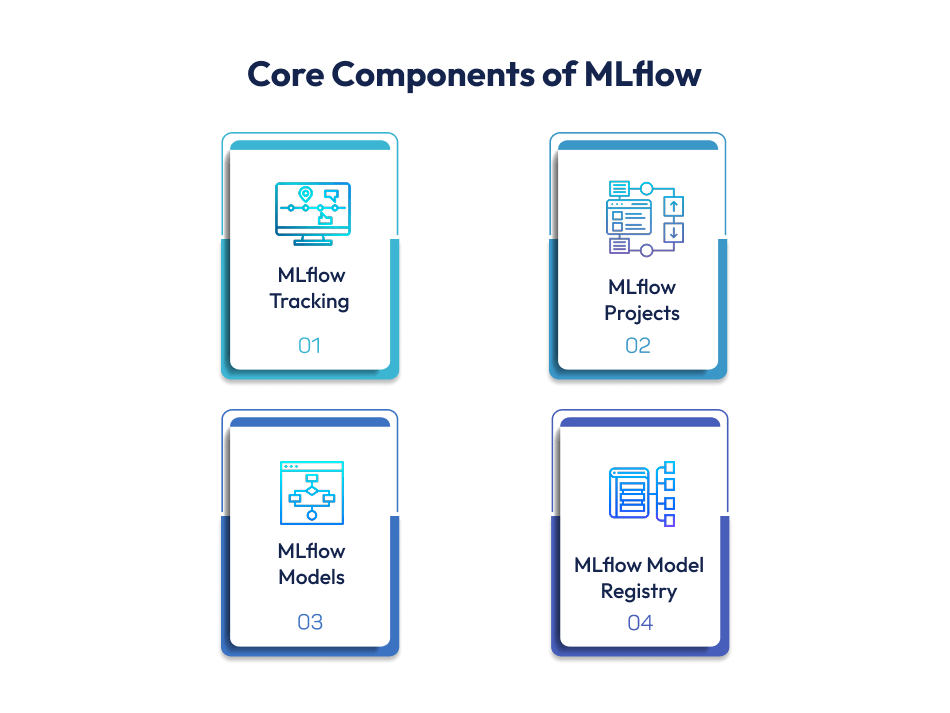
Together, these components deliver structured lifecycle management without forcing heavy Kubernetes adoption. That makes MLflow especially powerful for teams who want efficiency, speed, and cross-platform compatibility before stepping into containerised ML pipelines globally.
MLflow shines in fast-moving environments where rapid experimentation meets smart structure. If scale becomes a priority later, MLflow can integrate into broader orchestration ML workflows at scale or even complement a Kubernetes-native setup like Kubeflow for hybrid MLOps strategies.
| Criteria | Kubeflow | MLflow |
| Deployment Style | Kubernetes-native | Any cloud or local |
| Scalability | Enterprise-grade at scale | Strong, but lightweight |
| Pipeline Management | Advanced orchestration ML workflows at scale | Limited pipeline automation, great for experimentation |
| Learning Curve | Steep | Easy and smooth |
| Ideal Users | Teams needing containerised ML pipelines global | Teams wanting tracking and quick experimentation |
| Experiment Tracking | Basic built-in metadata support | Best-in-class experiment tracking with MLflow |
| Model Registry | Limited native features; external integrations used | Mature model registry in MLflow for lifecycle governance |
| Serving & Inference | KFServing/KServe for enterprise deployments | Deployment possible, but requires more engineering effort |
| Ecosystem Complexity | Full enterprise MLOps suite, many moving parts | Modular, simpler components, plug-and-play vibe |
| Cloud Support | Best on Kubernetes workloads, multi-cloud friendly | Cloud-agnostic, integrates with AWS, Azure, GCP, Databricks |
| Setup & Infrastructure | Heavy setup, infra-intensive | Lightweight, easy to start |
| CI/CD Compatibility | Strong for container-based pipelines | Works with broader CI/CD tools, simple integration |
| Team Skill Requirement | Requires DevOps + ML Engineering maturity | Suitable for data science teams starting MLOps |
| Best Use Case | Orchestration ML workflows at scale + production systems | Experiment tracking, versioning ML models globally, early-stage MLOps |
| When to Choose | When scale, automation, and Kubernetes obsession meet | When simplicity, iteration speed, and flexibility matter most |
Verdict?
The Kubeflow vs MLflow decision depends on your maturity level and infrastructure appetite. Production-heavy AI loves Kubeflow. Rapid research and iteration thrive on MLflow.

Pick Kubeflow if your machine learning roadmap already leans toward long-term scalability, enterprise-grade precision, and fully automated MLOps execution. Kubeflow thrives in environments where orchestrating ML workflows at scale is not optional, but a foundational requirement.
If you are designing containerised ML pipelines used globally and planning to support distributed training, GPU utilization, and repeatable workflows across Kubernetes clusters, Kubeflow becomes the most strategic choice.
Opt for Kubeflow when you need:
In short, Kubeflow shines when you are building serious machine learning systems for enterprises and need scalable machine learning workflow tools that align with Kubernetes architecture. If your engineering culture adopts DevOps maturity and long-term infrastructure thinking, Kubeflow pays off big time.
Pick MLflow if your focus lies in rapid model iteration, structured experiment tracking, and simplified lifecycle control without overwhelming operational complexity.
MLflow’s lightweight architecture is ideal for teams scaling their MLOps maturity gradually, especially when balancing cloud experimentation with production-ready model registry and lifecycle visibility.
Choose MLflow when you need:
MLflow wins when teams prioritize velocity and structured model management throughout R&D, while retaining flexibility to expand into more container-native ecosystems later.
It is perfect for teams choosing MLOps framework pathways that evolve from experimentation to production without rushing into heavy infrastructure upfront.
Honestly, neither wins universally. That is the beauty of modern MLOps framework comparison thinking. The question is not who beats who. It is which one aligns with your current AI adoption stage.
The smartest teams mix both. They start fast with MLflow, then evolve into Kubeflow as workloads grow and the business demands production-grade automation.
Here is the real power move: the future is hybrid.
👉Must Read: Scaling AI: Challenges, Strategies, and Best Practices
This is where intelligent AI teams play. Instead of choosing one, they integrate both tools to build scalable machine learning workflow tools and future-proof MLOps pipelines.
Hybrid looks like this in practice:
This approach allows you to preserve experimentation velocity while gaining infrastructure muscle. You do not sacrifice agility for scale, or scale for simplicity. You get both.
Companies adopting hybrid MLOps strategies end up with:
This setup hits beautifully for teams building AI-driven products, where research speed matters early, and operational excellence matters later.
The hybrid approach is not a trend, it is a future-proof engineering mindset. Scale where necessary, stay lightweight when possible. The balance is where innovation lives.
Before we close out the Kubeflow vs MLflow debate, there is one thing you should absolutely think about…
The next era of MLOps is not just about tracking experiments or deploying models faster. It is about building intelligent, self-running ML systems that scale across clouds, handle data drift automatically, retrain models without human push, and keep performance tight in production.
Basically, AI workflows are growing up.
No more manual ML babysitting.
No more scattered pipelines that break under real-world load.
Enterprises want:
This is exactly where tools like Kubeflow and MLflow fit in. Kubeflow brings Kubernetes-driven scalability. MLflow gives structured lifecycle management for rapid model iteration. Together, they shape the foundation for truly autonomous ML systems.
In short, the winners in enterprise AI will not be the ones who build models the fastest. They will be the ones who build scalable, intelligent MLOps pipelines that run quietly in the background and keep improving without manual hustle.
The future is automated, adaptive, and production-first. That is where you want your AI stack headed.
Scaling AI is mainly about choosing a workflow mindset. Kubeflow vs MLflow is not a “this or that” fight, it is a maturity curve.
You need someone who understands both the startup-velocity phase and the enterprise-hardening phase of AI systems. If you plan to scale AI applications globally, it helps to have a partner who has done it before.
Being a top mobile app development company, Techugo has an experience in working across enterprise-level Kubernetes deployments and rapid ML MVP cycles. Techugo builds AI apps using Kubeflow when teams need automated, distributed, enterprise-grade pipelines. Techugo uses MLflow for rapid ML app development, fast model iteration, and experiment tracking. That means you get the right MLOps setup aligned with your business stage, not just trending tools.
If you ever feel the need of MLOps consulting services or need help with AI-integrated app development, you can always reach out to the Techugo team that is fluent in both Kubeflow and MLflow.
Let our experts turn your model into a living, scalable product instead of a forgotten notebook script.

Scaling AI is not simply about training bigger models. It is about building a system that never breaks when reality hits. The Kubeflow vs MLflow choice plays a direct role in your AI future, your engineering culture, and your ability to stay competitive in global AI app development services.
Go with the option that fits your maturity, not the option that sounds trendier online. Smart AI teams build thoughtfully, not impulsively.
If you need expert help choosing MLOps for AI application development or implementing the right stack, Techugo’s professional MLOps consulting services can accelerate your journey. WhatsApp us today.
The real difference in the Kubeflow vs MLflow conversation comes down to scale, flexibility, and your MLOps maturity. Kubeflow is a Kubernetes-native MLOps framework designed for enterprise-grade, containerised ML pipelines that need orchestration of ML workflows at scale. It shines when you want automated training pipelines, distributed compute, and workflow automation for production ML.
MLflow focuses more on experiment tracking, model registry, and lightweight model lifecycle management. It lets teams handle model versioning and R&D workflows without wrestling with infrastructure. If your goal is fast experimentation with flexible cloud or on-prem setups, MLflow wins. If you want scalable machine learning workflow tools that feel built for global AI platforms, Kubeflow dominates.
Choose Kubeflow when your team has a Kubernetes mindset and wants enterprise-ready MLOps for AI application development. If your ML workloads are huge, if you care about pipeline orchestration, if you want reproducible workflows and automation at scale, then Kubeflow is not optional, it is the backbone.
Companies that care about containerised ML pipelines globally, CI/CD for machine learning, and GPU-optimized distributed training lean toward Kubeflow. Think of it as the go-to framework for global AI-powered product teams and mature digital enterprises building long-term AI roadmaps.
Yes, and honestly this combo is underrated. A hybrid MLOps framework setup lets you enjoy the best of both worlds. Teams use MLflow for experiment tracking, versioning ML models globally, and managing model registry workflows. Meanwhile, Kubeflow handles orchestration of ML workflows at scale, pipeline automation, and production deployment on Kubernetes.
This approach is becoming popular in global MLOps platforms because it speeds up research cycles while maintaining serious production-grade control. It fits teams scaling AI systems that start scrappy and then evolve into full cloud-native MLOps ecosystems.
For beginners and early-stage ML teams, MLflow is way smoother. It is lightweight, cloud-agnostic, and insanely simple for experiment tracking and model lifecycle management. It does not force you to understand Kubernetes on day one, so you can ship experiments without tears.
Kubeflow demands Kubernetes-native thinking. If your team lacks DevOps experience or you are not yet building scalable ML pipelines, Kubeflow might feel heavy. Start with MLflow when learning MLOps fundamentals, then graduate to Kubeflow once your AI stack grows and you need serious pipeline automation.
Kubeflow is built for enterprise AI and production-grade deployment at scale. It supports containerised ML pipelines, automated training workflows, and orchestration for massive datasets running across distributed infrastructure. If you are a global enterprise with complex AI workloads, Kubernetes-native MLOps Kubeflow hits harder.
MLflow supports scaling too, particularly when combined with platforms like Databricks, but it shines more in R&D and early-production setups. Many enterprises start with MLflow for experimentation, then move to Kubeflow for long-term scaling and global model operations.

A healthcare team decides to build an AI app; the goal is to detect a rare disease early because patient data already exists inside the Electronic Hea..


The idea of pharmacy app development in the UAE can feel overwhelming at first. From planning the features to understanding regulations and prepar..


Write Us
sales@techugo.comOr fill this form