

 SA
SA
 KW
KW
 IE
IE AU
AU UAE
UAE UK
UK USA
USA
 CA
CA DE
DE
 QA
QA ZA
ZA
 BH
BH NL
NL
 MU
MU FR
FR















📌 Key Takeaways
- A basic ambulance app with just booking and tracking costs $10,000, adding AI dispatch and analytics pushes it past $150,000.
- An ambulance app without load testing before launch will crash exactly when multiple emergencies hit simultaneously.
- Healthcare apps legally require high-level encryption and regulatory compliance.
- Smart dispatch assigns the nearest available ambulance automatically.
Emergencies don’t wait. And at such crucial times, it is usually the speed of assistance that determines the difference between life and loss.
However, the old-fashioned ambulance services remain in the mire of the outdated processes: it takes a long time to call, there is no certain availability, and no real-time visibility. That is why ambulance booking app development is on the rise, helping healthcare providers get to patients quicker and handle situations more efficiently.
Nowadays, technology enables one to order an ambulance easily, just like they can order a taxi. It only takes a few taps to dispatch, track, and coordinate help with hospitals in real time. But then, what is the cost of developing an ambulance booking app?
To be fair, the development cost of such an app can range widely, with the simplest apps costing about $10,000, and the most loaded and high-performance apps running up to $150,000. However, when you decide to deal with a healthcare app development company, it will be easier to do so, and it will be easier to scale up the final product.
This guide takes you step-by-step: the features of these applications, their prices, and how to create one that actually works when you need it the most.
Also Read – Cost To Develop a Healthcare App Like Patient Access in 2025
What is an ambulance booking app & how does it work?
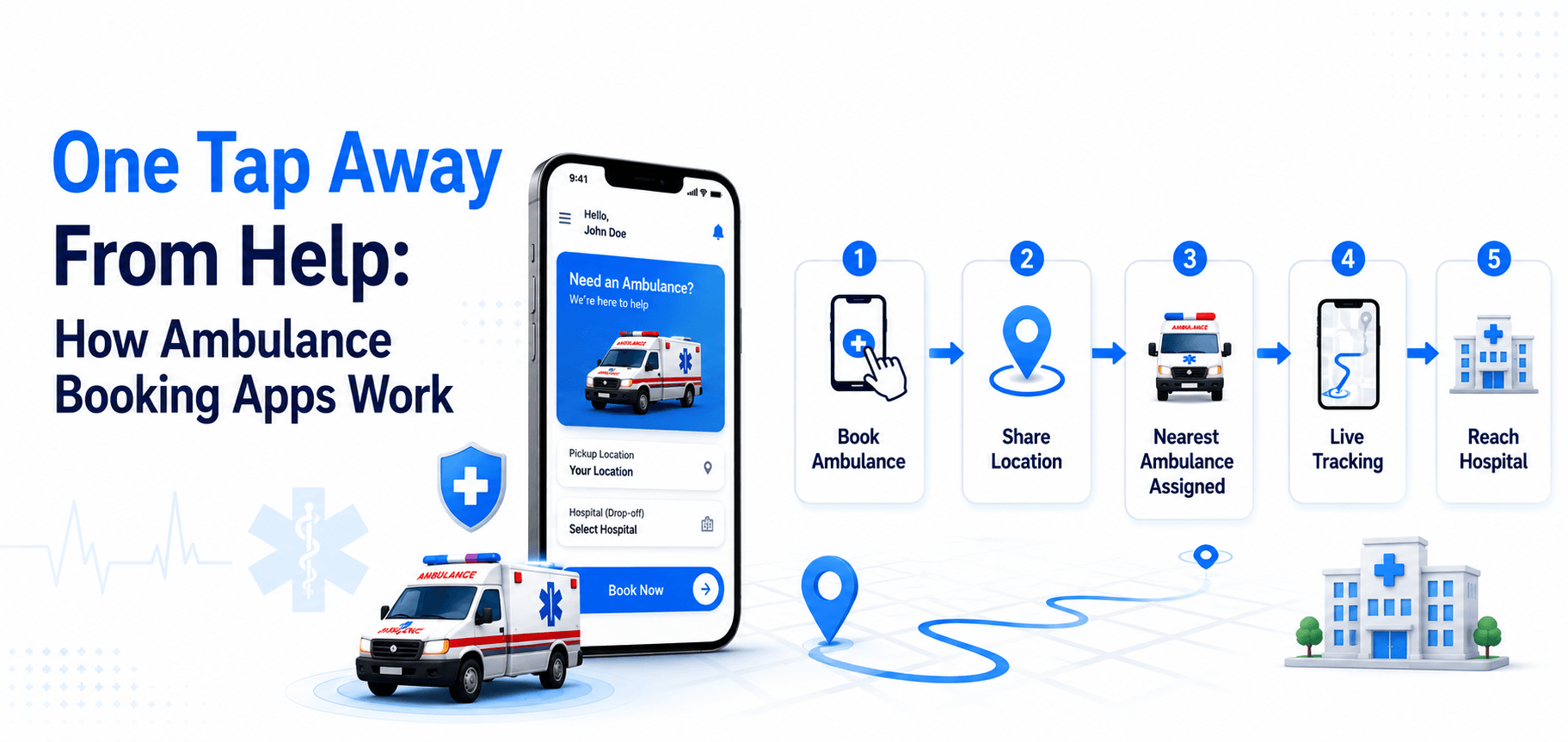
An ambulance booking app can be described as a platform of real-time coordination that integrates patients, ambulance drivers, and healthcare facilities into one ecosystem.
It is intended to be a quick, intuitive, and reliable process. A user opens the app, automatically broadcasts their location, and orders an ambulance. The system immediately recognizes the vehicles around it, allocates the nearest one, and allows it to be tracked in real time until it reaches the destination.
In the background, ambulance tracking app development plays a critical role. It ensures that both the user and the control center have complete visibility into movement, delays, and estimated arrival time.
The ability to book is not the only power of these apps, but also coordination. Patients can alert hospitals in advance, paramedics can have information about the patient early, and the time of response is considerably minimized.
Core features that define a high-performing ambulance app
Not everyone can make it in this space. The ones that are built are built on accuracy, speed, and reliability.
The ambulance application cannot be a one-time interface. It is a fully operational ecosystem that is driven by several fundamental functionalities that can guarantee speed, coordination, or reliability at each stage.
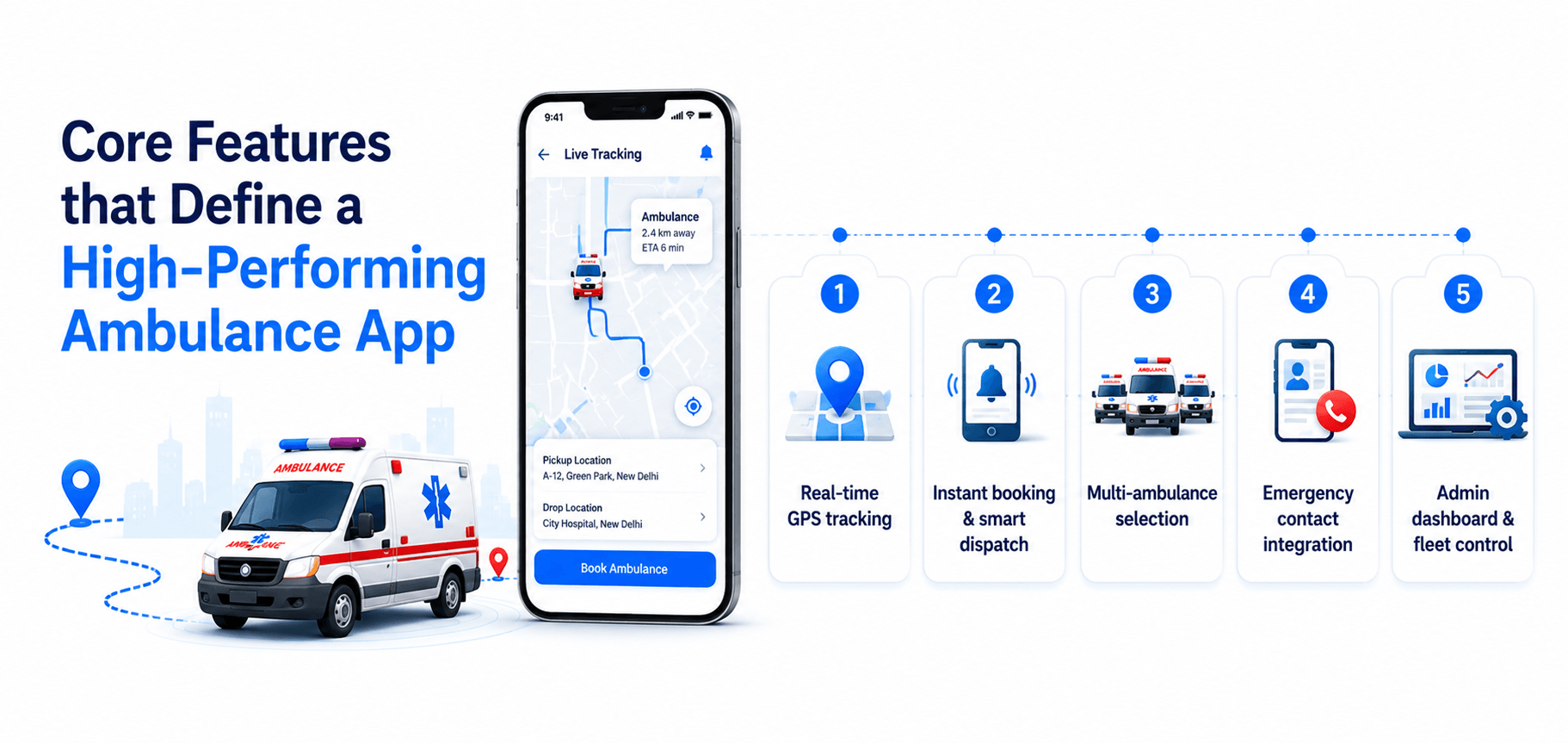
1. Real-time GPS tracking
This is the pulse of the whole application. Real-time tracking enables users to know the exact position of the ambulance as soon as it is sent out. It eliminates doubt and instills instant trust in situations that are stressful. On the operational level, it also allows admins to track the movement of the fleet and make sure that it is allocated efficiently. In the absence of this feature, the app is deprived of its greatest strength, visibility.
2. Instant booking & smart dispatch
Even several seconds count in cases of emergencies. A smart booking system will enable customers to send an ambulance with a tap or two, and the service will automatically dispatch the closest available ambulance. This is further improved by smart dispatch systems that take into account the traffic conditions, distance, and urgency levels. This is the aspect that makes sure that speed is not reliant on manual intervention.
3. Multi-ambulance selection
Each emergency is unique, and the response must be equivalent to the need. This enables users to decide on the ambulance type needed, be it a simple transport ambulance or a full-fledged ICU ambulance. The app provides an alternative, so patients can get the necessary amount of care immediately. It provides flexibility and efficiency to the service.
4. Emergency contact integration
Emergencies are not only personal issues, but family problems as well. Through this feature, users can immediately inform the selected contacts about the booking of an ambulance. Others can share live tracking links, keeping loved ones in the know at any given time. This gives a touch of reassurance to an otherwise stressful situation.
5. Admin dashboard & fleet control
The secret of all seamless user experiences lies behind a robust control system. The admin dashboard is the command center where operators can manage ambulances, keep track of response time, and monitor overall performance. It also gives information that assists in refining the operations in the long run. In its absence, it makes scaling of the platform very hard.
Must-have features that support these core functionalities
Although the main features are the defining trait of the system, a few support components that make all things run smoothly are present:
- In-app payments and automatic billing.
- Push notifications and real-time notifications.
- Navigation and route optimization.
- Data encryption and security measures.
All these factors enhance the overall functionality and stability of the platform, and they are necessary to provide efficient features of ambulance booking apps.
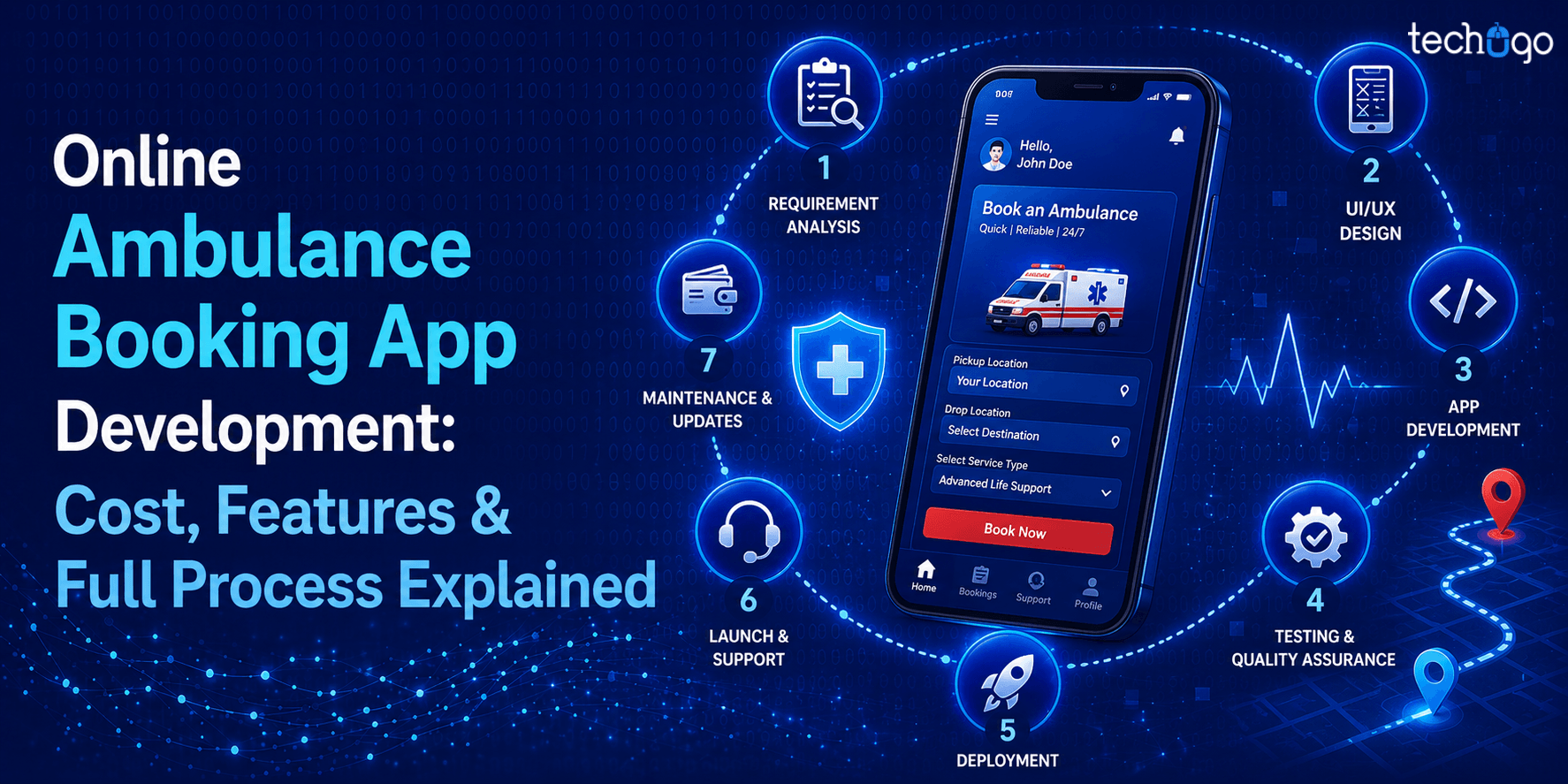
Step-by-step ambulance booking app development process
In case you don’t know how to build an ambulance booking application, here is a brief overview of how the whole process works:
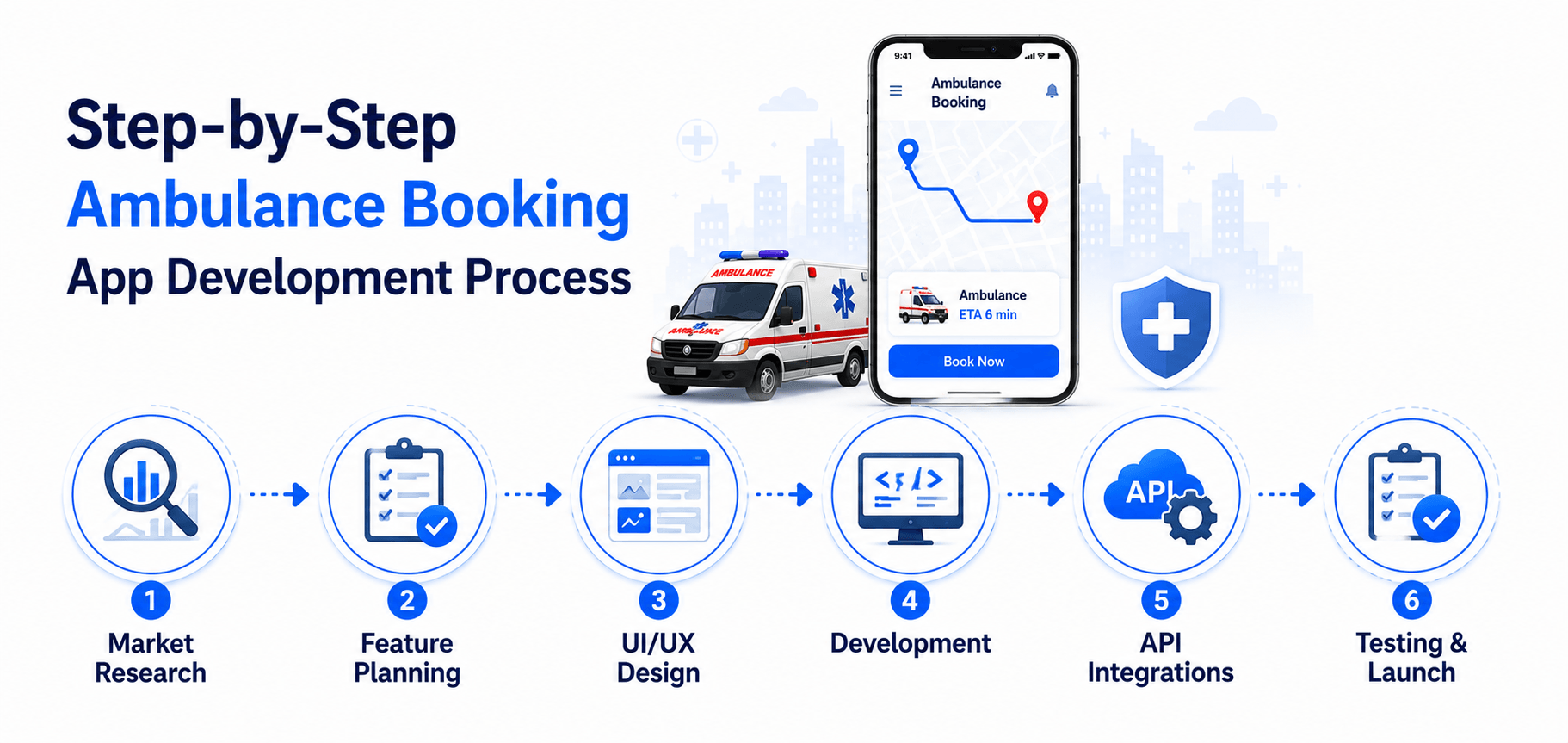
We will now divide this process into parts, without making it too difficult.
Step 1: Market research
It all starts with having the actual problem you are solving. This isn’t just about looking at competitors. It is concerned with researching the existing functionality of ambulance services, where delays occur, and what users have trouble with in emergencies. You must have an understanding of your target audience, the areas that you are serving, and the gaps that your app can possibly cover.
This move predetermines all that is to come. With poor research, your whole app will seem out of touch with the real world. But when it is done properly, it will provide you with a definite direction and guarantee you are creating something that people will actually depend on.
Step 2: Feature planning
After knowing what you need to solve, the next thing is how your app will solve it. This is where feature planning fits in. Not like a checklist, but as a strategy in making decisions.
You specify the functionality that your application will consist of, including the ability to book an ambulance, real-time tracking, dispatch smartly, and emergency alerts. Be it a lean MVP (Minimum Viable Product) or a full-blown platform, a well-defined set of features will help you avoid confusion in the development process and will help make sure that your project is on track with regard to its budget and what it will achieve.
Step 3: UI/UX design
Next is the element that directly influences user experience: design. However, design here is not about making things look good, but about making them work immediately.
Users will not take the time to browse your app in case of an emergency. They must move quickly. This is why your interface should be easy to use, simple, and without any distractions. The experience is smooth during stressful moments with features such as automatic location detection, easy-to-understand action buttons, and a fast booking process. An effective user interface/user experience not only enhances the ease of use, but it also has a direct effect on the rate at which assistance can be provided.
Step 4: Development
This is the stage where your idea begins to become a working mechanism. Front and back-end development occur simultaneously to maintain a smooth flow of information between what is visible to the user and what is going on in the system.
The application should be able to process real-time requests, sustain a data feed, and support multiple users without performance problems. Stability and scalability are of paramount importance, since this is not the type of application where downtimes and lag can be tolerated. The robust development stage guarantees your platform is able to operate well in real-life conditions.
Step 5: API integration
Integrations make everything alive when the core system is developed. Here, your app interacts with other services that enable real-time operations.
GPS services provide real-time tracking, communication APIs provide notifications and alerts, and payment gateways facilitate easy transactions. These integrations make sure that users, drivers, and admins are in touch with each other at any given time. They make even a well-developed app seem unfinished and disconnected without them.
Step 6: Testing & launch
The app must be tested prior to its launch as though it were already in use during a real emergency situation. This requires the testing of performance under load, the checking of tracking accuracy, and the testing of all features operating without any delays.
After all the arrangements are made, the application is started. But that’s not the end of the journey. The platform needs to be efficient and scalable through constant monitoring, updates, and improvements. Reliability is not a single accomplishment in a space such as this; it is one that you keep up.
Tech stack for ambulance app development
It is technology that makes it all work. The right stack makes sure that your application runs efficiently even at peak time.
An example of a simplified breakdown of some of the most common technologies used is as follows:
| Layer | Technologies |
| Frontend | Flutter, React Native |
| Backend | Node.js, Django |
| Database | MongoDB, PostgreSQL |
| APIs | Google Maps, Twilio |
| Cloud | AWS, Microsoft Azure |
Always remember that choosing the right tech stack for ambulance app development is less of a fad and more of a reliable choice. The aim is to create a system that is capable of processing real-time requests without failure.
Ambulance app development cost breakdown
Cost is a determinant for businesses venturing into this space. However, rather than searching to find a set number, it is better to see what makes the cost.
The following is a realistic estimate:
| App Type | Estimated Cost Range | What You Get |
| Basic App (MVP) | $10,000 – $30,000 | Core features like booking, basic tracking, and limited UI |
| Mid-Level App | $30,000 – $80,000 | Real-time tracking, better UI/UX, payment integration |
| Advanced App | $80,000 – $150,000+ | Smart dispatch, analytics, multiple integrations, scalability |
The ambulance app development cost must be estimated based on long-term value and not short-term cost. A robust platform does not just bring in revenue but also instills trust and confidence in the healthcare ecosystem.
What has the most influence on the cost?
The final cost isn’t random; it’s influenced by a few key factors.
First, there is the feature set, which is a significant factor. The simplest booking system will be much cheaper than an application incorporating AI-powered dispatch, real-time analytics, and IoT connections. Next is platform choice (iOS, Android, or both), which also has a direct impact on development time and cost.
Another large factor is team location. When you work with a mobile app development company in USA, you are likely to receive benefits such as enhanced compliance management, technical excellence, and international standards.
So, what should you expect?
If you’re just testing the waters, a basic app can get you started within a limited budget. But if your goal is to build a scalable, reliable platform that performs well under real-world pressure, investing in a mid-to-advanced solution is the smarter move.
At the end of the day, the cost to build an ambulance booking app should be seen as an investment in performance, reliability, and long-term growth, not just a one-time expense.
Challenges in ambulance app development & practical solutions
Creating an ambulance app is not that easy. Actually, it is among the most challenging types of mobile app development.
The first obstacle is often the level of real-time tracking. Even the slightest delays or improper location information can disrupt the whole experience. That is why it is necessary to have high-quality GPS systems and backup tracking mechanisms.
Another important issue is data security. As healthcare apps are sensitive, high-level encryption and adherence to regulations are of paramount importance.
The optimization of response time is also to be considered. The system should be able to automatically allocate ambulances depending on the position, traffic, and urgency.
Some of the typical issues encountered by developers are:
- Maintaining real-time accuracy
- Securing privacy and compliance of data.
- Reducing response delays
- Combining with hospital systems
The key to effective emergency healthcare app solutions is in solving them.
Future trends in ambulance app development
The future of this space is also being determined by the novelties of technologies, which extend and exhaust the possibilities.
Artificial intelligence is also being applied to optimize the dispatch systems so that the nearest ambulance is assigned immediately. IoT devices are facilitating real-time monitoring of the patient, and the hospital will be ready prior to the arrival of the patient.
Another new trend is predictive analytics, which assists in determining high-risk areas and enhancing emergency preparedness.
As ambulance tracking app development evolves, such innovations will provide emergency response with increased speed, intelligence, and efficiency.
Techugo’s role in building future-ready ambulance booking apps
With over a decade of experience, Techugo has built a strong reputation as a trusted healthcare mobile app development company, delivering healthcare solutions that are not just functional but built for real-world performance. Our team understands the importance of speed, accuracy, and a smooth coordination process, particularly in emergency-centered platforms such as ambulance booking apps.
Techugo is enabling businesses to develop scalable, reliable, and user-friendly solutions to pressure by integrating knowledge of healthcare and on-demand development of the app.
Here’s how Techugo supports your journey:
- Builds real-time tracking and smart dispatch systems for faster response
- Designs simple, user-friendly interfaces that work in high-stress situations
- Develops scalable apps that grow as your business expands
- Ensures secure data handling and compliance with healthcare standards
- Integrates advanced tech like AI and analytics for better performance
Got the idea? Let’s turn it into an app people can rely on, every single time. Connect with Techugo.
FAQs
Q1. How much does ambulance booking app development cost?
Ans) This is all based on the complexity of your app. The simplest model may cost as low as ten thousand dollars and the more sophisticated app with all its features may even exceed $150,000.
Q2. How long does it take to build an ambulance booking app?
Ans) The average is 3-6 months. An easy app can be developed quicker, whereas a platform with functionalities and integrations will be time-consuming.
Q3. What features should an ambulance booking app have?
Ans) At least it must have real-time tracking, fast booking, intelligent dispatch, emergency contact alerts, and an administrator panel to coordinate everything without any problems.
Q4. Should I start with an MVP or build a full app?
Ans) It is usually a good idea to start with an MVP. It allows you to test your idea, receive feedback, and refine the app to take it to the next level.
Q5. Why work with a healthcare app development company?
Ans) Because they are aware of medical-related requirements, such as data security, compliance and real-time systems which assists in making the development process more fast and certain.

Get in touch
We'd love to hear from you.