

 SA
SA  KW
KW  IE
IE AU
AU UAE
UAE UK
UK USA
USA  CA
CA DE
DE  QA
QA ZA
ZA  BH
BH NL
NL  MU
MU FR
FR [ LET’S TALK AI ]
X
Discover AI-
Powered Solutions
Get ready to explore cutting-edge AI technologies that can transform your workflow!



Get ready to explore cutting-edge AI technologies that can transform your workflow!






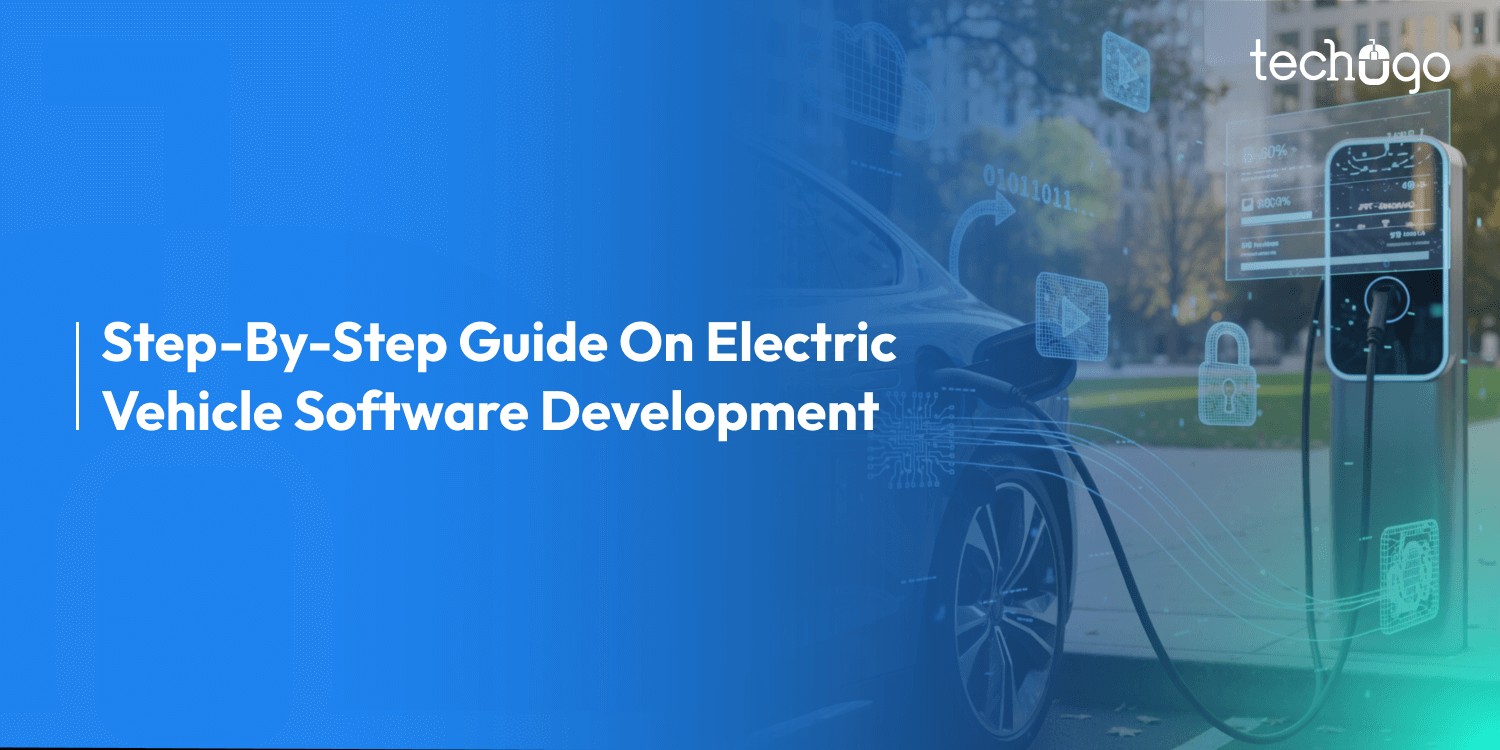
If we were to rewind life a decade or two, everyone imagined “future cars” as wild machines powered by water, air, or honestly… pure sci-fi vibes.
And sure, those ideas are still floating around. But we did not get flying cars in every neighborhood (not yet, at least). Instead, we invented something way more realistic and world-changing, i.e., Electric Vehicles.
Tesla did not just build an EV (electric vehicle). It has created a new definition of mobility. It took a dream from the late 90s, turned it into a mission, and the luxury EV (Electric Vehicles) era began. Suddenly, every automobile giant woke up like, “Okay, time to go electric or go extinct.”
Now, electric vehicles are the future that every nation, startup, investor, and eco-geek is betting on. But…EVs are not driven by batteries alone. They are also driven by software.
Everything from charging to navigation, battery health to remote controls, fleet tracking to autonomous driving…It is all powered by smart EV software development.
So if you are curious about how EV tech really works, how to build EV software step-by-step, or how to create apps for EV charging, telematics, etc, you are in the right place.
This blog breaks it all down in simple language. Just clean EV insights, real examples, and practical steps to electric vehicle software development.
If you imagine the world of cars just a few years ago, software was mostly an after-thought. Today it’s front and centre. The market for electric vehicles is booming, and with that comes a massive surge in demand for EV software development.
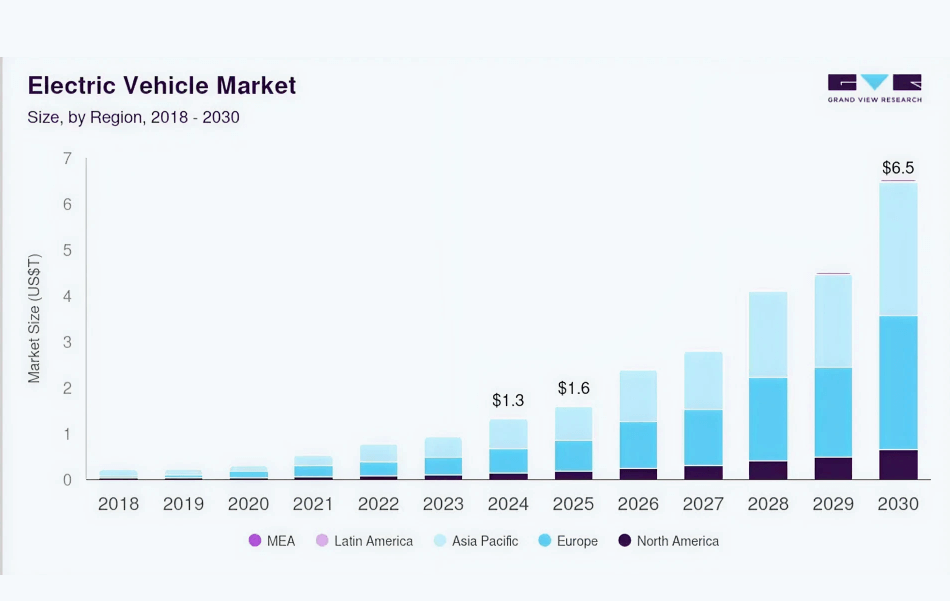
(Source: Grand View Research)
According to a recent report by Grand View Research, the global electric vehicle market size was around USD 1,328.08 billion in 2024.
By 2030, it is projected to hit USD 6,523.97 billion, growing at a CAGR of about 32.5% from 2025 to 2030.
What does that mean for us in the software space? It means every EV (passenger car, truck, bus) is becoming more than metal and battery. It is becoming a connected, software-driven system. So electric vehicle software development services and EV software architecture aren’t nice-to-haves. They’re central.
Market Dynamics
EVs are rising. Every dollar spent on EV manufacturing represents a need for EV software because they are incomplete without software, and this is where the role of app development companies comes into play. They help automotive business with –
Regulation and policy also push this trend. Governments are tightening emissions rules and incentivising EVs. That means OEMs and startups alike must invest in connected vehicle software development and strong digital ecosystems.
If you want to enter into this market as a product writer, software architect, or marketing lead, you cannot ignore electric vehicle software development. Because as you know, the hardware gets the headlines, but the software is what scales value.
The next step is to explore the step-by-step guide on how to build EV software, from concept to launch and app features to cost of development.
EV software development is exciting in a way only the future of mobility can be. Consider it as if you’re creating the digital nervous system of an electric vehicle.
We are talking about everything from battery intelligence to connected mobility experiences. Below is how the journey unfolds, step by step. For now, let us begin with the first step:
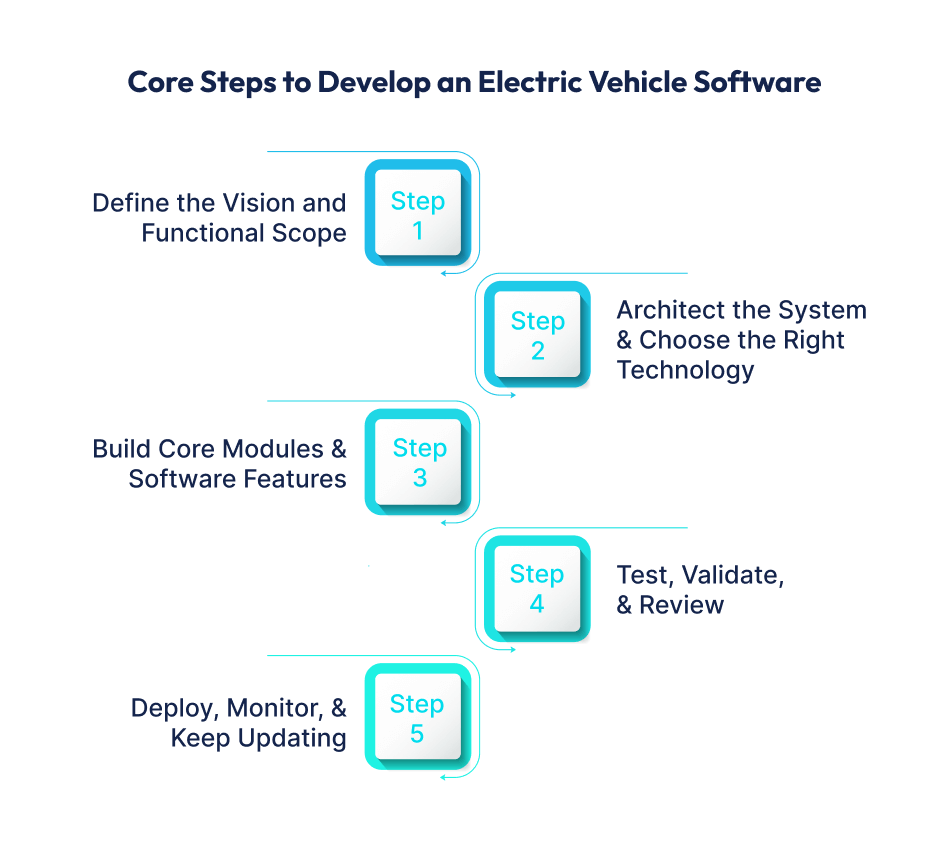
Every great EV ecosystem starts with clarity. Before building anything, you need answers. Real and future-proof answers. Ask yourself:
This phase shapes everything ahead.
Key elements to define here:
This is where your “big EV idea” becomes a structured roadmap. Get it right, and scaling becomes smoother. If you skip it, and the entire project stumbles later.
A strong vision lets you confidently choose the right partners, too. An experienced automotive app development company with clarity drives capability. Because the EV revolution rewards those who plan smart and build smart.
EV software is not a weekend app project. It handles real-time data, battery intelligence, charging networks, telematics, safety logic, and sometimes autonomous layers. So your EV software architecture must be tight, scalable, and secure.
What happens here:
Because laggy telematics? Not acceptable.
Unreliable fleet data? Huge red flag.
Weak BMS logic? Safety nightmare.
Tech choices matter too:
C++, Python, Rust for control logic.
Cloud + IoT frameworks.
Mobile frameworks for EV mobile app development.
This phase basically decides if your EV product is future-proof or future-problematic. Get the structure right now, scale like a legend later.
This is where your EV software moves from blueprint to behavior. This step is like assembling the digital engine of your electric vehicle ecosystem.
You are now building the core layers, like:
Every feature has a purpose here (Energy efficiency, safety, convenience, and connectivity). This is not about adding features fast. It is about adding features that work flawlessly under real driving conditions.
The dev team focuses on writing scalable, low-latency code, integrating EV hardware interfaces, and ensuring that communication is stable with cloud + edge systems. Then the focus must be on building EV mobile app features that feel intuitive and reliable, and securing data flows end-to-end.
This phase is intense, like code reviews, testing loops, and real-world parameters. But you are literally shaping how the EV behaves, learns, responds, and grows.
Remember, EV software development is a responsibility because every module you build becomes a part of someone’s daily mobility experience. Once these core modules are functional, we step into validation and testing.
EV software cannot just “work.” It has to survive real-world problems like cold weather, low network zones, charging interruptions, high-load telematics data, battery stress, and fleet-scale usage.
You test for all of it. Because in the EV world, bugs don’t just annoy users; they risk safety, performance, and trust.
This stage focuses on:
If your software holds up everywhere – in a remote mountain road, a busy highway, a scorching summer afternoon, a freezing morning, and a crowded charging station – you are on the right path.
EV software development demands proof, not confidence. Once the software passes stress, safety, and performance checks, you prep for real-world rollout. That’s where we step into deployment, monitoring, and continuous improvement.
Your EV software is finally ready to meet the real world – real roads, real drivers, real data. Deployment in the EV ecosystem is not a big-bang launch. It is controlled, monitored, and constantly tuned. Because the first version is never the final version in EV software development.
It is just the beginning.
What happens now:
Every data point becomes insight. Every insight becomes an upgrade.
Maybe your predictive battery analytics need fine-tuning. Maybe your telematics engine needs lower latency. Maybe fleet operators request smarter route logic.
Okay, you just adapt. That is how modern EV software development works: ship, measure, refine, repeat.
The truth is simple – EVs live and breathe software. The companies that are winning today are not just launching products. They are iterating relentlessly, building smarter systems every month, not every generation.
Tesla does it. Rivian does it. BYD does it. Any electric vehicle software development company aiming to lead must do it too.
Continuous monitoring keeps your system future-proof, scalable, and customer-obsessed. Because the EV revolution isn’t static. It is growing every charging cycle, every firmware push, and every mile driven.
Modern electric vehicles run on intelligence, not just energy. So every feature in EV software exists to solve a real-world mobility problem. Here is what that looks like.
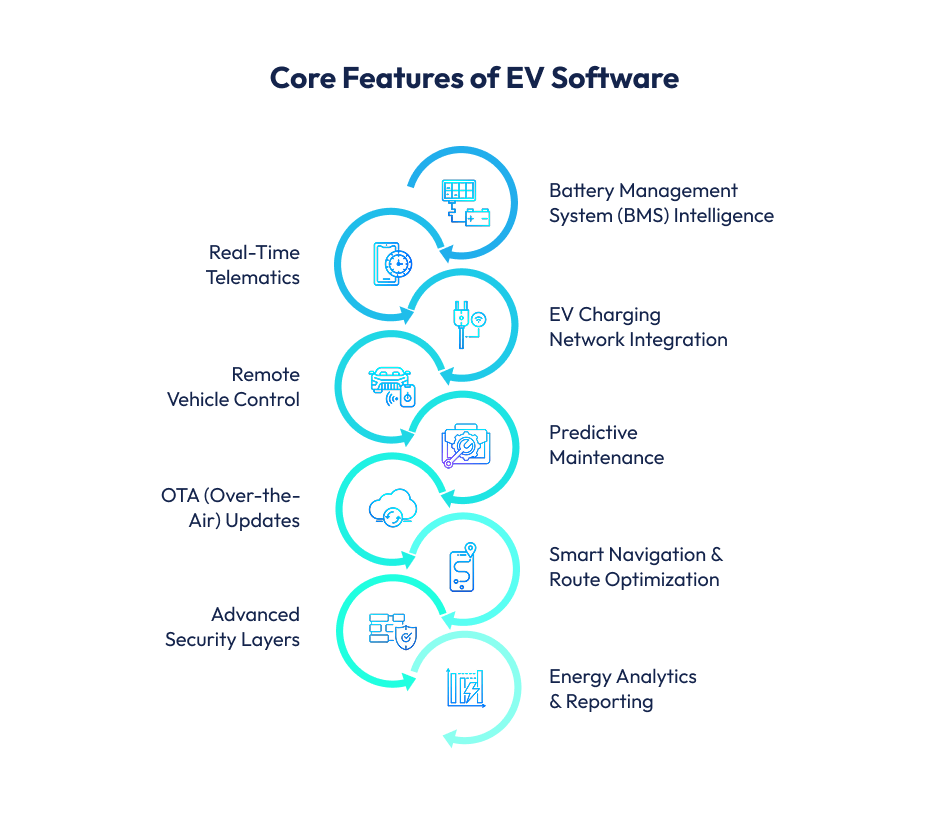
A smart BMS monitors temperature, voltage, and charging cycles in real time. That means your EV stays efficient, avoids overheating, and maintains healthy charging behavior.
Better efficiency. Better safety. Fewer battery replacements. In other words, your EV lasts longer and performs better every day.
Telematics pulls live vehicle data such as location, energy usage, motor performance, and more. Drivers get live alerts and insights. Fleet operators get control and transparency. This results in optimized routes, reduced downtime, and better cost management.
Your EV app can locate chargers, show availability, enable payments, and manage charging sessions. Drivers avoid “charging anxiety.” Plus, charging stations get smart load balancing and data insights. This is extremely convenient for EV users.
Whatever a user wants – lock/unlock, pre-cool the car, check charge status, schedule charging, track vehicle, they can do all via EV mobile app. Drivers love control. OEMs love user engagement. So this is a win-win for both.
Sensors + AI. They both track component health, like battery, motor, brakes, etc. So instead of finding problems late, the system predicts issues early in time. That means, there are fewer breakdowns, lower repair expenses, and higher vehicle uptime.
A user receives updates on new features, bug fixes, and performance improvements via electric vehicle app. This is just like receiving updates on a smartphone, but for your EV. No downtime. No hassle. Always up-to-date performance.
With an EV-optimized navigation feature, the app suggests the best route based on charging level, charger availability, and terrain. This gives drivers the confidence to travel long distances, and ultimately they can save time and energy along the way.
Each EV app designed by experienced EV software development companies like Techugo, includes encryption, secure APIs, anomaly detection, and user-auth controls. They are non-negotiable as they protect vehicle data, prevent unauthorized access, and keep everything cyber-safe. So trust is the currency here.
EV apps can track consumption patterns, charging behavior, and energy waste. This way drivers can optimize habits and reduce operating costs on the fleet. So here you can say that data is power.
Each of these features of EV software work together for the single objective, i.e., to provide a clean, connected, and intelligent transportation experience.
If you are willing to build in this space, whether it is EV app development, BMS software development, or connected vehicle ecosystems, these features are everything.
Yeah, building EV software is not just about slapping code onto batteries and calling it a day. The EV ecosystem runs on hyper-connected intelligence, and that means developers face real-world engineering, safety, and compliance puzzles every single step of the way. Here is what makes electric vehicle software development uniquely complex.
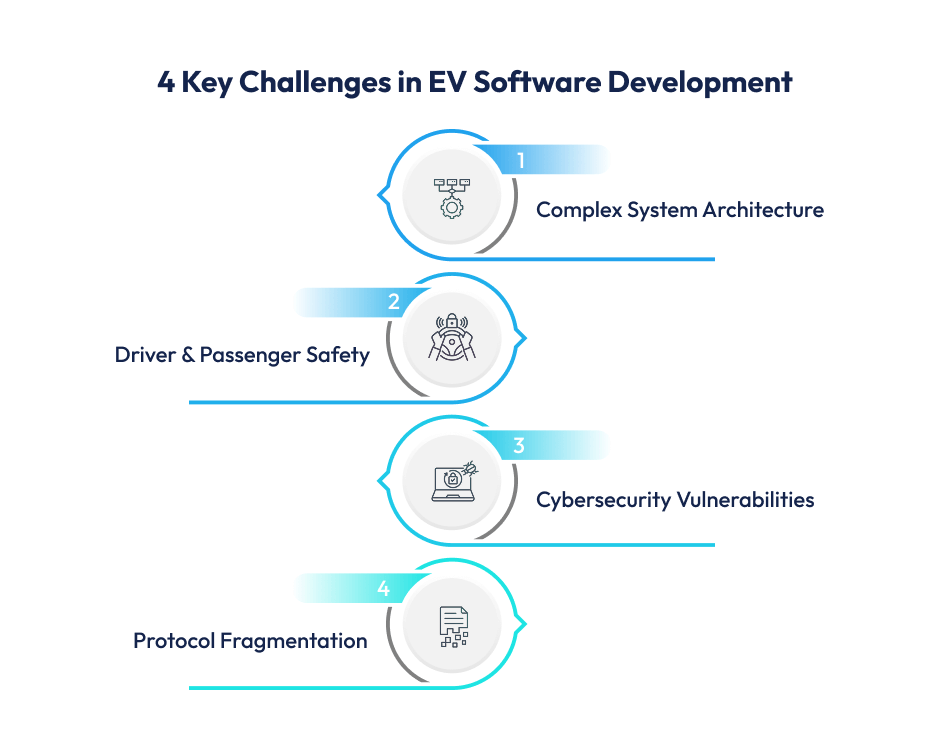
EV software development demands orchestration across battery systems, power electronics, charging modules, telematics, and vehicle control units. Everything has to communicate flawlessly in real time, without compromising safety or performance.
Safety frameworks like Automotive Safety Integrity Level (ASIL) matter here. Developers must engineer architectures that comply with them while balancing cost, compute power, and weight.
Modern EV players are also shifting toward consolidated ECUs instead of multiple distributed units. One core ECU means cleaner integration, lower hardware load, and reduced manufacturing complexity. Still, achieving that unified architecture takes serious engineering strategy.
In EVs, software literally impacts lives.
Battery Management Systems (BMS), thermal control, regenerative braking logic, power inverter software, and onboard diagnostics must operate with a zero-failure mindset.
One glitch in battery monitoring or motor control can trigger overheating, performance drop, or unsafe driving conditions. That is why EV safety software must be robust, fault-tolerant, redundant, and compliant with functional safety standards.
Basically, if the system flinches, the road feels it. No room for sloppy logic.
Electric vehicles are connected machines. OTA updates, cloud telematics, mobile apps for vehicle control, Wi-Fi integration, and even USB ports create massive digital attack surfaces.
DDoS threats, firmware tampering, malware injection, and data breaches are not hypothetical. Hackers love high-value, always-connected targets.
Plus, compromised charging infrastructure or BMS tampering can ripple into urban energy grids. The cybersecurity stakes are wild here, and EV manufacturers cannot ignore it.
EVs talk to chargers, backend cloud systems, OEM servers, mobile apps, and diagnostics tools. The problem? Charging protocols and communication layers differ across regions, OEMs, and hardware providers.
Developers must build network stacks that guarantee interoperability across CCS, CHAdeMO, GB/T, and emerging charging standards. If the EV software does not speak every charging language fluently, users get stranded and brands lose trust.
Every EV must charge, connect, and communicate universally.
So, you’re excited about the EV software development. The natural next question is: what’s the total cost of EV software development?
Short answer: there is no one-price-fits-all number.
Long answer: your cost depends on your vision, features, technology used, level of intelligence you want in the software, and who you partner with for development.
Electric vehicle app development requires more intelligence, automation, and safety layers which mean deeper engineering, safety compliance, real-time data handling, and cloud architecture. Naturally, that all reflects in cost and timeline.
Below is a realistic industry-aligned estimate you can use as a benchmark.
| Complexity Level | Estimated Cost | Timeline | What You Get |
| Basic EV Software | $40,000 to $60,000 | 3 to 6 months | Basic BMS monitoring, navigation integration, simple telematics, charging support |
| Mid-Level System | $60,000 to $120,000 | 6 to 9 months | Advanced battery analytics, smart charging, OTA updates, cloud sync, app + vehicle integration |
| Advanced EV Software / Full Suite | $120,000 to $300,000+ | 9 to 18 months | AI-driven range prediction, predictive maintenance, cybersecurity layers, fleet dashboards, ADAS tie-ins, interoperability protocols, private cloud & ECU-level intelligence |
If you are building EV software, you already know this space is intense. Real-time battery intelligence, secure telematics, charging network integration, AI-powered insights, fleet dashboards… nothing here is “simple code.”
That is exactly where Techugo fits in.
As a leading automotive mobile app development company in USA and Middle East, Techugo has been building web and mobile apps with real-world performance in mind.
We will help you add features that matter, for example:
As we’re one of the best mobile app development service providers, we build security and compliance into every layer. You do not want your EV system exposed, and we get that.
The goal is simple: to help you build EV software that feels intuitive, performs consistently, and scales with your product roadmap, not against it.
Clean UI. Reliable architecture. Smarter mobility. That is how Techugo builds for the EV era.
Smart EVs need smart software. The brands that win tomorrow will be the ones building intelligence, user trust, and seamless digital experiences today.
EV software controls everything from battery performance and charging to navigation, telematics, and remote vehicle functions. It is basically the brain that keeps the EV safe, efficient, and smart.
The timeline depends on complexity, integrations (BMS, telematics, charging ecosystem), and safety compliance. On average, development ranges from 4 to 12 months for a full EV software stack or EV mobile app.
Core elements include BMS software, telematics modules, OTA update framework, cybersecurity layer, charging network integration, and an EV mobile app dashboard. The system usually combines embedded software, cloud platforms, and mobile interfaces.
Pricing varies based on feature scope, hardware integrations, AI-powered functionalities, and testing needs. Typically, cost ranges from $40,000 to $500,000+ depending on whether you are building a fleet product, EV charging app, or full EV operating software.
Yes. Modern EV apps include predictive analytics, diagnostics, live telematics, remote locking, climate control, and charge management to give users more control and reduce breakdown risks.
Social media isn’t what it used to be. For years, platforms have relied heavily on ads, data tracking, and algorithms that shape what users see online..

In the growing food and grocery delivery market, taking your first step is only feasible when you have an application or have given the task to someon..



Write Us
sales@techugo.comOr fill this form