

 SA
SA  KW
KW  IE
IE AU
AU UAE
UAE UK
UK USA
USA  CA
CA DE
DE  QA
QA ZA
ZA  BH
BH NL
NL  MU
MU FR
FR [ LET’S TALK AI ]
X
Discover AI-
Powered Solutions
Get ready to explore cutting-edge AI technologies that can transform your workflow!



Get ready to explore cutting-edge AI technologies that can transform your workflow!






Mobile apps in Saudi Arabia are not just digital tools anymore, and they are no longer limited to simple tasks either. Rather, they are becoming the main way people bank, and shop, and book homes, and access daily services, because the smartphone has slowly turned into the first screen for almost everything.
Saudi government offers full support and smartphone use is also rising every year. That is why the growth in 2026 will not be driven only by basic mobile apps, but by smarter and more industry-focused platforms that can handle real business demands.
Now the question is not whether a business must invest in mobile apps, but how a business can stay relevant when user expectations have already changed. Brands have been pushed to rethink what they build and why they build it. You need to understand which technologies matter, and how user behaviour is changing, and where the real opportunities exist, so that your investment does not turn into just ANOTHER app.
The next wave of mobile app development trends in Saudi Arabia will be shaped by AI, data-led personalisation, IoT integration, 5G, etc. Reason? users now expect apps to understand them. This blog, therefore, breaks down the key app development trends for 2026 and explains what they mean in practical terms for businesses that are building in Saudi Arabia.
Almost everyone here is already on mobile, and heavily so. In fact, smartphone penetration was more than 92% in 2024, and mobile internet use was close to universal, which means mobile apps are a must for businesses because users use them on a daily basis for banking, shopping, ride-hailing, etc. Also, data says that the mobile app development market in Saudi Arabia is now expected to cross $2.3 billion by 2030. That means the market is not just active, but structured for long-term growth.
There are a few core forces pushing the mobile app scene forward:
Also Read: $22B by 2030: Building Software in a Growing Saudi Arabia Software Market
So if you are thinking about mobile apps for your business, here’s the practical takeaway: It’s not enough to have an app, but it is about how well your app works with the realities of user behavior because people expect fast, secure, personalized mobile experiences and they are familiarised to that level of polish in the apps they already use every day.
You need to think deeply about…
_why you’re building for mobile,
_what problem you solve, and
_how you leverage local trends, especially where AI, payments, e-services, and data personalisation intersect.
If you plan for AI, data analytics, and 5G-ready capabilities, this will help your app stay relevant in a market because it is a market that is not just growing, but growing very quickly.
For brand, businesses, startups, and investors as well, it is important to look at the following top trends in mobile app development in Saudi Arabia:
Also Read: AI in Automotive Industry: 6 Trends Shaping Saudi Arabia’s Mobility Future
Super apps bring many services into one place. Payments, shopping, bookings, and support all sit inside a single interface. This model is growing because users prefer fewer apps, and businesses want stronger engagement. So instead of building one function, companies are building platforms.
For your business, this changes the goal. The app is no longer just a tool. It becomes an ecosystem. A place where users return often because more needs are met in one flow. This is why super app development in Saudi Arabia is gaining attention across transport, retail, and service sectors.
What defines this trend:
Super apps are a crucial part of digital transformation in KSA and they support growth and convenience at the same time, and this is the reason why they are moving from idea to strategy in many industries.
Also Read: Why Businesses Are Investing in Super App Development Like Gojek: 8 Key Reasons
AI will not be an extra feature in Saudi apps in the coming app, rather, it will be built into the core because digital transformation in KSA has pushed many brands to move faster, therefore, users now expect apps to respond in real time. Therefore, AI in mobile apps is being used to guide decisions, reduce manual work, and improve accuracy as well.
For your business, this changes how apps behave. They are no longer static. They learn from what users search, click, and ignore. A real estate mobile app can suggest properties based on past choices. A service app can flag risky activity before it becomes a problem. It sounds advanced, but it is now part of everyday software development.
Automation is also growing. Tasks that were handled by support teams are now done inside the app. Forms are checked automatically. Requests are sorted without delay. This matters because the app development market in Saudi Arabia is expanding, and apps must handle more users without slowing down.
If you are building a custom app, the shift is clear. Apps will predict instead of wait. Apps will act instead of ask, that is why, many mobile app developers in Saudi Arabia are now designing systems where AI not just adds smart features for show-off, but supports performance in long-term and speed.
Today’s chatbots can provide contextually relevant answers to questions asked by users and therefore can provide meaningful responses faster. For companies needing systems that provide constant uptime (or very little downtime), they want intelligent chat systems. So chat is no longer just support. It is becoming part of the main app experience, and Generative AI is changing how apps talk to users.
For your business, this means the app can explain, guide, and even suggest actions in real time. A user can ask a question, and the app can generate a clear response instead of sending them to a help page. It feels simple. But behind it, AI in mobile apps is learning from past queries and improving over time.
These chatbots are also being used inside workflows. They help fill forms, track requests, and summarize information. It reduces friction. And it saves time, because fewer steps are needed to complete a task. Many teams in modern software development now design chat as a function, not just a feature.
This shift will matter more because the app development market in Saudi Arabia is growing, so businesses will need interfaces that feel human and work at scale. That is why generative AI, as well as intelligent chatbots, are becoming a practical layer in daily mobile apps; they’re not an experiment anymore.
Also Read: Agentic AI vs Generative AI: Understanding the Future of Intelligent Systems for Businesses
Cloud-based apps are becoming the default choice because they are easier to scale and faster to update. This will be a major driver for their widespread adoption. Developers will choose to save all of their application data in the cloud instead of on the user’s device. With the increase in demand due to user growth (number of users is increasing) and with expected increases in app traffic from multiple platforms (i.e., mobile and web browsers), this means that the cloud has become an integral part of application performance, not just a back-end solution.
For your business, this means updates can be pushed without forcing users to reinstall. It also means better speed and lower infrastructure stress. Many teams in software development now build apps with cloud-first logic so that growth does not break performance.
Key shifts you will see:
As the app development market in Saudi Arabia expands, cloud-based systems help companies stay flexible instead of locked into rigid setups.
5G is changing what mobile apps can actually do. Speeds are higher, and delays are lower, so apps can respond almost instantly, and this matters because users now want smooth video, fast actions, and updates in real time. And because networks are improving, apps are being designed to use that speed instead of waiting for it.
This means richer features without slowing the app down, and it also means new use cases that were not practical before. Live tracking, instant payments, and real-time support are becoming normal parts of the app flow.
What this trend enables:
As digital transformation in KSA continues, 5G is not just network progress. It is shaping how mobile apps are built and what users expect from them.
AR and VR are becoming less of a novelty and more of a usable tool for consumers. Instead of just showing information, apps can now show experiences, like users can see products in their room, walk through virtual rooms, and they can even explore places before visiting physically which is great for real estate businesses. This is possible and happening because visual decision-making is faster, and businesses want to leverage that and reduce uncertainty for users.
For your business, this means apps can explain more with less text. A user does not have to imagine. They can see. And that changes how trust is built inside the app.
Where this trend is showing up:
By 2026, AR and VR will not be limited to gaming or marketing. They will be part of everyday mobile app development trends in Saudi Arabia, especially in sectors where visual clarity improves decisions.
IoT connects devices and apps serve as the central “hub” to control devices. There is a growing trend in Saudi Arabia among companies to link mobile applications to smart devices so that their users can monitor, manage and/or automate various tasks using their mobile phones. The main reason for this growth is that customers expect to have seamless experiences across all of their devices, as well as wanting companies to provide them with actionable insights based upon data. As a result, an application is no longer just an independent entity, but it interacts with the greater digital ecosystem.
What does this mean for your business? Your application (mobile or otherwise) can communicate with sensors or “smart devices,” allowing you to provide customers with smarter, more efficient services. For example, a mobile app from a real estate company may be linked to smart home devices and allow users to monitor their energy consumption and/or security through their smart device.
Key applications you’ll see:
As digital transformation in KSA grows, IoT integration will become a standard expectation rather than a luxury feature.
Users now want their apps to understand them, not just their clicks, but their preferences, habits, and needs, and this is possible through hyper-personalisation. AI and data insights are collected so that every interaction feels tailored for hyper-personalisation. This is important because users don’t think twice before uninstalling apps that are slow or feel common.
For your business, this means apps can recommend products, suggest services, or adjust interfaces based on the user’s history. A real estate mobile app can show listings matching someone’s past searches, preferred locations, and budget range.
Key elements of hyper-personalisation:
By 2026, mobile app developers in Saudi Arabia will focus on personalisation as a core feature. It is no longer optional, now, apps must be intuitive, responsive, and smart to stay competitive.
In 2026, apps in Saudi Arabia cannot afford to treat security as an afterthought. With increasing data usage and stricter regulations, companies need to build apps with cybersecurity and data privacy at the core. This is happening because users expect their information to be safe, and breaches can destroy trust overnight.
For your business, this means your app must protect sensitive data, encrypt transactions, and comply with local regulations from day one. It is about avoiding risks, of course, but more about building confidence with users so they feel safe interacting with your app.
Key practices to focus on:
As the app development market in Saudi Arabia grows, security-first development will be a key differentiator. Companies that ignore it risk losing both users and credibility, while those who prioritise it gain a competitive advantage.
Vision 2030 is driving digital transformation in KSA, and mobile apps are at the centre of it. The government has pushed for smarter cities, cashless payments, and accessible public services, so companies have had to rethink how their apps work.
For your business, this means the focus is not just on features, but on speed, scalability, and compliance. Apps are being designed to handle large user bases, support government initiatives, and integrate with other platforms. And because Vision 2030 emphasises innovation, technologies like AI, cloud computing, and IoT are expected.
Key ways Vision 2030 impacts apps:
So, if you are planning a mobile app for Saudi users, then aligning it with Vision 2030 is a strategic move and ensures your app is relevant and ready for the future.
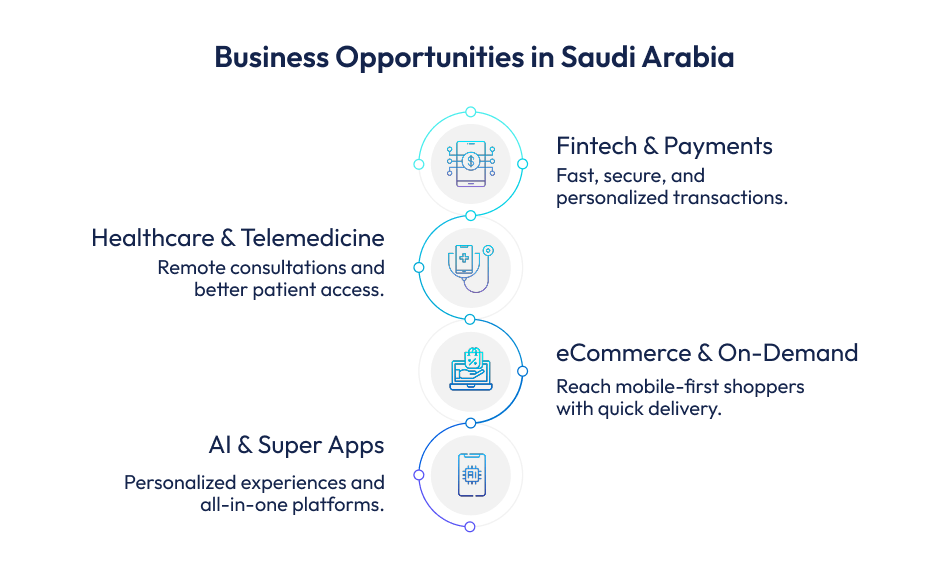
The app development market in Saudi Arabia is expanding rapidly, creating clear opportunities for companies across industries. Mobile apps are essential channels for engagement, sales, and operations. Some key opportunities include:
Invest now to grow with Saudi Arabia’s digital economy.
Investing in custom apps that use these trends positions your business to grow as Saudi Arabia’s digital economy expands, while those who wait risk falling behind.
Also Read: Why Marketplace App Development is the Next Big Investment in Saudi Arabia
Building apps in Saudi Arabia comes with many opportunities, but it also has its challenges. The app development market in Saudi Arabia is growing fast, and companies need to be ready for hurdles so that their apps succeed.
One major challenge is data privacy and cybersecurity. Users expect their information to be safe, and regulations are strict. Apps that don’t comply risk losing trust and facing legal issues.
Another challenge is keeping up with rapid technology changes. AI, cloud systems, IoT, and super apps are evolving quickly, so developers need to stay updated. Otherwise, apps can become outdated before launch.
There is also the challenge of user expectations. People want apps that are fast, reliable, and personalised. If an app is slow, confusing, or limited in features, users will drop it.
Finally, finding skilled mobile app developers in Saudi Arabia can be difficult. Companies need experts who understand local market needs, regulatory requirements, and advanced technologies, so that apps work at scale and meet user expectations.
In short, while the opportunities are huge, companies must plan carefully, invest in the right technologies, and follow regulations to overcome these challenges.
The mobile app development trends in Saudi Arabia for 2026 and beyond show one thing clearly: apps are becoming smarter, faster, and more essential for businesses.
Be it an AI-driven app or super app across fintech, healthcare, and eCommerce, the opportunities are growing, but so are expectations. Companies that adopt these trends, prioritise security, and align with Vision 2030 will be the ones leading the market.
If you want your business to stay ahead, building a custom app that leverages these trends is no longer optional. It’s a necessity. And that’s where Techugo comes in as a trusted mobile app development company in Saudi Arabia.
With experience across AI, cloud, and industry-specific solutions, Techugo helps businesses in Saudi Arabia and beyond create apps that are not just functional, but future-ready.
So if you’re planning to invest in a real estate mobile app, a fintech solution, or a super app, Techugo’s team can guide you from idea to launch. We also make sure that your app meets local standards as well as user expectations.
A: The biggest opportunities are in industries where mobile apps solve real problems and reach users directly. Fintech and digital payments are booming as people move toward cashless solutions. Healthcare and telemedicine apps are expanding because patients want convenient remote consultations. eCommerce and on-demand services are thriving, catering to mobile-first shoppers. And AI-driven apps and super apps are creating new ways for users to interact with multiple services in one platform. Businesses in these sectors can gain a strong edge by investing in apps now, rather than waiting.
A: AI and super apps are transforming how users engage with mobile platforms. AI can personalise experiences, automate workflows, and predict user needs, making apps smarter and more useful. Super apps combine multiple services—like payments, shopping, and bookings—into a single platform, keeping users engaged longer. By integrating AI and creating super apps, businesses in Saudi Arabia can increase retention, drive more transactions, and stay ahead of competitors.
A: Yes, the adoption of trends like AI, super apps, and advanced personalisation will influence development costs. Apps that leverage AI or integrate multiple services are more complex to build, and security, scalability, and 5G readiness also add to the investment. However, this extra cost is often offset by the higher user engagement, faster adoption, and long-term ROI that these advanced features bring to businesses.
Suppose a parent whose child develops a high fever on a weekend afternoon. It’s not serious enough for the emergency room, but waiting until Monday is..
Each package that goes out in Saudi Arabia or Dubai carries more than just goods. It carries expectations of speed, of accuracy, of a smooth digital e..



Write Us
sales@techugo.comOr fill this form