

 SA
SA  KW
KW  IE
IE AU
AU UAE
UAE UK
UK USA
USA  CA
CA DE
DE  QA
QA ZA
ZA  BH
BH NL
NL  MU
MU FR
FR [ LET’S TALK AI ]
X
Discover AI-
Powered Solutions
Get ready to explore cutting-edge AI technologies that can transform your workflow!



Get ready to explore cutting-edge AI technologies that can transform your workflow!






Enterprise AI agents are a new class of intelligent software “co-workers” that autonomously execute tasks by combining large language models (LLMs), generative AI, and connected data tools as well.
They are not like simple chatbots; rather, these intelligent agents plan and execute multi-step actions based on their objectives (goals), and connect to enterprise systems (CRM, databases, etc.), adapt to changes, and learn from the feedback they receive.
The rate of adoption of AI agents is increasing rapidly. A recent survey found over 50% of businesses already use AI agents in production and 78% plan to deploy them soon.
This trend is transforming workflows from static to dynamic, AI-powered processes. This will have a major impact on the future of new digital products.
OpenAI has recently launched ‘Frontier’. It is a new enterprise platform for building, deploying, and managing fleets of AI agents for businesses. It provides a unified, secure environment where agents operate like “AI coworkers” alongside human teams.
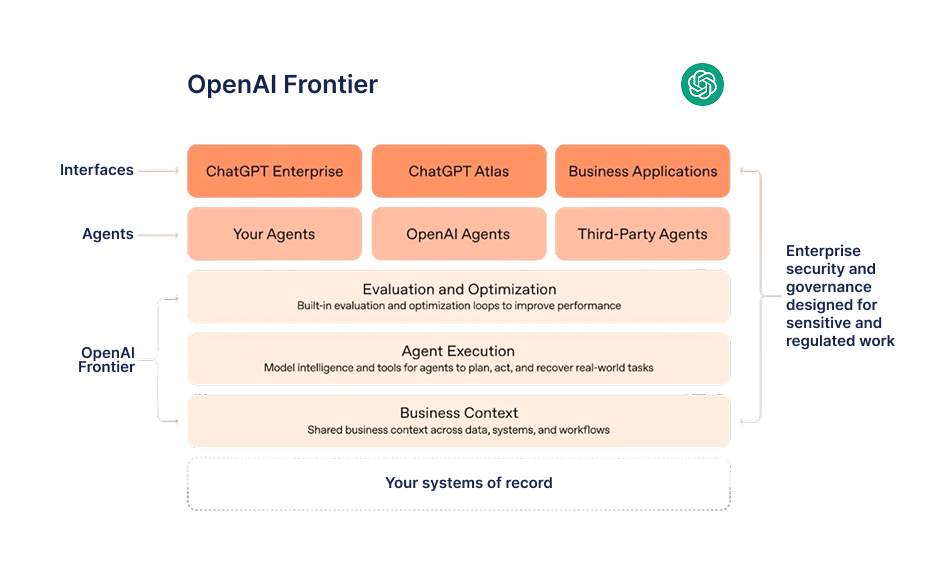
For example, Frontier’s Business Context layer connects to data warehouses, CRM tools, and internal apps, so agents share the same information and institutional memory as employees.
At runtime, its Agent Execution layer lets multiple agents work in parallel on real workflows, applying AI intelligence reliably across systems.
Frontier also has evaluation loops where analytics and feedback are embedded to allow agents to learn from results over time and to become more effective.
It has strong enterprise-grade governance features, such as agent-managed identities, strict permission (access) controls, audit logs, and compliance controls for safeguarding data.
In short, Frontier treats AI agents as if they were employees of a company, with on-boarding, goal tracking, and performance reviews integrated within its platform.
Some of the key features of OpenAI Frontier are as follows:
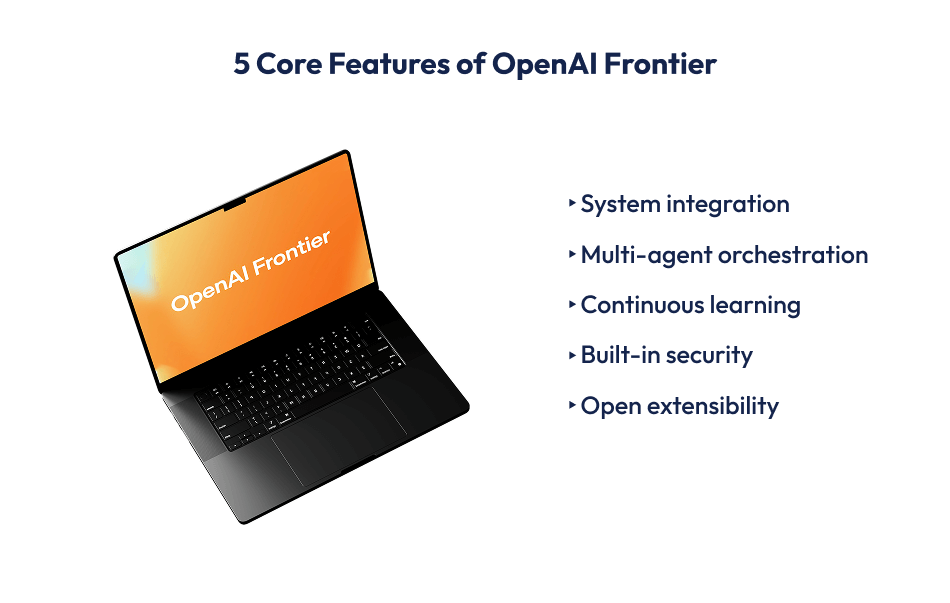
These capabilities mean Frontier isn’t just a chat interface; it’s a full agent workbench and part of a broader class of intelligent automation tools. It launched with pilot customers like HP, Oracle, and Uber (rolling out more broadly soon) and promises to handle enterprise-scale use cases.
In practice, Frontier aims to let developers and product teams quickly embed agents into their digital products or services. For example, a new financial dashboard app could call on Frontier agents to autonomously analyze metrics and suggest actions, all within the same enterprise ecosystem.
AI agents represent a paradigm shift from one-off AI tools to AI-powered workflows. Unlike a chatbot that only answers a query, an enterprise agent can initiate tasks, coordinate with other agents, and act on data automatically.
As BCG notes, agents work 24/7, can handle spikes in demand without extra headcount, and enable business processes to be up to 30–50% faster. They effectively turn static software platforms (CRM, ERP, service desk, etc.) into dynamic ecosystems.
An agent, for example, monitoring an order system, might detect a supplier delay and automatically reroute materials. Previously, these tasks were done manually.
These intelligent agents are designed to be embedded in products and services, not just surfaced as chat windows. Companies are weaving agents into their apps and systems. For example, they’re adding an agent in a mobile app to triage customer requests and plugging one into an analytics dashboard to auto-generate reports.
Microsoft’s Copilot Studio, for instance, lets teams deploy agents into Teams or SharePoint, where they can complete tasks or fetch data without separate user prompts. Similarly, Salesforce envisions an “agentic enterprise” where agents work through Slack and CRM tools in the background.
In short, enterprise AI agents become part of the product experience, powering features and automations under the hood, not merely serving as chat assistants built by a chatbot app development company.
OpenAI’s Frontier joins a fast-growing field of enterprise agent platforms. Each has a different approach:
A component of Microsoft 365, Copilot Studio lets businesses create custom agents tied to their corporate data. It provides templates (for things like scheduling assistants or FAQ bots) and supports voice agents as well as text. Crucially, it integrates with Teams, Office apps, and Power Platform for deployment. Microsoft also introduced “Agent 365” as the unified control plane, extending Microsoft’s security, identity, and management tools to these AI agents.
Salesforce’s answer is to embed agents across its Customer 360 suite. It champions an “Agentic Enterprise” vision, where humans and AI agents collaborate on the same platform. Agentforce 360 connects people, data, and agents in one flow. For example, agents plugged into Salesforce can automate parts of sales or service workflows while a human monitors.
LangChain isn’t a packaged platform but a developer toolkit that powers many AI agents today. It provides libraries to chain LLM calls with tools, APIs, and databases. LangChain and related frameworks are popular for rapid prototyping. However, using LangChain is a DIY approach: teams must build and maintain all the connectors to enterprise data and handle deployment themselves.
Other players (Oracle, CrewAI, and ServiceNow’s Now Assist) offer similar agent capabilities, but Frontier, Copilot, and Agentforce are among the leaders tightly integrated with large enterprise ecosystems. Choosing among them will depend on where your data lives and which vendors fit your stack when planning AI integration services.
Real-world examples show how agents are already improving workflows and enabling new features across sectors:
Large retail chains use AI agents for demand forecasting and inventory optimization. Agents continuously update store-level demand plans by synthesizing sales data and external signals, so warehouses and stores can auto-adjust stock levels.
On the customer side, retailers are adding agents into websites and apps. SharkNinja, for example, deployed a Salesforce Agentforce-powered AI assistant on its e-commerce site to handle routine support queries.
AI agents are automating many back-office tasks in financial services. Banks are piloting “AI-native” operations, using agents to reconcile transactions and flag anomalies across millions of daily events.
Financial advisory and accounting firms report major gains through AI in product development and internal automation.
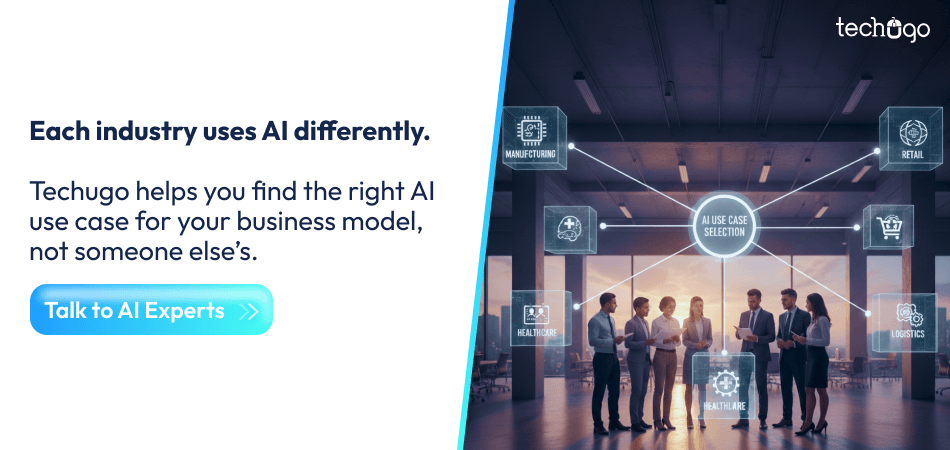
In logistics, agents continuously monitor and adapt.
In warehouses, agents optimize storage and picking by analyzing real-time demand and adjusting inventory flows. In transit networks, agents track shipments and reroute deliveries during disruptions.
AI agents power virtual service layers by summarizing conversations, triaging tickets, and surfacing relevant knowledge.
From healthcare approvals to HR onboarding, data-intensive workflows are increasingly handled by intelligent automation tools.
Each example above shows agents embedded in product workflows, not just as standalone chatbots. They sit inside enterprise systems (CRM, ERP, IoT platforms, etc.), automating processes end-to-end.
For new digital products, this means AI becomes part of the core experience.
For technology decision-makers and product strategists, enterprise AI agents open new possibilities and new questions:
If you’re planning your next digital product, think upfront about where autonomous intelligence fits. Identify repetitive, high-volume tasks that an agent could handle.
Deciding between a managed platform (Frontier, Copilot Studio, Agentforce) and a custom framework (LangChain) is crucial. Managed platforms accelerate deployment, while open frameworks offer flexibility.
Agents will act on your data and systems. Establish scopes, permissions, and human-in-the-loop checkpoints to ensure responsible AI integration.
Start with pilots. Track time saved, error reduction, and user satisfaction. Treat agents as evolving products, not fixed features.
In summary, enterprise AI agents are becoming a foundational technology for digital innovation.
OpenAI Frontier joins a growing lineup of platforms making it easier to embed autonomous, AI-driven workflows into products and operations.
For product leaders, this means new opportunities: your next solution from an AI app development company can bake in digital “co-workers” that operate continuously.
By understanding platforms like Frontier, Copilot Studio, and Salesforce Agentforce, and aligning them with business goals, companies can build products that scale efficiency and unlock new capabilities.
AI agents are becoming part of how real products work, whether it’s customer support, operations, or decision-making systems.
But building them the right way needs more than plugging in an API. It needs product thinking, security planning, and clean system integration. This is where Techugo helps.
As an AI app development company, Techugo works with businesses to design and build intelligent digital products powered by enterprise AI agents and generative AI. From workflow automation to smart chat interfaces, Techugo helps brands turn AI ideas into usable, scalable systems.
Whether you are exploring AI integration services, planning your next AI-first product, or looking for a reliable chatbot app development company, Techugo helps you:
AI is shaping how digital products will be built next. The question is not if you should use it, but how well you use it.
If your next product is meant to be smarter, faster, and more adaptive, Techugo can help you build it that way. Contact us today!
Enterprise AI agents go beyond chat. They can take actions. They connect with business systems. They handle tasks like reports, approvals, and workflows. Chatbots mostly answer questions.
They speed up research. They analyze user data. They help test ideas early. This makes AI in product development more practical, not experimental.
Yes, if built properly. Enterprise platforms focus on access control and data isolation. Businesses still need strong AI integration policies and monitoring.
They work best where processes repeat daily.
When was the last time you really stopped to appreciate just how handy it is to unlock your phone with just your face? We use facial recognition softw..

In the current technologically driven environment, where making a name for startups is difficult, it is best highlighted with the presence of a mobile..



Write Us
sales@techugo.comOr fill this form