


 SA
SA
 KW
KW
 IE
IE AU
AU UAE
UAE UK
UK USA
USA
 CA
CA DE
DE
 QA
QA ZA
ZA
 BH
BH NL
NL
 MU
MU FR
FR

















📌 Key Takeaways
-
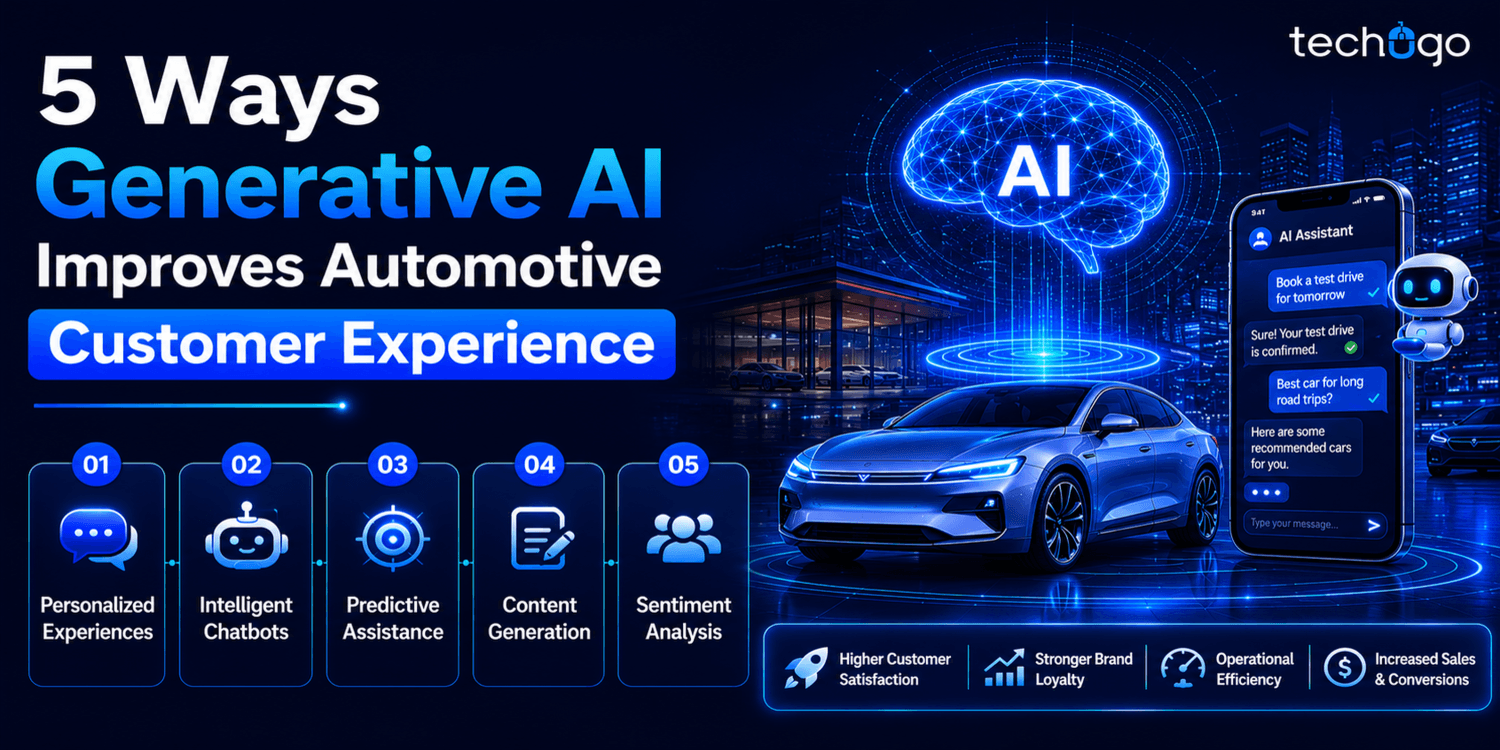
- Brands like BMW, Mercedes-Benz, and Tesla are already using AI to enhance personalization and customer interactions.
- Over 40% of companies are investing heavily in generative AI to improve customer experience and stay competitive.
- Gen AI enables hyper-personalized vehicle recommendations based on customer behavior and preferences.
- AI-powered virtual assistants and digital showrooms provide faster, more natural, and 24/7 customer support.
- Predictive maintenance helps automotive businesses detect vehicle issues early. Reduce downtime and improve trust.
The process of buying a car has changed into something beyond just the automobile itself. Now it has become as much about the overall customer experience as it has been about the car itself.
Today when purchasing an automobile, customers expect a seamless journey and quick and easy transactions when starting an online search, researching and comparing options, and finally arriving at a dealership to complete their vehicle purchasing process.
But all of this must be accompanied by a personal touch. So far, the advent of generative AI in automotive industry has begun to revolutionize these experiences in ways that were not really possible before.
Use of AI in improving automotive customer experience is growing…
Automotive companies have been investing heavily in this space, and there is a clear reason behind it. A McKinsey report shows that more than 40% of companies are already spending millions on generative AI, because the old ways were not enough anymore, and the expectations have changed faster than expected. So, businesses are now trying to catch up, and also stay ahead.
Today, you do not want to wait for answers, or go through generic suggestions that do not really fit. You expect quick responses, recommendations that are relevant, and also smooth interactions, whether it is on a website, an app, or inside a dealership. Since generative AI can create human-like responses and understand what you are looking for, it helps make these interactions feel more natural and less forced.
It is also quietly working in the background to connect different touchpoints and make sure that your journey does not feel broken or disconnected. So, instead of just selling cars, brands are now focusing on building better experiences, and that is where things are shifting.
This blog will examine 5 ways that generative AI can enhance the automotive customer experience, as well as how imperative it is for businesses wishing to remain competitive within this space.
What is generative AI in automotive?
Generative AI in automotive refers to AI systems that can create original content such as designs, simulations, or text based on patterns from large datasets. It’s used to improve vehicle design, personalize in-car experiences, enhance marketing, and optimize workflows, so that automotive businesses can save time, reduce costs, and offer better customer experiences.
Role of generative AI in automotive customer experience
There are multiple places where gen AI plays an important role, and below are some of the core areas…
How generative AI is changing customer interactions
As generative AI in automotive industry becomes more prominent in its use, it will change the way that customers interact with brands. Not only will the use of generative AI create new channels for connecting brands and customers, but it will also change customer expectations, which have changed; previously, customers were limited to infrequent interactions, and slow interactions; now, customers can enjoy more frequent, flexible, and responsive interactions.
How generative AI works differently from traditional systems
Generative AI is able to interact with customers much differently than traditional systems do, because it is capable of creating unique answers, suggestions, or conversations, and generating an experience that is much closer to that of a real person than that provided by traditional systems or algorithms. Therefore, overall customer experience will be improved and made less repetitive.
How AI enables personalization in automotive journeys
When you visit any website or when you are using an app, the system can track what you are looking at and what you prefer, so that it can show you the options that actually match your preferences and interest. It was not this accurate before, but now it has improved a lot, and therefore, customers are seeing more relevant suggestions. Automotive AI solutions are helping here, because they connect the data, and the behavior, and also the timing, into one continuous experience.
How gen AI improves availability and responsiveness
At the same time, businesses are trying to stay available, and responsive, because customers do not want delays anymore. Generative AI helps in this, as it can answer questions, and guide users, and even help with bookings, so that you are not stuck waiting for human support. And while the speed is improving, the quality is also getting better, which was not always the case earlier.
How technology partners support AI-driven transformation
Because all of this requires the right setup, businesses have been working with tech companies so that they can build systems that actually support these features. And in many cases, they are integrating generative AI as well, because it helps them add these gen AI capabilities into existing platforms, without completely changing everything.
How generative AI supports a software-driven automotive future
The automotive industry is also evolving rapidly from traditional product-driven paradigms to new software-driven paradigms where experiences can be just as valuable, or even more valuable, than the actual products themselves. For this reason, partnering with an AI app development company is becoming increasingly critical as businesses must remain relevant in today’s fast changing environments while meeting customers’ continually evolving expectations.
So, generative AI is not just supporting the automotive customer experience but it is slowly reshaping it, and making it more connected, and more adaptive, and also more aligned with what you actually expect, even if those expectations keep changing.
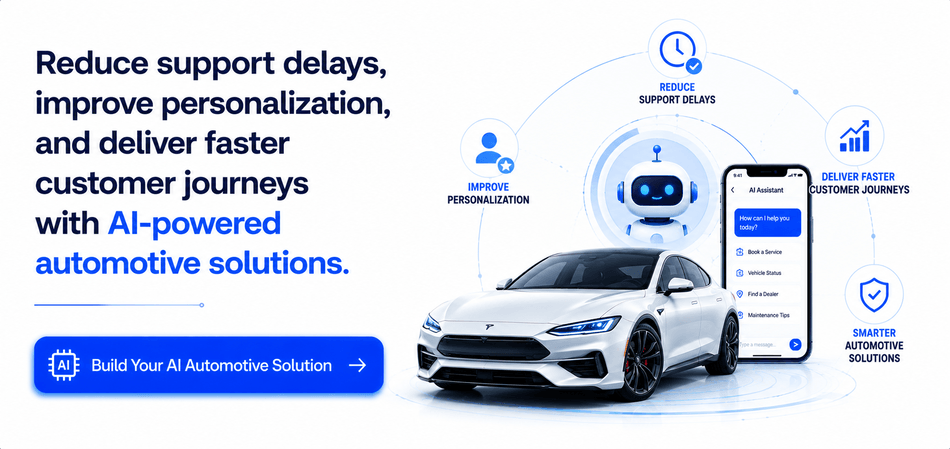
5 ways generative AI improves automotive customer experience
Below are some ways gen AI is improving customer experiences in automotive industry all across the world, let’s have a look at them…
1) Hyper-personalized vehicle recommendations
Choosing the right car was not always simple, and it often depended on what was shown to you, or what the salesperson suggested, but now it is changing, because generative AI in automotive can understand what you are actually looking for, and also what you might prefer next. It studies your behavior, and your budget, and even the way you explore options, so that the recommendations are not random anymore, but more aligned with your needs.
For example, brands like BMW and Mercedes-Benz have been using AI to personalize their platforms, and therefore, when you visit, you are shown vehicles, features, and even offers that feel relevant. So, instead of searching endlessly, you are getting filtered results, and that saves time, but also improves the overall automotive customer experience.
This is where AI in automotive retail and AI for car dealerships are becoming more practical, because they turn user data into something meaningful, and usable. And to build such intelligent platforms with Gen AI, many businesses have been using generative AI integration services so that these experiences are not just ideas, but are actually implemented well.
2) AI-powered virtual assistants and showrooms
Earlier, you had to depend on showroom visits, or wait for responses, but now you can interact anytime, because AI-powered assistants are available almost all the time, and they can guide you through the process step by step. These assistants can answer questions, compare models, and even explain features, so that you are not confused, or stuck.
Mercedes-Benz, for instance, has been experimenting with advanced voice assistants, and these systems are becoming more conversational, not just command-based. So, when you talk, it understands context, and responds accordingly, which makes the interaction feel more natural, even though it is AI.
This is one of the most visible automotive AI applications, and also one of the more useful smart AI tools for automotive businesses, because it improves engagement without increasing human effort. And to make these systems work smoothly across platforms, companies often rely on app developers because the experience has to be consistent, whether it is on an app, or web, or inside the vehicle.
Must Read: Techugo’s Journey as a Leading Automotive App Development Company: From Recognition to Real Impact
3) Faster and smarter customer support
Customer support has always been a challenge, because delays were common, and responses were not always helpful, but now things are improving, because generative AI can handle multiple queries at once, and it can also learn from past interactions, so that the responses are better over time.
You no longer have to wait for long, or repeat your problem again and again, because AI systems can understand what you are asking, and provide answers instantly. And while it is fast, it is also becoming more accurate, which was not always the case before.
Many businesses are now using automotive AI solutions to improve their support systems, because it helps reduce pressure on teams, and at the same time, improves the experience for customers. And since integrating such systems is not always straightforward, companies are also using generative AI integration services, so that everything works together without breaking existing workflows.
4) Predictive maintenance and proactive communication
One of the biggest shifts is happening before problems even occur, and that is where predictive maintenance comes in. Now, thanks to generative AI, vehicles can be analyzed using their test data to identify patterns that allow for preemptive notifications about potential problems. With predictive maintenance, you don’t just react to issues, but instead, you are actively preventing those issues from occurring; therefore, you will see a significant difference.
For example, Tesla uses AI-driven diagnostics to monitor your vehicle’s performance and provide an early warning if something is not working correctly. This greatly minimizes downtime and creates trust in the system because it is viewed as reliable.
These capabilities are part of advanced automotive AI solutions that are becoming more widely available as vehicles become increasingly connected.
5) Seamless omnichannel experience
The purchasing experience is no longer restricted to one location. You can begin the process using a website, switch to an app, and eventually go to a dealership. And when none of these touchpoints are connected, the purchasing experience appears disconnected and frustrating.
Generative AI provides a solution to this problem by creating a unified thread of data, preference, and interaction across all of these touchpoints, thereby providing a seamless experience. You will not have to remember what you searched for before and will not need to provide that same information again.
This is one of the key benefits of AI in automotive retail, because it creates a smoother journey, and also reduces friction at every step. And since building such connected ecosystems requires the right planning, many businesses have been working closely with a mobile app development company, so that the experience remains consistent, and scalable over time.
Generative AI use cases in car dealerships
Below are some of the core use cases of artificial intelligence in car dealerships…
1. Personalized sales recommendations
Car dealerships were always limited by what a salesperson could remember and suggest, and sometimes you had to scroll endlessly, but now it is changing, because generative AI can look at your preferences, your past visits, and even how you explore options, so that recommendations feel personal, and actually useful. You don’t waste time on irrelevant choices, because the system already knows what might interest you.
BMW and Mercedes-Benz have been testing these tools, and so, when a customer comes in, whether online, or on an app, they are shown cars, trims, and packages that actually matter. It feels natural, and smooth, and faster, but it also makes the buying process less stressful.
2. AI-powered virtual assistants
Previously, when you wanted to buy something, you would either have to wait for a salesperson to assist you, or find information in a manual. However, now with the advent of AI-powered virtual assistants, there is an assistant available to you almost constantly, ready to provide help through product availability, financing options, or product features. The assistants can understand natural language and respond like humans, though they are really artificial intelligence.
Some AI assistant systems have even added functionality for users to perform voice-controlled actions through mobile applications or on digital showrooms. The engagement level of asking a question and receiving a response is enhanced because there is a real-time response to the customer for asking a question, and often new questions are answered with new suggestions.
3. Automated follow-ups and communication
Prior to the introduction of AI in car dealerships, the follow-up process was problematic, and many follow up communications were not received because employees were busy. With AI, follow-up communications are now done automatically through sending calendar reminders, sending personalized emails, or through sending text messages to follow up on previous conversations with customers regarding test drives, new promotions, or maintenance service appointments.
When a customer receives automated follow-ups, the dealership appears to be attentive, proactive, and customers appreciate the time that the AI has saved them and the frustration that has been reduced. As AI continues to learn about each individual customer’s preferences, the AI can also improve the effectiveness of each follow-up communication. In addition, as the AI continues to gain experience from previous interactions with each customer, occasionally the AI will provide the customer with an unexpected follow-up opportunity, which has typically not been experienced previously.
Also Read: The Future of Customer Service with AI Chatbot Integration
4. Predictive maintenance and service recommendations
Car problems were mostly reactive, because most owners acted only when something broke, but AI changes that. Generative AI can monitor vehicle data, detect patterns, and predict issues before they happen, so that you can schedule service in time, and avoid unnecessary downtime.
Tesla and BMW are already using AI-driven predictive tools, and they alert users about battery health, tire conditions, or software updates. It builds trust, because it feels like the dealership is looking out for you, even when you don’t realize there’s a problem. And it also reduces stress, but you have to actually pay attention to the alerts, otherwise it is useless.
5. Content generation and marketing automation
Marketing has always been time-consuming, because creating ads, brochures, and posts takes forever, and sometimes the content was outdated, but AI can generate it automatically, and it can personalize it for customer segments, regions, or trends.
It can draft emails, landing pages, or social media posts, so that marketing teams can focus on strategy, and not on repetitive work. And it works fast, but sometimes the AI surprises you with ideas you wouldn’t have thought of, so that creativity actually improves.
Generative AI in car dealerships is transforming how people interact with vehicles, and the experience, and even the way decisions are made, because it makes everything smoother, faster, and more personalized. So, the automotive customer experience is no longer just about the car, it’s about the journey, the interaction, and how it all feels when you’re actually exploring options.
How Automotive Businesses Can Get Started with Generative AI
Here are some of the steps you (automotive businesses) need to take if you want to utilize generative AI in your business, first…
1. Identify high-impact areas
The first step is to figure out where generative AI in automotive can actually make a difference, and not just because it sounds fancy, right? You should look at areas like vehicle design, marketing, customer support, or predictive maintenance, so that your AI efforts bring real results. Focusing on high-value areas was often overlooked before, but now it is clear that identifying the right use case saves time and money, and improves the automotive customer experience.
2. Start small with pilot projects
It’s always better to begin with a pilot project, because jumping straight into full-scale deployment can backfire. Pick one thing, maybe AI-powered virtual assistants or predictive maintenance, and see how it works, so that you can learn and adjust. Pilot projects reveal a lot, and many dealerships were hesitant before, but testing small shows you what works and what doesn’t. This also helps teams understand the real benefits of AI in automotive retail, and prepares them for scaling later.
3. Build a strong data foundation
AI can’t function well without data, and it can’t function at all without good data, because bad or messy datasets lead to poor outputs. Collecting customer interactions, sales trends, vehicle info, and service history is important so that automotive AI applications can generate meaningful insights. It takes effort, yes, but the payoff is huge. AI becomes smarter, and you can predict issues, personalize experiences, and enhance the automotive customer experience.
4. Choose the right tools and technologies
Not all AI platforms are the same, and some will fit your business better than others. You should evaluate tools for NLP, simulation, predictive analytics, and also AI for car dealerships so that they integrate smoothly with your existing systems. Using the wrong tools can cause delays, but the right tools speed things up, and cloud-based solutions make it easy to scale without disrupting your workflows. So that you don’t have to rebuild everything from scratch.
5. Upskill teams and define processes
Generative AI works best when people know how to use it, and your teams are ready. Designers, engineers, marketers, support staff… they all need to understand generative AI use cases in car dealerships, and know how to interpret outputs. Processes need to be defined, because AI can automate repetitive tasks, but humans are still needed, especially for compliance, safety, and customer interactions. Without proper training, AI adoption can be slow or error-prone, and teams will get frustrated.
6. Monitor, measure, and iterate
Once AI is in use, it’s not enough to just set it and forget it. You have to monitor outcomes, measure KPIs like customer satisfaction, sales conversion, downtime, or faster design cycles, and then iterate based on what you see. AI improves over time, but only if humans guide it, adjust workflows, and feed it quality data. Using smart AI tools for automotive businesses ensures continuous improvement, so that your automotive customer experience becomes more personalized and efficient and maybe even surprising in a good way.
Starting with generative AI in automotive doesn’t have to feel overwhelming. If you focus on high-impact areas, pilot carefully, organize clean data, choose the right tools, train your teams, and iterate constantly, it can transform operations, improve customer experiences, and even open new opportunities because in the end, AI is not just technology, it’s a way to rethink the business itself.
How Techugo Can Help?
Techugo can help automotive businesses adopt generative AI in automotive in ways that are practical, and safe, and really effective, because they understand both AI technology and the automotive world, and that’s not something every company can do.
They provide generative AI integration services, and guide you through pilots, structure your data, and make sure AI actually improves the automotive customer experience, and it’s not just theory… it works in real life, and teams can see results quickly.
Techugo also helps you scale projects, personalize customer interactions, and turn AI plans into real outcomes, but they don’t just deliver software; they collaborate, train teams, and make sure adoption is smooth, because AI works best when people and technology work together.
With Techugo, you get more than development, you get a partner who helps you innovate, improve efficiency, and transform the way customers interact with your brand, so that AI adoption becomes a real advantage, and not just a buzzword.
Contact the top automotive app development company today and book your consultation call.
Frequently Asked Questions
Q1. What are the real-life examples of AI in car dealerships?
AI powers chatbots, virtual assistants, and recommendation tools, helping customers with test drives, service bookings, and personalized vehicle suggestions.
Q2. Can generative AI personalize in-car experiences for drivers and passengers?
Yes, it can adjust climate, music, lighting, and navigation based on preferences, and AI voice assistants make interactions natural and personalized.
Q3. What are the benefits of AI in automotive retail for dealerships?
AI improves customer support, predicts maintenance, optimizes inventory, and personalizes recommendations, making operations faster and smarter.
Q4. How can generative AI support marketing and customer engagement in automotive?
It creates personalized ads, landing pages, and emails, localizes content, and helps optimize pricing and promotions to engage buyers better.
Q5. What challenges do automotive businesses face when adopting generative AI?
Challenges include clean data requirements, skilled teams, integration with workflows, costs, and ensuring safety in in-car systems.

Get in touch
We'd love to hear from you.