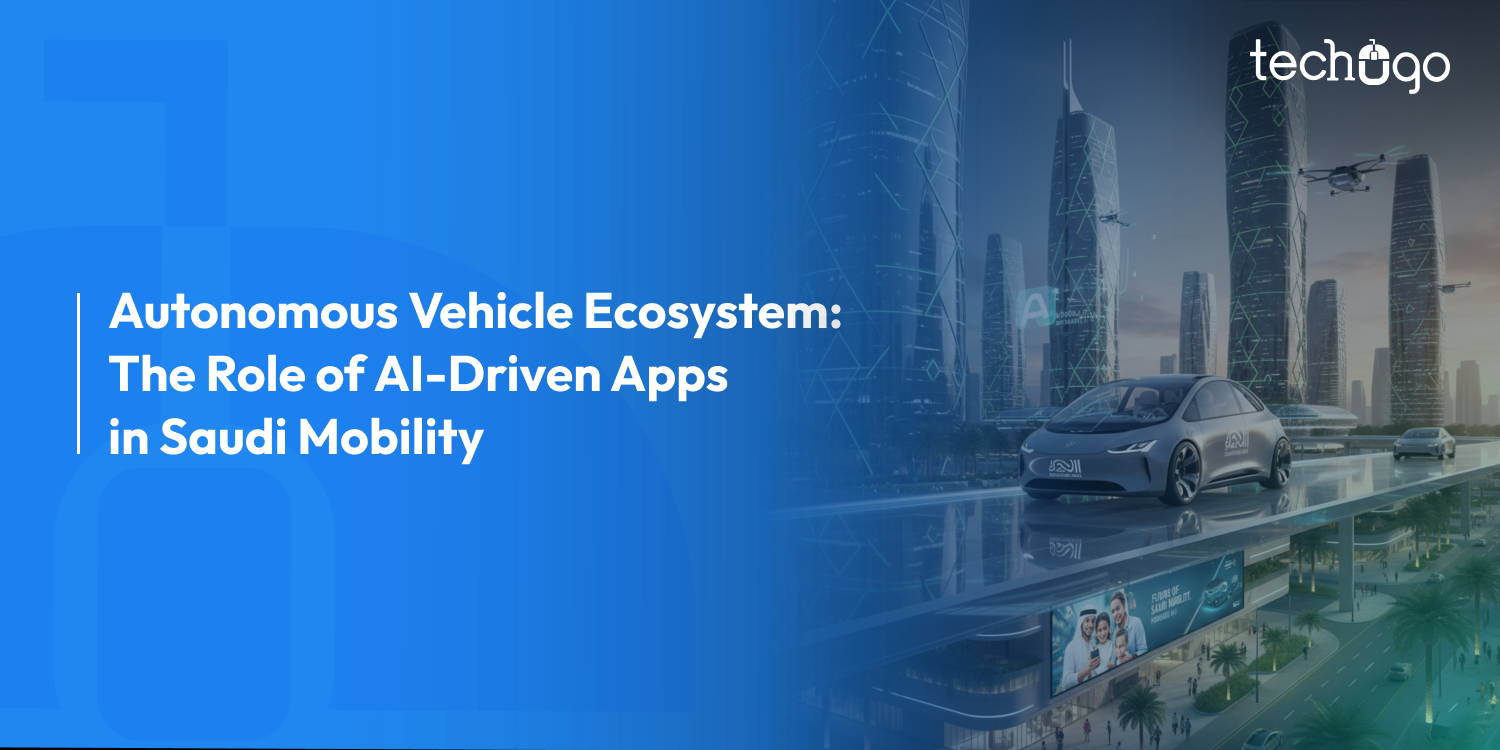
The shift from roaring engines to silent electric motors is transforming Saudi roads. As Saudi Vision 2030 accelerates technological growth, the traditional human touch on the steering wheel is being replaced by sophisticated AI. This revolution is powered by a growing autonomous vehicle ecosystem, where smart infrastructure meets cutting-edge mobility.
Imagine a commute that isn’t just stress-free, but personalized and seamless. This is made possible by AI-driven apps that handle everything from navigation and safety to predictive maintenance and smart charging.
In this blog post, we’ll explore how these intelligent applications are reshaping Saudi mobility and why they are the backbone of future transportation. Whether you’re a tech founder, a startup, or an enterprise team, this guide to the future of Saudi mobility is for you.
What is an Autonomous Vehicle?
Autonomous vehicles are called “self-driving cars” because of their ability to operate independently of human drivers. Autonomous vehicles are equipped with various technologies such as lasers, cameras, sensors, GPS units, and advanced computing capabilities that enable AVs to sense their surroundings, make decisions, and navigate through these environments. The SAE establishes six levels of automated driving capabilities. Level 0 represents no automation, and Level 5 represents total automation in every type of driving condition. Saudi Arabia has made significant progress in expanding its autonomous vehicle capabilities by pursuing further levels of automation and thus broadening the definition of urban and inter-city transportation systems.
1. Varieties of Autonomous Vehicles
The autonomous vehicle ecosystem is far from one-dimensional; it comprises multiple varieties of AVs tailored for different use cases. The SAE has established a uniform system (0-5) to evaluate how much control the human driver has over an autonomous automobile. The five distinct categories for classification, defined in development by the SAE, are as follows:
- Level 0 (No Automation): The driver is in complete control of the automobile. The automobile may give an alert warning such as blind-spot warning.
- Level 1 (Driver Assistance): The driver can utilize adaptive cruise control (and other similar technologies) to assist in controlling either speed or steering.
- Level 2 (Partial Automation): The driver can use autonomous driving technology for both speed and steering, but must always keep a close watch on the roadway.
- Level 3 (Conditional Automation): The vehicle can drive itself only under certain conditions (such as at low speeds on a highway), but the driver must be capable of taking control if necessary.
- Level 4 (High Automation): A fully autonomous automobile can navigate within a specific location (geofenced) without the need for human intervention.
- Level 5 (Full Automation): A driver can remain completely disconnected from the driving experience. The automobile will drive itself anywhere under all circumstances, with no requirement for a steering wheel or pedals.
2. Technology driving the Autonomous Vehicle Ecosystem.
The Autonomous Vehicle (AV) Ecosystem is supported by some innovative technologies:
- Sensors: A myriad of sensors, such as cameras, radar, lidar, and ultrasonics, create a comprehensive view of an automobile’s environment by providing a continuous 360-degree view.
- Artificial Intelligence (AI) & Machine Learning (ML): Machine learning technologies will process the data generated by sensors, analyze the behavior of all road users surrounding the automobile in order to make informed driving decisions in real time. This is where the function of AI-powered applications becomes useful by interpreting complex data into actionable information for the vehicle and its operator.
- Connectivity (5G, V2X): AVs can use the latest connectivity technologies to communicate with other vehicles (V2V), the roadway infrastructure (V2I), as well as pedestrians (V2P), and the remainder of the network infrastructure (V2N). This type of interaction will support a safer and more coordinated traffic flow when AVs become commercially available.
- High-Definition (HD) Mapping: In contrast to conventional GPS Technology, HD maps contain valuable information for AVs that include detailed roadway geometry, lane markings/signs, etc.
Why Developing the Autonomous Vehicle Ecosystem Is Key for Saudi Arabia
The Saudi Arabian autonomous vehicle market is projected to grow from $1.23 billion in 2025 to a staggering $6.82 billion by 2034, exhibiting a robust Compound Annual Growth Rate (CAGR) of 20.93%. Both future-oriented aspirations are guided by the Government of Saudi Arabia’s Vision 2030 plan.. This plan focuses heavily on increasing technology and improving the sustainability of urban centers. Autonomous Vehicle Ecosystems are a strategic pillar in meeting these National aspirations or goals.
1. Local Statistics/Cultural Behaviours
Saudi Arabia is in a position to have one of the best environments to support the use of Autonomous Vehicles and AI-based Applications due to the following:
- High Digital Adoption Rates: Saudi Arabia has one of the largest numbers of Smartphone users and internet usage around the World, allowing the population to engage with digital solutions and innovations readily.
- Smart City Projects: Saudi Arabia has invested in Smart City Development, including NEOM, THE LINE, and Qiddiya, all of which are designed to be built utilizing the next level of Mobility Solutions, which will provide the infrastructure for developing an Autonomous Vehicle Ecosystem.
- Traffic Congestion and Environmental Challenges: Traffic congestion and environmental mitigation are two of the areas that pose tremendous challenges for many of the major cities in Saudi Arabia. AV’s can offer a solution to reduce traffic congestion, decrease CO2 emissions and improve the Air Quality in Urban Centers in Saudi Arabia.
- Young Population: Saudi Arabia has a high percentage of young adults, which will enable the embracing of AV’s and other forms of innovative Transportation Solutions.
Regulatory Landscape and Vision 2030
Saudi Arabia’s Government has embraced the opportunity to establish the Kingdom of Saudi Arabia as a Global Leader in Autonomous Vehicles by developing and implementing a Comprehensive National Regulatory Framework for AV’s.
By working closely with the Saudi Standards, Metrology and Quality Organization (SASO) and the Public Transport Authority (PTA) to develop standards and policies that regulate both testing and operational procedures for positioning AV’s, the Government of KSA has set itself up as a global leader in autonomous mobility.
Smart cities and sustainable living are integral components of Vision 2030, and the development of sophisticated AI-powered applications will help facilitate the growth and use of charging infrastructures, routing optimization, and user experience as it pertains to autonomous vehicles.
AI-Based Software Applications are the Pivotal Component of the Saudi Autonomous Vehicle Market
Although autonomous vehicles are physical machines, AI driven apps provide smart software that brings to life the ecosystem of autonomous vehicle products and services. Following this, AI Applications play a vital role in navigating autonomously, protecting the vehicle, enhancing the convenience of driving, and operating a fleet of individual and large numbers of autonomous vehicles. For example, by being a top Mobile App Development Company in Saudi Arabia, Techugo produces these smart Applications that are driving the future of Mobility.
- Innovative navigation: It supports predictive route planning through analysis of traffic and weather in real time. Our app development services feature responsive directional guidance and smart parking assistance to promote smooth travel in regard to the smart cities of Saudi Arabia.
- Safeguarding and Predictive Maintenance: This includes integrating Artificial Intelligence (AI), which analyzes sensor data to facilitate the detection of hazards and drivers in real-time. For fleets, we offer predictive mechanical failure assessment so operators can minimize downtime and maintenance costs.
- Tailored User Journeys: We provide personalized user experiences through voice recognition, unique cabin configuration, and our position as one of Saudi Arabia’s foremost mobile app development companies enables us to construct comprehensive solutions that combine ride-hailing services with personal autonomous vehicle services.
- Sustainable Electric Vehicle Infrastructure: As this region embraces sustainability, our applications assist EV drivers with optimizing their charging schedules and monitoring battery health. We also support the development of electric vehicle charging applications by providing direction to the most efficient power sources for autonomous driving.
- Transformative Logistics: We enable the revolutionizing of the last-mile delivery and fleet management industries. Our app developers provide Saudi Arabian businesses with the ability to coordinate their autonomous delivery robot fleets and long-haul delivery fleets into a single cohesive supply chain through the use of efficient integrated AV logistics.
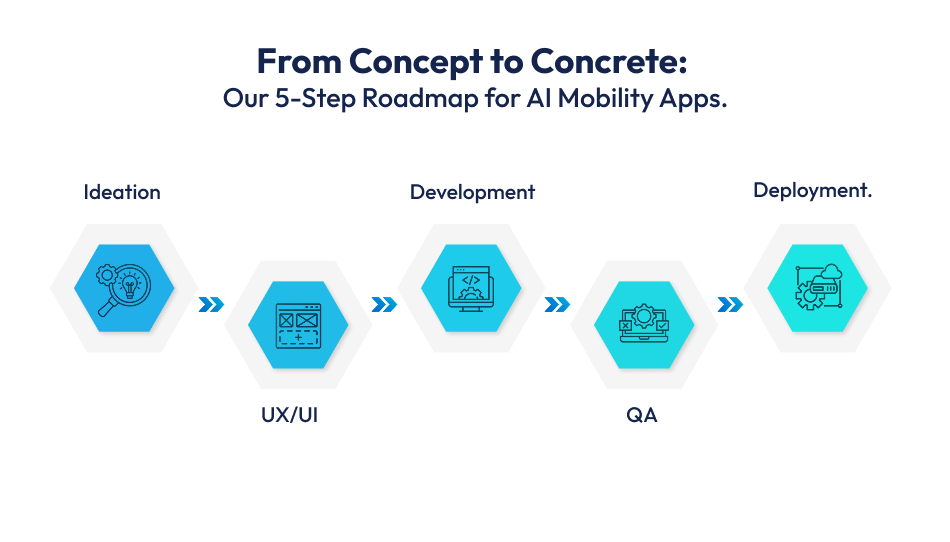
Breakdown of Steps: Building AI-Driven Applications within the Autonomous Vehicle Ecosystem
The process of creating advanced AI-driven applications to support the Autonomous Vehicle Ecosystem must be structured in order to produce high-quality products safely. To accomplish this goal, development must follow a formal modelling methodology for developing AI driven apps.
- Identifying/Researching Needs of the Market: The first step in Developing Applications is to identify gaps in the mobility landscape/Artificial Intelligence (AI) needs for Users, and Establish User Persona(s) that address them/establishing personas for mobility users (i.e. Commuters/Smart Cities). During this stage, the Application Architect/team must determine what the best technologies are for Seamless Integration of AI and Machine Learning (ML) for Rapid Scaling.
- Creating UX/UI Designs/Prototypes: The next step in Developing Applications is to design the Visual Interface (i.e. Wireframes and Prototypes) to be user-friendly and easy to understand for the end User, as well as making sure the interface of the application is able to show large amounts of Data and Alert User in Real-Time.
- Building Core Software Frameworks and Integrating AI into them: The next step in Developing Applications is to create a definitive back end software architecture and integrate the AI Prediction Model for Route Passing and Anomaly Detection into the Application.
- Rigorous Testing and QA: After building and/or integrating the Backend Architecture/AI Prediction Models, the Development Teams must conduct an Extensive Test Series on the Applications, including Functional Testing, Performance Testing, and Security Testing. This will also include User Acceptance Testing, specifically designed to simulate the real-world autonomous driving environments to confirm that the application is safe, responsible, low-latency, and reliable in conditions that are expected to be encountered.
- Ongoing Development/Security Updates and Support: Maintain Security from Malicious Attacks, etc. must be conducted to ensure that the Application Stays (Most Up-To-Date) in relation to the Current Evolution within the Autonomous Vehicle Industry
AV Application Development: Timeframes, Estimated Costs, and Common Builders’ Pitfalls
Creating an artificial intelligence-based application to support the autonomous vehicle industry in Saudi Arabia requires an investment of money, time, and talent. Developing a sound strategy allows for the optimal use of these resources.
1. Timeframes and Costs of Investment
The costs of building applications vary based on their complexity and integration requirements:
- Minimum Viable Product (Basic): Basic apps (like a locator for electric vehicle charging stations or basic ride-sharing applications) are estimated to start at $50,000 and reach as high as $150,000.
- Medium Complexity/Integrative ABV Models (low to mid-range complexity/low to mid-range integration): Medium-complexity applications provide intelligent routing based on customer preference, predictions for when to perform preventative maintenance on vehicles, and features for managing a fleet of vehicles. The cost of medium-complexity applications ranges from $150,000 to approximately $400,000.
- High Complexity/Full Scale Integrated Applications: Full-feature integrated platforms that incorporate real-time data from all available sources (smart city integration) can cost more than $400,000, with complete deployment costs often exceeding $1 million.
2. Factors That Affect Costs of Development
There are multiple variables that will affect a project’s budget. The number of features offered, along with the platform selection (including options for iOS vs. Android vs. hybrid platforms), greatly affects budgets for AV Application Development. More sophisticated applications require specialized knowledge in the fields of Artificial Intelligence and Machine Learning integration, as well as additional time spent developing the most sophisticated integrations due to the added complexity of API integration(s) (mapping and vehicle telematics). Finally, working with an experienced AV development company in Saudi Arabia can help ensure that the development team has a strong understanding of local market dynamics and the technical requirements unique to the region.
3. Businesses in Saudi Arabia are expected to face particular local adversities
- Regulatory Compliance: Staying compliant with the changing laws established by the newly created Saudi Data and Artificial Intelligence Authority (SDAIA) will require additional time for development.
- Infrastructure Integration: The technical complexity associated with connecting Smart City systems and V2X (Vehicle-to-Everything) requires significant engineering expertise.
- Data and Localization: AI requires large amounts of high-quality labeled training data, and localization means translating user interfaces into the Arabic language, as well as acknowledging cultural differences between Saudi Arabia.
- Security: There is a requirement to continue investing additional resources into creating advanced cybersecurity systems across the Autonomous Vehicle Ecosystem (AVE) to protect sensitive information.
What Makes Techugo Stand Out?
Techugo is the leading mobile application development company in Saudi Arabia, in regard to developing autonomous vehicle technologies. Techugo connects the complexity of integrating Artificial Intelligence requirements with real-world user mobility expectations.
1. Techugo’s Strategic Advantages
- Expertise in Domain: With various projects developed (including secure delivery and logistics applications as well as healthcare applications), Techugo possesses the knowledge and experience to work with the complex security requirements associated with managing the data we utilize for the operation of autonomous freight and delivery methods.
- Smart City Readiness: Techugo develops scalable and interoperable systems that meet the needs of Vision 2030 Smart Mobility Initiatives.
- Advanced Technology Stack: Techugo leverages Artificial Intelligence / Machine Learning for Predictive Analytics, Internet of Things (for connected Sensor Technologies), and React Native/Flutter (for High Performance Cross Platform Development).
2. Proven Reliability
- Global Trust: Techugo has partnered with many Fortune companies, and with numerous Saudi institutions, including Prince Mohammad Bin Fahd University; Techugo’s apps have assisted clients in raising over millions in funding.
- Mobility Success: As an electric vehicle (EV) charging application development company, Techugo has created several successful applications that provide real-time navigation to EV chargers with EV Charging App Development, as well as utilities for managing grid load and charger usage, to deliver robust solutions.
- Agile Partnership: Techugo offers complete app development services from collaborative planning and design through post-launch support to create and continue to develop your autonomous vehicle solution as a leader of transportation in Saudi Arabia.
If you’re looking for reliable AV mobile app development services in Saudi Arabia, Techugo is the perfect choice and meets all your needs. Contact us anytime. We’re guaranteed quality here.
FAQs
Q1: In what ways do mobile applications that are powered by AI differ from those that do not offer an autonomous driving experience?
A: Mobile applications that operate autonomously can operate more intelligently since they can use machine learning to continuously adapt the way an app responds to a user’s actions or inaction. For a mobile application designed for autonomous vehicles, this means proactive features such as predicting routing and sending alerts for maintenance will also evolve based on real-time road conditions and user behavioral patterns.
Q2: How do autonomous vehicles locate electric vehicle charging stations in Saudi Arabia?
A: Integrated applications will utilize HD maps combined with current data from an EV charging app development company to locate chargers. Charging stations will be identified, based on an autonomous vehicle’s available battery range, and routing to the charger will be calculated. Further, the integrated applications will use artificial intelligence to project demand levels of charger stations in the surrounding area, thus reducing wait periods.
Q3: What security best practices are required for the mobility application?
A: The security of the user and vehicle data must be ensured by creating end-to-end encryption of the mobile application, a multi-factor authentication process, and providing secure API integration with third-party applications. Additionally, preventing adversarial attacks on artificial intelligence will help ensure safe decision-making while on the road.
Q4: What steps do Saudi businesses need to take in order to incorporate AV technology into their operations?
A: The first step for businesses should be to initiate pilot programs based on their specific requirements, such as those related to last mile delivery. In conjunction with a mobile applications development firm located in Saudi Arabia, the business can develop additional tools that will assist in managing its fleet and optimizing routes, while also being aware of the current state of their infrastructure’s preparedness to support AV technology.
Q5: What makes 5G such an important factor for the growth and viability of the autonomous vehicle industry?
A: The very nature of 5G makes it ideal for the level of ultra-low latency and high-bandwidth needed for nearly instantaneous communication between vehicles and other smart city objects. How to connect a very large number of devices (vehicles and smart city objects) to provide reliable and secure services is the key to supporting the building of applications that utilize the sensor data from these devices as feedback for safe autonomous driving.
Post Views: 33



 SA
SA  KW
KW  IE
IE AU
AU UAE
UAE UK
UK USA
USA  CA
CA DE
DE  QA
QA ZA
ZA  BH
BH NL
NL  MU
MU FR
FR