

 SA
SA  KW
KW  IE
IE AU
AU UAE
UAE UK
UK USA
USA  CA
CA DE
DE  QA
QA ZA
ZA  BH
BH NL
NL  MU
MU FR
FR [ LET’S TALK AI ]
X
Discover AI-
Powered Solutions
Get ready to explore cutting-edge AI technologies that can transform your workflow!



Get ready to explore cutting-edge AI technologies that can transform your workflow!






As the rate of energy consumption in mature and emerging markets drives the new phase, it has become evident to understand the benefits that IoT is bringing.
One of the major beneficiaries, the Internet of Things, is offering solutions that were once a dream. With immense growth opportunities in every sphere of energy (oil, natural gas, coal, nuclear energy, hydroelectricity, and renewable energy), understanding the multiple advantages of IoT energy management solutions becomes key.
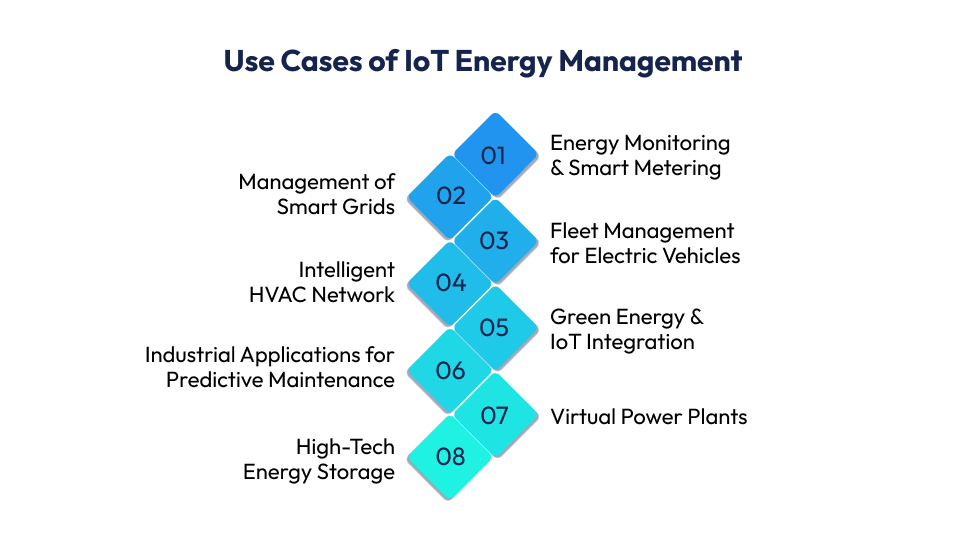
The Internet of Things has brought about sharp and intense change, ushering in revolutionary technology. To understand the benefits first, it is essential to know what the actual impact is going to be and where. Therefore, some of the use cases include:
With the help of smart IoT metering, the utilities and consumers are in complete control. Through this, actionable insights can be activated, taking into account smart meters with IoT sensors. This means the population will be in complete control of the consumption of electricity when such activity is recorded in the meters. Hence, you can control the unusual flow of energy and redirect it to the right use. Thus, smart energy monitoring solutions can predict peak loads, manage energy distribution, and control energy leakages, which is another benefit.
Real-time grid performance can be tracked with the effective application of IoT devices and sensors. So, managing natural energy sources (solar and wind), which are affected by weather conditions, can be supervised. Moreover, IoT systems are effective in understanding and managing demand spikes, which can be transitioned to other lacking areas. Hence, these smart grid management and other systems make the environment efficient and effective.
Keeping tabs on location, battery status, performance of each fleet, and charging requirements can be easily monitored with IoT devices. Therefore, clear route planning, pre-travelling status, and avoiding unnecessary delays or downtime can be achieved. With the integration of IoT systems, drivers get real-time updates on traffic routes and choose traffic-free routes. Furthermore, fleet managers will get insights into vehicle usage patterns and can make the decision to deploy EV fleet vehicles.
Also Read – Electric Vehicle Software Development Guide: Features, Cost & Benefits
Energy consumption in buildings is dominated by heating, ventilation, and air conditioning (HVAC). Based on the conditions in the surrounding environment, HVAC systems also change due to occupancy. This allows facility supervisors to adjust settings, no matter where they are. Hence, reduced energy consumption, reduction in emission of toxic gases, and IoT for operational efficiency are the results of smart devices. These are some of the aspects when it comes to smart building energy management with effective results.
IoT sensors optimize power distribution and generation with the assistance of solar panels, wind turbines, or distributed energy grids. Through their connection, IoT-enabled devices, including sensors, smart meters, and communication systems, are able to gather real-time data from the energy industry. The data can then be sent to a cloud platform to conduct analytics on all the information collected from within the energy system. This is where an IoT energy management software provider can be of exceptional use.
Also Read – IoT App Development Cost in 2026
Within industrial settings, various types of IoT (Internet of Things) sensors attached to machinery allow for continuous measurement of different properties, including vibration, temperature, pressure, and noise levels. Data obtained from these intelligent energy management technologies will be transmitted to monitoring systems. Now, algorithms can analyze the data to determine if there are abnormal patterns present.
Putting diversified energy sources, such as battery storage and solar panels, into a collective network is the use of virtual power plants in IoT. Therefore, reliance on the grid, distribution, and refining energy becomes easier for operators. And if you are one of the users who agrees to share it, especially during peak times, then a handsome profit is not that far away.
To operate efficiently and effectively, gathering vital information on temperature and charge cycles is necessary. However, operators can use this to their advantage, highlighting times of overcharging or overuse and enhancing it accordingly. Factoring in these aspects makes the IoT systems reliable and seamless, and helps them to last for longer periods. Thus, the need for intelligent energy management technology is on the rise.
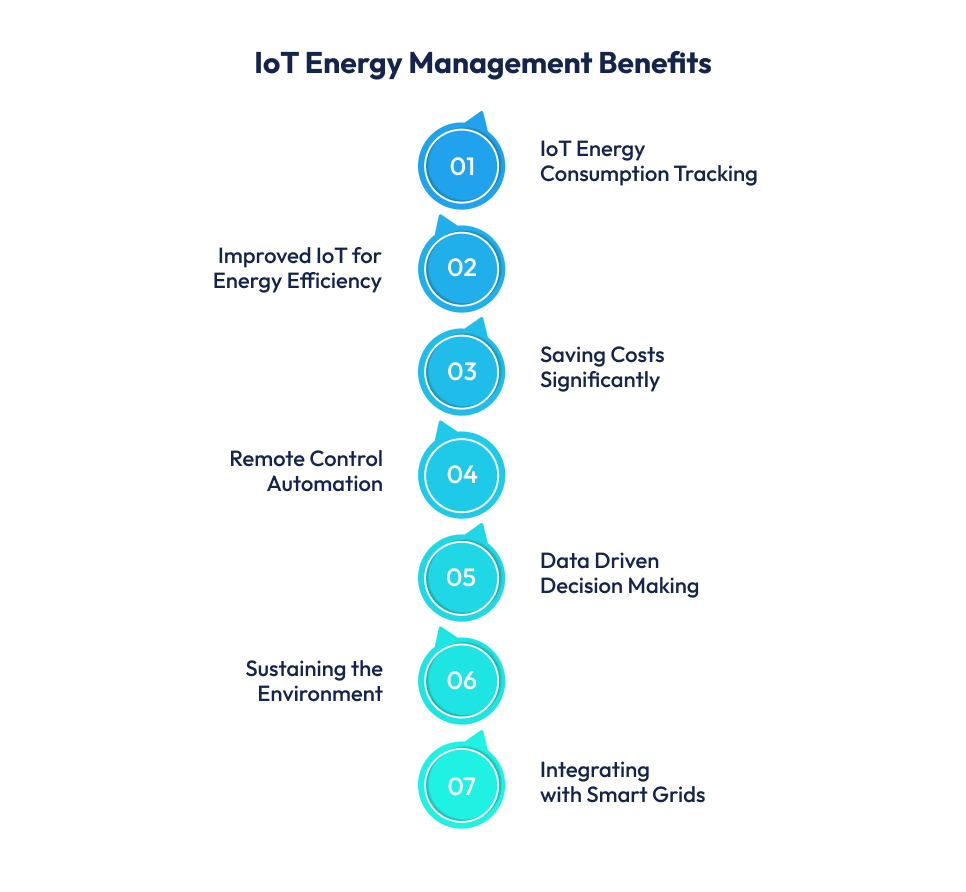
IoT platforms offer intensive and in-depth insights about energy consumption, assisting in areas of cost control and many other factors. Hence, the benefits can have a drastic impact on how the business is and will function in the days to come.
Data from different devices and equipment is collected continuously with sensors and smart meters, which send this data to one central location for users to see their energy usage right away from a dashboard or mobile device application. With real-time monitoring, users can easily calculate which devices use lots of power or look at patterns of unusual energy usage, making for an easier way to take corrective action quickly.
The use of IoT technologies allows for increased energy efficiency, as IoT-based systems can automatically control and optimize devices that consume energy. With smart systems, lights/heat/air ventilation/air conditioning can be adjusted automatically based on how many people are in an area, the weather outside, and the scheduled times that a building will be occupied. Therefore, using an IoT application reduces the amount of electricity consumed without needing to run devices unless they are actually needed to run – thus providing efficiency gains in both residential, commercial, and industrial applications.
Based on the concept of energy management, a reduction in energy costs is a major benefit that businesses will enjoy. This is done by managing usage patterns, reducing energy consumption leakages, and monitoring bills. At the end, the system will suggest various methods to control energy waste, which can be employed to best suit the user’s needs. This is why you must opt for an IoT app development company.
Users can control their appliances from anywhere via the Internet of Things (IoT) Energy Management System, and will have access to the appliances based on what they have done in the past. The Energy Management System can automate appliances based on preset rules or conditions, allowing users more convenience while decreasing any wasted electricity.
Based on large amounts of collected energy use data, IoT platforms are becoming valuable tools for making data-driven (aka “evidence-based”) decisions about energy usage by establishing energy use patterns and providing insight into how energy is purchased and used at facilities or by companies. These data-driven insights allow businesses/businesses to enhance their energy management strategies and therefore improve their overall level of operating efficiency.
By actively managing energy use using an IoT-based system, organizations are able to conserve energy by minimizing energy waste and reducing associated carbon emissions, thereby helping safeguard the planetary environment. Energy that is managed effectively through improved use of IoT requires less electricity generation via fossil fuels, thereby minimizing greenhouse gases in the air and supporting countries’ aspirations for achieving common goals of sustainable development and environmental protection.
By connecting to modern smart grid technologies, IoT-enabled energy management applications can support demand-side response programs and assist in balancing load across multiple electricity consumers, in addition to increasing overall reliability and stability of the overall electric supply network.
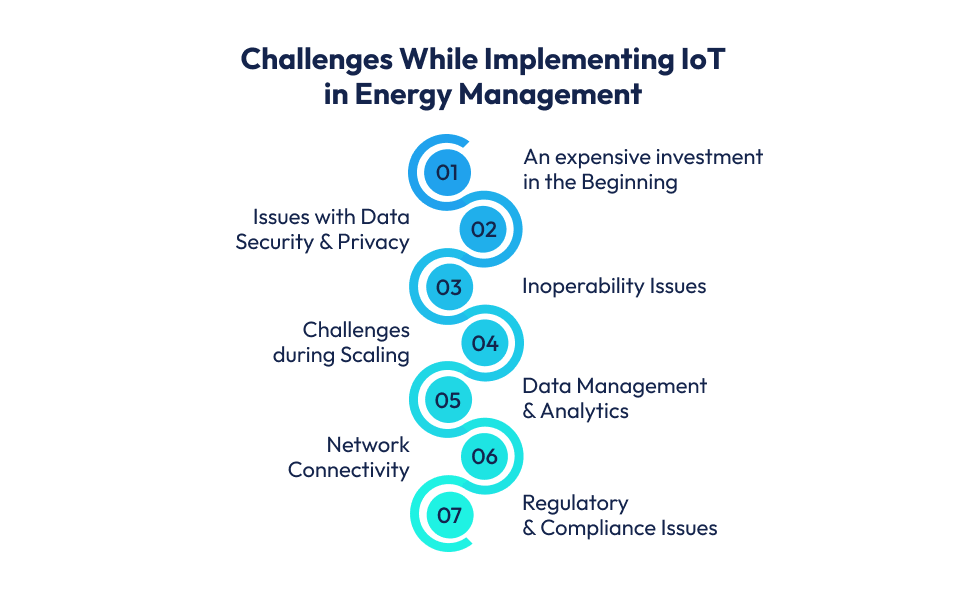
Unique challenges in the process of providing connected energy management solutions will help you to identify areas of potential. Thus, knowing them is of great importance, and you can leverage it to your advantage:
Implementing IoT energy management systems incurs a large amount of investment by companies. An example of this investment includes purchasing smart meters, smart sensors, communication networks, data storage systems, and integrating those systems into existing energy management systems. The initial cost of this investment can limit many small-to-medium-sized enterprises’ (SMEs) ability to adopt this technology.
Energy data is being constantly collected & transmitted by IoT devices, causing serious challenges in regard to privacy and security. Unauthorized access, cyber-attacks on energy systems, and potential for data breaches are major risks associated with these devices. If strong cybersecurity measures are not in place, then IoT-connected energy networks can be vulnerable targets.
Create compatibility problems due to the fact that many IoT devices have been built by individual manufacturers and have been built using diverse communication protocols. Furthermore, integrating these devices into existing infrastructure, like legacy systems, presents challenges. Due to the lack of standardization, the ability for multiple IoT devices to communicate with one another at the same time has been hindered.
When the number of IoT devices increases, the management of large amounts of data also becomes increasingly complicated. If the infrastructure does not have proper scalability features, then network congestion could create problems, and the overall performance of the system could decrease. Therefore, organizations must provide for the future growth of their IoT systems while continuing to deliver efficiency.
Many IoT systems produce a lot of data related to energy usage, which needs to be stored, processed, and analysed. Advanced analytics tool sets are necessary to derive useful insights quickly. Without adequate data management, the advantages of IoT for optimising energy will not occur.
The performance of IoT-based energy management relies on reliable communication networks. Areas with poor connectivity, downtime on your network, or latencies can create interruptions to your ability to monitor or control an IoT system in real-time, decreasing the overall efficiency and performance of the system.
Energy systems fall under the domain of governmental regulations and compliance. As energy is an essential element for the seamless functioning of society, safeguarding it is the right of every government. That is why it is surrounded by strict compliance requirements, and dealing with it can be problematic for businesses. Hence, IoT energy management solutions for businesses are a key player in this expanding environment.
The energy market size in the space of Internet of Things has grown from $29.87 Billion to $34.26 Billion from 2025 to 2026. Moreover, the projections for the period 2031 show $67.98 Billion, which is a CAGR of 14.69% over 2026 – 2031. The other data suggests that utilities show that commanding economies are moving from centralized command and control to distributed intelligence. This is where predictive asset care, real-time grid optimization, and autonomous energy trading can co-exist.
Moreover, capex on intelligent substation, smart meters, and edge analytics areas have increased due to lower maintenance cost also minimizing outage minutes. This is where the burgeoning demand for IoT power management solutions is on the rise.
Since 2015, we have automated businesses and have helped them to transform as opportunities have arisen. Techugo is an enterprise IoT energy monitoring solutions provider that has helped with providing digital solutions through:
As the demand for energy consumption is rising from 600 exajoules in 2019 to 800 exajoules in 2050 (for comparison: US alone consumed 94.6 exajoules of energy), there is a great need to match the growing demands. To grab this and scale it exponentially, IoT devices are becoming a lever that supports such a change.
Possible with the likes of energy monitoring and smart metering, intelligent HVAC network, virtual power plants, and more, diminishing energy waste and controlling costs is the aim. Although challenges do exist, so do the ways to navigate through them. And one such method is to seek help from a professional smart energy management system provider, and no one comes close to Techugo.
Ans) The ability of IoT technologies to recognize wasted energy, develop predictive maintenance, and automate control of systems will help to lower the overall cost of electricity and operating costs for businesses.
Ans) Smart buildings utilize IoT technologies to control all systems, including lighting, HVAC, and some appliances based on occupancy, environmental factors, and user-defined schedules, which increases comfort while minimizing energy use.
Ans) Real-time monitoring of energy usage, increased efficiency of energy, reduced costs, remote control/automation, and predictive maintenance for sustainability and environmentally friendly operation are some of the advantages of IoT technology.
Ans) Industries are using the Internet of Things (IoT) technologies to provide predictive maintenance, equipment tracking, and energy efficiency. By monitoring machines through sensors, they are able to detect potential machine failure (anomaly) before the actual occurrence of the event, thereby improving their productivity and reducing their downtime.
Ans) Helping businesses to become technologically independent is one of the aims of Techugo. That is why we are delivering expert-led services as an IoT app development company to fulfil your needs for 10+ years.
Do you think that building a fintech app like Citi Mobile requires a huge investment? What if we told you that you simply need $30K to get started? Ye..
Apps like Kling AI can generate videos in seconds. But do you know the actual cost to build an app like Kling AI that runs technology this advanced? ..



Write Us
sales@techugo.comOr fill this form