

 SA
SA  KW
KW  IE
IE AU
AU UAE
UAE UK
UK USA
USA  CA
CA DE
DE  QA
QA ZA
ZA  BH
BH NL
NL  MU
MU FR
FR [ LET’S TALK AI ]
X
Discover AI-
Powered Solutions
Get ready to explore cutting-edge AI technologies that can transform your workflow!



Get ready to explore cutting-edge AI technologies that can transform your workflow!






‘What’s the cost to build an app like Yandex Go?’ is often the first question businesses ask.
When you’re starting from zero, with no existing infrastructure, no backend system, and no pre-built modules, the investment becomes a serious consideration.
Building an app like Yandex Go is not just about launching a ride-hailing app. It’s about creating a real-time digital ecosystem that connects riders, drivers, payments, maps, data, and logistics into one experience.
Behind every ride request, a taxi booking app development has to bring together riders, drivers, payments, maps, and real-time data all work together
From the outside, it feels simple. A user opens the app, enters a destination, taps “Book,” and a driver shows up.
However, there are more than one systems which go on simultaneously behind that single tap. The app finds drivers nearby, adds estimated fares, ETA, authorizes payments, updates live maps, and makes data encrypted and secure. All this occurs in a few seconds.
This level of coordination is what influences the Yandex Go app development cost. To an end user, it may appear to be a simple exercise but in the real sense, a lot of powerful backend architecture is needed in the process.
Due to all this complexity, the Yandex Go app development cost is not a definite amount. It actually depends on what one is building and the size one wants to be.
Depending on scale and ambition, the overall cost to build an app like Yandex Go ranges anywhere between $40,000 and over $150,000.
To understand why, we need to break it down properly!
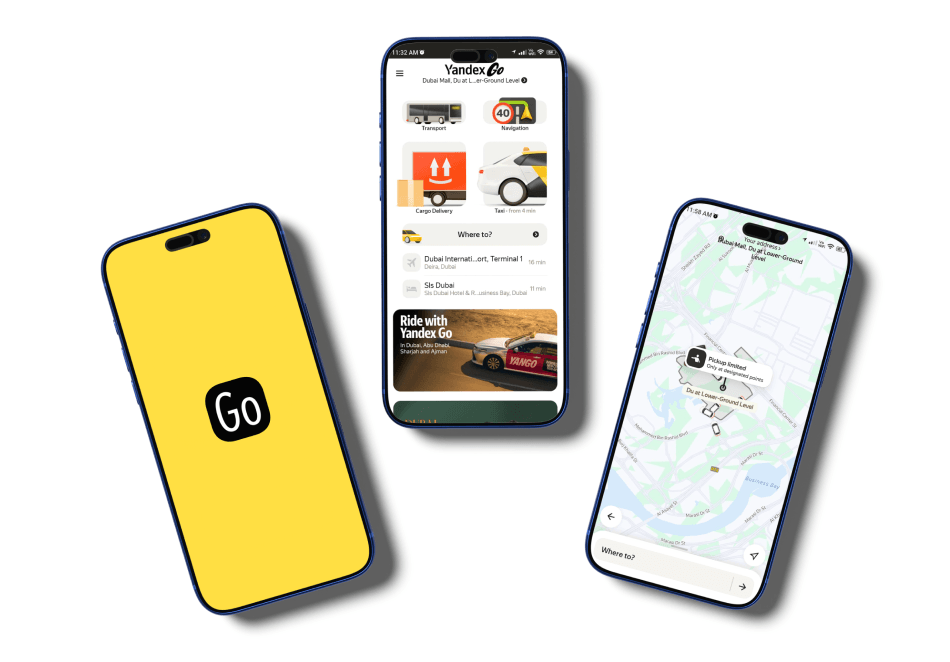
A Yandex Go-like app isn’t just a taxi app. It’s the kind of app you open when you need something – a ride, a delivery, maybe even groceries, and it connects you instantly to someone who can make that happen.
Think of it as a real-time, on-demand platform where everything runs behind the scenes so smoothly that the user barely thinks about it.
Apps like Yandex Go work by connecting three sides of a system:
In many markets, Yandex Go–style apps are also called “super apps” because they don’t just stop at rides. They may include food delivery, courier services, grocery delivery, or other on-demand services, all inside one ecosystem.
So when we talk about the cost to build an app like Yandex Go, we’re not talking about a simple booking app. We’re talking about building two mobile apps (rider + driver).
And once you understand that, the pricing conversation starts to make a lot more sense.
When you start calculating the cost to build an app like Yandex Go, the first big decision is the type of app you want to develop. And this isn’t just a technical choice.
This choice matters more than most people think. It affects your budget, your launch speed, and your long-term growth.
The overall Yandex Go app development cost changes depending on whether you go native, hybrid, or web. Native apps are normally more expensive. Why? Since you create different versions on iOS and Android. It implies increased development time and increased investment.
Hybrid applications are less costly. They lessen development effort and are capable of reducing your total price of Yandex Goo-like app development. This is why most startups are comparing it with the Yandex Go cost of the app development and making a decision.
Native or hybrid is not the end of it. The approach to development is important! The general Yandex Go app development price can or cannot be determined by platform choice.
The real budget shift happens when you decide: iOS, Android, or both.
Native applications are developed independently on iOS and Android in platform-specific languages such as Swift on iOS and Kotlin on Android.
If you care about speed, smooth performance, flawless animations, accurate real-time GPS tracking, and seamless payment experiences, native development usually delivers the best results.
But here’s the catch: you’re building two apps.
Since you’re building two separate versions, it takes more time, more effort, and a bigger budget.
That directly increases the cost to build an app like Yandex Go.
Native development offers top performance, but the Yandex Go app development cost for iOS and Android separately will always be higher than other options.
Hybrid apps use frameworks like Flutter or React Native to build one codebase that works on both iOS and Android.
This reduces development time and overall budget.
If your goal is faster market entry with optimized spending, hybrid is often the smarter route. Many startups choose this option to reduce the Yandex Go–like app development cost while still maintaining good performance.
Hybrid apps can lower the overall Yandex Go clone app development cost, especially during MVP development.
However, extremely complex features like advanced mapping systems or AI-based route optimization may require extra customization.
A web app is a browser-based version of your platform. It’s cheaper and easier to maintain but doesn’t offer the same experience as mobile apps.
If you’re building a booking-focused platform with limited real-time features, a web app can reduce your taxi booking app development cost.
But for a full-featured super app like Yandex Go, a web-only solution usually isn’t enough.
Building an app like Yandex Go isn’t about copying what’s already working. It’s about recognizing how dramatically everyday life has changed.
Think about it, when was the last time someone called a taxi company instead of opening an app?
Your target users book rides from their phones, order food in minutes, and pay digitally without a second thought. This mobile-first lifestyle isn’t a passing trend anymore; it’s just how things work now.
And that’s why understanding the demand is just as important as calculating the cost to build an app like Yandex Go.
Let’s look at why this opportunity is bigger than it seems.
Mobile penetration in most urban markets now exceeds 70–90%, with smartphones serving as the primary internet access point for millions of users.
For millions of users, their phone isn’t just a device, it’s their main way of accessing the internet, booking services, and managing daily life.
This is exactly why on-demand service apps & taxi booking apps consistently rank among the most downloaded categories in app stores. In metropolitan areas especially, consumers rely heavily on app-based transportation rather than traditional taxi services.
What this means for you:
The demand is already there.
When mobile usage dominates daily life, launching a Yandex Go–like app aligns directly with existing consumer behavior. However, higher app adoption also means higher competition. And that impacts how much you must invest in quality, performance, and differentiation.
Today’s users expect real-time ride tracking, transparent pricing before booking & fast loading speeds.
They compare every new app to established platforms. If your app feels slower or less intuitive, they move on instantly.
This matters because what users expect today shapes every decision you make during development – from how clean and simple the design feels to how strong and reliable the backend needs to be.
If your app loads slowly, glitches, or feels confusing, people won’t “give it time.” They’ll just delete it. So yes, meeting modern standards can increase the cost to build an app like Yandex Go. But not meeting them? That costs you users, ratings, and long-term growth.
Beyond what users expect, there’s something else you can’t ignore – the rules.
When you’re building an app like Yandex Go, you’re dealing with people’s personal data, their payments, and real-world transportation services. That automatically puts you under regulation.
In Europe, for example, data privacy laws like GDPR are strict. In the US, payment security and local transportation rules vary by state. In countries like India or the UAE, driver verification and licensing requirements are taken seriously.
This isn’t just background paperwork. These rules actually shape how your app is built, how you store data, how you process payments, and how drivers are approved.
If you don’t plan for compliance from the start, it can become an expensive fix later.
We will start with a recap of the major stages of developing such an application as Yandex Go, particularly when you are going to enter a competitive and regulation-oriented market.
This isn’t just about coding. It’s a structured process, and each phase directly affects the cost to build an app like Yandex Go.
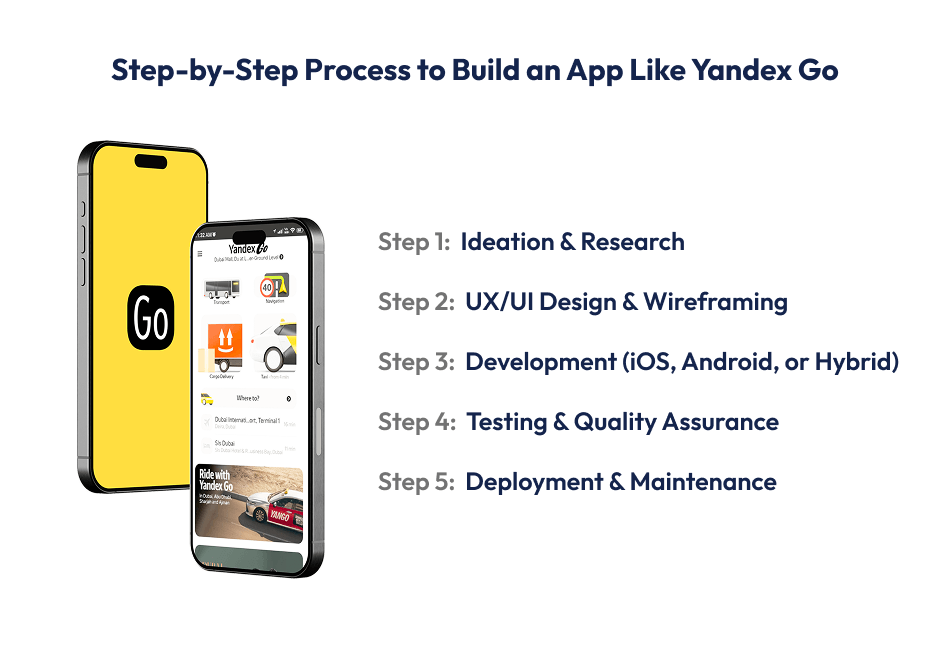
Every successful app like Yandex Go starts with clarity.
Before development begins, you need to define:
In markets with strong competition, research becomes even more important. You need to analyze competitors, pricing models, user expectations, and local regulations.
Skipping this phase might save money upfront, but it often leads to expensive pivots later.
Once the strategy is clear, the next step is designing the experience.
This includes:
In 2026, users expect clean, fast, and frictionless apps. If booking a ride takes too many steps, they’ll leave.
This stage directly impacts adoption. A strong UI/UX doesn’t just make the app look good — it increases retention and ratings.
Also Read: AI in UX/UI Design: 10 Ways to Transform User Experience (With Real Examples)
Now comes the technical build. This is where your biggest cost decisions happen.
You’ll choose whether to build:
This phase includes:
The complexity of features like surge pricing, route optimization, or multi-city expansion heavily influences your Yandex Go app development cost.
Testing is where many businesses underestimate effort.
For an app like Yandex Go, testing isn’t just about fixing bugs. You must ensure:
In countries with high mobile usage, performance expectations are strict. Even small glitches can lead to poor reviews and lost trust.
Strong QA reduces long-term maintenance costs and protects your brand reputation.
Once testing is complete, the app is launched on app stores. But this isn’t the finish line!
After deployment, you’ll need:
Constant improvement is needed in competitive markets. The best taxi-booking apps continue to improve based on the user reviews and the changes in the market.
Maintenance is basically a part of the long-term investment when calculating the cost to build an app like Yandex Go.
Building an app like Yandex Go goes far beyond getting the tech right. It’s about planning smartly from day one.
A lot of businesses focus only on the upfront development cost. But the truth is, what happens after development matters just as much. Infrastructure scaling, updates, testing, marketing, and ongoing improvements all add to the bigger picture, something an experienced mobile app development company usually plans for from the start.
When you understand what you’re likely to spend, what actually influences pricing, and where delays usually pop up, you’re far less likely to run into expensive surprises.
Also Read: How to Build an App Like Careem in UAE
In 2026, the cost to build an app like Yandex Go generally falls into three tiers.
in terms of timeframes:
What Influences the Price? So, there are some major factors that directly influence the cost of the Yandex Go app development.
Each additional layer increases both development effort and long-term infrastructure investment.
In addition to development, there are other costs that may be unplanned by the businesses.
In most countries, regulatory compliance may delay the launch schedules. Licensing, driver verification and data-protection standard may increase the additional development work.
Even the release can be delayed as a result of app store approvals. Scaling infrastructure when there is a peak can increase the costs of the servers. Maintenance, updates and security patches also bring additional costs that cannot be overlooked after launch.
One of the pitfalls is to rush a launch. Saving weeks in the present, missing the extensive testing can cost more money and customer confidence in the product in the future.
Being realistic in the initial planning phase eliminates the financial burden and facilitates easier implementation.
Building an app like Yandex Go in 2026 is no small decision. It’s not just about writing code or launching a ride-booking platform. It’s about creating a reliable, scalable digital service that fits into how people live today.
Yes, the cost to build an app like Yandex Go can vary. It depends on the features you choose, the platforms you build for, how scalable you want the system to be, and how well you plan for compliance and long-term growth. But this isn’t just a “development expense.” It’s an investment in a market that’s already active and evolving.
Platforms like Yandex Go often expand beyond rides into other on-demand services. That’s also why businesses often choose teams that have worked as both a ride-hailing app development company and a food delivery app development company.
The real risk is entering the market without a clear strategy or waiting too long while competitors strengthen their position.
If you approach it strategically, plan for growth, and build with performance in mind, a Yandex Go–like app isn’t just another tech product.
It’s the infrastructure for a modern, on-demand business. And that’s where the real opportunity lies.
Developing an app inspired by Yandex Go isn’t just a technical challenge, it’s a business decision.
Think about it, users expect everything instantly. And launching a mobility app isn’t just about getting the tech right. It’s about getting the timing right, the positioning right, and the rollout right. In a competitive market, small decisions early on can shape your growth for years.
That’s where Techugo, as a trusted mobile app development company in UAE, adds real value.
Techugo understands that users don’t care about code. They care about speed, reliability, and safety. Their team approaches development as a partnership, not just a project.
What makes Techugo different is how they think. They think beyond the first 10,000 users. They build for expansion and for dominance in competitive markets.
So yes, the cost to build an app like Yandex Go matters. But choosing the right partner matters more.
With Techugo, you’re not just entering the mobility space.
You’re entering it prepared.
The cost usually falls somewhere between $40,000 and $150,000 or more, but it depends on the features you want.
Development usually takes 3 to 12 months, depending on complexity and integrations.
Platform selection, feature complexity, real-time tracking, payment integrations, UI/UX design, and compliance requirements all impact the final cost.
Native offers better performance, while hybrid reduces development time and cost. The right choice depends on your budget and long-term goals.
Yes. Server scaling, third-party APIs, app store approvals, maintenance, and regulatory compliance can add to the total investment.

Marriage has always held a special significance in our lives, and it's something that families and individuals take very seriously, but over time, the..


A healthcare team decides to build an AI app; the goal is to detect a rare disease early because patient data already exists inside the Electronic Hea..


Write Us
sales@techugo.comOr fill this form