

 SA
SA
 KW
KW
 IE
IE AU
AU UAE
UAE UK
UK USA
USA
 CA
CA DE
DE
 QA
QA ZA
ZA
 BH
BH NL
NL
 MU
MU FR
FR


















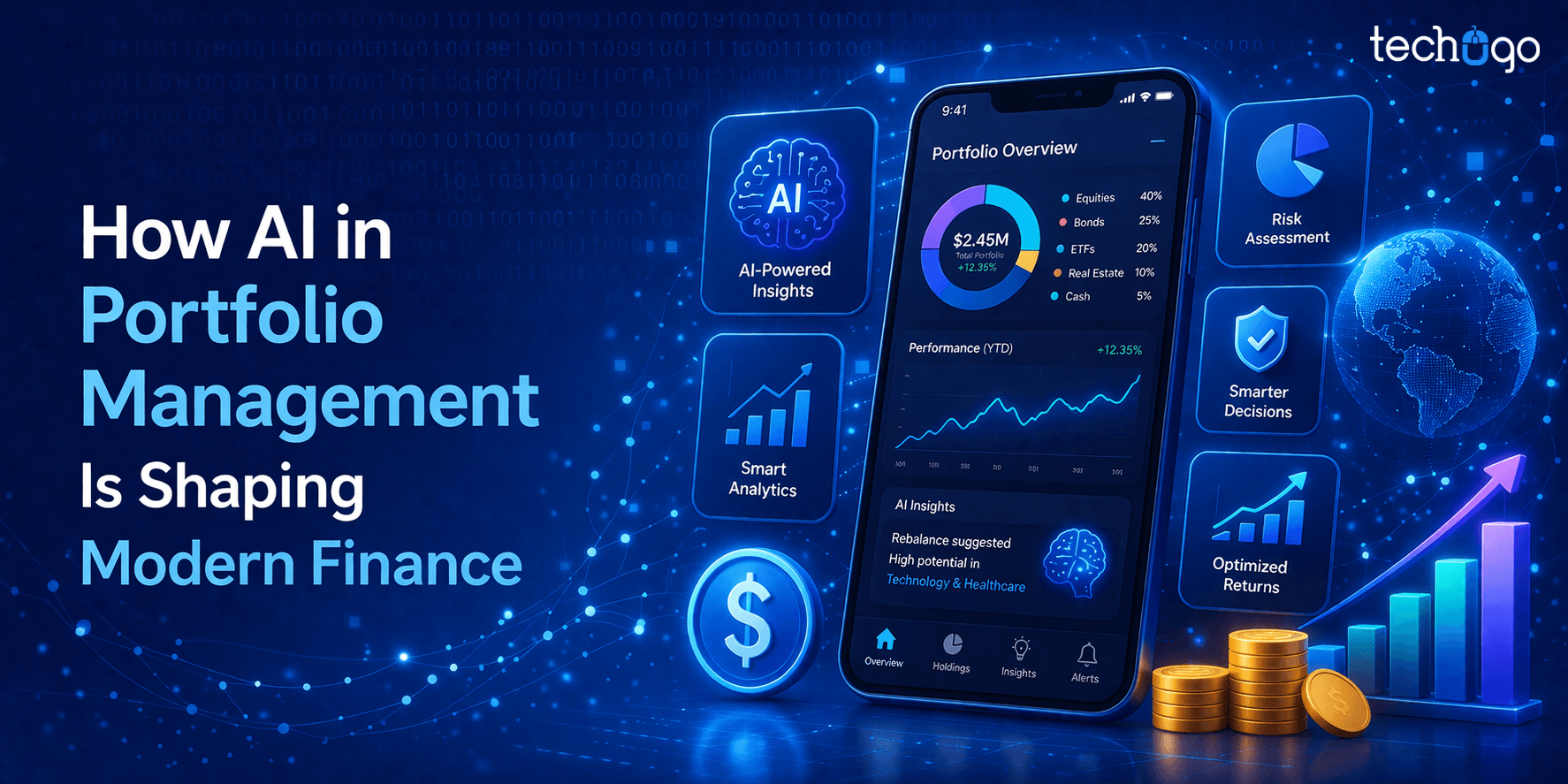


Financial investors who are already using AI in portfolio management have seen up to 33% higher returns, 28% more efficiency, and 25% lower risk exposure.
This shows how AI is shifting the complete market scenario of financial management techniques. In the USA, major platforms such as Betterment, Wealthfront, and Range.com have upgraded their system by implementing AI and NLP. This rise is driven by the growing need for speed, precision, and personalization in today’s complex financial markets.
Investors these days do not want to rely solely on human advisors because market situation changes too frequently, and managing everything in real-time is overwhelming.
AI agents provide real-time asset allocation, transforming portfolio management in this AI-driven world. AI can determine the optimal allocation of assets across stocks, bonds, ETFs, and other investment instruments, ensuring that portfolios remain aligned with an investor’s goals and risk tolerance at all times.
Let’s dive into how AI is reshaping portfolio management in the USA financial market.
What is Portfolio Management?
Portfolio management involves the continuous planning, selection, and supervision of investments to optimize financial performance in line with an investor’s goals and risk tolerance.
In simple terms, anyone can easily watch and select their investment in order to grow their money from assets such as stocks, bonds, mutual funds, and other financial assets to help people reach their financial goals. This type of platform is used by individual investors, financial advisors, and professional fund managers to make sure money is invested wisely and grows over time. It helps in reducing risks and helps to make smarter decisions in a systematic and organized way.
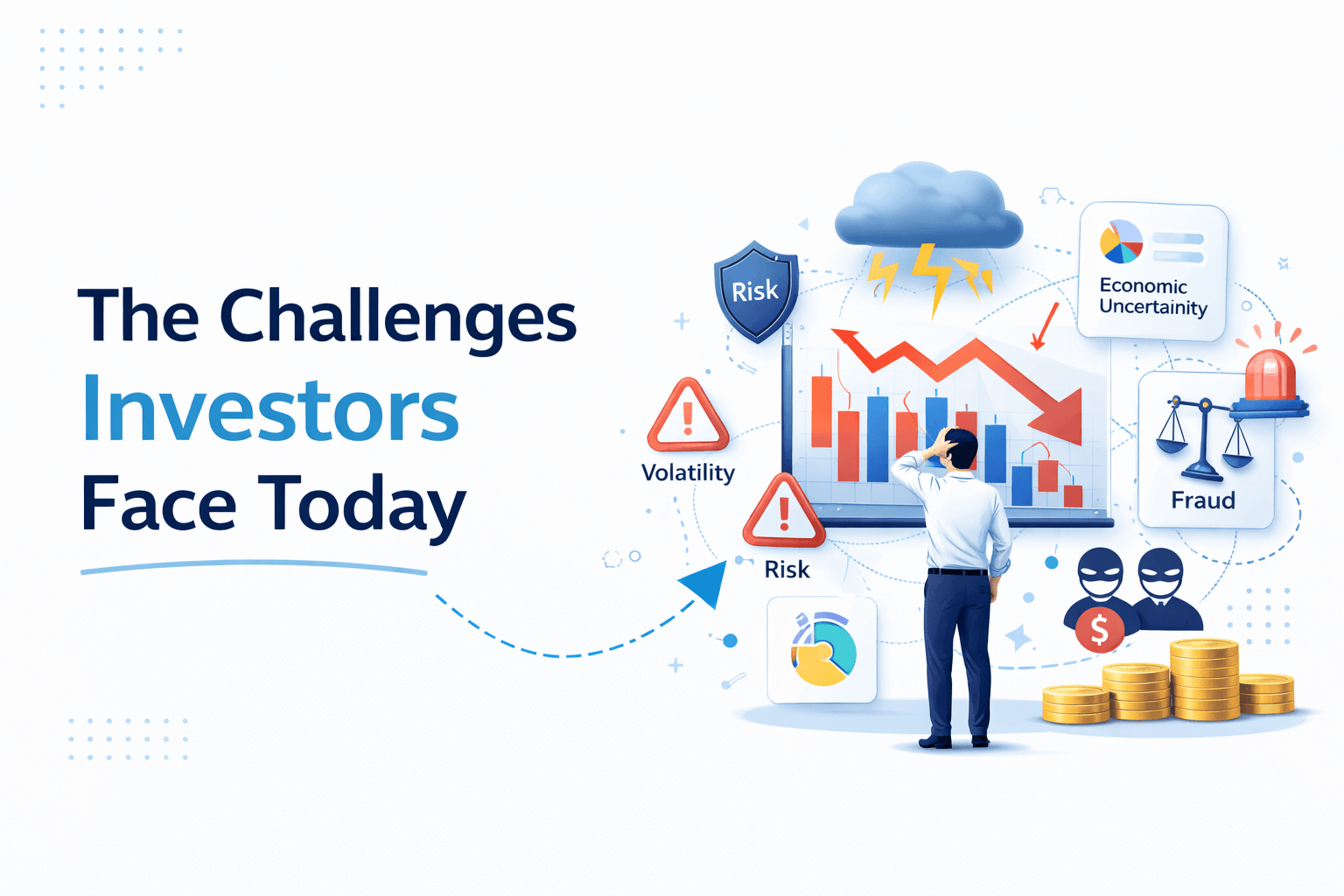
The Challenges Investors Face Today
1.Information Overload
According to IBM, over 2.5 quintillion bytes of data are created every day, and the financial sector alone generates a significant portion of this.
Every day, a financial investor deals with loads of data such as stock prices, earnings reports, geopolitical events, and even rumors. All these affect the financial decision.
2.High-Speed Market Fluctuations
As global market is currently fluctuating too much because of recent geopolitical conflict. Prices of stocks and commodities are changing rapidly. For instance, oil prices surged 10–15 %, and such sudden jumps or drops are almost impossible for investors to track and react to manually in real time.
3.Predicting Complex Market Patterns
The financial market is interconnected with various factors such as global politics, economic indicators, corporate earnings, interest rates, and even social media trends. These factors interact in unpredictable ways, which often leads to poor decisions, mistimed trades, and significant losses
4.Unstructured Data Analysis
Another common problem that investors face is the unstructured information these days scattered over multiple platforms such as news, social media, earnings calls, and reports. Because of this inconsistency in information format, it is difficult to manage and analyse information effectively.
5.Behavioral Biases and Emotional Decisions
In financial decision-making, it is important not to let your emotions take control. Emotional choices based on fear, greed, or overconfidence can lead investors to make impulsive decisions. This can prevent portfolios from achieving their full potential.
The Evolution of AI in Finance
The year 2026 is the year of Artificial Intelligence in every field, including finance. This is trending because of its precise, non-biased nature. Unlike humans, AI in portfolio management can analyse vast amounts of information (both structured and unstructured), along with addressing key challenges such as information overload, high-speed market fluctuations, and complex market patterns.
AI is revolutionizing portfolio and asset management by analysing and handling big data, making informed and unfavoured decisions. An AI-powered system easily handles and manages the stock data without getting compromised by short-term market fluctuations.
1. AI in Portfolio Management: Turning Data into Strategic Decisions
AI is a kind of catalyst in the process of investment. In simple words, the investment decision is faster, smarter, and more precise. Previously, these types of decisions were heavily based on human judgment, which can be limited by slow reaction times and the inability to process huge volumes of data.
How it manages strategic decisions-
- Gathers and analyzes data from multiple sources.
- Assesses and manages portfolio risk.
- Optimizes asset allocation for returns and safety.
- Detects trends and market patterns.
- Minimizes emotional or biased decisions.
- Monitors performance and suggests adjustments.
- Simulates scenarios for strategic planning.
2. Artificial Intelligence in Asset Management: A New Era of Investment Strategy
To make more informed decisions in asset management, AI has come up with advanced tools that are used by AI agents to analyze vast amounts of financial data, detect market trends, and optimize investment strategies. AI agents help asset managers to respond quickly to fast-moving market conditions. AI makes the data processing, cleaning and structuring process faster by ensuring accuracy. People rely on AI because of its unbiased nature, through which it optimizes returns and manages risk more effectively.
How AI Agents Help in Asset Management:
- Analyze large datasets and predict market trends.
- Detect hidden patterns and correlations.
- Optimize portfolio allocation and diversification.
- Monitor performance and volatility in real time.
- Minimize biases and emotional decisions.
- Automate trading and routine adjustments.
- Provide actionable insights for long-term strategy.
How AI Works in Portfolio Management
Portfolio management strategies have upgraded in 2026 as it combines with machine learning and Artificial Intelligence. AI addresses complex tasks such as market fluctuation, analysing a large amount of data, and predicting future scope, so that assets can gain maximum returns.
Continuous Monitoring – AI in portfolio management provides 24/7 real-time tracking and analysis of vast datasets of recent activities in the market.
Information Sourcing – It collects data from various sources, which makes the research and analysis process faster.
Data Preparation – Through NLP, unstructured data is converted into a format that machines can easily understand. Other processes such as aggregation, cleaning, and structuring are done by this method.
Pattern Recognition – AI in portfolio management understands the repeating behaviour or relationships with the market using machine learning and artificial intelligence.
Predictive Analytics – It analyses potential of stock prices, interest rates, and macroeconomic indicators in future market and improves forecasting.
Asset Scoring – It analyzes the market and scores assets based on historical returns, volatility, company financial statements etc. It gives expected numerical values of each asset which predict their expected return.
Portfolio Optimisation – Recommends the optimal allocation and diversification based on your specific investor objectives and risk appetite.
Decision Support – With AI-powered chatbot development, users can easily obtain portfolio performance insights, analytics, and guidance through conversational support.
Benefits of AI in Portfolio Management
1. Faster, Data-Driven Decisions
AI agents have the capacity to process vast amounts of information and discover patterns, trends, and opportunities in a matter of hours, which would take days to be processed manually. This also eliminates human error as it is based on unbiased, data-driven insights and not on intuition or estimation.
2. Enhanced Portfolio Optimization
It aids in optimising a portfolio by considering potential returns and risks, leading to better decisions than conventional methods. This ensures that portfolios stay true to investors’ objectives while evolving in response to market conditions.
3. Automatic Portfolio Rebalancing
AI portfolios continuously track market conditions and automatically adjust responses accordingly. Adapting to changes in the environment, it can also dynamically rebalance the asset allocation to keep the risk-reward level constant.
4. Improved Risk Management
AI continuously evaluates portfolio risk and simulates stress scenarios to protect investments. Identifying challenges and weaknesses in advance enables the portfolio manager to make proactive corrections and thus decreases the risk of loss and increases the overall stability of the portfolio.
5. Real-Time Market Insights
AI monitors news, reports, and social media sentiment to identify opportunities and risks instantly. Such real-time analysis enables investors and portfolio managers to respond rapidly to evolving situations, have more informed discussions, and get out in front of trends that may affect the value of their assets.
6. Reduced Emotional Bias
AI makes decisions purely based on data, eliminating the influence of fear, greed, or overconfidence. It results in more logical and predictable decisions, fewer costly mistakes due to knee-jerk reactions, and portfolios that stay true to long run objectives.
7. Cost Efficiency
With research and regular portfolio work automated, investment firms can get by with smaller teams of analysts. The purpose: simplify operations, reduce costs and enable the staff to concentrate on higher-value activities such as strategy and client service, ultimately leading to an investment-management process that is more efficient and potentially less expensive for investors.
8. 24/7 Monitoring and Alerts
AI portfolio systems are constantly watching the markets for movements or risks. This enables the firm to identify opportunities and risks in real time and react quickly, allowing it to more effectively manage assets without having to rely on human oversight.
9. Personalized Investment Strategies
AI has personalised investment strategies to meet the unique needs of each investor by considering their specific financial goals. This ensures more precise portfolio construction and can adjust dynamically as personal circumstances change.
10. New AI-Managed Products
AI-managed products can easily make data-driven decisions on asset selection, allocation, and portfolio rebalancing. It reduces human biases and improves efficiency while providing optimized returns while controlling risk.
Challenges of AI in Portfolio Management and How to Overcome Them
1. Data Quality & Availability
One of the major challenges that investors face is poor data quality and availability, it is because AI systems heavily rely on large volumes of data. It sometimes leads to poor predictions and risky investments when system can’t access accurate, complete, and timely data.
Solution – Gather information from trustworthy sources, clean and validate it, and continuously refresh it to maintain AI models’ accuracy and efficacy.
2. Model Bias & Accuracy
AI asset allocation and other processes run smoothly when they are trained well. If training data is incomplete or skewed, a portfolio platform can make biased decisions that may favor certain assets or ignore important factors. This can cause suboptimal portfolio decisions and unexpected losses.
Solution – Regular retraining of data modeling is a useful way to prevent this issue. Ensuring accuracy in predictions, backtesting, and performing bias audits are great methods.
3. Black Box Complexity
Many AI models, particularly complex deep neural networks, are considered “black boxes,” in which the way decisions are made is opaque or difficult for humans to understand. Because of this, investors often hesitate to trust AI systems for important stakes.
Solution- To resolve this problem, companies are using Explainable AI (XAI), providing visual dashboards, clear reporting, and step-by-step explanations of how the AI arrives at its recommendations.
4. Regulatory Compliance
With small negligence or oversight, AI tools can sometimes give advice that is not aligned with regulatory standards, which makes compliance a major concern for firms and investors alike.
Solution – To address this, firms need to build compliance checks into AI systems directly, have full audit traces of all decisions and be transparent about how models arrive at their recommendations.
5. Cybersecurity Risks
With the growing adoption of AI for portfolio management in finance, the potential for malware attacks or data leaks is increasing, which undermines investor trust and the reputation of a company. A breach or hack could expose confidential client information and manipulate AI-driven investment recommendations.
Solution – Through strong encryption, secure access controls, and continuous monitoring of AI systems, this problem can be prevented. Tools such as regular security audits, multi-factor authentication, and threat detection systems can prevent security breaches.
6. High Costs & Implementation Challenges
AI system implementation is a little expensive which can be a barrier for startups or firms. Without proper planning, AI projects may exceed budgets or fail to deliver expected results, slowing down innovation and limiting competitive advantage.
Solution – To overcome this, companies can start with pilot projects to test at smaller scale. The second and effective way is partnering with platforms like Techugo, an AI development company that provides scalable, budget-friendly AI solutions.
7. Market Adaptability
The financial market changes rapidly, and keeping up with it is complex. Sometimes AI models struggle to manage sudden shifts, unexpected events, or new market trends. Lack of ability can cause losses and reduce investor confidence.
Solution – To keep up with recent market updates, firms need to deploy adaptive AI models that learn from new market data on an ongoing basis and update predictions in real-time.
8. Human-AI Collaboration
Even the best AI can’t fully replace human judgment. In the absence of collaboration, decisions based on AI may overlook qualitative factors known to humans, such as sudden geopolitical risks or company-specific news.
Solution – Companies should encourage close collaboration between humans and AI agents by providing training on how the AI system works, where humans analyse AI insights to make more accurate portfolio decisions.
9. Unstructured Data Processing
Financial decisions are mainly dependent on information such as news articles, social media posts, analyst reports, and earnings transcripts. This sometimes contains valuable insights, even if it is unstructured and ignoring this can mean missing early signals.
Solution – Firms can leverage NLP and sophisticated text analytics to organize, extract meaning from, and analyze unstructured data.
10. Overreliance on AI
While AI quickly recognizes patterns and processes data, overly relying on it can also be risky. Blindly following AI recommendations given by artificial intelligence in asset management can lead to overconfidence in automated decisions and potentially costly mistakes.
Solution – Use human judgment to complement AI insights. Analysts should confirm AI recommendations, apply contextual information, and decide so that a balanced approach that leverages both speed and accuracy of execution is achieved.
Case Studies: AI in Action in the U.S. Market
1. BlackRock Aladdin
BlackRock is the AI-powered end-to-end investment management that handles more than $21.6 trillion in assets. It uses generative AI integration services so that users can easily interact with AI agents.
2. Wealthfront
Wealthfront is also known as robo adviser, which is a leading automated investment management service. It provides a modern AI system to manage your investment by analysing your future goals, income, and risk tolerance.
3. Betterment
It is also an AI automated investment adviser platform that uses AI agents to manage investments such as ETFs (stocks and bonds). One of the most amazing features of this platform is automatic portfolio rebalancing, which keeps investments aligned with the user’s risk profile without manual intervention.
4. PortfolioPilot
PortfolioPilot is also an AI-powered self-directed investment platform built especially for someone who wants to upgrade from a traditional human advisor to a robo‑advisor. It gives features such as a net worth dashboard, an estate planning checklist, continuous tax optimization, retirement Planner and AI Investing Advice.
5. Range.com
It is all in one investment platform that provides investment services through AI. It provides actionable insights to help people to make smarter decisions. It uses Artificial intelligence in asset management to analyze your financial situation, generate projections, optimize tax strategies, and deliver personalized recommendations.
The Future of AI in USA Portfolio Management
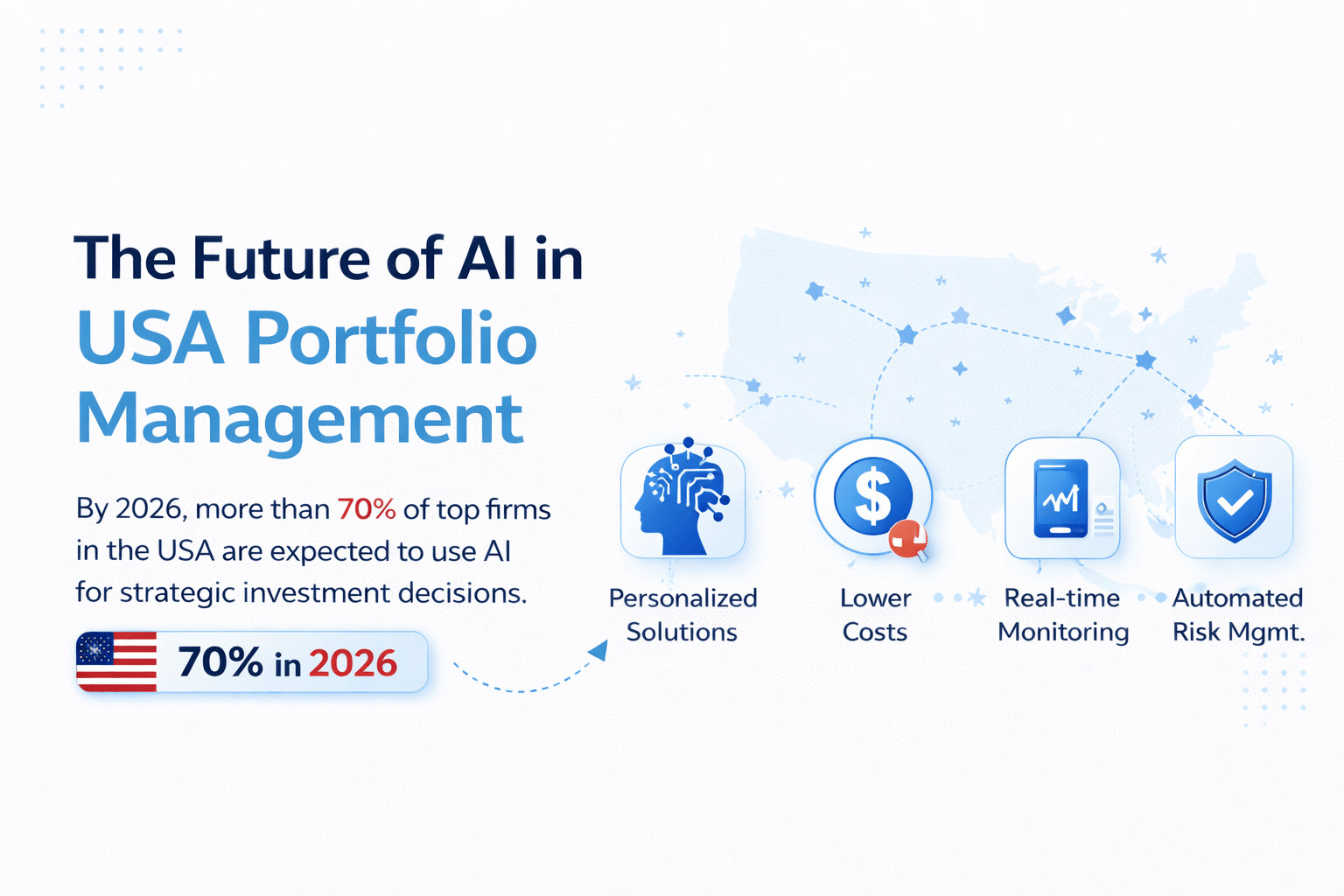
By the year 2026, AI in portfolio management is likely to be utilized by more than 70% of top firms to guide strategic investment decisions. AI asset allocation will grow rapidly in the coming years as features like personalized investment solutions, lower advisory costs, real‑time portfolio monitoring, and automated risk management are in demand.
The shift shows how market and smart investors are relying on AI-powered platforms because of increasing complexity of financial markets. Traditional methods will no longer be able to keep pace with rapid data flows, volatile market conditions, and emerging global risks. Generative AI asset allocation is expected to deliver hyper-personalized investment solutions based on individual goals.
In addition to this, robo-advisors also analyse diverse information on various resources such as social media sentiment, geopolitical developments, and climate data. It would be more practical because it enhances efficiency and reduces costs, as it reduces labor-intensive manual analysis and expensive advisory services.
Conclusion
As AI is reshaping the digital financial era and need for these types of platforms is increasing like never before. Businesses that are adapting these technologies are positioning themselves at the forefront of a rapidly evolving market, offering smarter, faster, and more personalized investment solutions to meet modern investors’ expectations. If you are a business planning to get into this space, or a developer wishing to create an AI based portfolio management app with real time tools and smart insights, Techugo is your guide. We help you create next-gen AI financial platforms with precision, speed, and innovation.
FAQ
1: How Has AI Evolved Portfolio Optimization by 2026?
AI now uses generative tools for scenarios and dynamic shifts. It outperforms standards in returns.
2: How Does AI Improve Asset Allocation?
AI adjusts assets dynamically based on risk, age, and markets. It diversifies by analyzing correlations and auto-rebalances.
3: What Role Do AI Agents Play?
AI agents monitor markets, trade, and rebalance portfolios autonomously. They adapt via learning to handle volatility.
4: Can AI Predict Market Trends for Portfolios?
Yes, AI forecasts via patterns in data, news, and sentiment. It cuts errors by up to 27%, especially for risks.
5: Is AI Used in Personalized Investment Strategies?
AI tailors plans by blending profiles with market data. It adapts allocations like stocks to bonds over time.

Get in touch
We'd love to hear from you.