

 SA
SA  KW
KW  IE
IE AU
AU UAE
UAE UK
UK USA
USA  CA
CA DE
DE  QA
QA ZA
ZA  BH
BH NL
NL  MU
MU FR
FR [ LET’S TALK AI ]
X
Discover AI-
Powered Solutions
Get ready to explore cutting-edge AI technologies that can transform your workflow!



Get ready to explore cutting-edge AI technologies that can transform your workflow!






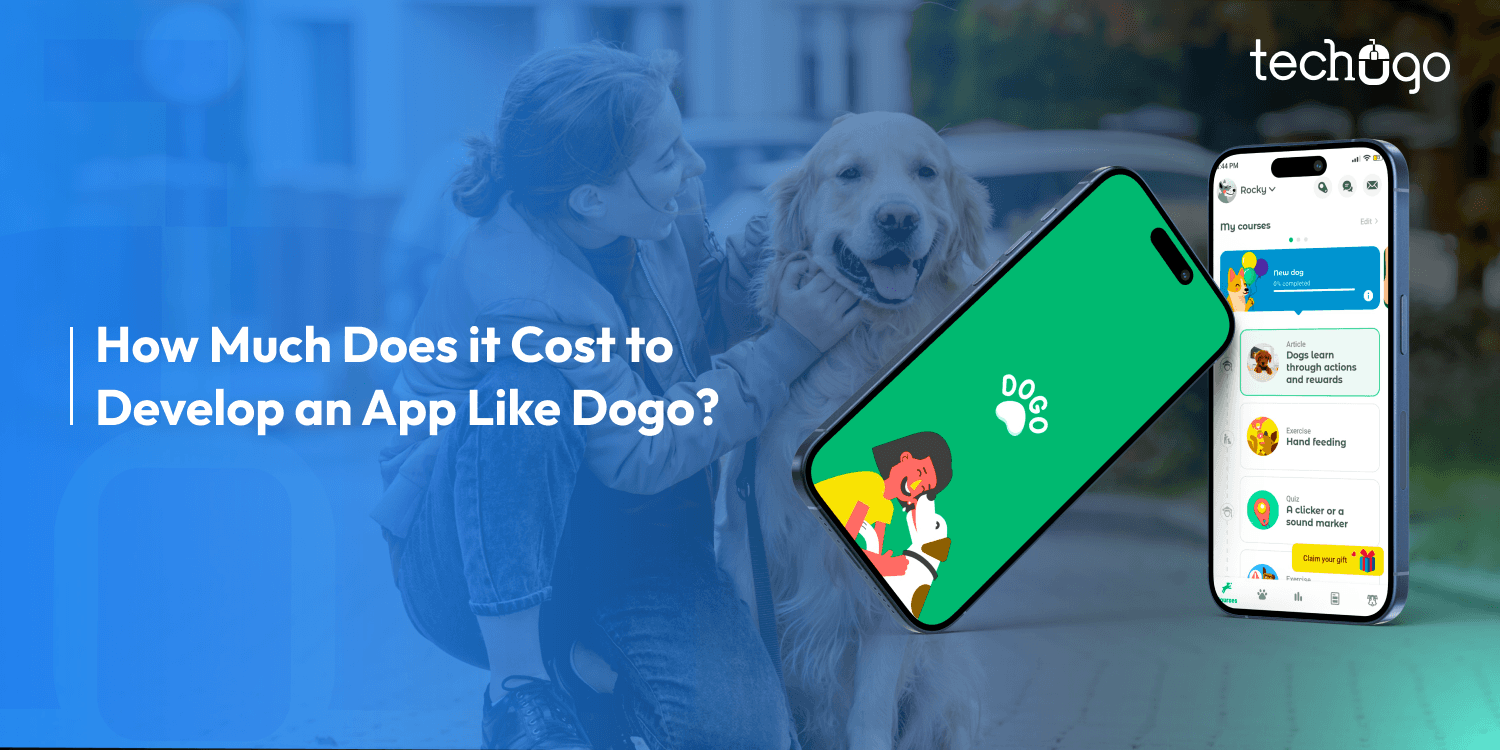
Suppose you bring a new dog home. You’ve named them, you pampered them, and now can’t wait to spend endless hours snuggled up together but the very next day, they start making a mess all over your home.
This happens because owning a dog is one thing. Then training them on how to behave is a totally different thing which requires time, patience, and consistent effort to turn your pet into a well-behaved furry friend exactly the way you want.
These days, mobile apps are humans’ new best friends. We rely on them to learn, shop, order food, or just organise our daily lives, so why not for training dogs too? More people are becoming pet parents, but most of them don’t know how to teach their pets commands like “sit,” “stay,” or “play.”
That’s where dog training apps like Dogo come in. These types of pet apps make it easier and more interactive to train your pet. If you provide dog or any pet services, or if you’re an investor, a startup, and are thinking to develop such an app for your users or to make money, you’re on the right track.
And if you’ve ever asked yourself, how much does it cost to develop an app like Dogo in Europe, then let us tell you, the rough estimate ranges between €25,000 and €100,000+. But it totally depends of type of app and its features. The cost may go up if you include AI guidance, AR exercises, and social or community features. But don’t worry, we’ll discuss the same later in the blog.
Let’s move ahead and understand – is it worth investing in a dog training app like Dogo in Europe?
A dog training app is basically a digital trainer in your pocket that helps pet owners teach their dogs good habits, new tricks, and basic obedience without always needing in-person classes. These apps usually come with video lessons, daily routines, progress tracking, and sometimes even smart tools like whistles or clickers. Simple idea. Big impact.
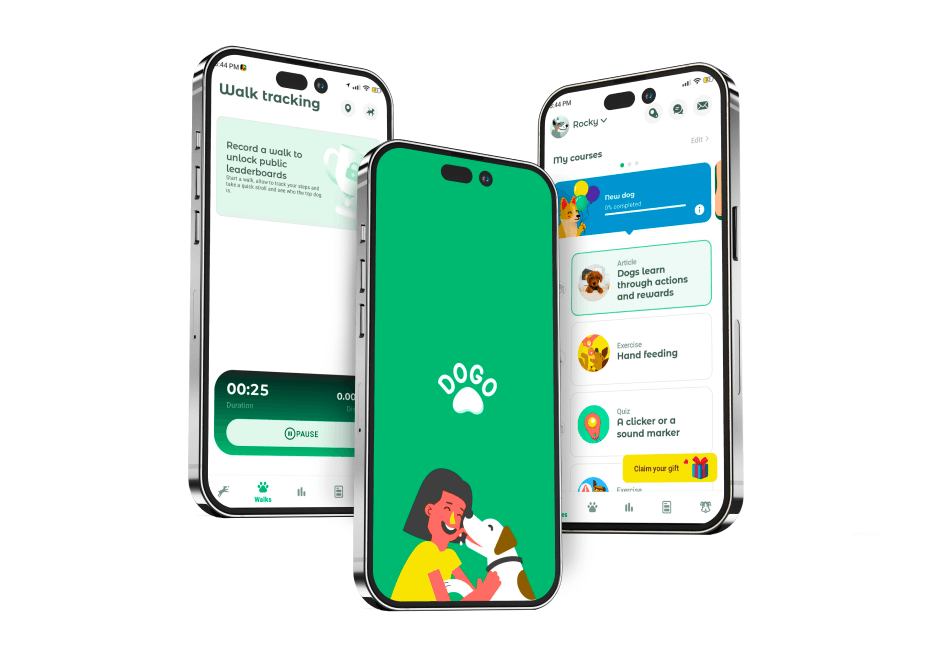
Dogo App is a mobile dog training app. It is especially designed for pet owners. It offers guided video tutorials, personalised training plans, and tools (like a built-in clicker/whistle) as well, to teach dogs new tricks and good behaviour.
What really sets Dogo apart is its focus on positive reinforcement. Trainers on the app encourage pet parents to teach, not punish. Reward good behaviour. Be patient. Repeat. This approach has helped the app earn massive trust from users.
The app boasts 10 million+ registered dog parents and 11 million happy dogs actively using its programs. That’s not just downloads… that’s daily use. Business Insider called Dogo “the leader of the dog training pack,” praising its clear, step-by-step videos and the option to get live feedback from professional trainers. In short, Dogo is a top-rated dog training app that makes it easy for busy owners to train pets at home with expert guidance.
Other reviews highlight how user-friendly and effective Dogo is: it offers over 100+ tricks with video instructions, progress-tracking “streaks” for daily training, and even community features to exchange tips. Every dog’s profile is customizable, and reminders help owners keep up daily sessions. By putting professional training programs in users’ hands (literally on their phone), Dogo has built a loyal user base and consistently leads the dog-training-app market.
Also Read – On-Demand Dog Walking App – Explore the Cost, Features, and Process
1. Dogo
2. Puppr
3. GoodPup
4. Zigzag
5. Woofz
These pet training apps are trusted by millions of pet owners for training, behaviour improvement, and expert guidance.
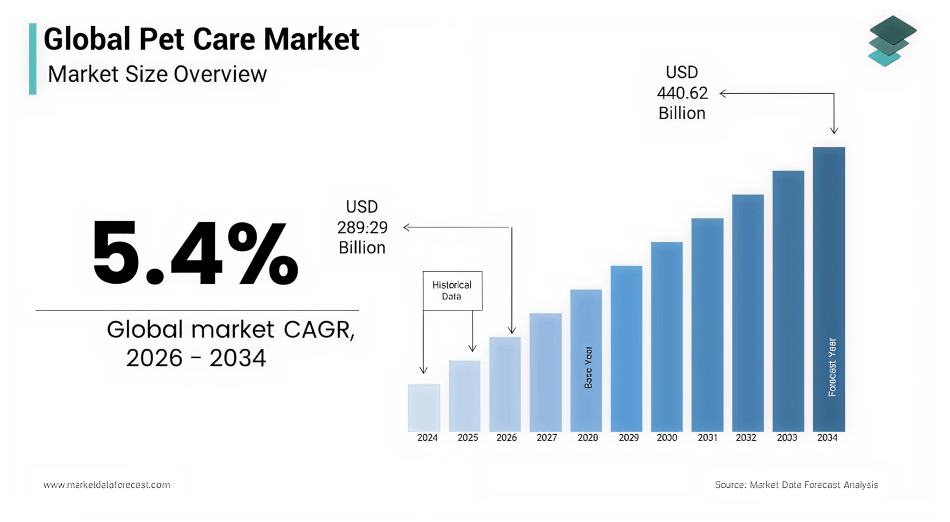
The pet industry is not slowing down. It’s expanding… fast. The global pet care market is projected to grow to $500 billion by 2030. Europe alone counts close to 139 million pet-owning households across the EU. That’s a massive audience already spending more on food, health, and yes, training.
Inside this huge market, pet training apps are carving out their own space. Still niche. Still growing. One market study even estimates the global dog training app market could reach $1.2 billion by 2033. Right now, pet training apps make up only a small slice of total pet spending. Which is exactly why they’re attractive. Low saturation. High potential.
From a business point of view, pet training app development in Europe is tapping into a user base that is already tech-friendly. Millennials and Gen Z pet parents don’t hesitate to pay for digital solutions especially when it comes to wellness and behaviour. A well-built dog training app development in Europe project can easily connect with users who prefer guided videos, reminders, and progress tracking instead of traditional classes.
There’s another advantage. Specialization. A custom mobile app development model for dog training (or cat training, or puppy-only apps) can stand out much faster than broad “all-pet” platforms. Niche apps feel personal. Focused. Useful. And that’s exactly what pet parents look for when they download something.
We’ve already seen how fast pet-tech can scale. Apps like Wag! and vet-booking platforms grew rapidly once demand kicked in. Training apps follow the same logic but with recurring use such as daily sessions, habit formation, and long-term engagement.
From an investment angle, this matters.
All of this makes pet app development a smart long-term play. Whether you’re planning a dog-only platform or a multi-pet solution, the fundamentals stay the same. Build something useful. Keep it simple. Add value to daily life.
And when founders start thinking about the cost to create a dog training app, the upside becomes clearer. You’re not just building software. You’re entering a market driven by pet humanisation where owners treat animals like family. That trend isn’t fading. It’s accelerating.
Which is why investing in a pet training app today doesn’t feel like a gamble. It feels like timing.
Let’s move to the main question – how much does it cost to build an app like Dogo in Europe?
Building a dog training app like Dogo isn’t about writing a few lines of code and launching it. There are many moving parts. So when someone asks how much does it cost to build an app like Dogo in Europe. Answer is – it depends on design, features, platforms, and backend. And yes… all of this changes the final price.
On the lower side, a basic pet training app with simple UI and limited features usually falls in the range of €25,000 to €50,000. This version covers essentials like training videos, basic user profiles, and progress tracking. Nothing fancy. But functional.
A mid-level app — with features such as GPS-based services, in-app payments, live video sessions, or community tools can cost anywhere between €50,000 and €100,000. This is the range most startups aim for when planning dog training app development cost in Europe. Balanced. Scalable. And ready for monetisation.
Now, if you’re thinking bigger… an advanced or enterprise-grade app goes beyond the basics. Premium UI/UX, multi-language support, AI-based training guidance, AR exercises, cloud hosting, and real-time analytics. These apps usually cross €100,000, and in many cases, go well beyond €120,000.
Industry benchmarks support this too:
| App Type | Estimated Cost in Euro | Estimated Timeline |
| Basic dog training app | €25,000 to €50,000 | 2 – 3 months |
| Mid-level dog training app | €50,000 to €100,000 | 3 – 5 months |
| Complex / enterprise-grade app | €100,000+ | 5 – 8+ months |
So when founders ask about the cost to develop an app like Dogo in Europe, the honest answer is… it depends. Depends on what you want your app to do. Depends on how smart it should be. Depends on whether it’s just training or training plus AI, plus community, plus monetisation.
This is why pet training mobile app development cost in Europe vary so much from project to project. A simple obedience trainer is one thing. A full-fledged custom dog training app development platform with AI and AR is another story altogether.
And we’re just getting started. Next, let’s look at how features directly impact the budget feature by feature.
When you break the budget down, features do most of the damage (in a good way). The more your app can do, the more time developers need. And time… is money.
At the base level, you start with the MVP features. These are the must-haves such as user accounts (pet owners + pet profiles) and a training content library (videos, short guides, articles). Plus, basic push notifications and reminders and progress tracking for daily sessions are also non-negotiable.
These features alone can already add several thousand euros to your dog training app development cost in Europe. Especially video. Streaming video lessons, storing them, and allowing offline access? That’s not cheap. It needs proper backend setup, cloud storage, and testing.
Then come the “nice to have” features. This is where the budget starts moving faster:
Each of these layers adds complexity and cost. Now, if you go one step further, things get serious, for example, live chat with trainers, video feedback sessions, community forums, and AI-based behaviour recommendations as well.
All of these features push your app beyond a simple product and into a custom dog training app development category. And that’s where pricing changes quickly. Let’s have a look…
| Module | Key Features Included | Estimated Cost Range (€) |
| Pet Owner App (User Panel) | Sign up & login, pet profiles, breed selection, training plans, progress tracking, reminders, push notifications | €7,000 – €14,000 |
| Training Content Library | Video lessons, articles, categories, difficulty levels, offline access, bookmarking | €5,500 – €11,000 |
| Gamification & Progress System | Badges, streaks, milestones, level unlocking, behavior charts | €3,000 – €6,500 |
| Built-in Training Tools | Clicker sound, whistle, timers, session counter, AR demos (optional) | €2,000 – €5,500 |
| Live Trainer Interaction | In-app chat, video feedback upload, live consultation, message history | €4,500 – €11,000 |
| Social & Community Features | Pet profile sharing, achievements sharing, comments, likes, community feed | €2,500 – €5,500 |
| Payments & Subscriptions | In-app purchases, monthly plans, coupons, Apple/Google payment gateway integration | €2,500 – €5,500 |
| Notifications & Reminders | Training alerts, streak reminders, class reminders, behavioural nudges | €1,500 – €3,000 |
| Multi-Language Support | Language switch, localised content, RTL support (if needed) | €2,000 – €4,500 |
| Admin Features | Estimated Cost Range (€) |
| User & Pet Management | €2,000 – €4,500 |
| Content Management System (CMS) | €3,000 – €5,500 |
| Trainer Management | €2,000 – €4,500 |
| Analytics & Reports | €2,000 – €3,500 |
| Subscription & Payment Control | €2,000 – €3,500 |
| Push Notification Control | €1,500 – €3,000 |
So when founders talk about how much does a dog training app cost in Europe, it’s not really about the app. It’s about what’s inside it. A simple obedience trainer will cost far less than a full-scale pet training mobile app development cost in Europe project with video, AI, and live trainers built in.
Same idea. Very different price tags.
The cost of building a dog training app like Dogo is never fixed. It shifts based on several technical and business decisions, and the biggest drivers are the level of app complexity, the quality of design, the platforms you choose, and the region where your development team is located.
Many founders prefer European teams because they understand privacy laws, payment regulations, and local user behaviour also which matters a lot when you want to develop a custom pet training app for the European market.
In the end, there is no single number for the cost to create a dog training app.
A simple dog training app built by a small team can stay closer to the lower range. A feature-rich, high-quality app built for Europe can easily cross higher budgets.
That’s why there is no single number for the cost to create a dog training app. It depends on your feature list, your design ambition, and your development region.
Most founders calculate only the development cost, but the real spending starts after launch.
So while you may focus on the dog training app development cost in Europe, the long-term cost of running the app depends just as much on what happens after launch. So think beyond just building the app and consider what it takes to run it long term. You may connect with an experienced mobile app development company in Germany, Techugo, for a one-on-one call with experts.
Building a pet training app does not mean you must spend everything at once. Smart planning can reduce the pet training app development cost without hurting quality.
Instead of launching with every possible feature, build a minimum viable product; focus only on the core training functions such as pet profiles, lesson videos, and progress tracking because once users start engaging, you can further add more features gradually step by step. This approach keeps early costs under control and lowers the risk of building things users may not even need.
Using cross-platform development is another strong way to save money because frameworks like Flutter or React Native allow you to build one codebase that works on both iOS and Android. This reduces development time and testing effort compared to building two separate native apps, which directly impacts the overall dog training app development cost in Europe.
Hiring developers in regions like Eastern Europe or India usually costs less than working only with local teams in Western Europe. Many startups choose a mixed model, where planning and design stay local while development is handled by offshore teams. This balance helps control the cost to create a dog training app without compromising too much on quality.
You can also save by reusing existing modules and libraries, for example, features like login systems, analytics, and notifications do not need to be built from scratch. You can use trusted third-party tools and it will reduce the development time as well as help you avoid unnecessary engineering work.
Finally, follow an agile development process. Build in small phases, test often, and improve continuously. This helps catch design or feature mistakes early, before they become expensive to fix later. Over time, this method helps you get more value from the same budget while still delivering a reliable custom dog training app development project.
In short, cost optimisation is not about cutting corners. It is about making smarter technical and business choices from the beginning.
Most dog training apps don’t rely on just one income source. They mix things up. That’s how they survive and grow.
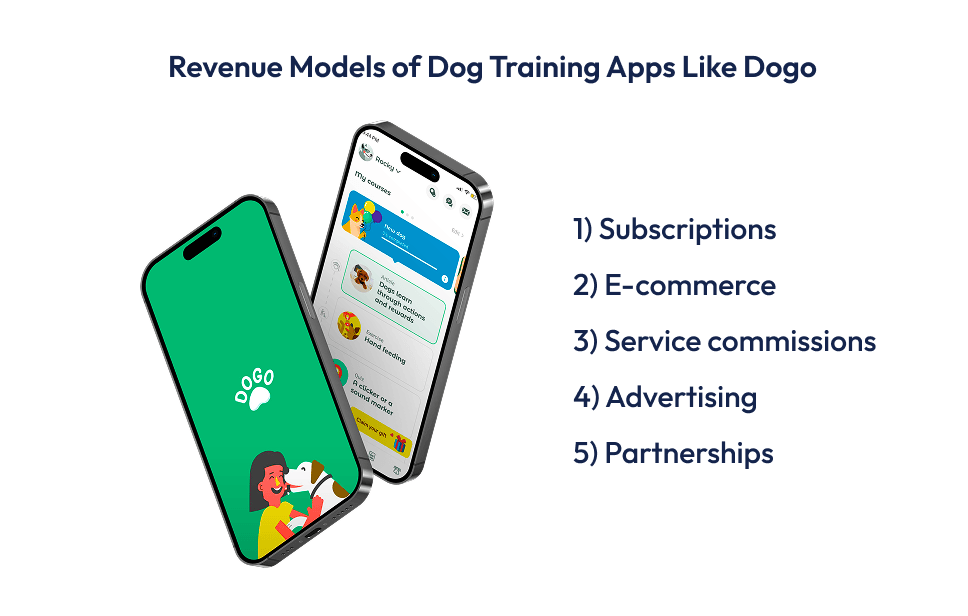
The most common model is subscriptions. Basic lessons stay free, but users pay monthly for full access, expert programs, or one-on-one trainer chats. Simple idea. Works well. Clavax reports that subscription models are the easiest way to stay profitable.
Then comes e-commerce. Some apps sell pet products inside the app. Others use affiliate links. A collar here, treats there. Small cuts. But steady money.
Another stream is service commissions. If the app connects users with dog trainers, boarding services, or vets, it can take a percentage from each booking. Not visible to users. But helpful for business.
There is also advertising. Free users see ads. Premium users don’t. Some apps keep an ad-supported tier and push upgrades slowly. Soft selling. Not forced.
Partnerships matter too. Tie up with pet brands, stores, or clinics. Run paid virtual classes. Host live training sessions. Charge for access. Add value. Add revenue.
And when the money comes in, apps reinvest it. More marketing. Influencers. Social media. Community features. Loyalty programs. Retention first, and then growth.
By combining these – e.g. subscriptions + e-commerce + ads – apps diversify their revenue and scale faster. Successful dog training apps then reinvest in marketing (social media, influencer partnerships) to acquire more users and improve retention (loyalty programs, community forums).
To build an app as good as Dogo, you need strong features on the owner’s side and complementary tools for trainers and admins. Key features include:
In essence, the admin panel “controls profile, payment, and analyses performance of the app”, ensuring smooth operation.
Each feature area should be designed for simplicity and reliability. For example, intuitive UI so even a first-time dog owner can start training immediately. By covering these must-haves, your app can compete with Dogo in functionality and user experience.
Beyond the basics, advanced features can make your app stand out.
A clear process is needed for pet training app development, because an app like Dogo is not built in one go. It is built in steps, and each step depends on the one before it.
Also Read: Pet Dating App Development: Market Opportunities, Features, Cost, and Business Models
First comes market research and validation, so that you understand what problem the app will solve and who it is for. You study other dog training apps, and you look at what works and what does not, because this shapes your custom dog training app development idea.
Then there is planning, and this step decides your features, your platform choice, and the cost to create a dog training app. You set a timeline, and you assign roles to designers and developers, so that work does not become messy later.
After that, design and wireframing start. Screens are sketched, and user flows are created, from sign-up to the first training lesson. This step exists because fixing design issues early is easier than fixing them after coding has started.
Next is development, where the backend and the main features are built first, and extra features come later. Teams usually work in short cycles, because this helps control the pet training app development cost and reduce risk.
Once features are ready, testing and QA happen. Bugs are found and fixed, and the app is checked on different devices and systems, so that users do not face problems at launch.
Then comes launch, with store listings and a possible beta release.
And after launch, there is post-launch improvement, where updates are released and new training modules are added, because the app must keep growing.
You plan, you build, and you improve, and therefore, the process never really stops.
Techugo is a top-rated mobile app development company in United Kingdom with a strong presence in Germany, the Netherlands, and France. To illustrate its capability, Techugo has delivered over 1400+ custom digital solutions worldwide and is consistently recognised among the best app development agencies for businesses to hire app developers in France.
For pet apps, Techugo’s tech expertise is a big advantage: their team integrates modern technologies (Flutter/React Native, AI/AR, IoT) into solutions. This means they can implement advanced features (machine-learning trainer advice, AR-guided exercises, personalised algorithms) that modern pet owners expect.
Moreover, Techugo’s familiarity with European markets helps ensure your app meets regional needs. They understand local compliance (GDPR, app policies). In short, Techugo combines proven experience (many large projects delivered), modern tech skills, and global reach, making it well-suited to build a market-leading pet training app in Europe.
Dog training apps like Dogo are riding the wave of the growing pet care market. They make training easier for owners, and honestly, that’s why people keep using them.
There is clear demand for digital pet services, so the business side looks promising too. But yes, it still needs proper feature planning, security, and a way to earn money that actually works. If done right, the app can grow, make profits, and keep both dogs and humans a little happier.
A dog training app is a mobile application that provides guidance, lessons, and tools for pet owners to train their dogs. It typically includes video tutorials, progress tracking, and may offer live coaching or community support.
The pet care market is huge (hundreds of billions globally) and growing. Many owners seek convenient training solutions, so a well-designed app can attract users and revenue (via subscriptions, ads, or e-commerce). Trends show high demand: for example, the dog training app market alone is projected to reach over $1 billion by the early 2030s.
At minimum, include user accounts (owner/dog profiles), a library of training videos/lessons, progress tracking (e.g. streaks or achievements), reminders/scheduling, and interactive tools (clicker, etc.). For trainers, provide a way to review owner-submitted videos and communicate. Admin features include content management, analytics, and payment processing.
Techugo has a proven record (1400+ apps delivered globally) and is recognised as a top developer in Europe. They specialise in modern mobile tech (Flutter, AI/AR, etc.) and understand the European market and regulations. This makes them well-equipped to build a high-quality, compliant pet training app that can compete with the best in the market.
If you are planning to build an app like Rover, the first thing you need to think about is not features… but budget. A pet care platform is not just a..


Fashion is already one of the biggest drivers of online shopping in Australia. Mobile-first buyers. Gen Z habits. Scroll, tap, buy… repeat. Globally, ..


Write Us
sales@techugo.comOr fill this form