

 SA
SA  KW
KW  IE
IE AU
AU UAE
UAE UK
UK USA
USA  CA
CA DE
DE  QA
QA ZA
ZA  BH
BH NL
NL  MU
MU FR
FR [ LET’S TALK AI ]
X
Discover AI-
Powered Solutions
Get ready to explore cutting-edge AI technologies that can transform your workflow!



Get ready to explore cutting-edge AI technologies that can transform your workflow!






“The future is already here—it’s just not evenly distributed.”
– William Gibson
This quote perfectly captures the state of IoT in 2026. Some businesses are already leveraging IoT to automate operations and unlock new revenue streams. But others are still figuring out where to begin. The difference often comes down to access! Access to the right technology, the right strategy, and most importantly, the right development partner.
For startup founders and decision-makers, the question isn’t whether to invest in IoT anymore! It’s how much will it cost to bring a secure, scalable IoT app to market in 2026? Well, the costs can vary dramatically. Depending on complexity, security needs, and the expertise of your development team.
So without delay, let us break down the IoT app development cost in 2026. Also, explore the key factors shaping IoT app development pricing. And, why investing in the right IoT app development company can make your digital transformation journey.
For startup leaders, understanding these cost levers lets you make smart trade-offs. Want to build MVP fast and lean? Stick to essential features, off-the-shelf infrastructure, and lean teams.
Planning an enterprise-quality launch? Build robust security, integrations, and scalability from the start.
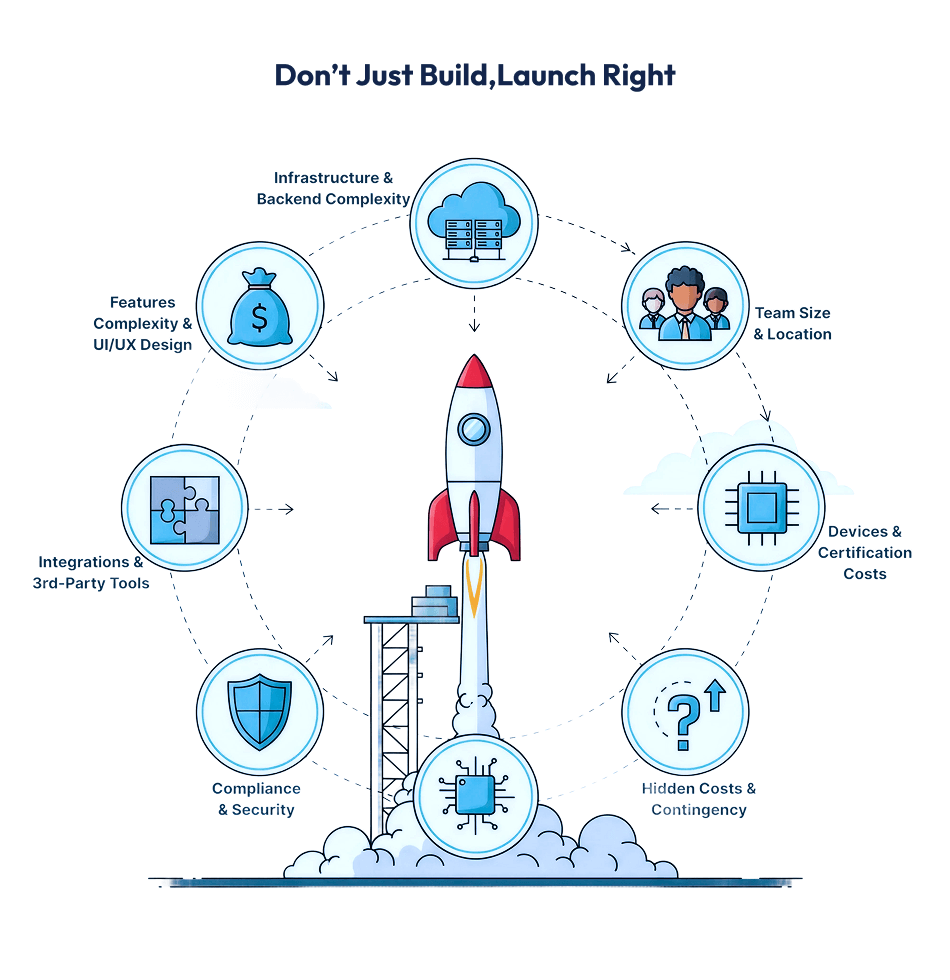
These are all the factors that come into play:
Every additional feature, from data visualization and AI-powered analytics to real-time alerts, adds development hours and complexity. In fact, basic push notifications may run under $5,000. Training machine learning models can cost as much as $80,000.
Thus, focus on must-have features that drive value. Fancy additions can wait until you’re more confident in product-market fit.
An elegant, intuitive design is more than aesthetics. It shapes product adoption. A simple template-based UI might cost $5,000-$15,000. Custom, interactive interfaces could hit $15,000-$50,000. Responsive designs that adapt across devices add another $10,000-$30,000.
Whether your app is consumer-facing or enterprise-grade, investing thoughtfully in UI/UX pays dividends in usability and polish.
Your backend choices impact both upfront and ongoing costs. Cloud solutions save on infrastructure costs but come with subscription fees. Building custom infrastructure offers control but demands expert backend support.
The team that brings your idea to life is a major cost driver. A larger, highly skilled team accelerates timelines but increases expenses. For instance, a 10-person IoT team might cost around $40,000 per month, depending on the region.
Hourly rates also vary widely:
For,
Every integration adds development time and cost. Basic integrations might cost under $5,000, while complex enterprise-level integrations can exceed $100,000.
Depending on your app’s use case, you might need to meet standards like GDPR, HIPAA, or FCC certification. GDPR certification alone can cost thousands to hundreds of thousands of dollars. Comprehensive security audits for complex IoT ecosystems might reach $95,000. Skipping these can cost way more in penalties or lost trust.
IoT projects often involve hardware, which can account for 70-80% of a budget in some cases. Additionally, device certifications (e.g., for safety, wireless compliance) vary by market and can add significant expenses depending on the scope.
These can quickly inflate budgets. Experts recommend reserving 10-20% of your project budget as contingency for surprises.
The pricing spectrum is key for smart decision-making. Let’s break down what different tiers of IoT app complexity typically cost:
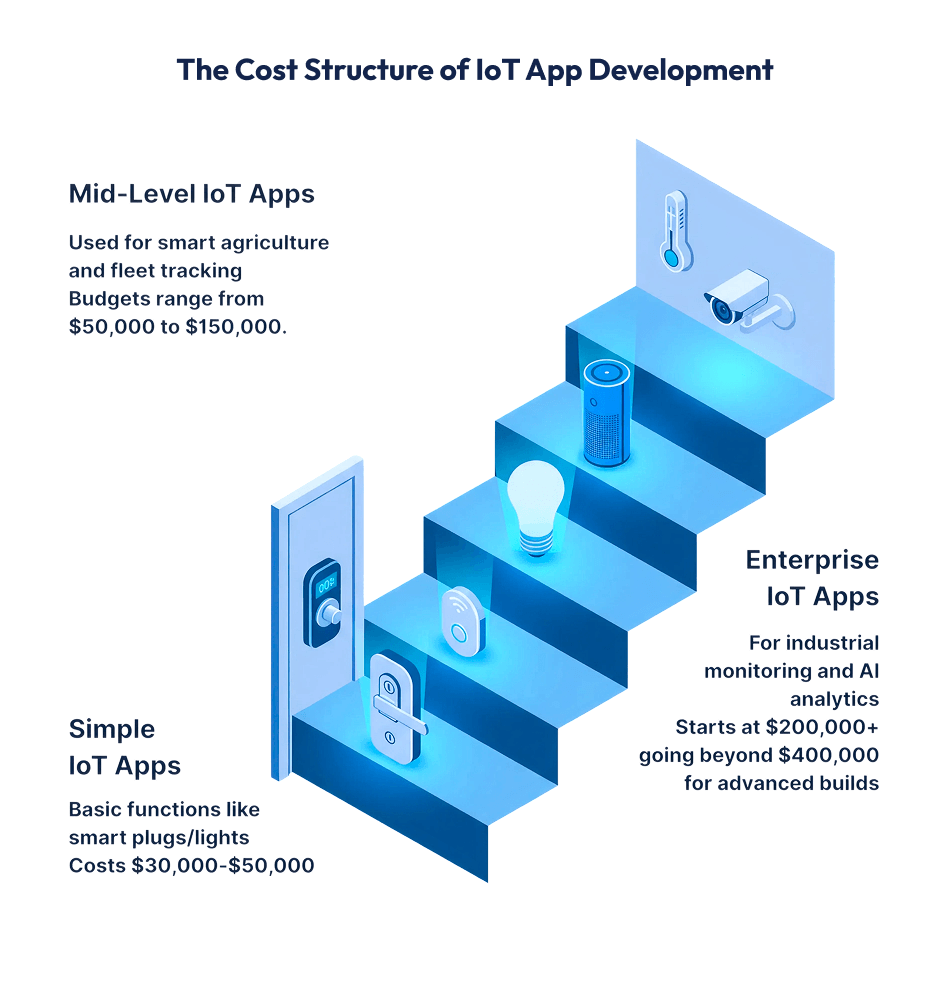
Ideal for basic functions like controlling a smart plug or light.
These budgets typically cover core software only. Hardware and servers are separate.
For use cases like smart agriculture, fleet tracking, or multi-device home automation.
Think industrial monitoring, AI-driven analytics, or managing hundreds of devices.
Some friendly tips here!
Tip #1
Always align the budget with your business goal.
Want to test a market quickly? A simple MVP at $20,000-$50,000 might be your sweet spot.
Tip #2
Mid-tier apps (think fleet tracking or multi-device control) usually land in the $70k-$150k range. They offer compelling functionality without overextending your runway.
Tip #3
Enterprise solutions with AI, real-time data, and large-scale deployment can climb past $200k. Factor in long-term maintenance and infrastructure costs, too.
When you’re building a smart home IoT app, be clear about the typical costs, based on trusted industry sources:
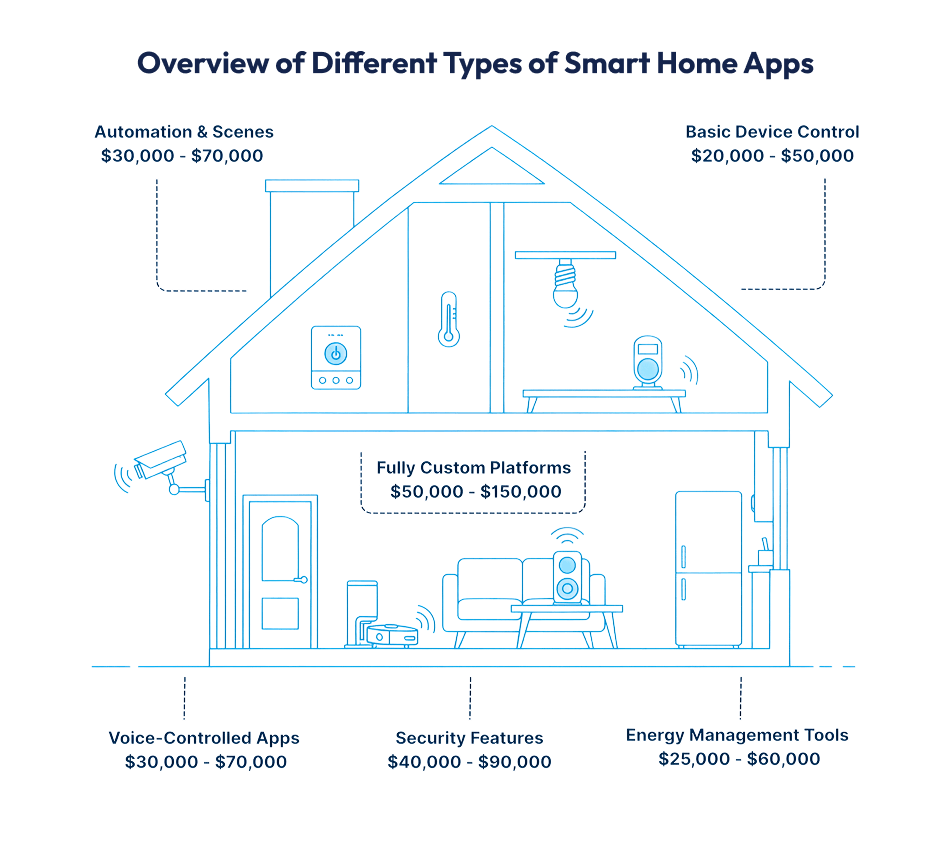
| Type of Smart Home App | Estimated Cost (USD) |
| Basic Device Control (lights, thermostat) | $20,000 – $50,000 |
| Automation & Scenes (routines, scheduling) | $30,000 – $70,000 |
| Voice-Controlled Apps (Alexa/Google/Siri) | $30,000 – $70,000 |
| Security & Surveillance Features | $40,000 – $90,000 |
| Energy Management Tools | $25,000 – $60,000 |
| Fully Custom Smart Home Platforms | $50,000 – $150,000 |
Why the wide range?
From planning to launch and maintenance:
Need lean and quick?
A basic device control MVP, targeting a single platform with minimal features, can often be built for $20,000-$35,000.
Looking for smarter homes?
If you’re building automation and plan to integrate voice controls or energy tracking, budget $50,000-$80,000, depending on the level of polish required.
Enterprise-grade ambition?
For full-stack smart home platforms, plan for $80,000-$150,000+.
Security is a must, not an add-on! Even for smaller apps, allocate a chunk of your budget to make it secure from the start.
Maintenance matters! Post-launch support can cost up to 20% of your initial development spend annually.
You’ve budgeted for design, development, and launch. But hold up! The real picture reveals a slew of hidden and ongoing costs that can quietly inflate your project. If not accounted for early on.
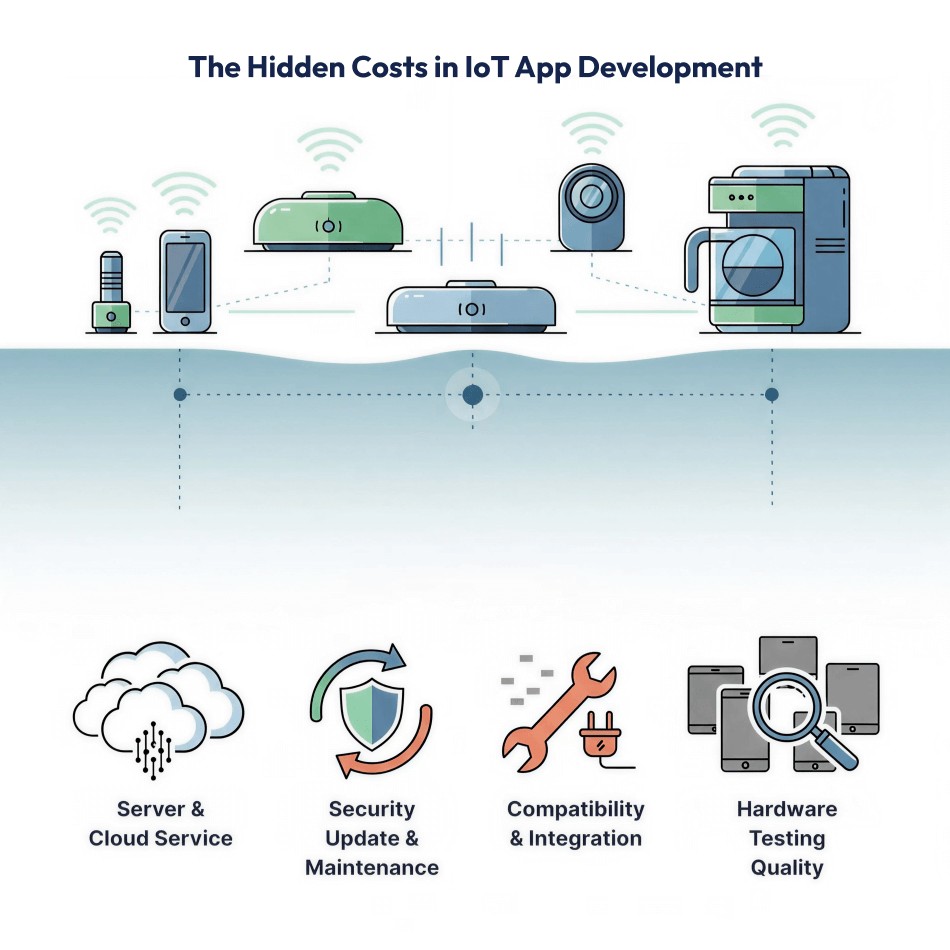
Even after release, your IoT app continues to run on servers, in the cloud, and across devices. These infrastructure costs include,
Plan for 15-25% of your initial development budget each year just for maintenance and infrastructure upkeep. If your IoT app costs $100,000 to build, expect $15,000-$25,000 per year in maintenance alone. Additionally, infrastructure misconfigurations or idle cloud resources can quickly spin into unexpected overages. 69% of organizations overshoot their cloud budgets. Public cloud spend is exceeding the budget by an average of 15%.
Yes, IoT consulting and security aren’t one-time tasks but ongoing necessities.
Many enterprises stumble by underestimating operational expenses related to connectivity failures and scalability challenges.
On top of that, standard security and regulatory updates. Especially under strict frameworks like GDPR or industry-specific mandates, expert attention is required. Investing early in IoT security consulting helps you define the level of data protection and compliance testing required for your app.
New OS versions, updated APIs, and evolving device firmware all mean ongoing compatibility work. Each update, plugin, or hardware change must be tested and supported.
These are often overlooked layers that accumulate significantly over time.
Unlike mobile apps that only need to adapt to new screen sizes, IoT apps must work seamlessly across numerous hardware types. All of which can evolve.
Cisco’s IIoT studies suggest that administrative labor for service lifecycle and support can account for 20-50% of operational expenditure. A substantial hidden burden if not forecasted.
How to prepare for these costs?
Engaging IoT consulting and IoT security consulting early might seem like an added expense. But it’s a critical investment to avoid far costlier breaches, non-compliance penalties, or deployment failures down the road.
Further, your app must survive changes in firmware, devices, and platforms. Allocate for testing across ecosystems and for future integrations or protocol shifts.
Avoid the short-sighted trap. Many IoT projects collapse not because of tech flaws, but because persistent cost leakage goes unmonitored. Keep operational expense visibility high and stay agile.
| Month | Cloud & Infrastructure | Connectivity (per device) | Security & Testing | Maintenance & Updates | Cumulative Total |
| 1 | $2,000 | $500 | $3,000 (setup & audit) | $5,000 (init bug fixes) | $10,500 |
| 2-3 | $1,800/month ($3,600) | $500/month ($1,000) | $1,000/month ($2,000) | $2,000/month ($4,000) | $21,100 |
| 4-6 | $2,000/month ($6,000) | $500/month ($1,500) | $500/month ($1,500) | $1,500/month ($4,500) | $28,600 |
| 7-9 | $2,200/month ($6,600) | $500/month ($1,500) | $500/month ($1,500) | $1,500/month ($4,500) | $36,100 |
| 10-12 | $2,500/month ($7,500) | $500/month ($1,500) | $500/month ($1,500) | $1,500/month ($4,500) | $46,100 |
When harnessed effectively through analytics, data becomes your strategic advantage. It drives savings and revenue and smarter planning.
Explore how investing in IoT data analytics transforms your project’s cost dynamics and return on investment.
| Benefit Category | Metrics & Examples |
| Maintenance Cost Reduction | Predictive maintenance reduces maintenance costs by 18-30% and cuts unplanned downtime by up to 50%. Example: a chemical plant eliminated urgent work from 43% of maintenance tasks. |
| Downtime Avoidance | Global unplanned equipment failures cost industries up to $1.4 trillion annually. North American factories deploy sensors and analytics to avoid costly downtime. |
| Operational Savings & ROI | The estimated ROI from smart analytics integrations is up to 30% savings and significant efficiency gains. IIoT systems can reduce breakdowns by up to 70%, cut scheduled repairs by 12%, and slash total maintenance costs by 30%. |
| Strategic Edge & Future Potential | Predictive maintenance market to grow to $70.7 billion by 2032 (26.5% CAGR). Sensor data + ML turns reactive operations into proactive, asset-aware systems. |
You can expect 18-30% cost savings and faster ROI, often within 1-2 years.
The industrial scale of unplanned downtime costs (up to $1.4T globally) shows just how impactful even modest improvements can be. Robust IoT analytics strategies combining sensors, ML, and planning open doors to faster maintenance, fewer crises, and more competitive agility.
The market trends (with predictive maintenance projected to reach $70B by 2032) underscore that analytics is the future of efficient business ops.
When it comes to IoT, choosing the right development partner is just as important as choosing the right technology stack. A specialized IoT app development company brings not only coding expertise but also domain knowledge in IoT security and data analytics.
Techugo has partnered with startups and enterprises worldwide to deliver secure and user-friendly IoT solutions. As a leading mobile app development company, our strength lies in combining innovation with business practicality. Helping founders launch faster without compromising on performance.
Working with a professional IoT application developer gives you several advantages over freelancers or small teams:
A full-service partner like Techugo ensures that your IoT project is aligned with both your technical and business goals.
Techugo stands out because we blend technical expertise with business-first thinking. Our team has hands-on experience delivering IoT apps for diverse industries, ensuring scalability and measurable ROI.
Yes. Security is a critical aspect of every IoT project we undertake. We offer IoT security consulting to identify vulnerabilities. We integrate best practices and ensure your app complies with the latest security standards.
Absolutely. Beyond development, our team specializes in integrating IoT data analytics into apps. This helps businesses leverage connected data for actionable insights, predictive analytics, and better decision-making.
Yes. Techugo offers long-term IoT app development services, including upgrades, bug fixes, performance monitoring, and feature enhancements to keep your IoT app future-ready.
We follow a transparent pricing model where all costs are clearly defined. Our goal is to help decision-makers forecast their IoT app development cost accurately, with no hidden surprises.
Yes. Whether you need a smart home IoT app for consumers or an enterprise-grade IoT solution for industrial operations. Techugo’s app developers have the expertise to deliver on both fronts.
Our IoT consulting services help you
All tailored to your business goals before moving into development.
For decision-makers, the takeaway is clear! Partnering with an experienced IoT app development company ensures that your product is not only functional but also scalable and aligned with your ROI goals. With the growing importance of IoT consulting, your choice of partner will directly impact both cost and success.
So let Techugo help you transform ideas into powerful IoT solutions. With expertise in IoT software development, we’ve supported global startups and enterprises in building apps that drive measurable results.
“My app/website is beautiful, but when Arabic-speaking users open it, the interface looks confusing to them. Text alignment looks weird, navigation se..

Developers aren’t being replaced. But AI coding tools are quickly becoming the invisible teammates we didn’t know we needed. From fixing bugs to auto-..


Write Us
sales@techugo.comOr fill this form