

 SA
SA  KW
KW  IE
IE AU
AU UAE
UAE UK
UK USA
USA  CA
CA DE
DE  QA
QA ZA
ZA  BH
BH NL
NL  MU
MU FR
FR [ LET’S TALK AI ]
X
Discover AI-
Powered Solutions
Get ready to explore cutting-edge AI technologies that can transform your workflow!



Get ready to explore cutting-edge AI technologies that can transform your workflow!






Decentralised applications, commonly known as DApps, are bringing in major change when it comes to Web3 technologies. Trustless interactions, security, enabling transparency, and operating blockchains become extremely seamless for users and for businesses. Furthermore, a DApp website is the trend of tomorrow happening today, for which businesses need to jump on to get the best output and quality. However, not many people know how to create a DApp website to pounce on this opportunity. And it is why, let this piece of content be your guide to make one.
A DApp (decentralized application) website is a user interface that allows users to use a blockchain application. It functions like a typical web page. However, instead of connecting to a centralized server, it connects directly to the smart contract(s) on the underlying blockchain.
The main features of DApps are:
Decentralized: DApps are not governed, controlled, or managed by a single (central) authority.
Transparent: All transactions executed in the DApp are recorded on and can be publicly viewed on the underlying blockchain.
Secure: Cryptographic methods confirm the authenticity of transactions and that the DApp is secure.
Trustless: Users can utilize or engage with DApps without relying on or using intermediaries. Hence, this is what fulfils the criteria for DApp architecture explained.
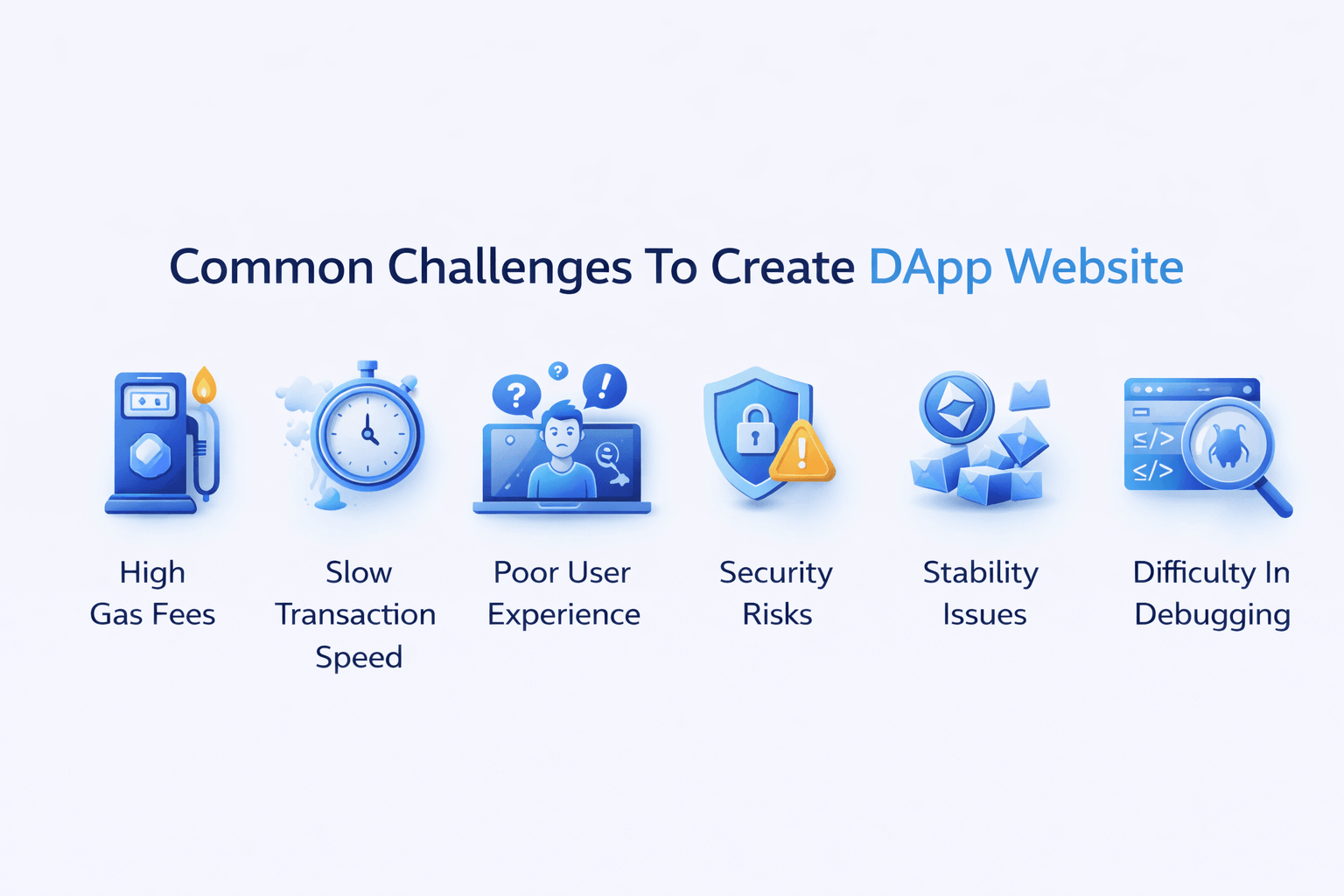
Building a DApp website from scratch is an exciting prospect. However, it comes with a unique set of challenges that can lower overall productivity and performance.
High gas costs are among the most evident obstacles for developers of Decentralized Applications (DApps), particularly those using well-established protocols such as Ethereum. Every single transaction on the network incurs a cost to the user who initiates it, but in times of high use, the cost to complete similar transactions can increase dramatically. Therefore, high gas fees can act as barriers to users performing simple actions, such as voting or sending funds in small amounts, on DApps.
Transaction verification speed is another challenge that impacts users’ overall experience with DApps. DApps behave differently from traditional software; that is, users expect transactions submitted to DApps to be completed within seconds. However, blockchains can add considerable delay (on the order of seconds to minutes) from the time a user submits their transaction until the moment that transaction is finalized on the blockchain.
User experience in many DApp cases is often poor – especially for beginners who are new to blockchain technology. The connections to wallets, approving transactions, and some technical errors can make this process feel very intimidating and complex to complete. Even if the backend has no issues, you can lose users due to the confusing nature of the interface itself.
Security risks represent some of the most significant barriers to developing DApps. Once a smart contract has been deployed, it is immutable and therefore cannot be easily modified (e.g., any vulnerabilities within a smart contract’s code can be exploited). Because most DApps involve financial transactions, they represent an attractive target for hackers.
Scalability difficulties emerge as a DApp accumulates greater usage, and the supporting blockchain cannot effectively process the additional workload. Most blockchains are restricted in the number of transactions they are able to process each second. Thus, when the amount processed exceeds the established thresholds, it can cause a corresponding increase in the amount of time it takes to process one transaction and a corresponding increase in the cost of processing that same transaction.
In DApp development, debugging occurs at a much greater level of complexity than in traditional types of applications. Errors in the smart contracts that are executed on the blockchain will be much more difficult to locate and fix than in a standard type of application. Furthermore, testing errors on live networks will cost “real money.” Consequently, debugging in this space is both a tension point from a technical level and a significant cost issue.
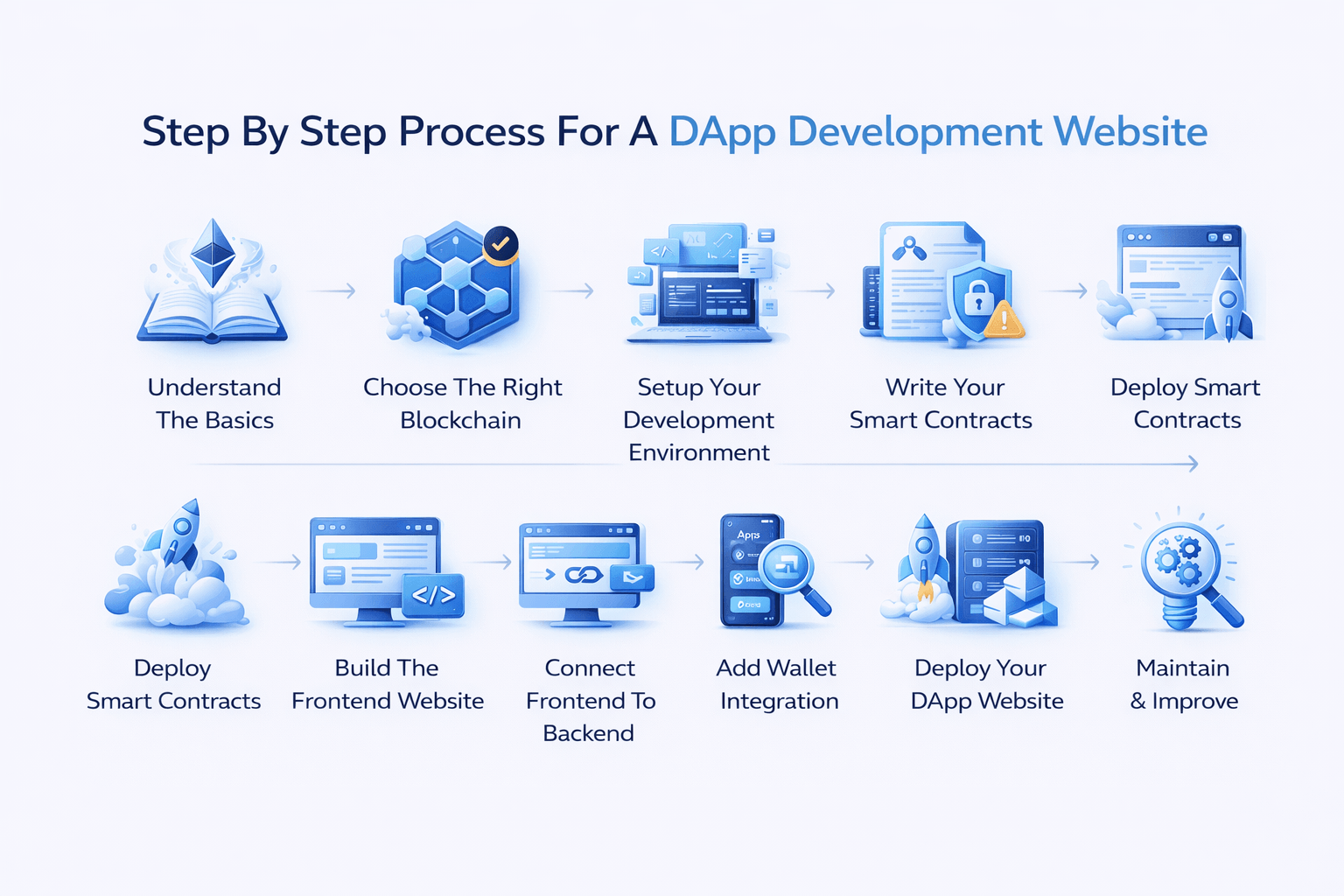
In this day and age, it is critical to know what is the step by step DApp development process. Here is the DApp architecture explained in detail:
In this day and age, it is critical to know what is the step by step DApp development process. Here is the DApp architecture explained in detail:
In general, developers jump right into coding DApps (decentralized applications) when they begin to develop them, but they wind up getting confused by not completely understanding how everything fits together when they begin to build them.
The website is what users see and interact with and is built using HTML, CSS, and JavaScript (or frameworks like React).
Smart contracts are self-executing programs that are stored on the blockchain and specify the logic of your DApp.
The blockchain network is where your smart contracts are located (for instance, Ethereum, Polygon, or BNB Chain).
Users connect their crypto wallets (such as MetaMask) to your DApp.
There are many blockchains available, and the choice you make will impact your DApp’s cost, speed, and scalability. You can also consider them under the category of tools for DApp development.
Common choices of blockchain:
To create your DApp website, you’ll require several tools:
For this, you can take the help of dependencies that include:
Moreover, you will want to install several development frameworks or libraries designed for use on the blockchain, for example;
Finally, once you have your chain built and deployed to the proper environment (Testnet), you are now ready to develop your DApp.
A smart contract is the backbone of your DApp. Some common use cases involve:
After completing your smart contract development, you’ll need to deploy your smart contract.
Once your Smart Contract has been completed, you need to go through the following steps:
Testnets allow you to develop and test your DApp without risking any real assets or funds. This is why it is a crucial component of the step by step DApp development process.
This stage is often a favourite part of the development process as it involves creating the user interface of the application and giving it a design aesthetic.
For this, you can use a technology stack:
At this point, you have created your DApp! Technology stacks you should be using include:
A wallet interface is required for users to interact with your DApp. For wallet integration, some of the aspects include:
Testing is very important in order to ensure everything is functioning correctly. Therefore, some of the aspects you can work upon include:
After you have your app ready, you have to consider:
The reason for going with IPFS is that it adheres to the decentralization principles of not relying on a central server or host.
Design a high-quality image, and in the image write “How Can AI Help You With A Frontend DApp Website?”
Every tech interface will go through the AI revolution. Helping businesses to point out their pain points and areas for improvement is just one of the ways in which AI can help with a frontend DApp website. Various other ways point towards:
By utilizing simple prompts or design inputs, AI is greatly accelerating the process of designing and building a DApp’s front end (user interface) as it can automatically generate code based on the user’s input. Developers no longer have to manually code every component using tools such as GitHub Copilot, v0 from Vercel, and ChatGPT.
Even though integrating blockchain functionality into a front-end may be challenging, it becomes significantly easier to do so with AI. This is because it helps developers write, debug, and deploy code related to wallet connection and smart contract interactions. Furthermore, it can create all the necessary boilerplate code for using tools such as ethers.js, as well as give direction on how to use contract ABIs (Application Binary Interfaces).
The use of DApps may prove challenging for novice users due to the complexity of their different uses and features. With the implementation of artificial intelligence (AI), users will have a more intuitive and engaging experience as they navigate their DApp interface. This could occur through the use of AI-powered chatbots that guide through transactions, as well as a clearer explanation of each transaction in natural language.
Another benefit of using AI is its ability to help users resolve problems that may arise while utilizing DApps. Both technical error messages and human-readable explanations can be translated into both formats by AI. In addition to this, AI tools can also provide suggestions on how users may fix transactions that did not succeed, as well as assist developers in identifying bugs within their frontend code.
In order for individuals to have an enjoyable experience while utilizing DApps, the performance of DApps will be a major factor in determining how satisfied or developer completing tasks within those DApps. Due to the latency involved in performing blockchain calls, AI tools that monitor and evaluate the frontend performance of DApps will provide valuable insights on how to improve performance, such as:
Simulating blockchain interactions and unit tests for UI components is what can be integrated with AI. Testing scenarios like network failures or wallet interactions are just some of the ways in which AI can be used for testing and automation. Therefore, reducing the probability of failed DApps reaching the production stage is what makes all the difference.
Techugo, as a software development company, offers services to nascent-stage startups, midscale companies, fully fledged businesses, and government organizations with:
When you can enjoy a load of benefits and tools for DApp development with the expertise of Techugo, why wait? Connect with our experts now!
Driven by smart contracts, unique security, and censorship resistance guarantees, a DApp website allows you to take the first step into a Web3 world. These applications are characterized by decentralization, transparency, and security. However, the path is not that simple. To know the answer to “how to create a DApp website”, you will have to deal with many problems. Some include high gas fees, slow transaction speed, poor user experience, and more. But if you take the help of Techugo for tools for DApp development or for general assistance to create a DApp website, you might just have an edge.
Ethereum, Polygon, BNB Chain, and Solana are some of the commonly used blockchains for DApp development. However, if you need more help with this, connect with Techugo for detailed guidance.
Reducing the risks of costly errors, finding vulnerabilities, testing UI components, and smart contracts are the reasons why testing is important for a DApp website.
Frontend for DApp website helps in:
The average DApp development cost in UAE falls between $75,000 to $200,000+. This variation is according to the basic and advanced features DApp development website will have.
With the help of AI, businesses can automate testing processes, assist in debugging, enhance the performance of the website, and improve the user experience, which are just some of the ways AI helps to create DApp website.

Some brands are scaling fast while others struggle. The gap isn’t random; it’s being created by how quickly businesses adapt to change. Digital tra..


Tired of slow payments and endless paperwork? You are not alone. Imagine paying your vendors or employees without the headaches of checks or slow ..


Write Us
sales@techugo.comOr fill this form