

 SA
SA  KW
KW  IE
IE AU
AU UAE
UAE UK
UK USA
USA  CA
CA DE
DE  QA
QA ZA
ZA  BH
BH NL
NL  MU
MU FR
FR [ LET’S TALK AI ]
X
Discover AI-
Powered Solutions
Get ready to explore cutting-edge AI technologies that can transform your workflow!



Get ready to explore cutting-edge AI technologies that can transform your workflow!






Millions of people open mobile apps every day without thinking about what it actually takes to make those apps work. They scroll, swipe, watch videos, book rides, or order products in just a few taps.
But behind every app people scroll through or tap open, there’s a business model at work.
Not every app charges users directly. Some stay completely free, yet still manage to generate huge revenue.
Some apps rely on advertising. Others earn through subscriptions, in-app purchases, or commissions. Many of today’s most successful platforms combine several monetization strategies to turn user activity into sustainable income.
Apps like Spotify, Uber, and Tinder are great examples of how different monetization models can power massive digital businesses.
Which brings us to something every founder eventually thinks about:
How to make money from mobile apps?
In this guide, we’ll explore 10+ proven mobile app monetization methods used in 2026, and how businesses choose the right strategy to turn their apps into profitable platforms.
With so much competition, an app that doesn’t earn is like a shop on a busy street that no one notices, it won’t survive for long.
The mobile application market is not losing its momentum. There are millions of apps, which are being competed in the app stores in 2026 and the expectations of the users are greater than ever before. They do not simply desire an app to work, but they desire to experience a fast, smooth and valuable one. In the case of businesses, monetization of mobile apps is not longer a luxury to have but a necessity.
Money today is not the only thing to do to monetize. It is the development of a sustainable app ecosystem that facilitates development, regular updates, reliable infrastructure, and customer responsiveness. In a simple way, an app that is unable to make any revenue is an app that is unable to develop.
A smart app monetization strategy helps companies:
1. Recover development costs: Building an app takes time, money, and talent. Monetization ensures your investment pays off instead of being a sunk cost.
2. Fund new features and improvements: Users expect constant updates and new functionalities. Revenue from in-app purchases, subscriptions, or ads can fuel these enhancements.
3. Scale infrastructure as the user base grows: More users mean more servers, better security, and faster performance. A revenue model keeps the app running smoothly as it grows.
4. Build a long-term profitable product: The ultimate goal is an app that continues to generate income while keeping users happy, engaged, and loyal.
Without a clear mobile app revenue model, even a popular app can struggle to survive. Downloads and daily active users are great, but if those numbers don’t translate into ways apps make money, the app risks stagnation or shutdown.
Business must be creative in 2026. Rather than depending on one type of revenue, most apps use a combination of several models of monetizing mobile apps, such as freemium upgrades, subscriptions, in-app purchases, and ethical advertising to collect as much revenue as possible without disrupting the user experience.
Monetization isn’t just something your app needs to make money. It’s what makes it strong, successful, and ready for the future.
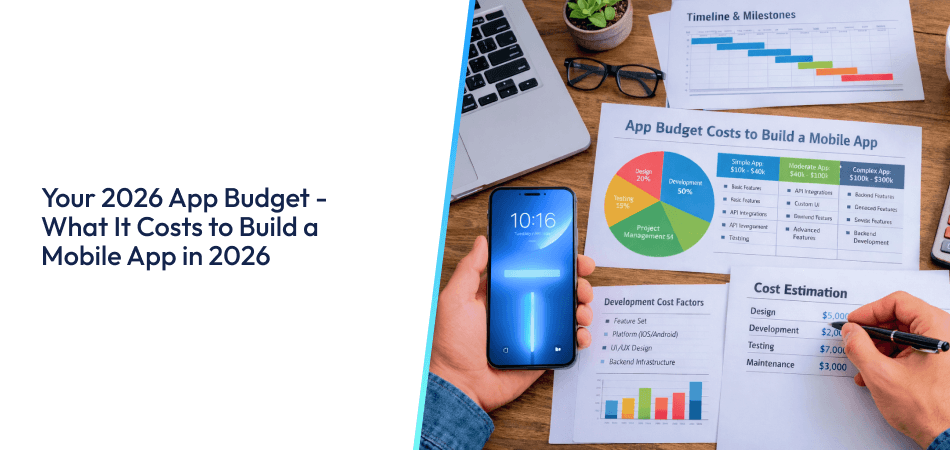
If you’re wondering how much it actually costs to build a mobile app in 2026, here’s the deal. There’s no single number.
According to 2026 industry research, the biggest factor affecting the cost to build a mobile app is its complexity. Your app’s price tag depends on how complex it is, the features you want, and how polished you want the experience to be.
To make it simple, here’s a breakdown based on current market trends:
| App Type | Features & Complexity | Cost Range (2026) | Ideal For |
| Simple App | Basic features, minimal backend, simple design | $40,000 – $100,000 | MVPs, utility apps, simple content apps |
| Medium Complexity | Custom UI, payment gateways, API integration | $100,000 – $200,000 | Fitness apps, small marketplaces, content apps |
| Advanced App | Real-time features, AI, social or marketplace functionality | $200,000 – $400,000+ | Social platforms, gaming apps, feature-rich marketplaces |
| Enterprise / High-End | Global-scale platforms, multiple integrations, advanced security | $400,000+ | Large businesses, enterprise solutions, apps with complex workflows |
Here’s what really affects the cost:
Building an app in 2026 is an investment, not an expense.
Understanding the cost upfront helps you plan your monetization strategy, decide on features wisely, and ensure your app grows into a sustainable, revenue-generating product. Spend smart today, and your app can pay off big tomorrow.
Now let’s get to the real question that every app creator and entrepreneur wants to know:
How to make money off mobile apps?
Every app is different, and the way it generates revenue depends on its purpose, audience, and features.
According to the recent research of the industry, over 60 percent of the highest-grossing mobile applications now adopt hybrid monetization strategies.
In this section, we will discuss 10+ proven ways mobile apps make money in 2026.
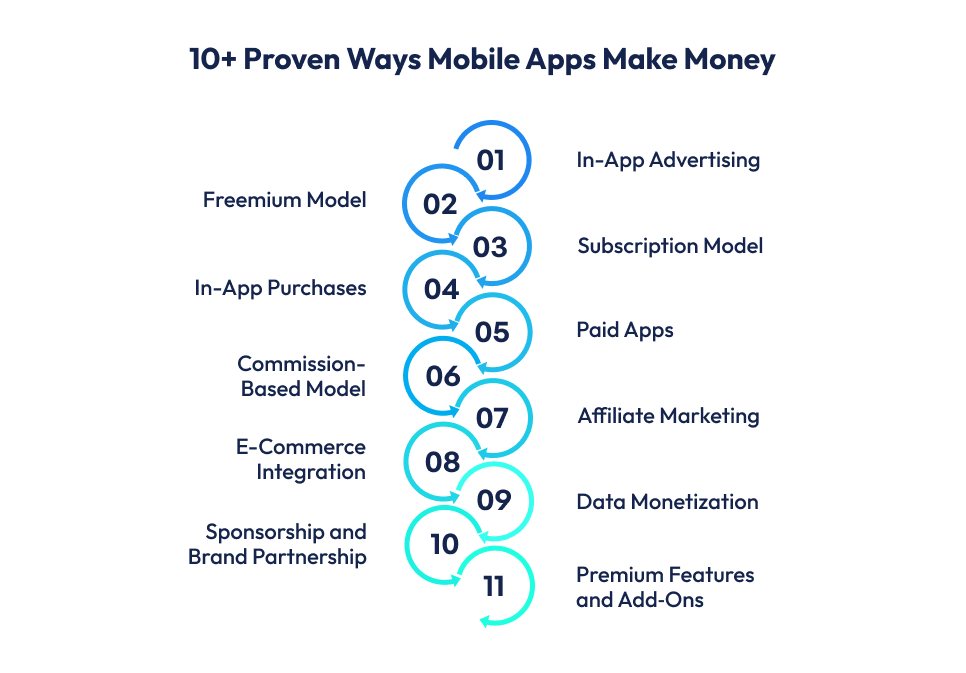
Free apps often use ads as a method of making money. Ads are displayed on the interface, and users are not charged.
Advertisements may take a variety of formats: banners, full screen interstitials that happen between actions, native ads that do not interrupt the design or rewarded video ads that reward the viewer with incentives.
Applications that have numerous users such as YouTube are dependent on advertisement. Well-designed ads allow apps to become free and still make money.
This is the “try before you buy” approach. Users can download and use the app for free but pay for premium features.
The freemium business model allows people to be free to download and use the app without any cost but requires payment of premium features. It is effective since users are able to test the app to make a commitment. A perfect example would be Spotify, where users can play free and with advertisements, or they can buy a premium subscription without advertisements and other perks. This reduces the entry barrier and fosters upgrade in the long run.
Subscriptions are all about recurring income. Users pay weekly, monthly, or yearly to access content or services.
Netflix, Headspace and fitness applications depend on subscription since they are a certain source of revenue. Subscriptions can be one of the surest sources of income in case your app is able to deliver constant value to users in the form of content, tools, or services.
In-app purchases let users buy extra features, tools, or content inside the app. This could be:
These may be virtual goods, additional content or game levels, game enhancements or boosters and premium tools. Mobile games such as Candy Crush Saga have millions of dollars in sales of boosters and extra lives to those gamers who desire more of the game.
Some apps still charge upfront to download. It’s less common now, but it works for specialized apps, especially productivity or creative tools.
Procreate, for example, charges a one-time fee but provides professional-grade features. Paid apps work best when the value is obvious from the start. This model is most effective when the value of the application is immediate.
Marketplace applications are monetized by charging a commission on purchases that are made via their app. Uber is an example which charges a percentage per ride. Airbnb both charges the hosts and the guests. This is effective in those applications that unite buyers and sellers.
Affiliate marketing is a marketing method that makes a commission on the promotion of third-party products or services. The app is paid a percentage when a user clicks on a link and makes a purchase. This model is typical of shopping, traveling and deals apps. It is an easy alternative to selling your products and making money.
Other applications earn revenue through the sale of tangible goods. The obvious one is Amazon where the user can do all in the app: browse, purchase, and even monitor the delivery. An app that can be used to make a mobile store can be a significant digital retail outlet to businesses that have already products to sell.
User insights and analytics can be used to create value using apps. Anonymized and aggregated information assists companies in the process of service enhancement or sharing knowledge with partners. Privacy and ethics are very important. The user has to be confident in the application and agree to the collection of data.
Apps that have loyal/niche audiences can collaborate with brands. Fitness and lifestyle apps and content apps regularly team up with businesses to conduct a sponsored campaign or promotion. It is able to make money and provide customers with special experiences.
Other than making the whole app a purchase, others sell specific features or add-ons. Tinder, as well as some other dating apps, have options where people pay to boost their profile, or use advanced filters or other features. This allows users to create a customized experience and generates additional revenue to the app.
Experts agree that the apps that earn the most don’t rely on a single strategy.
Making money from apps is never just one thing. Ads, subscriptions, in-app purchases all work together like a team. Each one helps, but the real magic happens when you use the right mix for your app, your users, and your goals.
Applications can be used to ensure the greatest amount of money without ruining the experience of the user.
It could be advertisements, subscription or in-app purchases, but the key to making mobile apps profitable is to know how to make money on them. The trick is to select strategies that suit your type of apps, audience and long-term objectives. When done properly, monetization does not only help support your app, but also helps you improve it and make it grow and be successful over the years.
It is not about fast cash when monetizing an app. In case you pursue revenue only, users will feel it. Prioritize user experience. Make the app clean, minimalistic, and actually helpful. When they like it, users will remain and use it more, as well as upgrade to the premium features without any reservations.
An irritated user will not upgrade, tap advertisements, or purchase in-application products. A contented user will do more than that. This is the reason why the best applications in 2026 do not use one monetization strategy. They combine subscriptions with in-app purchases and advertisements, and they are user-centric.
“Build for your users first, the money will follow naturally.”

You might think picking a mobile app development company is simple. Just Google a few names, check a portfolio, and pick one. Well, this is not how it works.
The reality is, the company you choose can make or break your app. From idea to launch, your partner shapes everything: speed, quality, user experience, and even how fast you start making money from your app.
So, how to choose a mobile app development company in USA that’s right for you?
Here’s how:
Look for a company that has built apps similar to yours. Don’t just take their word for it. Download the apps, test them, and see how they perform.
Techugo has delivered apps across healthcare, fintech, lifestyle, and e-commerce. Their track record shows they know how to take ideas and turn them into apps that users actually love.
The tech stack matters. Are they using React Native, Flutter, Swift, or Kotlin? Do they know when to pick one over another? The right mobile app development services will match technology choices to your app goals.
Your app could have every feature in the world, but if it’s clunky or confusing, users won’t stick around. The right company prioritizes UX, creating apps that are intuitive, engaging, and fun to use.
How often will they update you? Who will be your point of contact? The best partners communicate clearly from day one and offer post-launch support, updates, and maintenance.
Review the scope of services provided: UI/UX design, development, backend architecture, testing, and after-sales support. A company that offers full-stack mobile app development services such as Techugo ensures the successful operation of your project.
If you’re searching for how to choose a mobile app development company in USA, don’t just go by price. Look for experience, technical expertise, UX focus, strong communication, and a company that offers comprehensive mobile app development services.
Techugo checks all these boxes. We’ve built successful apps across healthcare, fintech, lifestyle, and more, delivering polished, scalable solutions. Choose the right team, and your app won’t just launch. It will grow, delight users, and generate revenue for years to come.
Your Idea Isn’t Ordinary, So Your App Shouldn’t Be Either!
Based on 2026 industry cost guides, the price tag for mobile app development depends heavily on what the app does and how complex it is.
The base cost of a basic app in the year 2026 is approximately 40,000 dollars. Medium complexity application costs between $100,000-$200,000. Enterprise level applications are between $200,000 and $400,000 (or more). The major input variables that modify the price are UX design, backend integration, and maintenance after launch.
It has no single response to the question of the extent to which an app should cost. Appropriate apps are usually a combination of revenue models. The most common ones include in-app advertising, subscriptions, in-app purchases, in-app freemium, and affiliate marketing.
Having said that, it is the most crucial aspect to select the ways of monetization that would correspond to your type of app, target demographic and your long-term objectives.
The experience, technical knowledge, UX/UI design, communication, and all the range of mobile app development services are the main aspects to be considered. Techugo combines these advantages to develop scalable, high quality apps that are successful in the market.
Both options work, but a US-based company may offer advantages like better communication, time-zone alignment, and familiarity with local market regulations. Companies like Techugo also have global experience, bridging quality, expertise, and accessibility.
Simple apps can take 2–3 months, medium apps 4–6 months, and complex apps with advanced features 6–12 months or more. Timeline depends on features, design complexity, integrations, and testing.
Yes! Apps can generate revenue through ads, sponsorships, affiliate marketing, and data insights.
When someone decides to build an app in France the question everybody asks is never related to design, user experience, or the functionality of the ap..
For entrepreneurs, startups, and established companies looking to break into the largest digital market in Europe, launching a mobile app in Germany p..


Write Us
sales@techugo.comOr fill this form