

 SA
SA
 KW
KW
 IE
IE AU
AU UAE
UAE UK
UK USA
USA
 CA
CA DE
DE
 QA
QA ZA
ZA
 BH
BH NL
NL
 MU
MU FR
FR















📌 Key Takeaways
- Dubai’s mobile app industry is rapidly moving toward AI-powered, cloud-based, and hyper-personalised mobile experiences.
- AI-powered apps are helping businesses automate operations, improve customer engagement, and deliver smarter user experiences.
- Super apps are becoming a major trend by combining multiple services into one platform.
- AR/VR technologies are enhancing customer engagement in real estate, retail, and education.
- Cross-platform app development is helping businesses reduce costs and launch apps faster.
- Cloud-native infrastructure and cybersecurity are becoming essential for future-ready mobile apps in Dubai.
A few years ago, businesses in Dubai were simply trying to “have an app.” but now they want apps that think faster and personalise better. They want mobile apps to automate tasks and keep users coming back, and honestly, that change is happening quicker than many expected.
Whether it’s super apps or cloud-based mobile apps, the mobile app market in Dubai is entering a completely new phase in 2026 and businesses don’t want to be late in adopting these trends.
They’re adopting them early so that they can stay competitive, therefore, it is crucial to understand why the latest mobile app development trends in Dubai matter now more than ever.
In this blog, we will learn about major mobile app development trends affecting all industries while having an impact on the future of mobile app development in Dubai.
Must Read: AI Investment Trends from Dubai AI Festival 2026 | What They Mean for App Developers
Why is Dubai becoming a global hub for mobile app innovation?
Dubai has been transforming itself into a technology-first economy for a long time, and because of that, the demand for digital products has grown massively over the last few years.
Earlier businesses were simply trying to launch an ‘app’ so that they could stay visible online but now, things are very different. Companies are investing in intelligent mobile platforms that can automate services, personalise experiences, and keep users engaged for longer periods of time.
And honestly, the speed of this transformation has been surprising.
Rising smartphone and mobile app usage
The way people use smartphones in their daily lives is one of the top reasons behind the growth of mobile app development in Dubai and we are all already aware of this. Be it shopping, banking, healthcare, food delivery, or transportation, people rely on apps for almost everything.
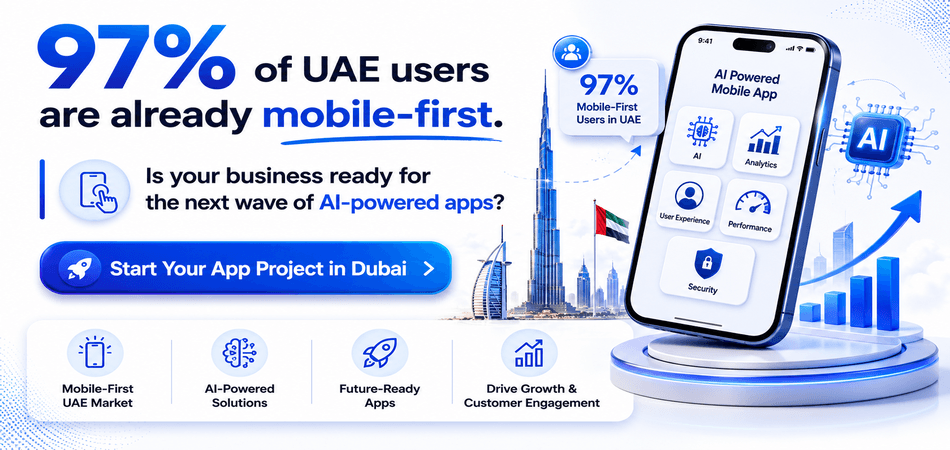
DataReportal says that smartphone penetration in the UAE has crossed 97%, while internet users spend close to 8 hours online daily. And since consumers are already highly digital, businesses are now under pressure to offer faster and more personalised mobile experiences.
That change has pushed many companies to adopt AI-powered mobile apps and cloud-based mobile apps, especially because customers are expecting convenience almost instantly now.
Strong government focus on digital transformation
Another major reason is the government’s continuous investment in digital transformation to boost Dubai’s app innovation. Initiatives like Smart Dubai and the UAE’s AI-focused programs have created an ecosystem where businesses are encouraged to adopt emerging technologies much earlier than many other regions. So naturally, companies have been exploring:
- AI app development in Dubai
- automation-driven mobile platforms
- smart city integrations
- digital payment ecosystems
And this support has helped startups and enterprises experiment faster and grow and expand quickly, so they can launch innovative digital services with less hesitation.
Growth of fintech, eCommerce, and on-demand businesses
The rise of fintech and eCommerce businesses is also the reason for growth in the mobile app adoption rate in the UAE. Consumers now prefer digital wallets, online shopping, and app-based services because they seem convenient, easy, and faster to use to the users.
Hence trends like super app development, cross-platform apps and hyper-personalised mobile experiences are becoming more common in multiple industries.
The ecommerce market in Dubai is likely to reach $13.8 billion by 2029 and somewhere businesses have realised that mobile apps are not just an optional digital asset anymore, rather they are becoming a core business strategy.
Dubai is attracting startups and global enterprises
Dubai has also become a strong innovation hub for startups, investors, and global enterprises. The city is offering advanced infrastructure and policies that are business-friendly and encouraging, and offers a highly connected audience as well, so naturally Dubai attracts businesses that want to build future-ready products.
Thus, app developers in Dubai are focusing more on AI integration, automation, immersive experiences, and cloud ecosystems.
By 2026, businesses across Dubai are already exploring how they can implement mobile app development trends that make their apps even more personal and predictive in nature.
Suggested Read: Got an App Idea but No Funds? Here’s How to Make It Happen in Dubai Without Upfront Funding
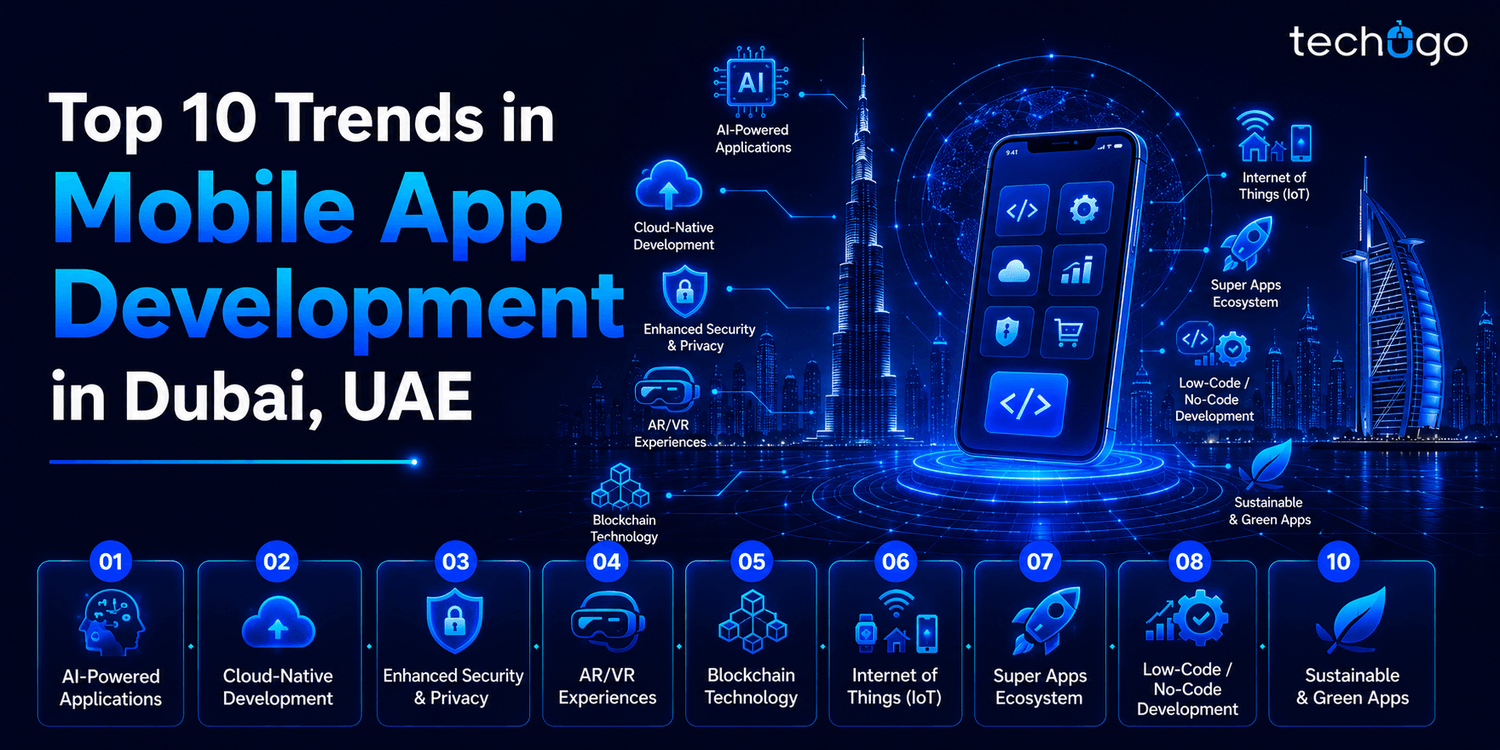
Top 10 mobile app development trends in Dubai, UAE
Dubai’s mobile app ecosystem is growing and changing rapidly. That means many businesses have adopted smart technologies that deliver enhanced, rapid, and highly connected digital experiences.
Trend #1. AI-powered mobile apps
Artificial Intelligence (AI) is one of the most significant trends influencing how businesses engage with customers, automate business processes, and enhance customer experience.
AI mobile apps are being used in all industries throughout Dubai to provide faster and smarter service delivery. Some of the AI technologies that are currently prevalent in mobile applications include chatbots, predictive analytics, voice assistance, and anti-fraud measures.
- Banking app in the United Arab Emirates (UAE) is an example of an application, using AI technologies to monitor and identify fraudulent transactions.
- Retail and eCommerce platforms utilize recommendation engines to create personalised shopping experiences.
- Healthcare uses AI technologies to provide appointment scheduling assistants and virtual consultation capabilities, as well as create engagement with patients through AI apps and assistants.
The UAE’s breathtaking commitment toward AI will drive this transition even more rapidly. To that end, the UAE government has already introduced numerous AI-related initiatives such as:
- UAE’s National Artificial Intelligence Strategy 2031
- Smart Dubai
- Dubai AI Strategic Plan
- Dubai 10X Initiative
The goal of these current initiatives is to establish the UAE and Dubai as a world leader in AI.
That’s why businesses are now investing more heavily in AI app development in Dubai so that they can stay competitive in the market.
And TBH, this trend is only getting stronger. In 2026, AI-powered mobile apps are likely to move beyond automation and focus more on predictive experiences and hyper-personalised customer interactions.
Also Read: FinTech Innovation in MENA: Digital Banking Trends 2026
Trend #2. Voice recognition and AI chatbots
Rather than typing long queries or waiting for customer support to help, users now want instant, conversational experiences as they are quite fast and feel more natural, therefore voice recognition and AI chatbots are helping users interact with mobile apps in Dubai.
Businesses in different sectors such as banking, eCommerce, healthcare, and telecom are integrating AI chatbots because they want to automate customer support and offer 24/7 assistance, and they also want to improve engagement at the same time. That’s why voice-enabled features are helping users search, shop, and access services more easily and quickly.
Gartner says that conversational AI is expected to reduce contact center labour costs by $80 billion globally by 2026 and this is one reason businesses are investing heavily in AI mobile apps and chatbot-driven customer experiences.
In Dubai especially, users expect speed and convenience, hence voice recognition and conversational AI are becoming an important part of modern mobile app development trends in Dubai.
Trend #3. Super apps
As of 2026, super apps are set to be one of the largest mobile app trends since users prefer to have everything in a single application rather than switching from application to application throughout their daily lives. An example of this is a single app could include; payment processing, shopping, ordering food, and ride hailing but all of these applications would provide a smooth digital experience for the customer.
The global super apps market was valued at nearly USD 121 billion in 2025 and is expected to grow at a CAGR of 30.1% through 2033. Source: Grand View Research
Some of the top and most recognised super apps in Dubai and the UAE are:
A strong example of super app is Careem, which has expanded beyond ride-hailing into food delivery, digital payments, and other daily services. But like Careem, many other UAE businesses are now exploring similar super app development models to increase customer engagement and retention.
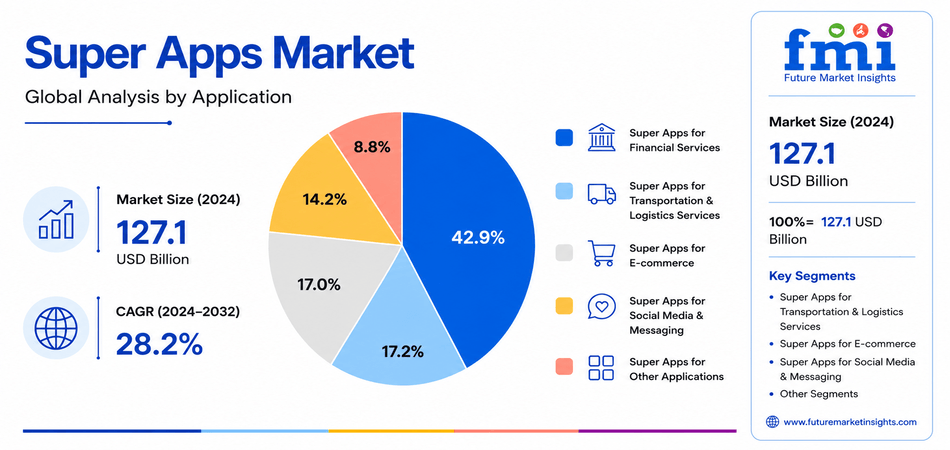 Source: Future Market Insights
The super apps for financial services segment are likely to hold around 42.90% of the total revenue share which makes it a leading area for apps.
The super app ecosystem in Dubai is still growing compared to Asian markets like China but the UAE is moving aggressively in this direction because users already prefer convenient platforms.
Super apps don’t mean to combine services but to help increase user time spent on the platform and improve customer loyalty, so that a business can also create multiple revenue opportunities within a single app ecosystem.
And since Dubai already has a highly mobile-first audience, super apps are most likely to become an important part of mobile app development in Dubai in the coming years.
Trend #4. Fintech mobile apps
The fintech industry in Dubai and the UAE is growing rapidly as consumers are moving toward digital wallets, online banking, and AI-powered financial services. They want fast and secure, and highly convenient banking experiences, directly from their smartphones.
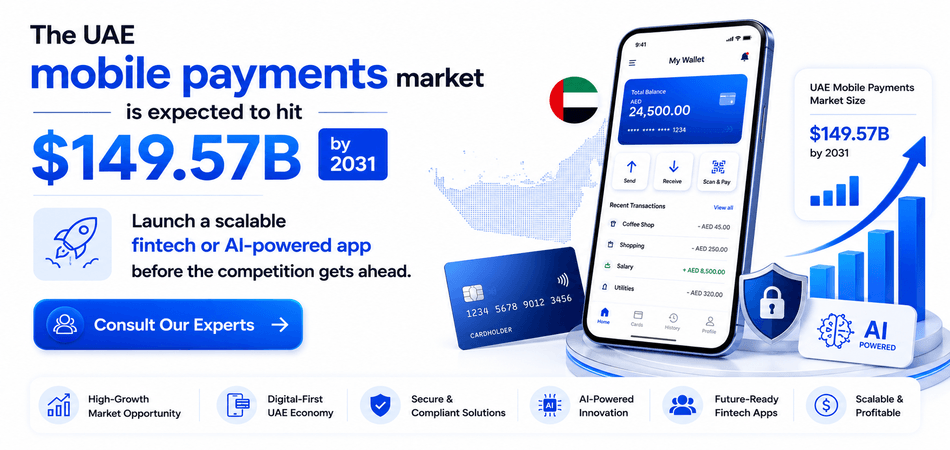
Hence, the UAE mobile payments market has been growing by 10.91% annually from 2026–2031, and is likely to reach $149.57 billion by 2031. (Source: Mordor Intelligence)
Since Dubai strongly supports innovation and cashless transactions, businesses are now investing more in AI-powered digital payment apps. Here are some of the top fintech and digital payment apps widely used in Dubai and the UAE:
- Careem Pay
- BOTIM
- Wio Bank
- Liv Bank
- FAB Mobile
- Mashreq Neo
- ADIB Mobile Banking
- ENBD X
These platforms are redefining how users manage payments and financial transactions in Dubai and the UAE.
Seeing the market growth and fintech app development in region, it is clear that fintech apps are becoming a major part of Dubai app development trends and will continue driving innovation.
Trend #5. Cross-platform apps
Every business wants their apps to be developed fast and costs low and, wants to reach wider audience without building separate apps for iOS and Android. Therefore, cross-platform app development is becoming one of the most practical as well as widely used mobile app trends in 2026.
In competitive markets such as Dubai, where both startups and established companies are constantly competing against each other to get their digital products to market first, developing an application using this method is the preferred option because it allows companies to keep a single code base while being able to provide an application that functions like a native application (with similar performance and look) on both iOS and Android Devices.
That’s why cross-platform frameworks like Flutter and React Native are used by over 50% of developers.
In the UAE, many startups and enterprise solutions are now being built using cross-platform technologies because as obvious, they reduce time-to-market and make it easier to scale apps when the user demand grows.
Trend #6. Hyper-personalisation through data and AI
Hyper-personalisation is currently one of the most influential trends impacting the current mobile experience. This trend is particularly evident in a market like Dubai where consumers expect every application they download to provide them with fast, relevant and personalized interaction every time they use them.
Instead of showing the same content to every user, businesses are now using AI and real-time data to understand behavior, preferences, and intent and this lets apps adjust content, and recommendations as well as offers according to the individual user journeys.
McKinsey report says that companies that use personalisation effectively can increase revenue by 5% to 15% and improve marketing efficiency by 10% to 30%, as a result, brands in the UAE are investing seriously in AI-powered mobile apps that are able to deliver intelligent experiences for their end user customers.
This trend can be clearly seen in Dubai in eCommerce, fintech, and streaming platforms where recommendations, offers, and dashboards are customised for each user. Now it doesn’t make sense to build a generic app, instead, it’s crucial to offer an experience that feels personal at every touchpoint.
So hyper-personalisation is now a core part of mobile app development trends in Dubai and is most likely to grow even stronger as AI capabilities are continuously rising.
Trend #7. Healthcare and telemedicine apps
Earlier people used to visit hospitals even for small issues but now they are using telemedicine apps for consultations, for follow-ups, and for prescriptions as well, because it is quicker, and more convenient. Healthcare mobile apps are now becoming a normal part of how people get access to doctors and medicines in Dubai
According to BCG, around 41% of UAE residents have already used telemedicine services, and it is not just a trend anymore. It is becoming a habit, and people are getting used to it.
Hospitals and clinics in the UAE are also adopting video consultations, AI-based symptom checking, and digital reports so that patients can get help faster, and without long waiting times. It makes the whole system more efficient… and easier for you as a patient.
In Dubai, even government-supported health platforms have encouraged virtual care, and therefore telemedicine usage has increased even more over time. It was slow earlier, but now it is widely accepted.
Because of this shift, healthcare has become an important area for mobile app development services in Dubai, and companies are focusing more on secure and simple apps that make patient care easier, faster, and more accessible.
Trend #8. AR/VR experiences
AR and VR technologies are slowly becoming part of everyday mobile experiences in Dubai, and it is not just limited to gaming anymore. Now businesses are using AR/VR apps so that users can explore products, places, and services in a more interactive way… before they even make a decision.
For example, AR is enabling users to visualize properties, furniture, or any type of interior space in real-time when it is being applied in the Real Estate and Retail industries. It feels more real and thus leads to better comprehension of a product than just an image on the screen.
Likewise VR is also being leveraged for numerous applications including virtual tours, training and immersive brand experiences.
Globally, the AR and VR market is growing and is being driven by retail, healthcare, education, and real estate industries. And in the UAE, adoption is growing faster because businesses are always open to new digital experiences.
In Dubai especially, companies are using AR/VR to create engaging customer journeys… and therefore, users spend more time interacting with brands. It was mainly experimental earlier, but now it is becoming practical and business-focused.
As such, AR/VR is becoming a significant tech in mobile application development in Dubai, and is significantly shaping how organisations understand customer engagement through an immersive and visual experience.
Suggested Read: Techugo Recognized As One Of The Most Reviewed AR/VR Companies
Trend #9. Cloud-native and scalable mobile apps
Cloud-native apps are becoming more important in Dubai because businesses now want apps that can scale easily, handle more users, and perform smoothly even during high demand. Earlier, apps were built in a more traditional way, but now companies are shifting toward cloud-based systems so that performance stays stable… and updates become faster.
With cloud-native development, apps are not tied to a single server, and therefore they can grow as the business grows. It helps startups and enterprises manage traffic spikes, data storage, and real-time updates without major disruptions.
Gartner says that more than 85% of organisations would have adopted cloud-first strategy in 2025, and this change is already visible in Dubai, UAE. Here businesses are quickly moving their digital infrastructure to the cloud.
Cloud-based mobile applications are being utilised in industries such as e-commerce, financial technology and logistics in Dubai, UAE, which enables them to deliver a faster service and create a better user experience even during busy periods.
Given the increase in demand, cloud-native architecture has become an integral component of the mobile app development in Dubai, particularly by companies looking for long-term scalability and flexibility and improved system performance.
Trend #10. Cybersecurity and data privacy
Cybersecurity and data privacy have become one of the most critical concerns in Dubai’s digital ecosystem, especially as mobile apps handle more personal, financial, and business data than ever before. Users are more aware now and they expect apps to protect their information without any compromise.
As the amount of online payment options, online banking, health care apps, and digital commerce continue to grow, so do the chances of data breaches. In response to this, many companies are currently investing heavily in new security features such as encryption, biometric authentication technologies, and artificial intelligence-based threat detection.
The global average cost of a data breach reached USD 4.45 million in 2023 (Source: IBM’s Cost of a Data Breach Report); therefore, it is extremely important to take care of security when developing any application.
Due to the strict data protection laws within the UAE, as well as the increase of digital adoption rates, companies are looking closely at implementing security into their projects from inception and within their overall strategy rather than as an afterthought like they did previously; therefore, they view security as one of the foundational elements of their mobile strategies, not just an afterthought.
As a result, cybersecurity has become one of the key areas of mobile app development in Dubai. Companies are actively engaged in building secure architectures to establish trust with their users and protect their data while operating in a digitally connected world.
The future of mobile app development in Dubai, UAE
The future of mobile apps in Dubai looks much more advanced, intelligent, and connected than before. Businesses are creating complete digital ecosystems that can automate services and deliver experiences that feel more personal and faster at the same time… not because they need an online presence.
1.Since Dubai has been investing heavily in digital transformation, businesses are adopting emerging app development technologies much earlier than many other regions. Core technologies include AI, cloud computing, AR/VR, automation, and predictive analytics which are becoming part of everyday mobile experiences… not just experimental ideas anymore.
2.In the coming years, apps are likely to become more AI-driven and deeply connected with smart city infrastructure.
3.You can expect to see more automation, more use of AI assistants and chatbots, personalized recommendations, and increased usage of voice interaction in almost all major industries such healthcare, financial technology (fintech), retailing and transportation.
4.At the same time, there will be intense competition and thus simply launching an application is not going to be sufficient for businesses to stay relevant in their respective markets, businesses will also need to focus on building scalable, user-friendly and secure applications; as well as investing in long term innovation.
Consequently, companies that invest early in future-ready technologies and smarter app ecosystems are more likely to lead the next phase of mobile app development in Dubai and the wider UAE market.
Why businesses choose Techugo for mobile app development in Dubai, UAE
Dubai’s digital market is growing and changing fast, and businesses today need AI-driven mobile apps that are scalable and built for long-term growth.
Being a prominent mobile app development company in UAE, Techugo helps, in fact, has been helping startups and enterprises build AI-powered mobile experiences aligned with the latest industry trends.
Techugo stands out due to…
- Expertise in AI-powered mobile apps and emerging technologies
- Strong experience across fintech, healthcare, eCommerce, and on-demand apps
- Focus on scalable and user-friendly app experiences
- End-to-end mobile app development services in Dubai
- Dedicated strategy, design, development, and post-launch support
- Agile development approach with faster time-to-market
And since every business has different goals, Techugo team focuses on building practical solutions that are growth-focused, and of course, ready for the future.
Looking to build your next mobile app in Dubai? Connect with Techugo and transform your idea into a powerful digital product.
FAQs
Q1. Why is mobile app development growing rapidly in Dubai?
Mobile app development in Dubai is growing because the UAE has a highly digital population, strong smartphone usage, and government-led digital transformation initiatives. Businesses across healthcare, fintech, retail, and logistics are adopting mobile-first strategies to improve customer experiences and operational efficiency.
Q2. What industries are investing the most in mobile app development in the UAE?
Industries like fintech, healthcare, eCommerce, transportation, real estate, and on-demand services are investing heavily in mobile apps across the UAE. These sectors are focusing on AI integration, digital payments, and personalized mobile experiences.
Q3. Why are AI-powered mobile apps becoming popular in Dubai?
AI-powered mobile apps are becoming popular because businesses want smarter automation, faster customer support, predictive recommendations, and personalized user experiences. AI is helping companies improve engagement while reducing manual operations and response times.
Q4. How much does mobile app development cost in Dubai?
The cost of mobile app development in Dubai usually ranges between AED 25,000 to AED 300,000+, depending on the app’s complexity, features, technologies, and development requirements.
For example:
- Basic mobile apps may cost around AED 25,000–50,000
- Mid-level apps with custom features can range between AED 50,000–150,000
- AI-powered, enterprise, fintech, or super apps may exceed AED 300,000
The final cost also depends on factors like UI/UX design, platform selection, third-party integrations, security requirements, and the expertise of the app development company in UAE.

Get in touch
We'd love to hear from you.